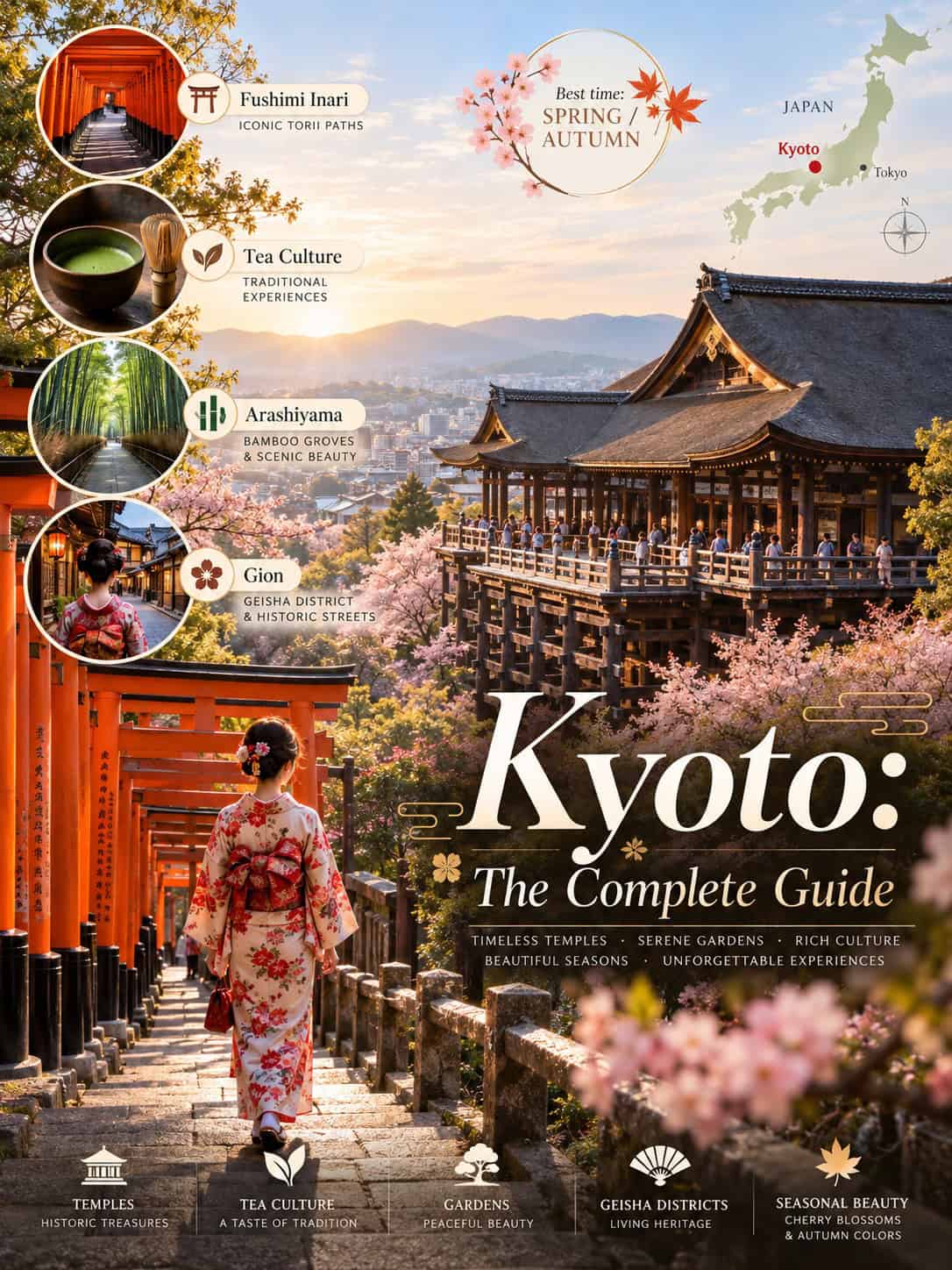
By Nippon With Me EditorialPublished Updated
Japan’s former imperial capital packs more UNESCO World Heritage temples and shrines into one city than almost anywhere else in the country. This Kyoto travel guide covers the best things to do in Kyoto, where to base yourself, how to get in from Tokyo or Osaka, and a 2-day and 3-day Kyoto itinerary that avoids zig-zagging across the city. It also explains when Kyoto is at its best and when it is at its most crowded.
Best Things to Do in Kyoto at a Glance
These are the top Kyoto tourist attractions, with where they are and when to go to avoid the worst crowds. Check opening hours and entry fees on each site before you go, since they can change.
| Sight | Area | Cost and hours | Best time to avoid queues |
|---|---|---|---|
| Fushimi Inari Taisha | Fushimi, south of central Kyoto | Free, grounds open 24 hours | Early morning, ideally before 8am |
| Kiyomizu-dera | Higashiyama | Paid entry, check current fee and hours; special evening openings in spring, summer and autumn with last entry at 9:00pm | Right at opening |
| Kinkaku-ji (Golden Pavilion) | Northern Kyoto | ¥500 for adults, open daily 9:00am to 5:00pm | Opening time or late afternoon |
| Arashiyama Bamboo Grove | Arashiyama, west Kyoto | Free to walk; Tenryu-ji charges separate admission | Early morning |
| Gion and Hanamikoji-dori | Higashiyama | Free to walk | Early evening, when lanterns come on |
| Nishiki Market | Downtown Kyoto | Free to walk, most stalls open in the daytime | Weekday mornings |
| Nijo Castle | Central Kyoto | Paid entry, check current fee and hours | Opening time |
| Ryoan-ji | Northern Kyoto | Paid entry, check current fee and hours | Early or late in the day |
Kyoto Tourist Attractions by District
Kyoto is spread wider and lower than Tokyo, with its major sights clustered into a handful of distinct areas rather than one dense downtown.
Higashiyama and Gion
Kyoto’s best-preserved historic district, where the stone-paved lanes of Sannenzaka and Ninenzaka lead up toward Kiyomizu-dera, and the wooden teahouses of Gion and Hanamikoji-dori still occasionally host a geiko or maiko hurrying between appointments in the early evening. This is Kyoto’s most atmospheric area to simply walk without a fixed plan.
Arashiyama
A western district built around the Arashiyama Bamboo Grove, a dense, towering bamboo path that photographs best early in the morning before tour groups arrive, alongside Tenryu-ji’s temple gardens and the Iwatayama Monkey Park on the hillside above the Togetsukyo Bridge.
Fushimi
South of central Kyoto, home to Fushimi Inari Taisha and its thousands of vermilion torii gates climbing the mountainside, as well as several of Kyoto’s historic sake breweries.
Northern Kyoto
Home to Kinkaku-ji, Ryoan-ji’s famous rock garden and Kyoto’s main university district, generally quieter and more spread out than the eastern and central areas. Nijo Castle, a short ride from central Kyoto rather than strictly northern, is often paired with this side of the city, known for its “nightingale floors” that chirp underfoot.
Downtown Kyoto (Kawaramachi and Nishiki Market)
Kyoto’s main shopping and dining core, anchored by Nishiki Market, a covered arcade of food stalls often called “Kyoto’s Kitchen,” and the Kamo River, a popular spot for an evening walk.
Top Things to Do in Kyoto
Fushimi Inari Taisha
Thousands of bright orange torii gates form a tunnel-like path up the mountainside behind the shrine. Admission is free and the grounds are open 24 hours, but the famous gate corridor gets genuinely crowded by mid-morning, so arriving before 8am makes a real difference. The full hike to the summit and back takes roughly two hours; a shorter version to the Okusha viewpoint, about a third of the way up, still delivers most of the photogenic gates and a view back over the city.
Kiyomizu-dera
A wooden temple built on a hillside, famous for its main hall’s wide veranda supported without nails, with sweeping views back over Kyoto. It charges an entry fee, opens at 6:00am and closes at a time that shifts with the season. It also runs special evening openings in spring, summer and autumn, with last entry at 9:00pm. Combine it with the Sannenzaka and Ninenzaka lanes on the way down.
Inside the grounds, all public areas are accessible to strollers. Eating and drinking are limited to the cafés and tea houses, and smoking, drones, monopods and tripods are prohibited. Bicycles are not allowed inside except at one designated parking area, and pets are not allowed other than service dogs.
Kinkaku-ji (the Golden Pavilion)
A gold leaf-covered pavilion reflected in its own pond, originally a retirement villa before being converted to a Zen temple. Admission is ¥500 for adults and the temple is open daily from 9:00am to 5:00pm, though hours can change for special events. Most visits are a focused 30 to 45 minute loop around the garden path, since the pavilion’s interior is not open to visitors.
Arashiyama Bamboo Grove and Tenryu-ji
Walking through the bamboo grove is free and takes about 15 to 20 minutes end to end, best at or near opening time before the path fills with tour groups. Tenryu-ji, a UNESCO-listed Zen temple next to the grove, charges a separate admission: ¥500 for the garden for high school students and older (¥300 for elementary and middle school students), and adding the temple buildings costs ¥300 more. It is open 8:30am to 5:00pm, with last admission at 4:50pm. The Cloud Dragon painting in the Hatto hall is a separate ¥500 ticket and can be seen only on weekends, holidays and selected spring and autumn periods.
Gion and Hanamikoji-dori
Kyoto’s historic geisha district is at its most atmospheric in the early evening, when lanterns light up the wooden facades along Hanamikoji-dori. Photographing or approaching a geiko or maiko directly is intrusive. Kyoto asks visitors not to touch, chase or photograph geiko and maiko without permission, not to enter private property, and not to block the streets or walk in large groups. So enjoy the architecture and atmosphere rather than chasing a photo.
Nishiki Market
A narrow covered market street packed with stalls selling pickles, skewered seafood, matcha sweets, knives and tea, and a good one-stop introduction to Kyoto’s food culture, best visited with an appetite and not on a tight schedule. The market runs about 400 meters from Teramachi to Takakura. Eating while walking is discouraged, so buy at a stall and eat on the spot, or take the food with you.
Nijo Castle
Castle admission is ¥800 for adults, or ¥1,300 as a combined ticket that includes the Ninomaru Palace. For castle admission, elementary school students pay ¥300, junior high and high school students pay ¥400, and children younger than elementary school age enter free. The Honmaru Palace is a separate ticket that needs a prior reservation, and castle admission is required as well.
Admission and Hours for More Kyoto Sights
Kinkaku-ji and Ginkaku-ji are linked directly by City Bus, so they pair well on one day. The Kyoto National Museum is the indoor option, reached from Shichijo or Kyoto Station.
| Sight | Admission | Hours | Getting there |
|---|---|---|---|
| Kinkaku-ji | ¥500 for adults, ¥300 for primary and middle school students | 9:00am to 5:00pm, open all year | City Bus 12, 59, 205 or M1 to Kinkakuji-michi |
| Ginkaku-ji | ¥1,000 for adults, ¥500 for primary and middle school students | 8:30am to 5:00pm from March 1 to November 30; 9:00am to 4:30pm from December 1 to February 28 | City Bus 5, 7, 32, 102, 203 or 204 to Ginkakuji-michi; EX100 or 105 to Ginkakuji-mae |
| Kyoto National Museum | ¥700 for adults (collection exhibitions; special exhibitions cost more) | 9:30am to 5:00pm, closed Mondays and over New Year | Shichijo Station (Keihan) or Kyoto Station (JR and Kintetsu) |
Kyoto Itinerary: 2-Day and 3-Day Plans
Each day below is built around one part of the city to limit backtracking. Allow extra time to move between areas, since Kyoto’s sights are spread out and trains and buses can be crowded in peak seasons.
Kyoto in 2 Days
- Day 1, Fushimi and Higashiyama: Fushimi Inari Taisha before 8am, then a short train ride to the Higashiyama area for Kiyomizu-dera, the Sannenzaka and Ninenzaka lanes, and Gion at dusk.
- Day 2, Arashiyama and the north: the Bamboo Grove and Tenryu-ji early, then Kinkaku-ji, and finish with dinner around Nishiki Market and the Kamo River.
Kyoto in 3 Days
- Day 1, Higashiyama and Gion: Kiyomizu-dera and the old lanes in the morning, lunch in the area, Gion and Hanamikoji-dori in the early evening.
- Day 2, Fushimi and downtown: Fushimi Inari Taisha early, then Nishiki Market, the Kamo River and Pontocho for dinner.
- Day 3, Arashiyama and the north: the Bamboo Grove and Tenryu-ji early, Kinkaku-ji in the afternoon, and Nijo Castle if time allows.
This is a compact starting template, and most visitors who love Kyoto’s temple culture extend it to four or five days to add Ryoan-ji, a day trip to Nara or a stay in a traditional inn from our guide to Kyoto ryokan. If you are fitting Kyoto into a longer route, see our 10-day route through Tokyo, Kyoto and Osaka or the 5-day Kansai extension from Tokyo.
If It Rains in Kyoto
Swap the outdoor-heavy stops for covered ones. Nishiki Market is a covered arcade, the Kyoto National Museum’s collection galleries cost ¥700 and are open 9:30am to 5:00pm except Mondays, and the Ninomaru Palace at Nijo Castle, included in the ¥1,300 combined ticket, is a building you walk through rather than a garden. Save Fushimi Inari’s mountain path, the Bamboo Grove and Kinkaku-ji, whose pavilion interior is closed to visitors, for a dry day.
Where to Stay in Kyoto: Kyoto Station vs Gion
| Area | Best for | Pros | Cons |
|---|---|---|---|
| Kyoto Station | First-timers and day trips | Hub for Shinkansen, JR lines and buses; hotels at every price point | Less atmosphere, a bus or train ride from most temples |
| Gion and Higashiyama | Atmosphere and evening walks | Kiyomizu-dera and Gion within walking distance, often in traditional ryokan | Busy with day visitors, generally pricier, less convenient for trains |
| Kawaramachi and Gion-Shijo | Food, shopping and a middle ground | Strong Keihan and Hankyu access, close to Nishiki Market and the Kamo River | Can be noisy at night |
Kyoto Station is the most practical base for most first-time visitors, while Gion suits those who prioritize atmosphere over convenience. Budget for the accommodation tax, which Kyoto raised on 1 March 2026 and charges per person per night on a sliding scale based on the room rate: ¥200 for rooms under ¥6,000, ¥400 for ¥6,000 to ¥19,999, ¥1,000 for ¥20,000 to ¥49,999, ¥4,000 for ¥50,000 to ¥99,999 and ¥10,000 for ¥100,000 or more. It is usually collected at check-in, and some booking sites include it upfront.
Getting to Kyoto
From Tokyo, the Tokaido Shinkansen runs frequent direct services to Kyoto Station. The fastest Nozomi trains take roughly two hours and ten to twenty minutes and are not covered by the Japan Rail Pass, while Hikari trains, which the pass covers, take a little longer. See our Tokyo to Kyoto Shinkansen guide and our Japan Rail Pass guide for tickets and seat tips.
From Kansai Airport, the JR Haruka limited express runs directly to Kyoto Station in around 80 to 90 minutes, and airport limousine buses cover a similar route, which can be simpler with heavy luggage. See our Kansai Airport guide. From Osaka, frequent JR and Hankyu trains reach Kyoto in well under an hour, and our guide to getting between Kyoto and Osaka covers the options.
Getting Around Kyoto
Kyoto’s rail network is thinner than Tokyo’s, so city buses fill much of the gap. Most City Bus routes charge a flat ¥230 for adults, and a one-day pass covers the buses and the subway. The same IC cards that work in Tokyo (Suica, Pasmo) also work on Kyoto’s buses, subway and trains. Many visitors rent a bicycle for a day, since central Kyoto is flatter and more compact than it first appears.
Kyoto Buses, Subway and Day Passes
City Bus fares are a flat ¥230 for adults and ¥120 for children. Board through the rear door, exit through the front door and pay as you get off, with cash or an IC card (ICOCA, Suica, PASMO and PiTaPa work; credit cards and the Japan Rail Pass do not). The Sightseeing Limited Express buses EX100 and EX101 work the other way round: board at the front, pay when you board, and exit at the rear, for a flat ¥500 for adults and ¥250 for children. The subway has two lines, the Karasuma Line running north to south and the Tozai Line running east to west, which meet at Karasuma Oike Station. Adult fares run from ¥220 to ¥360 and child fares from ¥110 to ¥180, and trains run from about 5:00am to 11:00pm.
| Pass | Adult | Child | Covers |
|---|---|---|---|
| Subway & Bus 1-Day Pass | ¥1,100 | ¥550 | Both subway lines, all City Bus routes, and selected Kyoto Bus, Keihan Bus and West Japan JR Bus routes |
| Subway 1-Day Pass | ¥800 | ¥400 | Both subway lines only; a transfer to the Kintetsu or Keihan Otsu line costs extra |
Both passes work only on the day they are first used, not for 24 hours, and the date is printed on the ticket the first time it passes through a gate. They are sold at subway stations, on City Buses while stock lasts, and at select convenience stores, tourist information centers and accommodations in Kyoto City. Late-night buses need a separate fare. For Arashiyama, the Arashiyama/Takao Grutto Pass costs ¥1,000 for adults, is valid only on the day of purchase, and covers the Randen Arashiyama Main and Kitano lines plus the JR Bus Takao-Keihoku line between Kyoto Station and Toganoo.
To reach Fushimi Inari, take the JR Nara Line from Kyoto Station: Inari Station is two stops and about 5 minutes away, with the shrine right beside it. On the Keihan Main Line, Fushimi-Inari Station is a 5-minute walk from the shrine. Kinkaku-ji and Ginkaku-ji are linked directly by City Bus 102 or 204, running between the Kinkakuji-michi and Ginkakuji-michi stops.
Best Time to Visit Kyoto
Kyoto’s seasons swing more sharply than many visitors expect: cold, occasionally snowy winters, a humid rainy season through June, hot and sticky summers, and a cool, clear autumn. Cherry blossoms typically bloom from late March into mid-April, and autumn colors (koyo) run from mid-October through early December. Both are widely considered the best windows and both are the busiest and most expensive. Late February to mid-March is often cited as Kyoto’s quietest stretch, and the Gion Matsuri fills most of July with events across the city. Golden Week (29 April to 5 May) brings a sharp surge in domestic travel and hotel prices. For the whole country, see our guide to cherry blossoms, autumn leaves and seasons.
Day Trips from Kyoto
Kyoto’s location in the Kansai region puts several worthwhile day trips within easy reach. Nara, famous for its free-roaming deer and the giant bronze Buddha at Todai-ji, is roughly 45 minutes away by train. Uji, best known for Byodo-in Temple and some of Japan’s most respected matcha producers, is closer still, around 20 minutes by train.
Food in Kyoto
Kyoto’s food culture leans refined and seasonal: kaiseki (multi-course traditional dining), yudofu (hot tofu, especially around temple districts) and Kyoto-style obanzai home cooking sit alongside Nishiki Market’s stall food and a strong matcha and wagashi tradition. Pontocho, a narrow lantern-lit alley near the Kamo River, is one of the city’s best-known dinner streets.
Practical Tips for First-Time Visitors
Kyoto’s temples and shrines are active places of worship, so quiet, respectful behavior and removing shoes where indicated are expected. Many of the most-photographed spots (Fushimi Inari’s gates, the Bamboo Grove, Kiyomizu-dera) are most enjoyable early in the morning, both for lighter crowds and softer light. Cash remains common at smaller temples’ ticket windows and family-run restaurants, so carry some yen, and see our guide to cash and ATMs in Japan. Deciding between cities? Compare Tokyo vs Kyoto and Kyoto vs Osaka, or start with our Tokyo guide.
For a first day in the city, the Kyoto Top Four Highlights Day Trip from Osaka or Kyoto can be booked in advance.
Frequently Asked Questions
How many days do I need in Kyoto?
Three to four days covers the major districts at a comfortable pace. If you are short on time, two full days can cover Higashiyama, Fushimi and Arashiyama, though it will feel rushed.
What are the best things to do in Kyoto for first-timers?
Fushimi Inari Taisha, Kiyomizu-dera and the Higashiyama lanes, Kinkaku-ji, the Arashiyama Bamboo Grove, an evening walk through Gion and a meal around Nishiki Market cover most first-visit highlights.
Is Kyoto expensive to visit?
Many of Kyoto’s best-known sights, including Fushimi Inari Taisha, are free, while temples such as Kinkaku-ji charge an entry fee. Accommodation and traditional dining can run considerably higher during cherry blossom and autumn color weeks, and the city’s accommodation tax now rises with the room rate.
Can I visit Kyoto as a day trip from Osaka or Tokyo?
From Osaka, yes, since the train takes well under an hour. From Tokyo, a day trip is technically possible by Shinkansen but leaves little time on the ground, so an overnight stay is strongly recommended.
Is it better to stay near Kyoto Station or in Gion?
Kyoto Station is the most practical base for transport and day trips, while Gion and Higashiyama suit travelers who want atmosphere and evening walks. Kawaramachi is a middle ground for food and shopping.
When should I avoid visiting Kyoto if I want to skip the crowds?
Late March through April (cherry blossoms) and most of November (autumn colors) are the most crowded and expensive weeks. Late February to mid-March tends to be quieter.
Bottom Line
Kyoto rewards an early alarm clock more than almost any other city in Japan: its best-known sights are at their most atmospheric, and least crowded, in the hour or two after opening. Anchor a visit around Fushimi Inari at dawn, an unhurried walk through Gion at dusk and whichever temple’s architecture speaks to you most, and the rest of the city tends to fall into place around that rhythm.