By Nippon With Me EditorialPublished Updated
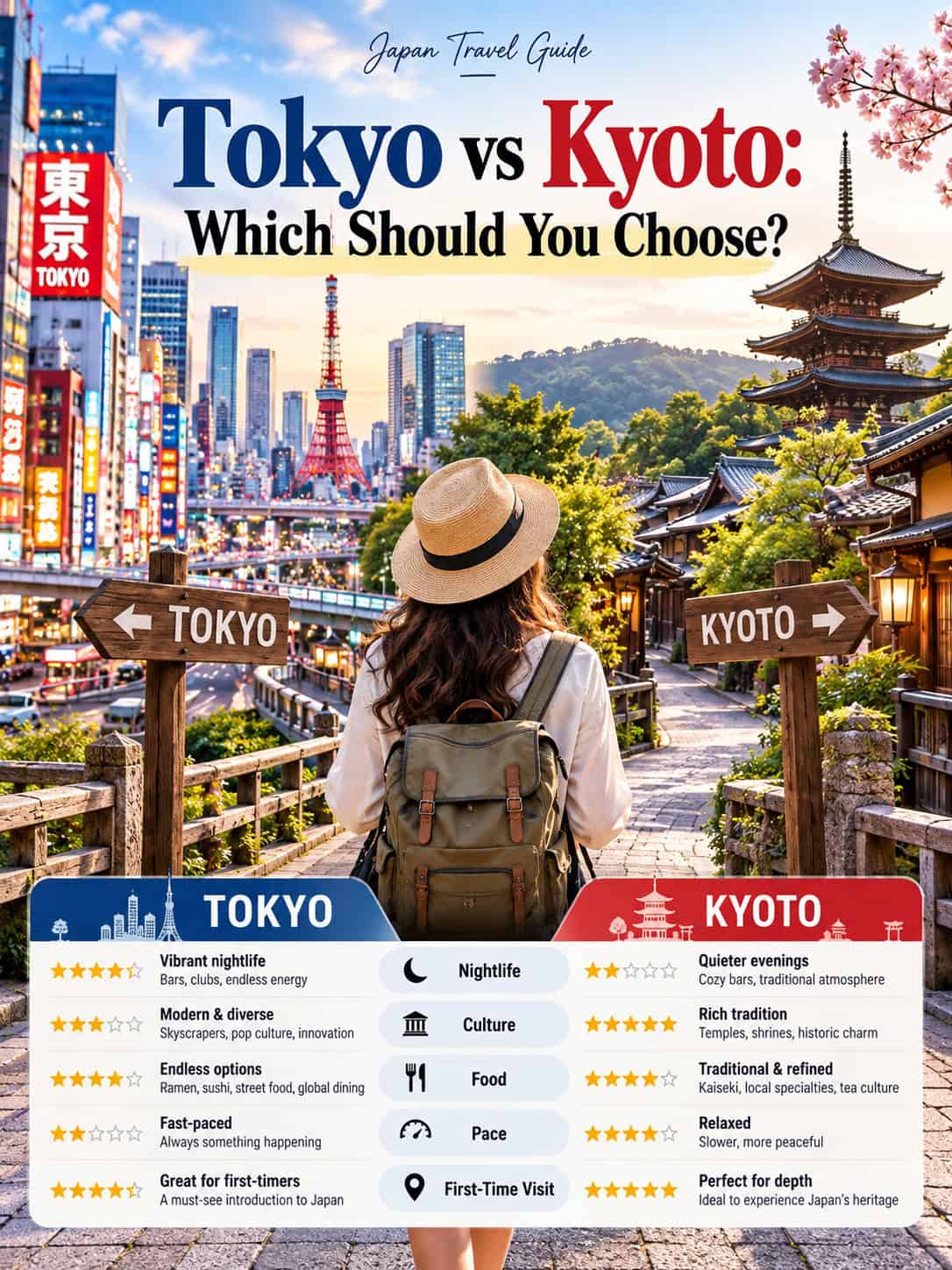
Tokyo vs Kyoto: should you choose Japan’s energetic capital or its historic former imperial capital? Tokyo offers modern neighbourhoods, major museums, dining and day trips (see our Tokyo guide), while Kyoto concentrates celebrated temples, gardens, traditional streets and ryokan (see our Kyoto guide). This guide compares costs, sightseeing, transport, families, crowds and the ideal number of days in each city.
Tokyo vs Kyoto: Quick Answer
| Question | Answer |
|---|---|
| Which city should I see first? | Follow your international flights: Tokyo first for Haneda or Narita arrivals, Kyoto first if you land at Kansai International Airport. |
| Which has more temples and historic sites? | Kyoto has a denser concentration of historic shrines and temples, including 17 component sites of a single UNESCO World Heritage inscription. Tokyo has major historic sites too. |
| Which is more expensive? | Neither is always cheaper. Compare equivalent hotels on the same dates; Kyoto adds a per-person accommodation tax that can affect higher-priced stays. |
| Can I just day-trip Kyoto from Tokyo? | You can, but most guides advise against it — give Kyoto at least two full days if you can |
| Which has the crowding problem? | Both. Kyoto’s compact temple corridors experience concentrated congestion; Tokyo’s major stations and famous districts can also be very busy. |
Tokyo vs Kyoto: Complete Comparison for First-Time Visitors
| Factor | Tokyo | Kyoto |
|---|---|---|
| Best for | Shopping, varied food, modern culture, museums | Temples, historic streets, gardens, ryokan |
| Typical stay | 3–5 days | 2–4 days |
| UNESCO highlights | Western Art Museum building, Ogasawara Islands | 17 Historic Monuments component sites |
| Food strengths | Sushi, ramen, international cuisine | Kaiseki, tofu, matcha, seasonal meals |
| Public transport | Dense rail and subway network | Buses, subway, JR and private trains; more walking |
| Hotel costs | Premium central districts can be expensive | Seasonal prices plus city accommodation tax |
| Day trips | Kamakura, Nikko, Hakone, Fuji area | Nara, Uji, Osaka, Himeji |
| Good for families | Large museums and entertainment options | Railway Museum, gardens and cultural experiences |
Neither destination wins every category. Choose the city that matches your itinerary rather than assuming one is automatically cheaper, safer or less crowded.
Two Very Different Cities, Despite Being Two Hours Apart
Tokyo is a vast capital with modern districts and significant historic neighbourhoods. The 1923 Great Kanto Earthquake and World War II bombing reshaped large sections, but temples, shrines, gardens and older streets survive in areas such as Asakusa, Yanaka and Ueno. Population comparisons depend on which metropolitan boundary a source uses. Tokyo also has UNESCO-listed places: the National Museum of Western Art building in Ueno forms part of the transnational Le Corbusier architectural inscription, while the Ogasawara Islands are a UNESCO natural World Heritage site within Tokyo Metropolis. Kyoto wins on the concentration of accessible UNESCO cultural components, not because Tokyo has no historic sites.
What Tokyo Does Better
Tokyo combines modern culture, shopping, food and substantial historic sights; its major advantage over Kyoto is the wider range of metropolitan experiences. The Michelin Guide Tokyo 2026 lists 160 starred restaurants: 12 three-star, 26 two-star and 122 one-star. This is a count of restaurants, not total individual stars, and dining also ranges from ramen shops and casual sushi to high-end omakase. Tokyo is also the country’s shopping and nightlife centre, with entire neighbourhoods built around different identities: Shibuya and Harajuku for youth fashion and street style, Shinjuku for nightlife and the city’s biggest train station, Ginza for luxury, Akihabara for electronics and anime culture. It is the easiest base for day trips, too: Hakone’s hot springs, Nikko’s shrines, Kamakura’s Great Buddha and Mount Fuji viewpoints are all one to two and a half hours away by train.
Tokyo or Kyoto for Food, Nightlife and Shopping?
| Interest | Tokyo suggestion | Kyoto suggestion |
|---|---|---|
| Food | Shoyu ramen, Edomae sushi, Tsukiji | Kaiseki, yudofu, Nishiki Market |
| Evenings | Shinjuku izakaya, Shibuya nightlife | Gion and Pontocho restaurants |
| Shopping | Ginza, Harajuku, Akihabara | Kyoto crafts, Nishiki area, ceramics |
| Cultural experience | Museums, entertainment, historic Asakusa | Temples, tea experiences, traditional inns |
| Family attraction | Ueno, museums, nearby Disney Resort | Railway Museum and selected cultural workshops |
Tokyo Disney Resort is located in Urayasu, Chiba, rather than central Tokyo; allow travel time when comparing cities for family trips.
What Kyoto Does Better
Kyoto’s strongest advantage is the concentration of major historic sites, gardens and traditional streets in a compact sightseeing region. Fushimi Inari’s thousands of vermilion gates, the bamboo grove at Arashiyama, the geisha districts of Gion and Pontocho and the raked gravel gardens at Ryoan-ji are the images most people picture when they think of traditional Japan. Kyoto is also the centre of traditional craft and cuisine: kaiseki multi-course dining, matcha culture (nearby Uji is considered one of Japan’s best matcha-producing regions), and ryokan inns such as those in our guide to the best ryokan in Kyoto. Kyoto rewards slowing down, spending a full morning at one temple complex rather than checking sites off a list.
Is Kyoto More Expensive Than Tokyo? Cost Comparison
Neither Tokyo nor Kyoto is consistently more expensive across every hotel category and travel date. Kyoto’s central rooms can rise sharply during cherry blossoms, autumn foliage and major holidays, while Tokyo also has costly districts and event-date price spikes. Compare matching hotel standards, cancellation rules, station access and all required taxes, not just displayed room rates; our guide to the best hotels in Tokyo helps with the Tokyo side. Osaka can sometimes provide better accommodation value, but add daily commuting costs and the time required to reach Kyoto sightseeing districts. JR Special Rapid trains between Osaka Station and Kyoto Station take about 30 minutes and often make more financial sense than the Shinkansen between Shin-Osaka and Kyoto, which takes around 15 minutes. Neither connects directly to Gion or every temple.
Is Kyoto More Expensive Than Tokyo? Real Costs to Compare
| Expense | Tokyo | Kyoto |
|---|---|---|
| Accommodation | Depends on area, dates and hotel standard | Same variables, plus Kyoto accommodation tax |
| Casual dining | Planning estimate ¥1,000–2,000 per meal | Planning estimate ¥1,000–2,000 per meal |
| Public transport | Mix of JR, Tokyo Metro, Toei and private rail | City Subway & Bus 1-Day Pass ¥1,100 |
| Major historic sites | Some shrines free; museums charge separately | Many gardens and temple buildings charge admission |
| City accommodation tax | Check hotel and metropolitan tax conditions | ¥200–10,000 per guest per night based on lodging price |
Food costs above are examples for budgeting, not citywide averages. Compare like-for-like room quotes and include transportation between the hotel and attractions.
Kyoto Accommodation Tax Rates
| Room charge per guest per night | Tax per guest per night |
|---|---|
| Under ¥6,000 | ¥200 |
| ¥6,000–19,999 | ¥400 |
| ¥20,000–49,999 | ¥1,000 |
| ¥50,000–99,999 | ¥4,000 |
| ¥100,000+ | ¥10,000 |
Kyoto City applies the revised tax from March 1, 2026. A guest staying three nights in a ¥15,000-per-person room pays ¥1,200 city tax in total; at ¥25,000 per person the same stay produces ¥3,000 tax. Rates apply per person, not per room.
Kyoto vs Tokyo: Crowds and Tourist Rules
Kyoto’s narrow historic streets, popular bus routes and residential districts have prompted crowd-management measures, and Tokyo also manages visitor traffic at specific attractions and neighbourhoods. In Gion, some private lanes restrict entry and photography, so follow posted notices rather than treating all public streets as closed. Kyoto’s revised accommodation tax took effect on March 1, 2026, with five bands from ¥200 to ¥10,000 per person per night. The highest band applies to accommodation charges of ¥100,000 or more per guest per night, not necessarily to an entire room costing ¥100,000. Early mornings can reduce crowd pressure at Fushimi Inari and on the public Arashiyama Bamboo Grove path. However, adjoining temples, paid areas, transport services and shops keep separate operating hours, so do not assume every facility there is open around the clock.
Kyoto vs Tokyo: Tourist Rules That Apply
| Rule | Visitor implication |
|---|---|
| Kyoto accommodation tax, in force since March 1, 2026 | Budget ¥200–10,000 per person per night |
| Gion private-lane restrictions | Observe signs; do not chase or block geiko or maiko |
| Public Fushimi Inari paths and bamboo-grove path | Generally accessible without a timed reservation; nearby facilities follow their own hours |
For city buses, the ¥1,100 Kyoto Subway & Bus 1-Day Pass can help visitors making several covered trips. It does not cover JR, Keihan or Hankyu trains, but it works on the subway, city buses and selected Kyoto Bus, Keihan Bus and West Japan JR Bus routes. Children pay ¥550, and validity is a service day rather than 24 hours. City fares and admission rules can change, so check the municipal transport and attraction websites.
Cherry Blossoms and Timing
Tokyo and Kyoto often reach peak cherry blossom season in late March or early April, but the order and dates vary by year and weather. Check Japan Meteorological Agency observations and current bloom forecasts instead of planning a fixed difference between the cities. Both cities can experience rain and strong winds during peak bloom.
How to Split Your Time
For a first Japan trip, allocate approximately three or four nights in Tokyo and two or three in Kyoto when you have a full week or more. Fewer than five total days makes visiting both relatively rushed because transfers, hotel check-in and local sightseeing consume time beyond the Shinkansen ride itself. Prioritise the city with the attractions that matter most to you. Our 10-day itinerary for Tokyo, Kyoto and Osaka and 5-day Kyoto itinerary show how to split the time. The best order depends on your flights: Haneda or Narita arrivals often make Tokyo first practical, while Kansai International Airport arrivals can make Kyoto first easier.
How Many Days in Tokyo vs Kyoto? Sample Itineraries
| Trip length | Tokyo | Kyoto | Why |
|---|---|---|---|
| 4 days | 4 days | 0 | Choose one city rather than lose time transferring |
| 6 days | 3 days | 3 days | Classic highlights in both, limited excursions |
| 8 days | 4 days | 4 days | More comfortable visits and one optional day trip |
| 10 days | 5 days | 4 days | One day for train travel and changing hotels |
| 14 days | 5 days | 5 days | Four remaining days for Osaka, Nara or other regions |
These allocations are suggestions, not fixed rules. Check your flight airports before deciding the direction.
Tokyo vs Kyoto: What You Can See in Three Days
Tokyo: Day 1 Asakusa and Ueno; Day 2 Shibuya, Harajuku and Shinjuku; Day 3 Tsukiji, Ginza and an optional museum. Kyoto: Day 1 Kiyomizu-dera, Higashiyama and Gion; Day 2 Fushimi Inari and central Kyoto; Day 3 Arashiyama and Tenryu-ji. These schedules are better as separate city stays than as repeated intercity day trips.
Can You Day-Trip One From the Other?
A Tokyo-to-Kyoto day trip is technically possible at about 130 minutes per Nozomi ride, but a return trip leaves limited time for the sights and costs roughly ¥28,340 for two illustrative reserved tickets, before local transport. Spend at least two nights in Kyoto if your schedule allows, particularly if you want both Higashiyama and Arashiyama. See our Tokyo to Kyoto Shinkansen guide for fares and booking. From Osaka Station, JR Special Rapid services reach Kyoto Station in roughly 30 minutes, so an Osaka base can work for budget travellers if the hotel savings exceed commuting fares and time.
Tokyo to Kyoto: Shinkansen vs Staying Overnight
| Option | Reference | Best for |
|---|---|---|
| Nozomi Tokyo → Kyoto | Approx. 130 minutes, ¥14,170 one way reserved in regular season | Comfortable intercity transfer |
| Nozomi Tokyo ↔ Kyoto | Approx. ¥28,340 return at same example fare | Possible but expensive one-day visit |
| JR Special Rapid Osaka → Kyoto | Approx. 30 minutes from Osaka Station | Day trip from an Osaka base |
| Shinkansen Shin-Osaka → Kyoto | Approx. 15 minutes, station access extra | Useful mainly when already at Shin-Osaka |
Nozomi requires an additional special ticket when traveling with a national Japan Rail Pass: for Tokyo–Kyoto it costs ¥4,960 per adult for each ride and is bought at stations or ticket offices in Japan, not online beforehand. The quoted ¥14,170 is a normal-period adult reserved-seat example; booking products and seasonal surcharges vary.
Compare Tokyo–Kyoto train tickets. For guided sightseeing, browse Kyoto and Tokyo experiences.
Tokyo vs Kyoto for Families
Kyoto offers the Railway Museum, gardens and selected low-gradient shrine approaches, but historic cobblestones, steep roads and temple stairs can challenge strollers and wheelchairs. The optional Tainai-meguri experience at Kiyomizu-dera involves dark interior access and should not be presented as universally suitable for young children. Check official accessibility guidance for each venue. Tokyo offers family attractions such as Ueno Zoo, interactive museums and several teamLab installations. Tokyo Disneyland and DisneySea are in Urayasu, Chiba Prefecture, outside Tokyo city limits, though easily reached from the Tokyo area. Consider children’s ride-height requirements and transit times.
Tokyo vs Kyoto: Frequently Asked Questions
Tokyo or Kyoto: which is better for first-time visitors?
Tokyo suits modern urban culture and varied entertainment; Kyoto suits temples and traditional streets. With six days or more, visit both if travel logistics allow.
Should I visit Tokyo or Kyoto first?
Start in Tokyo if you fly into Haneda or Narita; consider Kyoto first if you arrive at Kansai International Airport. A Nozomi ride between Tokyo and Kyoto takes about 130 minutes.
Is Kyoto more expensive than Tokyo?
Not consistently. Kyoto can be expensive during seasonal peaks and has a tiered per-person accommodation tax. Tokyo can cost more for comparable hotels in premium districts. Check same-date, similar-quality lodging totals and transit costs.
How many days in Tokyo vs Kyoto for a week?
Three to four nights in Tokyo and two to three in Kyoto is a workable starting point, depending on flight airports and any day trips.
Can I see Kyoto as a day trip from Tokyo?
Yes, but the Nozomi takes around 130 minutes each way and the round-trip reference fare is about ¥28,340. An overnight stay is more practical.
Does Kyoto have more UNESCO sites than Tokyo?
Kyoto has 17 component properties in the Historic Monuments of Ancient Kyoto inscription. Tokyo has the National Museum of Western Art’s UNESCO-listed Le Corbusier building and the Ogasawara Islands.
How much is Kyoto accommodation tax?
Since March 1, 2026, it ranges from ¥200 to ¥10,000 per guest per night depending on the per-person accommodation price.
Is Tokyo or Kyoto better for cherry blossoms?
Both have excellent viewing areas. Peak timing varies each spring, so follow current blossom forecasts instead of assuming a fixed date difference.
Is Tokyo or Kyoto better for food?
Tokyo has the deeper and broader food scene, while Kyoto is strongest for kaiseki, tofu and matcha. Choose by the kind of meals you want.
Which city has better day trips?
Tokyo works for Kamakura, Nikko and Hakone. Kyoto offers shorter rail excursions to Nara, Uji and Osaka. Choose by your preferred attractions.
Can I stay in Osaka and visit Kyoto daily?
Yes. JR Special Rapid takes about 30 minutes between Osaka and Kyoto stations, but temple access requires extra time. Compare the hotel saving against the commute.
What if I only have time for one city?
Pick based on what you actually want: food, shopping and day-trip range point to Tokyo, while temples, UNESCO sites and traditional culture point to Kyoto.
Bottom Line
Tokyo vs Kyoto depends on your interests: choose Tokyo for varied neighbourhoods, shopping, major museums and broad dining options, or Kyoto for historic temples, traditional streets, gardens and ryokan. Both have UNESCO connections and affordable as well as high-end experiences. With six or more days, a combined Tokyo–Kyoto itinerary is often more rewarding than choosing only one.