By Nippon With Me EditorialPublished Updated
Planning a Kyoto itinerary for 5 days from Tokyo? Base yourself in Kyoto for four nights and group sights by area: Higashiyama and Gion, Fushimi Inari and central Kyoto, Arashiyama, then one day trip to Nara, Uji or Osaka. This route covers the Shinkansen journey, local passes, temple admission fees and Kyoto’s revised accommodation tax, so you can add a proper Kansai extension without racing the clock.
Kyoto Itinerary 5 Days: Quick Answers
| Question | Answer |
|---|---|
| Base in Kyoto or day-trip from Tokyo? | Base in Kyoto for four nights. A same-day Tokyo–Kyoto round trip is possible but spends more than four hours on intercity trains alone |
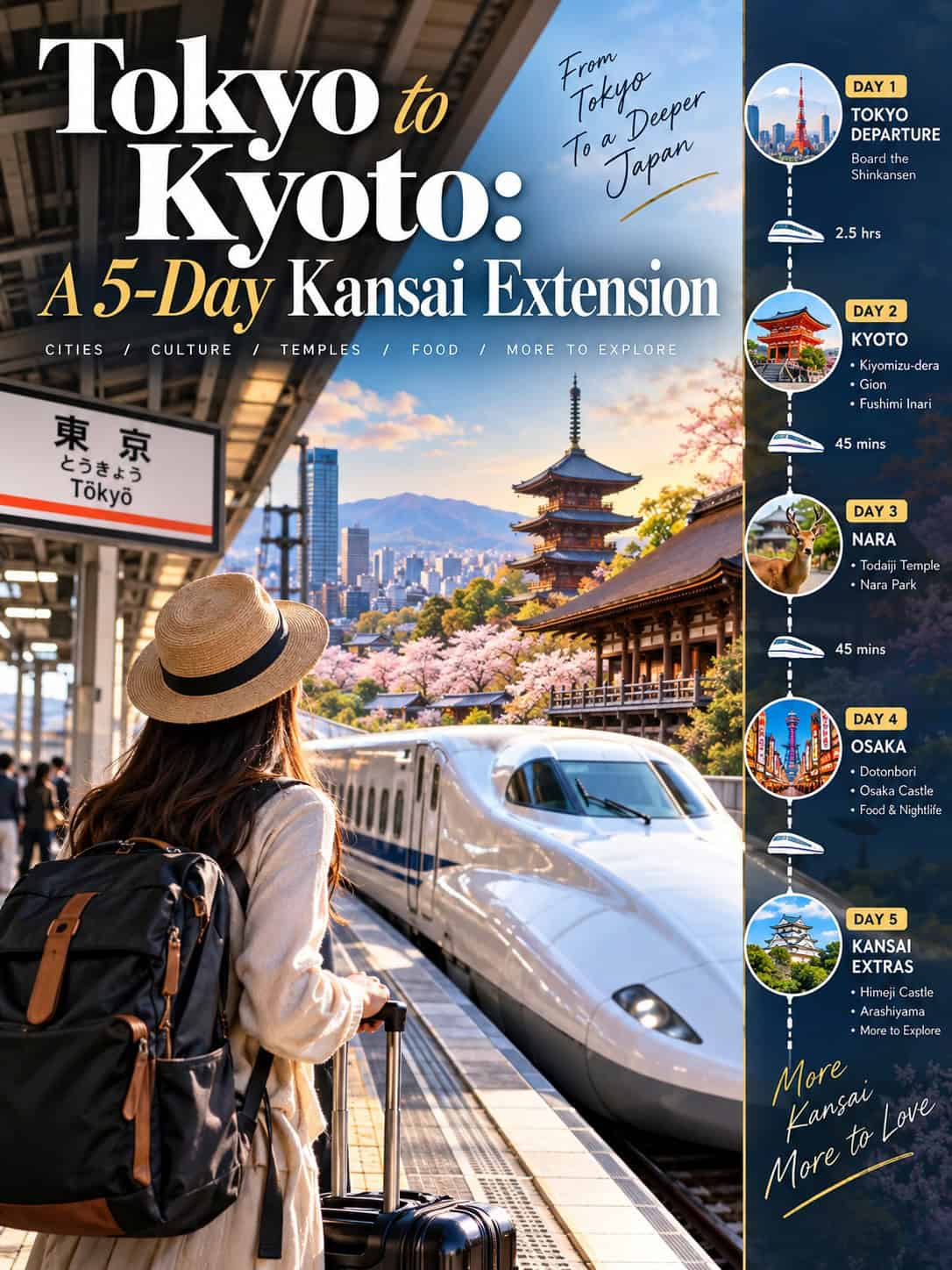
| How should the 5 days split? | Day 1 arrival and Higashiyama; Day 2 Fushimi Inari and central Kyoto; Day 3 Arashiyama; Day 4 Nara, Uji or Osaka; Day 5 Kyoto morning and train to Tokyo |
| What’s the non-negotiable Kyoto core? | Higashiyama/Gion, Fushimi Inari (early morning), and Arashiyama |
| Best single add-on if you only pick one? | Nara works well for temples and deer; Uji is a shorter visit focused on tea and Byodo-in; Osaka is best for an urban food evening |
| What about my luggage in Tokyo? | Ask your Tokyo hotel to hold your main bag, or request a courier quote based on suitcase size and delivery conditions |
Kyoto Itinerary 5 Days: Route at a Glance
| Day | Morning | Afternoon / evening | Overnight |
|---|---|---|---|
| 1 | Tokyo → Kyoto by Shinkansen | Kiyomizu-dera, Sannenzaka, Gion | Kyoto |
| 2 | Fushimi Inari Taisha | Nishiki Market and central Kyoto | Kyoto |
| 3 | Arashiyama Bamboo Grove | Tenryu-ji, Togetsukyo Bridge | Kyoto |
| 4 | Nara, Uji or Osaka | One complete day-trip option | Kyoto |
| 5 | Nearby Kyoto sights / breakfast | Kyoto → Tokyo Shinkansen | Tokyo |
This itinerary includes five calendar days and four nights in Kyoto, not five full Kyoto sightseeing days. To spend five entire days sightseeing in Kyoto, add extra travel days at the beginning and end.
Kyoto Itinerary 5 Days: Stay in Kyoto or Commute?
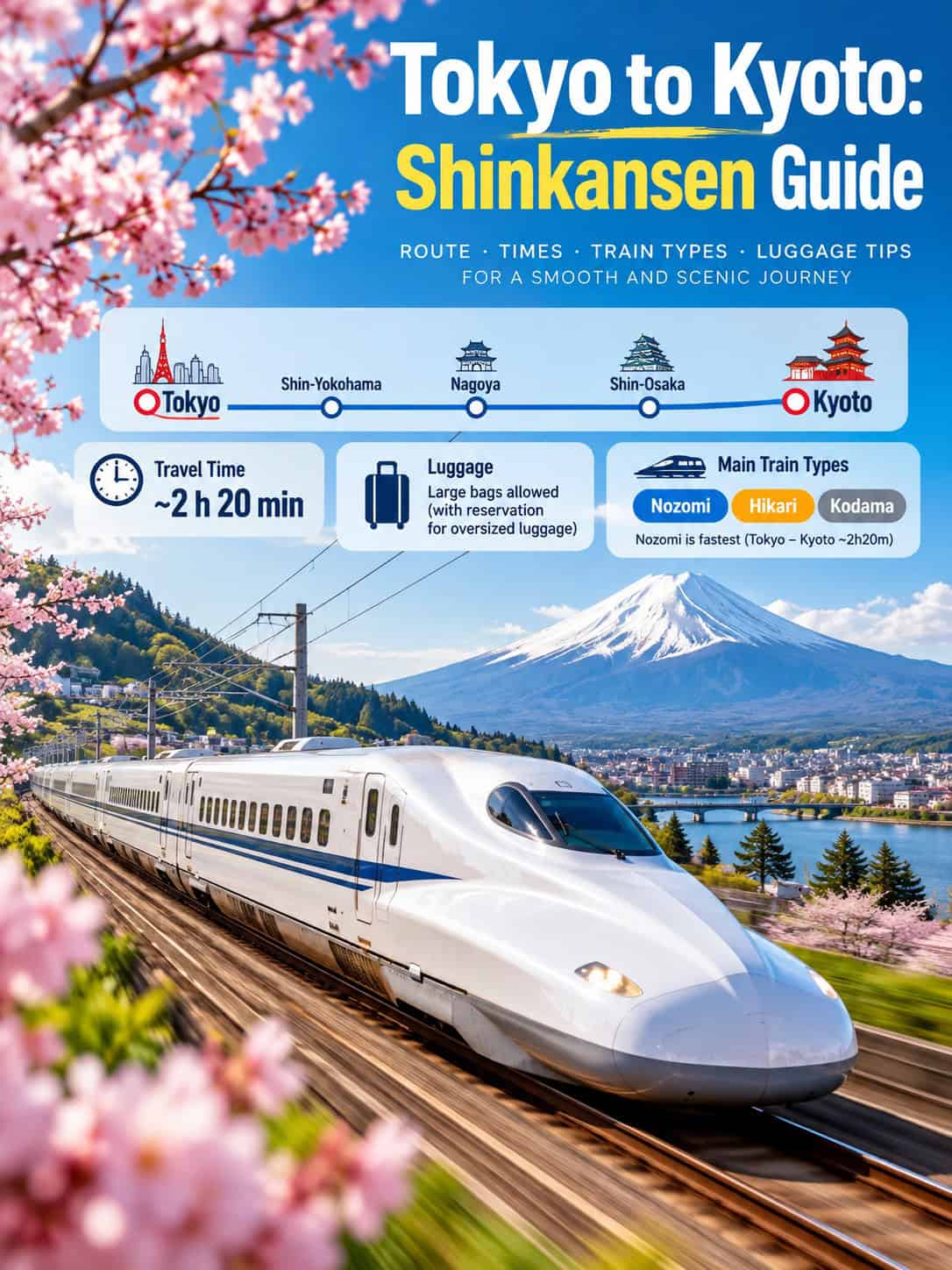
Tokyo–Kyoto by Tokaido Shinkansen takes about 2 hours 10 minutes on the fastest Nozomi trains, excluding station access. A same-day return is technically possible, but it would spend more than four hours on intercity trains alone. For this five-day plan, stay four nights in Kyoto to enjoy early temple visits and late meals without repeated long-distance journeys. Kyoto makes a practical base because most sightseeing days stay within the city, while JR and private railways provide day-trip connections to Nara, Uji and Osaka.
Kyoto Itinerary Day 1: Shinkansen, Kiyomizu-dera and Gion
Leave Tokyo in the morning on a Nozomi or Hikari service, store your bags near Kyoto Station or check into your accommodation, then explore southern Higashiyama. Visit Kiyomizu-dera first because it has a closing time, then follow Sannenzaka and Ninenzaka toward Yasaka Shrine. Finish with dinner in Gion or Pontocho. Kiyomizu-dera normally opens at 6 AM, with seasonal evening extensions, so check its actual closing time for your date.
Kyoto Day 1: Practical Timeline
08:00–11:00: Leave Tokyo, arrive at Kyoto Station and drop off luggage. The fastest Shinkansen ride itself takes roughly 2h10, but station access increases total time.
12:00–14:00: Visit Kiyomizu-dera, then explore Sannenzaka and Ninenzaka downhill.
14:00–17:00: Continue to Yasaka Shrine, Maruyama Park and the streets around Gion.
Evening: Eat around Gion-Shijo or Pontocho. Respect signs restricting entry or photography on private streets. Planning time in the capital too? Our Tokyo travel guide covers the main areas.
Kyoto Temples: Fees and Hours
| Sight | Admission | Timing |
|---|---|---|
| Kiyomizu-dera | See the current official ticket calendar | Opens daily 6 AM; closing time varies by season and special illumination dates |
| Yasaka Shrine | Grounds free | Public shrine approach accessible throughout the day |
| Sannenzaka / Ninenzaka | Free streets | Shops set individual hours |
Kyoto Itinerary Day 2: Fushimi Inari and Nishiki Market
Take the JR Nara Line from Kyoto Station to Inari Station for Fushimi Inari Taisha, or use Keihan Railway to Fushimi-Inari Station. The outdoor shrine paths remain accessible around the clock and do not charge general admission, while staffed facilities have their own hours. Arrive early to walk under the torii gates; the full Mount Inari circuit can take roughly 2–3 hours. Continue to Nishiki Market around lunchtime, then explore downtown Kyoto or Nijo Castle if time permits.
Fushimi Inari and Central Kyoto: Avoid Wasted Transfers
The famous torii route is a hillside walk rather than a single short photo stop; returning from the lower viewpoints is reasonable if you do not want the full 2–3-hour summit circuit. Next, travel toward downtown Kyoto for Nishiki Market. Most individual shops focus on daytime business, so use lunchtime rather than expecting a late-night food market. Nishiki is a working commercial arcade, so follow each vendor’s eating and photography rules.
Optional Nijo Castle Add-On
If you finish early, consider Nijo Castle and its gardens. It requires a separate ticket and its hours can change with special exhibitions. Do not add Nijo Castle when the full Mount Inari hike has already taken most of your morning.
Kinkaku-ji, the Golden Pavilion in northwest Kyoto, is another optional stop for a free afternoon. Admission is ¥500 for adults, and it is open daily from 9 a.m. to 5 p.m.
Kyoto Itinerary Day 3: Arashiyama Bamboo Grove and Tenryu-ji
Travel early to Arashiyama and walk the free public Bamboo Grove before the busiest hours. Visit Tenryu-ji’s garden (¥500 for high-school-age visitors and older), then continue to Togetsukyo Bridge and nearby riverside paths. Tenryu-ji opens 8:30 AM–5 PM, with last entry at 4:50 PM. Consider a Hozugawa River boat ride only if you have checked its operator’s reservation options, travel to Kameoka, weather rules and the time required. Arashiyama alone can absorb a full day, so do not bolt on another district afterward.
Tenryu-ji Kyoto: Ticket Breakdown
| Experience | Adult price |
|---|---|
| Tenryu-ji garden | ¥500 |
| Garden + buildings | ¥800 (¥500 + ¥300) |
| Cloud-Dragon painting in Dharma Hall | Additional ¥500 on eligible open days |
| Arashiyama Bamboo Grove public path | Free |
| Togetsukyo Bridge | Free |
Tenryu-ji opens its garden 8:30 AM–5 PM, last entry 4:50 PM. The Dharma Hall opens mainly on weekends, holidays and selected special dates, so check the temple’s calendar. For temples and old streets, see our Kyoto travel guide.
Hozugawa River Boat Ride: Planning Advice
The boat trip departs from the Kameoka side and finishes in Arashiyama. It is not a simple loop leaving from Togetsukyo Bridge. Check official booking, departure points, water levels, operating season and the trip back from any onward destination before adding it to Day 3.
Kyoto Itinerary Day 4: Nara, Uji or Osaka Day Trip
Choose one day trip. JR rapid trains from Kyoto to Nara generally take about 45 minutes, while faster Kintetsu services can take approximately 35–45 minutes. Visit Todai-ji’s Great Buddha Hall (¥800 adult), Nara Park and nearby historic streets; our Nara guide covers the details. For a calmer half-day, take JR to Uji for Byodo-in and matcha shops. Alternatively, head to Osaka for Dotonbori food and city sights: JR Special Rapid connects Kyoto and Osaka Station in approximately 30 minutes, but Dotonbori lies near Namba and requires an additional local connection (see our Kyoto to Osaka guide). If temples are the priority, keep the whole day for Nara rather than trying both.
Best Day Trips from Kyoto: Nara vs Uji vs Osaka
| Destination | One-way travel | Best for | Suggested duration |
|---|---|---|---|
| Nara | About 35–60 minutes depending on railway | Great Buddha, deer park, old streets | 5–7 hours |
| Uji | About 20–35 minutes | Byodo-in, green tea, riverside | 3–5 hours |
| Osaka | About 30 minutes JR to Osaka Station plus metro for Namba | Dotonbori street food, nightlife | Afternoon and evening |
Nara Day Trip: Temple Tickets
Todai-ji’s Great Buddha Hall charges ¥800 per adult and ¥400 for children aged 6–12. It opens 7:30 AM–5:30 PM April–October and 8 AM–5 PM November–March. Entry to Nara Park itself is free. Keep a respectful distance from deer and do not feed them anything other than designated deer crackers.
Uji Day Trip: Tea and Byodo-in
Visit the Byodo-in temple precinct and the riverside tea streets; allow time for any extra wait to enter the Phoenix Hall interior. JR and Keihan stations are in different positions in Uji, so choose a walking route suited to your departure station.
The Byodo-in garden and museum ticket costs ¥700 for adults. Going inside Phoenix Hall costs an extra ¥300, paid at the garden reception, with entries every 20 minutes for up to 35 people from 9:30 a.m. to 4:10 p.m. Arrive early on busy days, because the interior can close once the daily limit is reached.
Osaka Evening: From Kyoto to Dotonbori
JR trains reach Osaka Station from Kyoto, not Dotonbori directly. Continue via Osaka Metro to Namba, or consider Hankyu or Keihan depending on the hotel and starting location. Leave room for takoyaki, okonomiyaki and kushikatsu rather than planning another temple-heavy day.
Explore Kyoto, Nara and Osaka guided day trips.
Kyoto Itinerary Day 5: Final Kyoto Morning and Tokyo Return
Use your last morning for a nearby Kyoto neighbourhood or museum, or simply a slow breakfast before the trip back. Kibune, Kurama and Ohara are worthwhile destinations but do not fit reliably into a final morning before an early-afternoon Shinkansen, so extend your stay by another full day for a northern mountain excursion. Allow time to collect luggage and reach Kyoto Station. For a traditional stay, see the best ryokan in Kyoto.
Kyoto Travel Itinerary: Luggage and Hotel Logistics
Ask your Tokyo hotel whether it can hold bags during your trip; policies vary, so confirm this when you check in. Alternatively, luggage delivery between Tokyo and Kyoto is available through courier services such as Yamato Transport, but rates vary by parcel dimensions, pickup and drop-off points and delivery options. Next-day service and holding periods depend on your specific shipment. Keep medication and a change of clothes with you.
Kyoto Accommodation Tax Rates
| Accommodation charge per person per night | City tax per person per night |
|---|---|
| Under ¥6,000 | ¥200 |
| ¥6,000–19,999 | ¥400 |
| ¥20,000–49,999 | ¥1,000 |
| ¥50,000–99,999 | ¥4,000 |
| ¥100,000 or more | ¥10,000 |
Kyoto City applies these rates from March 1, 2026, based on the accommodation charge per person per night, excluding meal charges and consumption tax but including applicable service fees. The tax may be collected separately at check-in or checkout, even for reservations made before the new rule began. The former maximum tax was ¥1,000.
Where to Stay for a Five-Day Kyoto Itinerary
Kyoto Station: Best for easy Shinkansen arrival and Day 4 intercity transport. Shijo-Karasuma: Central for restaurants, shopping and buses or subways. Gion / Higashiyama: More atmospheric evenings and walkable old streets, but potentially longer luggage transfers and higher rates. Compare the hotel’s total four-night price including accommodation tax. Our Tokyo to Kyoto Shinkansen guide explains tickets and schedules.
Kansai Itinerary 5 Days: JR Pass or Individual Tickets?
For a trip this short and this focused, a national Japan Rail Pass usually isn’t the right call. You are making exactly one round trip between Tokyo and Kyoto on the Shinkansen, plus whatever local trains you use for Nara or Uji. A Tokyo–Kyoto reserved Nozomi reference fare is ¥14,170 one way, or ¥28,340 return, far below the ¥50,000 official 7-day ordinary pass price. A Japan Rail Pass also requires a special additional ticket for travel on Nozomi or Mizuho services, so do not present those trains as fully included. If you are combining this extension with a longer multi-city loop, that is a different calculation: see our Japan Rail Pass guide.
Tokyo to Kyoto Shinkansen: Fare Comparison
| Ticket | Reference adult fare |
|---|---|
| Tokyo → Kyoto, Nozomi reserved | ¥14,170 one way on an example departure |
| Tokyo ↔ Kyoto, same fare both ways | ¥28,340 |
| Japan Rail Pass, 7-day ordinary, official online price | ¥50,000 |
The sample reserved-seat fare is a timetable reference, not a universal price on all dates; discounts and peak-period conditions can change it. A national JR Pass requires a separate special ticket to board Nozomi services. A round trip alone does not justify buying a national pass for this itinerary.
Compare Tokyo–Kyoto Shinkansen tickets.
Kyoto Local Transport: Best Passes
| Pass | Adult cost | Coverage |
|---|---|---|
| Kyoto Subway & Bus 1-Day Pass | ¥1,100 | Kyoto city subway and city buses, plus eligible other routes |
| Kyoto Subway 1-Day Pass | ¥800 | Kyoto City Subway only |
The Subway & Bus pass is valid for the calendar service day, not 24 hours from first use. It does not include most JR, Hankyu or Keihan rail services, so its usefulness depends on your actual daily trips. Check the transport bureau for other passes sold in the current season.
Kyoto Itinerary 5 Days: What to Book Ahead
Reserve accommodation for peak blossom and autumn foliage periods, since popular Kyoto ryokan and machiya guesthouses in Higashiyama and Gion book out weeks ahead. Arashiyama Bamboo Grove has no timed admission requirement. Hozugawa boat departure options can vary by operating season and reservation channel, so check the operator’s current rules. If Uji is your pick, popular matcha cafes near Byodo-in can have lines by late morning, so go when they open. Check whether restaurants, special temple visits or popular activities accept bookings.
Kyoto Itinerary Budget: Four-Night Example
| Expense | Illustrative cost per adult |
|---|---|
| Tokyo–Kyoto Nozomi reserved return | ¥28,340 |
| Tenryu-ji garden | ¥500 |
| Todai-ji Hall if choosing Nara | ¥800 |
| One Kyoto Subway & Bus pass | ¥1,100 |
| Subtotal, before hotels, food and other tickets | ¥30,740 |
As an example, four nights at a per-person nightly accommodation charge of ¥15,000 generate ¥1,600 in Kyoto city tax, bringing the illustrative subtotal to ¥32,340 before accommodation, other transport, meals and activities. These figures are estimates for planning, not bundled prices.
For navigation between stations and attractions, compare Japan eSIM data plans. For an airport arrival or departure outside Tokyo’s centre, compare airport transfer options.
Kyoto Itinerary 5 Days: Frequently Asked Questions
Can I day-trip to Kyoto from Tokyo instead of staying overnight?
Technically yes, since a same-day Shinkansen round trip is possible, but it spends more than four hours on intercity trains alone. For five days, base yourself in Kyoto.
Is a Kyoto itinerary for 5 days too long?
No. Five calendar days allow three principal sightseeing districts, one day trip and arrival and departure travel. To spend five full sightseeing days in Kyoto, allow extra travel days.
How many days in Kyoto are ideal for first-time visitors?
Three full days cover many highlights. Four or five calendar days allow slower sightseeing and one excursion to Nara, Uji or Osaka.
Should I add Nara, Uji or Osaka on my flexible day?
Nara works well for temples and deer; Uji is a shorter visit focused on tea and Byodo-in; Osaka is best for an urban food evening. Choose by interests, train travel and your energy level.
Is the five-day Kansai itinerary possible without a Japan Rail Pass?
Yes. Individual Shinkansen tickets and local rail or bus tickets are usually better value for a Tokyo–Kyoto return without additional long-distance JR journeys.
Does Kyoto’s ¥1,100 bus and subway pass cover JR to Nara?
No. It covers Kyoto municipal services and designated other buses, not the JR Nara Line or most private railways.
How long does Tokyo to Kyoto take by Nozomi?
The fastest services take around 2 hours 10 minutes from Tokyo Station to Kyoto Station, excluding platform access and onward travel.
How much is Todai-ji in Nara?
Great Buddha Hall admission costs ¥800 for adults and ¥400 for children aged 6–12.
Can I see Fushimi Inari and Arashiyama on the same day?
It is possible but involves crossing Kyoto and can feel rushed. This itinerary gives each area a separate morning to reduce travel and crowds.
What is Kyoto’s accommodation tax?
From March 1, 2026, the tax ranges from ¥200 to ¥10,000 per person per night based on the pre-tax accommodation charge per guest.
Is Arashiyama Bamboo Grove free?
Walking the public bamboo path is free. Tenryu-ji Garden costs ¥500 for an adult and additional temple buildings cost more.
What should I do with my luggage if I’m returning to my Tokyo hotel?
Ask your Tokyo hotel whether it can hold bags during your trip, or request a courier quote based on suitcase size and delivery conditions.
Are Kibune, Kurama or Ohara worth visiting on a short trip?
These are best added as a separate half-day or day. Do not squeeze a remote mountain excursion into Day 5 before an early return train.
Bottom Line
This Kyoto itinerary for 5 days combines three sightseeing areas, one optional day trip and a comfortable Shinkansen journey back to Tokyo. Stay four nights in Kyoto, budget separately for temple entry and city tax, and choose the Nara, Uji or Osaka option that matches your interests.