By Nippon With Me EditorialPublished Updated
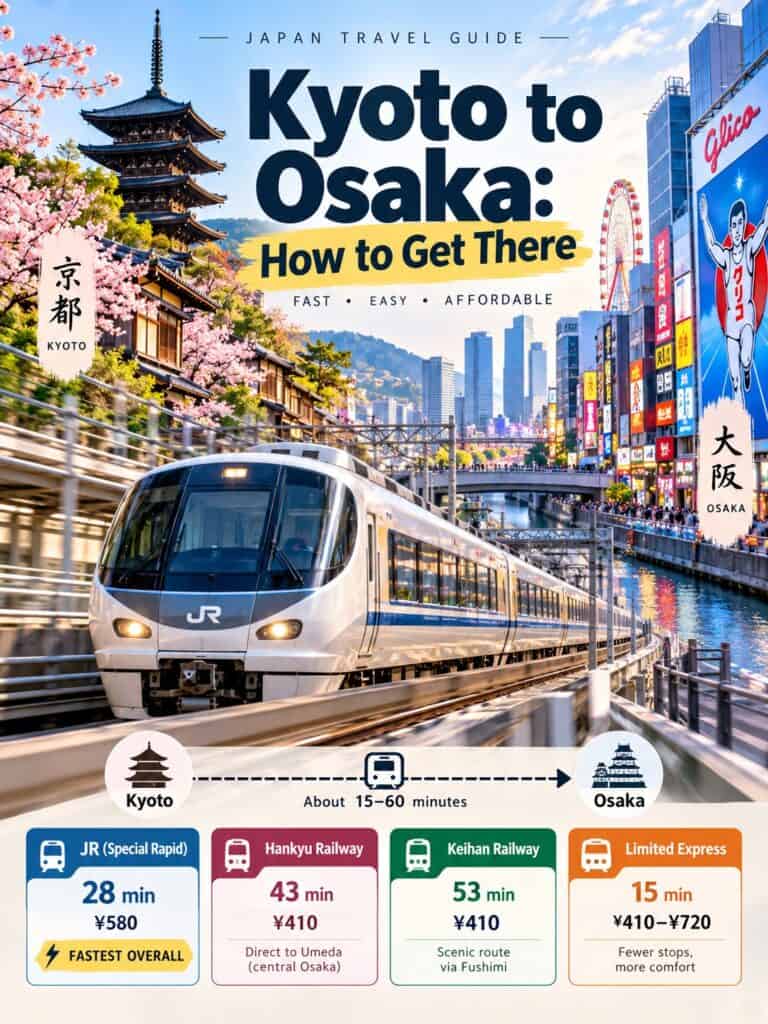
Quick answer: from Kyoto Station to Osaka Station, take the JR Special Rapid on the JR Kyoto Line. It takes about 28 minutes, costs ¥580, runs every 10 to 15 minutes in the daytime and needs no reservation. If you are staying near Gion or Kawaramachi, skip Kyoto Station and take the Hankyu line from Kawaramachi to Umeda, or the Keihan line from Sanjo to Yodoyabashi, instead. For Namba and Dotonbori, take any of these into Osaka and add a short subway ride. The Shinkansen is almost never the better choice for this short hop.
Fares in this guide are adult one-way fares. None of these trains needs a reservation, and Hankyu and Keihan also sell optional reserved premium seats for a small extra charge, covered in their sections below.
Kyoto to Osaka at a Glance: Which Train to Take
| Route | Operator and train | Time | Fare | Arrives at | Best for |
|---|---|---|---|---|---|
| Kyoto Station to Osaka Station | JR Kyoto Line Special Rapid | About 28 minutes | ¥580 | Osaka Station (Umeda) | Most travelers, and anyone with a Japan Rail Pass |
| Gion/Kawaramachi to Umeda | Hankyu Kyoto Line Limited Express | About 43 to 45 minutes | ¥410 | Osaka-Umeda | Staying in downtown Kyoto |
| Gion-Shijo/Sanjo to Yodoyabashi | Keihan Main Line Limited Express | About 46 to 50 minutes | ¥490 | Yodoyabashi, Kyobashi | Gion and riverside stays, Nakanoshima and Osaka Castle |
| Kyoto to Namba/Dotonbori | Any line above, then the Osaka Metro Midosuji Line | About 45 to 55 minutes in total | Train fare plus a subway fare of a few hundred yen | Namba | Dotonbori, Shinsaibashi, nightlife |
| Kyoto Station to Shin-Osaka | Tokaido Shinkansen | About 13 to 15 minutes | About ¥1,450 unreserved, more for reserved seats | Shin-Osaka | Onward Shinkansen connections, Haruka to Kansai Airport |
Frequency is high on all of these lines. JR runs a Special Rapid every 10 to 15 minutes in the daytime, and Hankyu and Keihan also run frequent services, though the exact intervals vary by time of day, so check the timetable if timing matters.
JR Kyoto Line: The Fastest, Cheapest Way
The JR Kyoto Line’s Special Rapid service (Shinkaisoku) connects Kyoto Station and Osaka Station in about 28 minutes for ¥580 one way. The fare is distance-based, not tied to the type of train, so the slower Rapid and Local trains cost the same but take longer. No seat reservation is needed. This is a regular JR West line, not a Shinkansen route, so it is covered by the Japan Rail Pass and by JR West regional passes with no supplement.
JR West fares on this route have been stable in recent years, but fare revisions are discussed periodically, so check the current fare close to your trip.
Hankyu Kyoto Line: Best From Downtown Kyoto
The Hankyu Kyoto Line runs between Osaka-Umeda and Kyoto’s Kawaramachi Station, with Karasuma Station one stop earlier. The Limited Express (Tokkyu) covers the route in roughly 43 to 45 minutes for ¥410 one way. Kawaramachi sits in the Gion and Shijo-Kawaramachi area, well away from Kyoto Station, so for travelers based downtown it can mean skipping a trip out to the JR station entirely. Hankyu is not covered by the Japan Rail Pass. If you want a guaranteed seat, Limited Express trains on this line include a reserved PRiVACE car that stops at Osaka-Umeda and Kyoto-Kawaramachi, for a flat ¥500 on top of the fare; seats can be booked online from 14 days before the ride.
Keihan Main Line: Best From Gion and the Riverside
The Keihan Main Line links Osaka’s Yodoyabashi and Kyobashi stations with Kyoto’s Sanjo and Gion-Shijo stations, both in the Gion and riverside area a short walk from Kawaramachi. The Limited Express takes roughly 46 to 50 minutes between Yodoyabashi and Sanjo or Gion-Shijo. The one-way fare between Yodoyabashi and Gion-Shijo or Sanjo is ¥490. Older guides that quote ¥430 date from before Keihan’s fare revision of October 2025. Limited Express trains also carry a reserved Premium Car with roomier seats: for the full run from Yodoyabashi to Demachiyanagi it costs ¥500 on top of the fare, and seats are sold at cashless machines on the platform for the next five trains. Kyobashi is a shorter and cheaper trip and connects to the JR Osaka Loop Line.
Kyoto to Namba and Dotonbori
No direct train links Kyoto and Namba. The simplest way is to take the JR Special Rapid or the Hankyu line to Osaka-Umeda and transfer to the Osaka Metro Midosuji Line toward Namba. From Keihan’s Yodoyabashi, the same Midosuji Line also reaches Namba. Allow about 45 to 55 minutes in total, depending on connections. For what to eat once you arrive, see our Osaka street food guide.
The Shinkansen Option: Rarely Worth It for This Hop
The Tokaido Shinkansen connects Kyoto Station and Shin-Osaka in about 13 to 15 minutes, which sounds appealing until you look at the cost and the arrival station. An unreserved seat is around ¥1,450, and reserved seats cost more, with the Nozomi priced higher than the Hikari and Kodama. That is roughly two and a half times the JR fare or more to save around 13 minutes, and Shin-Osaka is not central Osaka. Most travelers then need another local train to reach Umeda or Namba, which erases the time saving.
The Shinkansen mostly makes sense if you are already on it going to Hiroshima or Tokyo, if you are carrying heavy luggage and want space, or if you are continuing from Shin-Osaka to Kansai Airport on the Haruka express. For the longer route, see our Tokyo to Kyoto Shinkansen guide.
Japan Rail Pass and Other Passes
The Japan Rail Pass covers the JR Kyoto Line and the Hikari and Kodama Shinkansen. Nozomi and Mizuho services can be used if you pay a supplement, and Hankyu and Keihan are not covered. Japan Rail Pass prices have risen, and we cover the October 2026 change in our guide to whether a Japan Rail Pass is worth it. For a single Kyoto to Osaka trip or one round trip, a pass rarely pays off. A prepaid IC card such as ICOCA works on JR, Hankyu, Keihan and the Osaka Metro without any pass math.
Regional passes only make sense if you ride the private railways several times in one day. The Kansai Railway Pass Lite, which replaced the Kansai Thru Pass, covers Hankyu, Keihan and the Osaka Metro but not JR, and it is sold as a two-day or three-day pass at around ¥5,200 and ¥6,500. The current version is a digital pass sold from October 1, 2026 to March 31, 2027 and used on consecutive days. It does not cover the Kyoto City Subway, Randen, Keihan’s Keishin and Ishiyama-Sakamoto lines or any buses, and reserved seats such as Keihan’s Premium Car and Hankyu’s PRiVACE still cost extra.
Which Osaka Station Will You End Up At?
| Station | Served by | Best for |
|---|---|---|
| Osaka / Umeda | JR Special Rapid, Hankyu Kyoto Line | Umeda and Kita shopping and business district, with connections to the JR Osaka Loop Line, Hankyu and Hanshin |
| Shin-Osaka | Shinkansen (also a JR Kyoto Line stop) | Onward Shinkansen connections and Kansai Airport, with one more local transfer to central Osaka |
| Namba | Not reached directly from Kyoto | Dotonbori, Namba and Shinsaibashi, via a transfer to the Osaka Metro Midosuji Line |
| Yodoyabashi / Kyobashi | Keihan Main Line | Kyobashi connects to the JR Osaka Loop Line, and Yodoyabashi connects to the Midosuji Line, useful for Osaka Castle and Nakanoshima |
“Osaka Station” and “Umeda Station” refer to the same complex under different names, since JR calls it Osaka Station and Hankyu, Hanshin and the Osaka Metro use the name Umeda, so do not be confused if your app shows a different name than your ticket.
Kyoto to Universal Studios Japan
None of these routes stops at Universal Studios Japan. From Osaka Station, take the JR Osaka Loop Line to Nishikujo Station, then the JR Yumesaki Line to Universal City Station, or take a direct Yumesaki Line train if one is running. For tickets and entry rules, see our Universal Studios Japan guide.
Which Kyoto Station Should You Leave From?
Kyoto Station is the default hub, serving JR, the Shinkansen and most long-distance buses, and it is the obvious choice if you stay nearby or need an onward Shinkansen or airport connection. But if you stay in Gion or downtown Kyoto, you are probably closer to Kawaramachi or Karasuma Station on Hankyu, or Sanjo or Gion-Shijo Station on Keihan, than to Kyoto Station. In that case, boarding Hankyu or Keihan directly usually beats backtracking to the JR station, even though the JR line is nominally faster and cheaper on paper. Our Kyoto guide explains the neighborhoods.
Kyoto to Osaka Day Trip: Planning the Return in the Evening
Kyoto and Osaka are close enough for an easy day trip in either direction, and many travelers stay in Kyoto and visit Osaka for dinner. Here is a simple plan for the return:
- Leave Osaka early enough. Aim to board a train back to Kyoto by about 22:00 to 22:30, so you have a buffer if you miss a connection.
- Check the last train for your line on the day. Last departures differ by line and by day, and timetables change, for example Keihan revised its timetable in August 2026. Look up your last train in a route planner or on the operator’s site.
- Know your stations. From Dotonbori, take the Midosuji Line to Umeda for JR or Hankyu, or walk to Yodoyabashi or Kyobashi for Keihan.
- Have a backup. If you miss the last train, a taxi or a night in Osaka costs more than the train, so keep a margin.
- Choose the line by where you stay in Kyoto. JR returns to Kyoto Station, while Hankyu and Keihan return you to Kawaramachi and Sanjo in central Kyoto.
For a decision about where to base yourself, see Kyoto vs Osaka and our Osaka hotel guide, and for timing see the best time to visit Japan.
Practical Tips for the Kyoto to Osaka Trip
- Check the platform and train type before boarding the JR Special Rapid, since Rapid and Local trains share the same platforms and are easy to mix up.
- On Hankyu and Keihan, the Limited Express skips stations that regular trains serve, so make sure you are on the right service.
- Luggage: the JR Kyoto Line and the Shinkansen have more luggage space per car than the Limited Express of Hankyu or Keihan.
- Use an IC card such as ICOCA or Suica for all lines, and see our Japan cash and ATM guide for payment tips.
- Allow extra time at rush hour in both cities.
Kyoto to Osaka FAQ
What is the fastest way from Kyoto to Osaka?
The Shinkansen is fastest at 13 to 15 minutes, but it arrives at Shin-Osaka and costs much more. The JR Special Rapid from Kyoto Station to Osaka Station takes about 28 minutes for ¥580 and is the fastest practical choice for most travelers.
How much is the Kyoto to Osaka train?
The JR Special Rapid costs ¥580. Hankyu from Kawaramachi to Umeda is ¥410, and Keihan from Gion-Shijo or Sanjo to Yodoyabashi is ¥490. The Shinkansen is around ¥1,450 unreserved.
How long does the Kyoto to Osaka train take?
About 28 minutes by JR Special Rapid, 43 to 45 minutes by Hankyu, 46 to 50 minutes by Keihan and 13 to 15 minutes by Shinkansen.
Is the Kyoto to Osaka Shinkansen worth it?
Generally no. It saves around 13 minutes over the JR Special Rapid, costs more than twice as much and lands at Shin-Osaka, which usually needs another local transfer.
How do I get from Kyoto to Namba?
Take JR or Hankyu to Osaka Station/Umeda, then the Osaka Metro Midosuji Line to Namba, or use the Keihan line to Yodoyabashi and then the Midosuji Line. Allow about 45 to 55 minutes in total.
Does the Japan Rail Pass cover Kyoto to Osaka?
Yes, on the JR Kyoto Line and on Hikari and Kodama trains. Nozomi and Mizuho need a supplement, and Hankyu and Keihan are not covered.
Is Kyoto to Osaka a good day trip?
Yes. The trip takes under an hour each way, and trains are frequent. Check the last train back before you head out in the evening.
I am staying in Gion. Should I go to Kyoto Station first?
No. Hankyu Kawaramachi and Keihan Sanjo or Gion-Shijo are close to Gion, so you can board from downtown.
Bottom Line
For almost everyone, the JR Kyoto Line Special Rapid is the simplest answer: about 28 minutes, ¥580, no reservation and covered by the Japan Rail Pass. If you stay in Gion or downtown Kyoto, Hankyu from Kawaramachi or Keihan from Sanjo will often save you more time overall. Save the Shinkansen for days when you are already riding it to another city.