 By Nippon With Me EditorialPublished Updated
The Tokyo to Kyoto bullet train, also called the Tokyo to Kyoto shinkansen, is the one journey almost every visitor to Japan ends up taking, and it is easy to get wrong because there are three train types, two Tokyo stations and several ways to book. This guide covers the Tokyo to Kyoto shinkansen cost, travel times, stations and booking steps so you can buy the right ticket the first time.
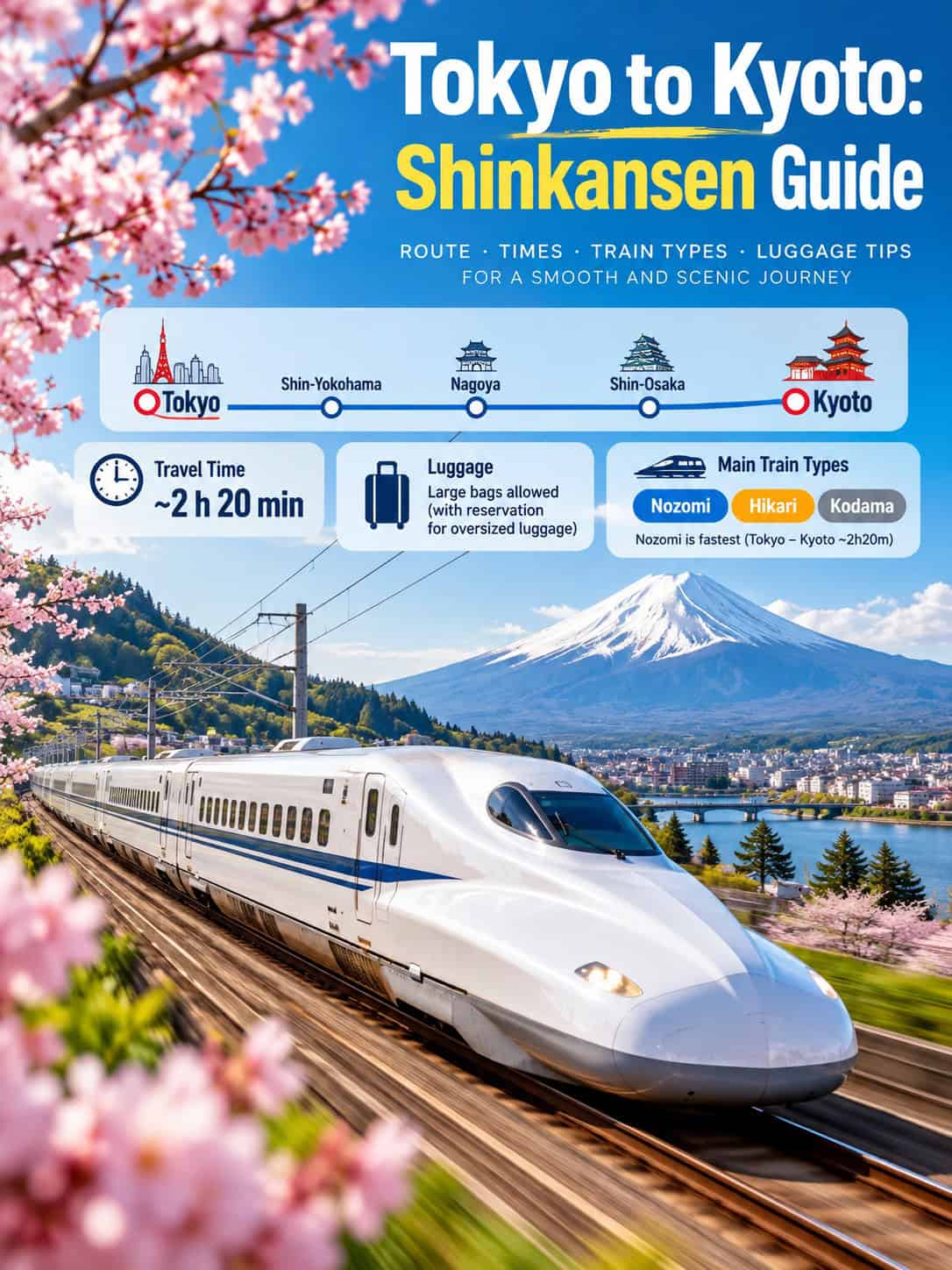
Tokyo to Kyoto Bullet Train at a Glance
| Train | Time | Stops | Notes |
|---|---|---|---|
| Nozomi | About 2 hours 10-15 minutes | Fewest | Fastest and most frequent; not covered by the Japan Rail Pass alone |
| Hikari | Roughly 2 hours 40-50 minutes | A handful of extra stations | Covered by the Japan Rail Pass |
| Kodama | Roughly 3 hours 40 minutes to 4 hours | Every station | Local service; covered by the Japan Rail Pass |
| Ticket (adult, one way) | Approximate price |
|---|---|
| Nozomi, non-reserved ordinary | About ¥13,320 |
| Nozomi, reserved ordinary | A little more, around ¥14,170 in the regular season |
| Hikari or Kodama, reserved ordinary | Around ¥13,850 |
| Green Car | Higher; the exact price is shown when you book |
The Tokyo to Kyoto shinkansen cost shifts slightly with the season: a reserved seat costs ¥200 less than the regular-season price in the off-peak season and ¥200 more in the peak season, while the non-reserved fare stays the same. Children aged 6 to 11 pay half fare, and younger children ride free if they do not need their own seat. Tickets are priced per one-way journey, so there is no round-trip discount.
Nozomi, Hikari or Kodama: What Is the Difference?
The three trains run on the same Tokaido Shinkansen line, and the Tokyo to Kyoto train time depends on which one you pick. The difference is how many stations they skip. The Nozomi stops least often and is the fastest. Between Tokyo and Kyoto the Nozomi calls only at Shinagawa, Shin-Yokohama and Nagoya. The Hikari also serves Shin-Yokohama and adds extra stops such as Odawara, Shizuoka or Hamamatsu, depending on the service. The Kodama stops at every station between Tokyo and Shin-Osaka.
For Nozomi Tokyo to Kyoto trips on a regular point-to-point ticket, the Nozomi is the obvious choice: it costs only slightly more than the Hikari and saves real time. If you hold a rail pass, see our rail pass guide to decide whether it pays off. A pass holder can ride the Nozomi only by buying a separate NOZOMI MIZUHO Ticket each time, which costs ¥4,960 for Tokyo to Kyoto. Most pass holders simply take the Hikari from Tokyo to Kyoto, which takes only a little longer.
Which Station for the Tokyo to Kyoto Bullet Train?
Both Tokyo Station and Shinagawa Station serve Nozomi and Hikari trains to Kyoto, so choose by convenience. Tokyo Station sits by the Marunouchi and Ginza areas and connects to the Yamanote Line and several subway lines. Shinagawa is a few minutes further along the line and is the better pick if you are staying in southern Tokyo or arriving through Haneda Airport, because it avoids a backtrack into the center.
Allow real buffer time in either station. Both are large and shared with commuter lines, and the signed walk from a regular JR platform to the shinkansen gates can take ten minutes or more on your first attempt.
Sample Routes From the Airport and Hotel
From Haneda Airport: take the Keikyu line to Shinagawa, then change to the shinkansen. From Narita Airport: take the Narita Express to Tokyo Station and change there. Our Narita and Haneda transfer guide compares the options. From a central Tokyo hotel: use the Yamanote Line or a subway to Tokyo Station, which usually beats a taxi in traffic.
In Kyoto: the trains arrive at Kyoto Station, which has a subway line, buses and taxis outside. For most central hotels the subway or a short taxi ride works well, and many travelers use the coin lockers or luggage forwarding if their room is not ready. See our Kyoto guide for where to base yourself.
How to Book the Tokyo to Kyoto Bullet Train
- SmartEX app or website: register a credit card (Visa, Mastercard, JCB, American Express and Diners Club are generally accepted). Your card needs to support 3D Secure authentication, and if the check fails you may be unable to complete the booking online.
- Choose your train and seat: pick the date, the Nozomi or Hikari, reserved or non-reserved and ordinary or Green Car. If your bag is oversized, choose a seat with an oversized baggage area. For a chance to see Mount Fuji on a clear day, pick window seat E (seat D in the Green Car), which is on the right-hand side heading to Kyoto.
- Link an IC card or use a QR ticket: link a Suica, Pasmo or ICOCA card to tap through the gate, or display the QR ticket from the app at gates marked with a QR symbol. The shinkansen fare is charged to your registered credit card when you book, not deducted from the IC card balance.
- Fallback: buy at a shinkansen ticket machine or staffed window at the station. Machines at Tokyo and Shinagawa have an English interface, and the in-person route avoids online card checks.
Tokyo to Kyoto shinkansen tickets can be reserved from 5:30 a.m. Japan time one year before travel through the official SmartEX booking service. For a booking made that far ahead, SmartEX confirms the exact train, time and seat after 8:00 a.m. one month before the travel date. You can change a SmartEX reservation free of charge as many times as you like up to 4 minutes before departure, and cancelling an Ordinary Car ticket before departure costs a ¥320 fee. For busy dates, book early: Golden Week, Obon and New Year sell out fastest, and on those dates the Nozomi runs with reserved seats only.
Reserved vs. Non-Reserved Seats
Hikari and Kodama trains always have both reserved and non-reserved cars, and so does the Nozomi outside its all-reserved peak periods; the car types are marked on the platform and the train. A non-reserved ticket is cheaper and flexible, because you can board any train of that type on the day. In busy periods such as weekday rush hours, Golden Week, Obon and New Year, those cars fill up and you may stand. During the Golden Week, Obon and New Year peak periods, a non-reserved ticket lets you ride a Nozomi only standing in the passageway (not in the Green Cars, cars 8 to 10), but before boarding you can switch it once to a reserved seat without a fee, paying only the price difference. A reserved seat removes the uncertainty and is worth the small premium for a first trip or when you carry luggage.
Oversized Luggage Rule
On the Tokaido, Sanyo and Kyushu Shinkansen, a bag whose three dimensions add up to more than 160 cm, up to 250 cm, needs a free reservation for a seat with an oversized baggage area. Without it you may be charged around ¥1,000. Bags over 250 cm total cannot be taken on board. The oversized baggage area is the space behind the last row of seats in some cars, shared by the passengers who reserved that row, so it cannot be used without the reservation. Bags of 160 cm or less need no reservation and go in the overhead rack or at your feet, and each passenger can bring two pieces of up to 30 kg each. Add up the length, width and height of your suitcase before you travel. Our packing list helps you keep bags manageable.
What to Expect on the Day
Platforms are organized by car number, with floor markings showing where each car stops, so line up at the right marker. Trains stop briefly at Tokyo and Shinagawa, so keep your ticket or IC card ready. Buy a bento box and a drink in the station before boarding, since the Tokaido Shinkansen has no trolley service in its ordinary cars. Only Nozomi and Hikari Green Car passengers can order snacks and drinks to their seat by scanning a QR code.
If you plan to continue beyond Kyoto, see how the trip fits into a 5-day Kansai extension or the onward ride to Osaka. Our Tokyo guide covers what to do before you leave.
Frequently Asked Questions
How long does the Tokyo to Kyoto bullet train take?
The Nozomi takes about 2 hours 10 to 15 minutes. The Hikari takes roughly 2 hours 40 to 50 minutes, and the Kodama roughly 3 hours 40 minutes to 4 hours.
How much does the Tokyo to Kyoto train cost?
A non-reserved ordinary seat on the Nozomi costs about ¥13,320 one way. A reserved ordinary seat costs a little more, and prices shift slightly with the season. Green Car costs more again; check the exact price when you book.
Do I need to reserve a seat in advance?
No. You can board a non-reserved car on the day. Reserve if you travel with luggage or in a busy period, because non-reserved cars can fill up, and Nozomi trains run with reserved seats only during New Year, Golden Week and Obon.
Can I ride the Nozomi with a Japan Rail Pass?
Not on the pass alone. Pass holders buy a separate NOZOMI MIZUHO Ticket each time, which costs ¥4,960 for Tokyo to Kyoto. Most pass holders take the Hikari instead.
Which Tokyo station should I use?
Either Tokyo Station or Shinagawa. Both are served by Nozomi and Hikari trains to Kyoto. Pick whichever is closer to your hotel or airport route.
Do I need to reserve a seat for a large suitcase?
Yes, if the three dimensions add up to more than 160 cm, up to 250 cm. The reservation is free and assigns a seat with an oversized baggage area. Without it you may be charged about ¥1,000. Bags over 250 cm cannot be taken on board.
Can I use a Suica or Pasmo card to tap through the gates?
Only if you have linked it to a SmartEX reservation first. The gates read your reservation, not just a stored-value balance. The fare itself is charged to the credit card registered with SmartEX when you book, so the card balance is not used.
Is there a round-trip discount?
No. Tickets are priced per one-way journey, so two one-way tickets cost the same as a round trip.
Bottom Line
For a first trip on the Tokyo to Kyoto bullet train, take the Nozomi from Tokyo Station or Shinagawa. Book through SmartEX if your card supports it, or at a station counter if it does not. Reserve a seat if you travel with a big suitcase or in a holiday period, and reserve the oversized baggage seat if your bag adds up to more than 160 cm. The ride takes a little over two hours, so the real planning happens before you reach the platform.