By Nippon With Me EditorialPublished Updated
A night in a ryokan is one of the few hotel stays that’s genuinely part of the sightseeing itself, and Kyoto has one of the best concentrations of them anywhere in Japan. This guide to the best ryokan in Kyoto explains what a traditional Japanese inn actually involves, names specific Kyoto ryokan across luxury, mid-range and budget tiers, and covers the etiquette first-time guests usually want to know before they check in.
What Is a Ryokan? Traditional Ryokan Kyoto Explained
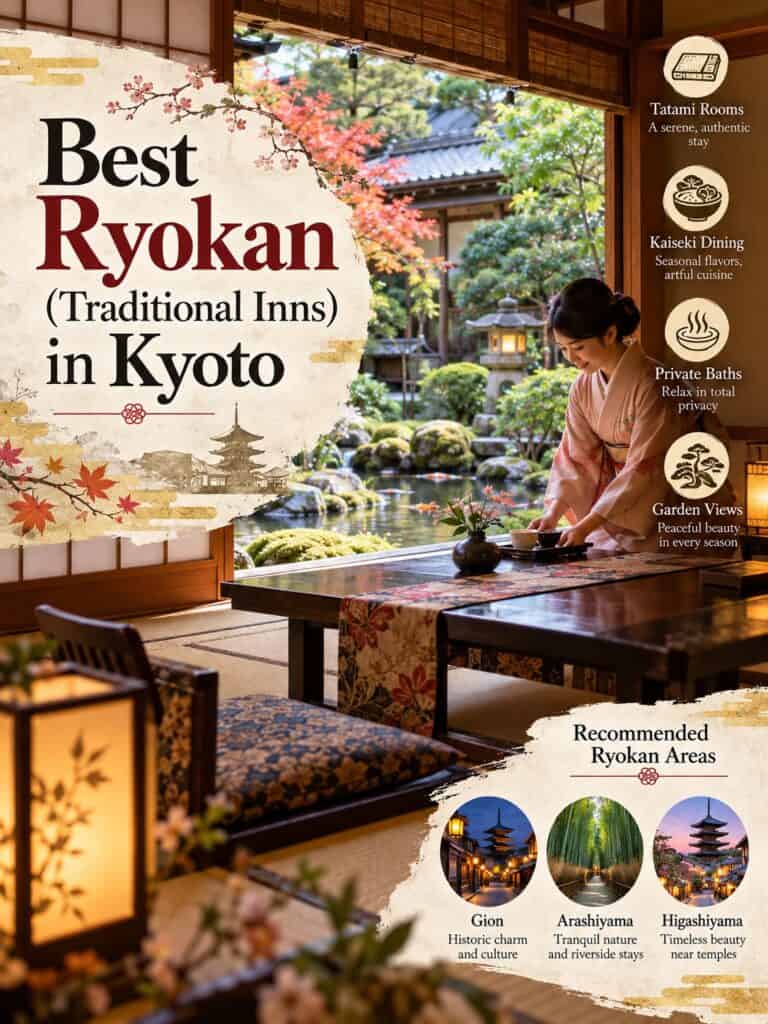
A ryokan is a traditional Japanese inn, and many of the best-known ones are old and treated as destinations in their own right rather than just a place to sleep. Rooms are typically minimalist: tatami straw-mat floors, fusuma paper sliding doors, and low tables with cushions instead of Western-style furniture. A futon is laid out on the tatami at night rather than a fixed bed, often with firm pillows filled with buckwheat husks (sobagara). Baths are a central part of the experience, sometimes communal and sometimes private, and sometimes fed by genuine hot spring water, though many city ryokan in Kyoto heat ordinary water instead. A nakai-san, a dedicated attendant somewhere between a butler and a host, typically checks you in personally and may prepare your bedding in the evening. Meals matter just as much as the room: many ryokan describe themselves first and foremost as places to eat well, often built around a multi-course kaiseki dinner, although a few serve no dinner at all.
Best Ryokan in Kyoto at a Glance
| Tier | What to Expect |
|---|---|
| Luxury | Private open-air or semi-open-air baths, kaiseki dinner, historic or architecturally distinct buildings |
| Mid-range | Private or reservable baths, kaiseki or seasonal dining, often family-run for generations |
| Budget | Shared or public baths, simpler rooms, still genuinely traditional rather than a Western-style budget hotel |
Luxury Kyoto Ryokan
Nazuna Kyoto Nijo-jo
Nazuna Kyoto Nijo-jo offers rooms with a private open-air bath, in Nakagyo Ward an 8-minute walk from Nijo-jo mae Station on the Tozai Line, with breakfast and a set dinner on site and free WiFi. Guests rate it 9.4 from 210 reviews, and it is a boutique ryokan with a strong focus on privacy.
Seikoro Ryokan
Seikoro Ryokan is a traditional ryokan in Higashiyama, a 7-minute drive from JR Kyoto Station, with traditional Japanese-style rooms, a public bath, massage services and free WiFi. It is a genuine old inn rather than a modern building styled to look old. Guests rate it 9.5 from 1,329 reviews, and the dinner is an optional kaiseki plan rather than a mandatory one. The half-board plan, with dinner and breakfast served in the room, runs from ¥26,250 to ¥63,000 per person depending on date and room.
Nazuna Kyoto Gosho
Nazuna Kyoto Gosho sits in Nakagyo Ward, about 0.7 miles from Nijo Castle and 0.8 miles from the Kyoto Imperial Palace, with an Irori lounge and seven rooms, the luxury ones with a private open-air or semi-open-air bath. Marutamachi Station on the Karasuma Line is about a 5-minute walk away. It is the sister property of Nazuna Kyoto Nijo-jo, and guests rate it 9.0 from 120 reviews.
Mid-Range Ryokan in Kyoto
Kyoto Arashiyama Onsen Ryokan Togetsutei
Kyoto Arashiyama Onsen Ryokan Togetsutei sits alongside the Katsura River in Arashiyama, right beside Togetsu Bridge and a 7-minute walk from Hankyu Arashiyama Station (about 15 minutes from JR Saga-Arashiyama Station), with Japanese-style rooms with private bathrooms and mountain views. Breakfast and dinner are served, and Iwatayama Monkey Park and Tenryuji Temple are about a 10-minute walk away. Guests rate it 9.1 from 334 reviews.
Toshiharu Ryokan
Toshiharu Ryokan is a Meiji-era ryokan registered as a cultural asset, a 5-minute walk from Gojo Station and one subway stop from JR Kyoto Station. Guests sleep on a futon on a tatami floor, and green tea and a yukata robe are provided. It is rated 9.6 from 373 reviews, one of the highest-rated traditional ryokan Kyoto has. The building dates from 1909, and a taxi to JR Kyoto Station takes about 8 minutes.
Nishiyama Ryokan
Nishiyama Ryokan in Nakagyo Ward is a nonsmoking ryokan with Japanese-style rooms, a garden and rental bicycles, about a 2-minute walk from Exit 10 of Kyoto Shiyakusho-mae Station, reached through the Zest Oike underground mall. In-room massage can be arranged. It is rated 9.4 from 470 reviews. Bicycle rentals make it easy to reach nearby sights without relying on buses. There is no on-site parking, and a taxi from JR Kyoto Station takes about 15 minutes.
Muromachi Yutone Kyokoyado
Muromachi Yutone Kyokoyado is a ryokan in Shimogyo Ward with an on-site restaurant serving Kyoto-style kaiseki, free WiFi and just seven rooms, each with a private cypress bath. It is rated 9.4 from 360 reviews and is a convenient base for the central sights.
Budget-Friendly Traditional Ryokan Kyoto
Ryokan Ryokufuso
Ryokan Ryokufuso in Shimogyo Ward is a 15-minute walk from JR Kyoto Station, with a spacious public bath and traditional multi-course meals featuring local Kyoto ingredients. Massages can be requested. It is rated 9.3 from 1,179 reviews, and it is a good option for travelers who want the ryokan experience without the luxury-tier cost. The half-board plan runs from ¥14,700 to ¥17,850 per person depending on date and room, and a taxi from JR Kyoto Station takes about 5 minutes.
Yuno Yado Shoei
Yuno Yado Shoei is an 8-minute walk from JR Tambaguchi Station, with an on-site public hot spring bath, a Japanese restaurant and free parking on prior reservation. It is rated 9.1 from 1,828 reviews, making it a genuine onsen stay at a budget price.
Ryokan Sanga
Ryokan Sanga is in the heart of Kyoto in Nakagyo Ward, a 7-minute walk from Karasuma Oike Subway Station, with tatami flooring, futon bedding and a restaurant. It is rated 8.8 from 690 reviews and is a traditional, simple base close to the center.
For a luxury hotel with Japanese design and a spa rather than a traditional ryokan experience, consider HOTEL THE MITSUI KYOTO.
Check-In, Rooms and Dinner at Each Ryokan
Arrival windows and dinner formats differ more than the room rates suggest, and a late flight or an early dinner seating can decide the choice.
| Ryokan | Rooms | Check-In / Check-Out | Dinner and Breakfast |
|---|---|---|---|
| Nazuna Kyoto Nijo-jo | 5 suites | 3 PM to 9 PM / by 11 AM | Sukiyaki dinner at 5:30 PM or 7:30 PM, reserved 3 days ahead; breakfast 7:30 to 9:30 AM |
| Nazuna Kyoto Gosho | 7 rooms | 3 PM to 9 PM / by 11 AM | Same sukiyaki seatings and 3-day reservation; breakfast 7:30 to 9:30 AM |
| Seikoro Ryokan | 22 rooms | 3 PM / 10:30 AM | Dinner and breakfast served in the room on the half-board plan |
| Toshiharu Ryokan | 5 rooms | 4 PM / 10:30 AM | Breakfast of seasonal Kyoto home-style dishes; no dinner service |
| Ryokan Ryokufuso | 28 rooms | 4 PM / 10 AM | Dinner served in the room on the half-board plan |
Ryokan Etiquette for First-Time Guests
Shoes come off at the entrance and stay off for the rest of the stay, so never wear them indoors or on tatami flooring. The yukata (cotton robe) provided in your room is meant to be worn freely, to breakfast, to the baths, and often around the surrounding streets if the ryokan sits in an onsen town. Keep your voice down in common areas, since much of the appeal of a ryokan is its calm atmosphere. Many traditional ryokan still prohibit visible tattoos in communal baths, so check policy in advance if this applies to you; private baths are usually not an issue either way. If dinner is included in your plan, don’t ask to skip it for a discount, as that is considered poor etiquette. Tipping is not expected in Japan, and if you want to leave something, do it discreetly in an envelope. Guests with limited mobility or back problems should look specifically for ryokan advertising Western-style beds or raised tables, since futons on tatami and low seating aren’t comfortable for everyone.
Kaiseki Dinner: What to Expect
Kaiseki is a multi-course Japanese dinner built around seasonal ingredients, usually served directly in your room or in a private dining area rather than a shared restaurant floor. Courses typically arrive one or two at a time, moving through small, deliberately composed dishes, often starting with something light, building through grilled, simmered and sometimes raw courses, and finishing with rice, soup and a seasonal dessert. At several of the ryokan above, dinner comes as part of a half-board plan or a bookable set meal, and the format differs: Nazuna serves sukiyaki at fixed seatings, Muromachi Yutone serves kyo-kaiseki, and Toshiharu Ryokan serves no dinner at all.
Choosing Between a Ryokan in Kyoto and a Hotel
A ryokan in Kyoto makes the most sense if part of your reason for visiting is to experience something distinctly Japanese rather than just somewhere convenient to sleep: the shared bathing, the kaiseki dinner and the tatami rooms are the point, not a trade-off. A conventional hotel still makes more sense if you’re traveling with very young children, need flexible late check-in or a Western-style bed as a hard requirement, or are only in Kyoto for a single rushed night between other stops. Nazuna Kyoto Nijo-jo and Nazuna Kyoto Gosho accept guests aged 13 and older only, which rules them out for families with younger children. For more on choosing your base, see our Kyoto complete guide and our comparison of Tokyo vs Kyoto.
Best Time to Book a Kyoto Ryokan
Cherry blossom season (late March into early April) and autumn foliage season (November) are Kyoto’s two busiest windows, and the smaller, most atmospheric ryokan sell out months ahead for both. Booking three to six months in advance for either season is realistic rather than cautious, especially for any property with private open-air baths, since those rooms tend to go first.
Kyoto Lodging Tax Per Night
Kyoto City adds a lodging tax for every guest on every night, on top of the room rate. It is worked out from the room charge before meals and consumption tax, so a half-board rate can fall into a lower band than the headline price suggests. Children are not exempt.
| Room Charge Per Person Per Night | Tax Per Person Per Night |
|---|---|
| Under ¥6,000 | ¥200 |
| ¥6,000 to under ¥20,000 | ¥400 |
| ¥20,000 to under ¥50,000 | ¥1,000 |
| ¥50,000 to under ¥100,000 | ¥4,000 |
| ¥100,000 or more | ¥10,000 |
Practical Tips for First-Time Visitors
Check whether dinner and breakfast are included in your rate before booking, since kaiseki dinner can be the single biggest cost difference between two ryokan that otherwise look similarly priced. Confirm the exact check-in window, since many ryokan have a more rigid check-in time than hotels, often clustered in the late afternoon to allow time for dinner preparation. If you’re traveling with a tattoo and want communal bathing, call ahead rather than assuming. And pack light where you can, as many of Kyoto’s most characterful ryokan are in older buildings with narrow stairs and no elevator. For how cash works on the trip, see our guide to money in Japan, and for a full route, our Japan 10-day itinerary.
Best Ryokan in Kyoto FAQ
What is a ryokan?
A traditional Japanese inn, often old, built around tatami rooms, a futon laid out at night, communal or private baths, and often a kaiseki dinner included in the stay, although some inns serve breakfast only.
Which Kyoto ryokan is the highest rated on this list?
Toshiharu Ryokan is rated 9.6, ahead of Seikoro Ryokan at 9.5, and Nazuna Kyoto Nijo-jo and Nishiyama Ryokan at 9.4.
Do all ryokan include dinner?
Not always. At Seikoro Ryokan, for example, dinner is an optional kaiseki plan rather than mandatory. Toshiharu Ryokan goes further and serves breakfast only, with no dinner service.
Can I stay at a ryokan if I have tattoos?
Many traditional ryokan still restrict visible tattoos in communal baths, though private baths are usually unaffected, as at Nazuna Kyoto Nijo-jo, where rooms have a private open-air bath. Check the specific ryokan’s policy in advance.
Is tipping expected at a ryokan?
No, tipping is not expected in Japan.
What’s a good budget-friendly ryokan option in Kyoto?
Ryokan Ryokufuso near Kyoto Station has a spacious public bath and traditional multi-course meals at a lower price than the luxury tier, and Yuno Yado Shoei has its own hot spring bath.
Which Kyoto ryokan is best for a stay near Arashiyama?
Kyoto Arashiyama Onsen Ryokan Togetsutei sits by the Katsura River, right beside Togetsu Bridge and a 7-minute walk from Hankyu Arashiyama Station.
Which ryokan is closest to Kyoto Station?
Toshiharu Ryokan is a 5-minute walk from Gojo Station and one subway stop from JR Kyoto Station, and Ryokan Ryokufuso is a 15-minute walk away.
How far ahead should I book a Kyoto ryokan?
Three to six months ahead for cherry blossom season (late March into early April) or autumn foliage season (November), since the most sought-after properties sell out early.
Bottom Line: Best Ryokan in Kyoto
Kyoto’s ryokan range from a long-established inn in Higashiyama to a boutique townhouse ryokan by Nijo Castle, and the right one comes down to how much of the full experience, from kaiseki dinner to private onsen, you actually want, rather than which property simply ranks highest.
Related Guides
Kyoto: The Complete Guide
Money in Japan: Currency, Cash Culture and ATMs
Japan 10-Day Itinerary: Tokyo, Kyoto and Osaka
Tokyo vs Kyoto: Which Should You Choose?