By Nippon With Me EditorialPublished Updated
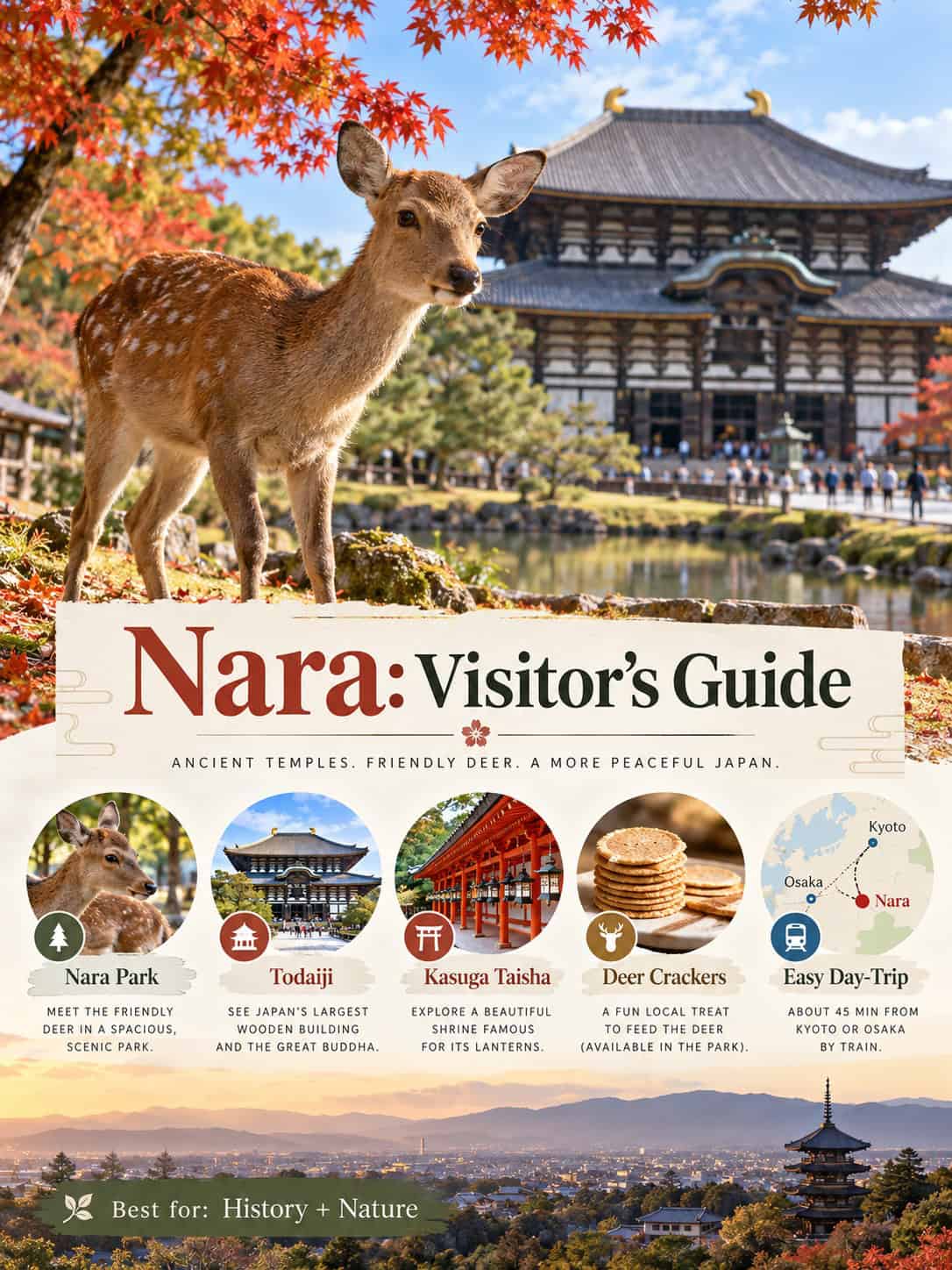
Nara was Japan’s capital more than a thousand years before Tokyo, and it still feels like it: a compact city built around a park full of free-roaming, bowing deer and anchored by one of the largest bronze Buddhas in the world. This Nara travel guide lists the best things to do in Nara, gives a 4 to 6 hour walking route from Kintetsu Nara Station with times between stops, and compares the day trip from Kyoto and from Osaka.
Things to Do in Nara at a Glance
| Sight | Plan on | Free or paid |
|---|---|---|
| Nara Park and the deer | 1 to 2 hours, mixed with walking between sights | Park is free |
| Todai-ji Great Buddha Hall | About 1 hour | Paid |
| Kasuga Taisha | About 1 hour, more with the forest approach | Grounds are free; inner areas are paid |
| Kofuku-ji | 30 to 45 minutes | Grounds are free; museum and halls are paid |
| Isuien Garden | About 45 minutes | Paid; closed on Tuesdays |
| Yoshikien Garden | About 30 minutes | Check current rules for foreign visitors |
| Naramachi | 1 to 1.5 hours | Free to wander |
Hours and ticket prices change, so confirm them on each sight’s own page before you go.
Nara Walking Route: 4 to 6 Hours From Kintetsu Nara Station
The best things to do in Nara are easy to cover on foot, and the route below runs in one loop with no backtracking. Walking times are approximate.
| Stop | Walk from previous stop | Suggested time |
|---|---|---|
| Kintetsu Nara Station to Kofuku-ji | About 5 to 10 minutes | 30 to 45 minutes |
| Kofuku-ji to Nara Park deer area | About 5 minutes | 45 to 60 minutes |
| Deer area to Todai-ji | About 15 minutes | About 1 hour |
| Todai-ji to Isuien and Yoshikien | About 10 minutes | About 1 hour for both |
| Isuien to Kasuga Taisha | About 25 to 30 minutes | About 1 hour |
| Kasuga Taisha back to the station through Naramachi | About 30 to 40 minutes | 1 hour or more |
Start early, since the park and the temples are quietest in the morning. If you only want the Great Buddha, the walk from Kintetsu Nara Station to Todai-ji takes about 20 minutes along Noborioji-cho. If you want a shorter day, drop Isuien and Yoshikien and the loop comes down to about six hours at the suggested times, and less if you shorten the stops. With both gardens and the full time at every stop, plan on closer to seven hours. If you prefer to save your legs in summer, city buses run from both JR Nara and Kintetsu Nara stations to the Todai-ji Daibutsuden / Kasuga Taisha-mae stop, about a 5-minute walk from the Great Buddha Hall, and a round bus from Kintetsu Nara Station serves the Daibutsuden-mae parking lot via the Omiya Street or Nara Park routes.
What the Nara Loop Costs per Person
The walking route is mostly free, and the three biggest paid items add up to ¥2,700 per adult. Entry to the paid halls at Kofuku-ji, deer crackers and meals are extra.
| Sight | Adult | Child |
|---|---|---|
| Nara Park and the deer | Free | Free |
| Todai-ji Great Buddha Hall | ¥800 | ¥400 (ages 6 to 12); ages 13 to 18 pay ¥800 |
| Todai-ji Great Buddha Hall plus Todai-ji Museum | ¥1,200 | ¥600 (ages 6 to 12) |
| Kasuga Taisha grounds and approach | Free | Free |
| Kasuga Taisha special worship, main sanctuary | ¥700 | See venue |
| Kasuga Taisha Manyo Botanical Garden | ¥700 | ¥300 |
| Kofuku-ji grounds | Free | Free |
| Isuien Garden, including the museum | ¥1,200 | ¥300 (elementary and junior high), ¥500 (high school and university) |
| Yoshikien Garden | Free | Free |
| Naramachi | Free | Free |
| Todai-ji hall, Isuien and Kasuga special worship | ¥2,700 | See venue |
If It Rains
The Great Buddha Hall is indoors and open 7:30am to 5:30pm from April through October and 8:00am to 5:00pm from November through March, and the joint ticket adds the Todai-ji Museum. Kasuga Taisha’s main sanctuary can be visited through special worship from 9:00am to 4:00pm. Swap the open-air Nara Park and Isuien stops for Naramachi’s cafes and small museums when the rain is heavy. Isuien is also closed on Tuesdays, so on a wet Tuesday stay with Todai-ji, Kofuku-ji and Naramachi.
Nara Deer Park: How to Feed the Deer Safely
The deer in the park are wild animals despite their tameness, and they bow because they have learned that it earns a cracker. Follow these rules to keep it pleasant.
- Feed only the special deer crackers (shika senbei) sold at the stalls in the park. Do not bring your own food.
- Buy crackers only when you are ready to hand them over, and keep any food out of sight otherwise.
- Do not tease the deer or hide a cracker. Pushy behavior comes from teasing.
- Bucks with antlers can nip or nudge impatiently, so keep a distance from them and watch children.
- Hold bags and paper maps close, because deer will try to eat them.
Top Things to Do in Nara
Todai-ji and the Great Buddha
Todai-ji houses the Daibutsu, a bronze seated Buddha roughly 15 meters tall, inside one of the largest wooden buildings in the world. Entry to the Great Buddha Hall costs ¥800 for adults and ¥400 for ages 6 to 12 (ages 13 to 18 pay the adult rate), and it is open 7:30am to 5:30pm from April through October and 8:00am to 5:00pm from November through March. A joint ticket with the Todai-ji Museum is ¥1,200 for adults.
Nara Park and its deer
More than a thousand sika deer roam the park, considered sacred messengers in local tradition. The park itself is free and open at all times. It connects Todai-ji, Kasuga Taisha and Kofuku-ji, so most first-time visitors spend the bulk of the day here.
Kasuga Taisha
A vermillion shrine founded in the 700s, known for the thousands of bronze and stone lanterns along its forest approach. The grounds are free to enter, while special worship at the main sanctuary costs ¥700 and runs 9:00am to 4:00pm. General worship hours are 6:30am to 5:30pm from March through October and 7:00am to 5:00pm from November through February. The shrine museum and the Manyo Botanical Garden are ¥700 each for adults.
Kofuku-ji
A former Fujiwara-clan temple best known for its five-story pagoda, one of Japan’s tallest wooden pagodas. The pagoda is under restoration and its exterior is covered, so adjust your expectations for photos. The grounds are free.
Isuien and Yoshikien gardens
Isuien is a strolling garden around two ponds that frames Todai-ji’s rooflines as part of the view, and it is closed on Tuesdays (the following day when Tuesday is a national holiday), as well as for maintenance from late December to mid-January and during the last third of September. It is open 9:30am to 4:30pm with last entry at 4:00pm, and adult admission is ¥1,200 including the garden museum (¥500 for university and high school students, ¥300 for younger students). The smaller Yoshikien next door has three garden styles in one compact area. Yoshikien is free to enter, open 9:00am to 5:00pm with last entry at 4:30pm, and closed February 24-28.
Naramachi
The former merchant district south of the park is a network of narrow lanes lined with Edo-period townhouses, now cafes, craft shops and small museums. It is a quieter contrast to the park’s crowds and a good place for an early dinner.
Nara Day Trip From Kyoto or Osaka: More Things to Do in Nara
| From | Line and station | Typical time | Best for |
|---|---|---|---|
| Kyoto | JR Nara Line Miyakoji Rapid to JR Nara; Kintetsu Kyoto Line to Kintetsu Nara | Roughly 45 to 55 minutes; a reserved Kintetsu limited express is a few minutes faster | Starting from central Kyoto |
| Osaka (Namba) | Kintetsu Rapid Express to Kintetsu Nara; JR Yamatoji Line to JR Nara | Roughly 40 minutes by Kintetsu, 50 to 55 by JR | Short trip from Namba or Dotonbori |
| Osaka (Umeda or Shin-Osaka) | JR via Tennoji or a transfer to the Kintetsu line | Longer, with a change | Rail pass holders |
Kintetsu Nara Station is closer to Nara Park and the main sights than JR Nara Station, so use Kintetsu when you can. JR Nara Station suits Japan Rail Pass holders and onward travel to Horyu-ji. The pass details are in our pass-or-no-pass planning. Nara is an easy half-way stop in a Kansai trip, as our five-day Kansai extension shows.
Choosing a base? For the old capital, see the temple-city walkthrough, and for food and nightlife, the street-food capital walkthrough. If you cannot decide between them, compare the two cities side by side.
Where to Stay
Near Kintetsu Nara Station is the most convenient base, within easy walking distance of the park, Naramachi and the main shopping streets. Naramachi suits travelers who want a quieter, more traditional evening, with a few machiya-style guesthouses in old merchant homes. Many visitors skip overnight stays and base themselves in Kyoto or Osaka, which are both well connected.
Best Time to Visit Nara
Late March through April brings cherry blossoms and November brings autumn color, especially around the forest approach to Kasuga Taisha. Both seasons are the most crowded. Summer is hot and humid, although the park’s shade helps. Winter is quiet and cold, with far fewer crowds. For the wider picture, see our season-by-season timing.
Adding Horyu-ji
Horyu-ji has some of the oldest wooden buildings in the world and was Japan’s first UNESCO World Heritage listing. It is about 20 to 30 minutes from central Nara by the JR Yamatoji Line to Horyuji Station, followed by a walk or short bus ride. It adds roughly an hour or more of round-trip travel, so it works best as part of a two-day visit.
Food in Nara
Kakinoha-zushi, sushi wrapped in persimmon leaves, is the signature dish. Narazuke (vegetables pickled in sake lees) and chagayu (a savory rice porridge brewed with tea) are other local specialties, found in Naramachi’s older restaurants.
Practical Tips for First-Time Visitors
Whatever things to do in Nara you pick, start early, wear comfortable shoes and keep your bag zipped around the deer. Carry cash for small stalls, and remember that temples and shrines have their own manners, as our etiquette basics explain. Check the entry and visa rules before you fly.
Frequently Asked Questions
What are the best things to do in Nara?
Walk Nara Park and meet the deer, see the Great Buddha at Todai-ji, stroll Kasuga Taisha’s lantern-lined approach, visit Isuien and wander Naramachi.
Can Nara be a day trip from Kyoto or Osaka?
Yes. Direct trains take well under an hour from both cities, and most of the core sights fit into one well-planned day.
Is it safe to feed the deer in Nara Park?
Yes, with care. Buy the special crackers sold in the park, hand them over right away and do not bring your own food. Keep a distance from antlered bucks.
How long does the Nara walking route take?
About four to six hours from Kintetsu Nara Station, depending on how long you spend at each stop and whether you include the gardens. Counting both gardens and the full suggested time at every stop, the loop takes about seven hours.
Which station is better, Kintetsu or JR?
Kintetsu Nara Station is closer to the park and the main sights. JR Nara Station suits rail pass holders and onward travel to Horyu-ji.
Is Horyu-ji worth adding to a day trip?
It is worthwhile for Japan’s oldest wooden architecture, but it adds an hour or more of travel, so it fits better into a two-day visit.
Bottom Line
The best things to do in Nara reward an easy, unhurried day. Its best sights sit close together around one park, and little else in Japan matches a 15-meter bronze Buddha and a thousand deer that bow for crackers. Use the walking route, feed the deer carefully and travel by Kintetsu when you can.