By Nippon With Me EditorialPublished Updated
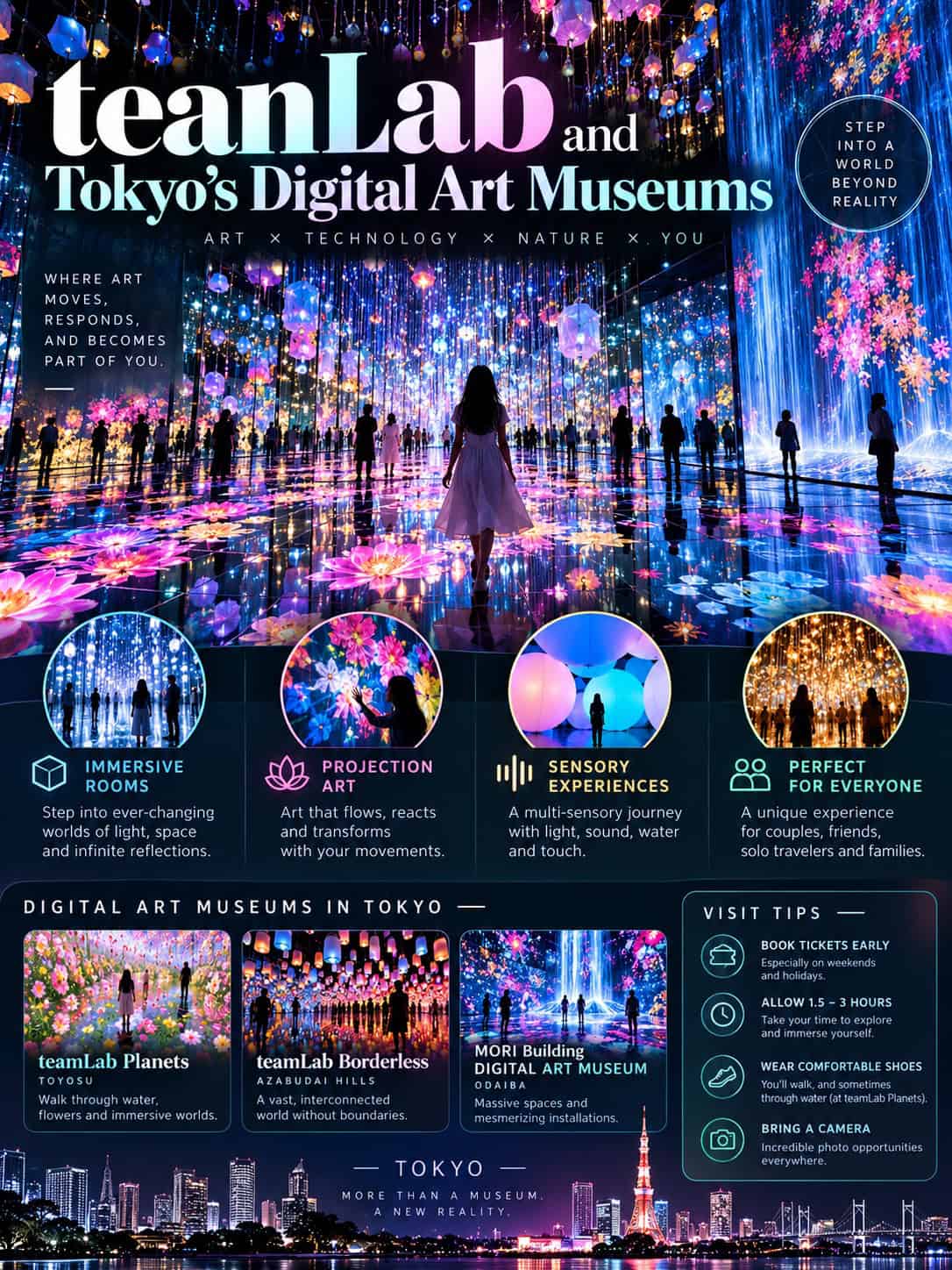
Tokyo has two big teamLab museums, and choosing between them is the hardest part of the trip. teamLab Planets Tokyo is a fixed-route walk-through museum in Toyosu where you go barefoot through water. teamLab Borderless is a map-free maze of moving artworks at Azabudai Hills. They are two genuinely different museums by the same collective, not duplicates, so this guide compares them side by side and helps you decide which to book, how to buy teamLab Tokyo tickets and what to do if your slot is sold out.
Which teamLab Should You Book?
Short answer: book Planets if you want a clear route and physical, water-and-garden rooms; book Borderless if you like wandering and photographing moving light. If you can do both, treat them as two separate outings.
- First visit, you like structure: teamLab Planets Tokyo.
- You like to explore and get a little lost: teamLab Borderless.
- Travelling with young children: Planets has a single route to follow, but water and slopes need care. Borderless is dark and maze-like.
- You hate getting wet or cannot go barefoot: Borderless, where you keep your shoes on.
- Short on time: pick the one nearest your hotel and book the first slot of the day.
teamLab Planets vs Borderless: Side-by-Side
| teamLab Planets (Toyosu) | teamLab Borderless (Azabudai Hills) | |
|---|---|---|
| Where | Toyosu, Koto-ku, Tokyo waterfront | Azabudai Hills, Minato-ku, central Tokyo |
| Format | One fixed route through connected rooms | No map and no fixed route, artworks move between rooms |
| Interactivity | Immersive: you walk through water, gardens and mirrored halls | Interactive: light and objects respond to you, and visitors draw and watch their drawings come alive |
| Shoes | Barefoot, shoes and bags in lockers | Shoes on |
| Water | Yes, you wade through shallow water, so wear rollable trousers | No water |
| Typical visit | About 2 hours or more, depending on the crowd | About 2 to 3 hours, since there is no end point |
| Best for | Clear structure, sensory rooms, first-time visitors | Wandering, photos, repeat visitors |
| Station | Shin-Toyosu on the Yurikamome Line | Kamiyacho on the Hibiya Line, or Roppongi-itchome on the Namboku Line |
| Booking | Timed-entry tickets only on the official website | Timed-entry tickets online, door tickets only if not sold out |
The two are not close to each other. Allow at least 30 to 40 minutes of transit between them if you try to do both in a day, and plan on separate half-days if you can.
teamLab Borderless at Azabudai Hills
The original teamLab Borderless opened in Odaiba in 2018 and closed in 2022. It reopened in a new form on February 9, 2024, at Azabudai Hills in Minato-ku, and it is not at Odaiba any more, so do not confuse the two when you search. The museum’s own framing is “Wander, Explore, and Discover”: there is no map or suggested route, and artworks move between rooms rather than staying fixed.
Signature installations include Borderless World, a maze of interactive LED corridors around the large piece “What a Loving, and Beautiful World”, and Infinite Crystal World, a mirror-paneled room of suspended, color-shifting LED nodes. In Future Park, the Sketch Ocean room projects drawings submitted by visitors as creatures swimming across the walls and floor. The En Tea House installation serves a bowl of tea in which digital flowers bloom as you drink. Newer works at Azabudai Hills include Bubble Universe, Light Sculpture, Megalith Crystal Formation and Microcosmoses.
teamLab Planets Tokyo at Toyosu
teamLab Planets Tokyo sits next to Shin-Toyosu Station on the Yurikamome Line, a very short walk from the north exit, and it is also reachable on foot from Toyosu Station on the Yurakucho Line in about ten minutes. The visit is a single sequence of rooms, several of which have you wade through shallow water, so you go barefoot and leave shoes and bags in lockers at the entrance. Current listings show the museum scheduled to run until the end of 2027, so confirm that on the official page if you are planning a later trip.
The Universe of Water Particles is a dark hall where digital waterfalls project around your feet as you wade through. In the Floating Flower Garden, real orchids rise and fall overhead as you walk beneath them, one of the museum’s most photographed rooms. The Moss Garden of Resonating Microcosms fills a quiet space with glowing, rippling spheres on real moss, and the Infinite Crystal Universe closes the main sequence with a mirrored room of suspended LED strands. A separately booked dining experience, The Table, projects animated imagery onto the table.
teamLab Tokyo Tickets and Booking
Both museums sell timed-entry teamLab Tokyo tickets, and pricing is dynamic, so the cost depends on the date and time. Adults currently pay from roughly the mid-¥3,000 range, and children aged 4 to 12 pay less, with very young children free, but prices change and rise on busy dates, so check the figure for your exact day. A flexible or premium pass costs far more and removes the entry-time restriction, which can be worth it on a fixed itinerary. Book on the official website, and avoid buying from resellers whose cancellation terms differ.
- Book as soon as your dates are firm, and a week or more ahead for weekends and school holidays.
- Arrive within your entry window, because late arrival can lose your place during busy periods.
- Changes are usually allowed a few times until shortly before entry, but cancellations and refunds generally are not.
- Hours differ by date and by museum, with last entry about an hour before closing, so check the schedule for your day.
If Your Time Slot Is Sold Out
- Check other times and days first. Weekday mornings and early evenings often have gaps, and the first slot of the day is usually quieter.
- Look at the other museum. If Planets is full, Borderless may have space, and the reverse.
- For Borderless, door tickets are sometimes sold at a higher price if the day is not sold out.
- A flexible pass is the fallback when your dates are fixed and the standard slots are gone.
- If neither works, add another art stop to your Tokyo plan, such as the Setouchi islands in our Naoshima guide, or fill the time from Tokyo: the complete guide.
Getting There: Routes From the Station
teamLab Planets Tokyo
Take the Yurikamome Line to Shin-Toyosu Station and use the north exit. The museum is a very short walk. From Shimbashi it takes roughly 20 minutes. If you are on the Yurakucho Line, get off at Toyosu Station and walk about ten minutes via exit 7. Our guide to Tokyo subway, JR lines and IC cards covers fares and the card you need.
teamLab Borderless
From Kamiyacho Station on the Hibiya Line, use exit 5 and follow the underground passage into Azabudai Hills, about a two-minute walk. From Roppongi-itchome Station on the Namboku Line, take exit 4 and walk about six minutes through the passage. Both are easy to reach on foot even in rain.
What to Wear and Bring
- Planets: wear trousers or shorts you can roll up, not a skirt or tight jeans, because you wade through water. Bring a small towel for your feet. Keep valuables in your pockets, since bags go in lockers, and expect cool, damp floors.
- Borderless: flat, comfortable shoes, because there is a lot of walking in dim light. No special clothing is needed.
- Both: a small bag, a charged phone and layers. Dark rooms can be warm or cool depending on the installation. See our Japan packing list for the wider picture.
Families and Accessibility
Both museums are dark and crowded at peak times, and Planets includes water, slopes and mirrored floors, while Borderless has maze-like corridors. Stroller and wheelchair rules are specific to each room and change, so check the official page for both museums before you go, and contact the museum if you need step-free access. Very small children are easier to carry than to push through either museum.
Best Time to Visit
Weekday mornings are the quietest at both museums. Weekend afternoons, public holidays and school vacations bring the biggest crowds and the first sellouts. See the best time to visit Japan if you are planning your whole trip around the seasons, and the Japan visa guide for entry requirements.
Practical Tips
- Photography is generally allowed, but flash and tripods are usually restricted, so check signs in each room.
- Plan some time afterwards to dry off and put your shoes back on at Planets.
- Eat nearby before or after your slot, and see our Tokyo food guide for ideas.
- Stay near a station on a convenient line, as in our Tokyo hotel guide.
Frequently Asked Questions
Are teamLab Borderless and teamLab Planets the same museum?
No. They are separate museums in different parts of Tokyo. Borderless has no map or fixed route, and Planets follows a single sequence of rooms, some involving wading through water.
Which should I book first, Planets or Borderless?
Choose Planets if you want a clear route and physical, sensory rooms. Choose Borderless if you prefer to wander and photograph moving light.
Where is teamLab Borderless now?
It is at Azabudai Hills in Minato-ku, not at Odaiba. The Odaiba site closed in 2022 and the museum reopened at Azabudai Hills on February 9, 2024.
Do I need to book teamLab Tokyo tickets in advance?
Yes. Both museums use timed-entry tickets sold online, and popular slots, especially on weekends, sell out.
Do I need to take my shoes off at teamLab Planets?
Yes. You go barefoot and wade through shallow water, and shoes and bags go into lockers. At Borderless you keep your shoes on.
Can I visit both teamLab museums in one day?
It is possible but tight. They are in different parts of the city, so allow transit time between them on top of about two to three hours at each.
What if my time slot is sold out?
Check other times and days, look at the other museum, and consider a flexible pass. Weekday mornings and early evenings usually have more space.
Bottom Line
teamLab Planets Tokyo and teamLab Borderless are two of Tokyo’s most distinctive museum experiences. Pick Planets for structure and water, Borderless for wandering, book early, dress for the one you are visiting and treat them as two separate outings.