By Nippon With Me EditorialPublished Updated
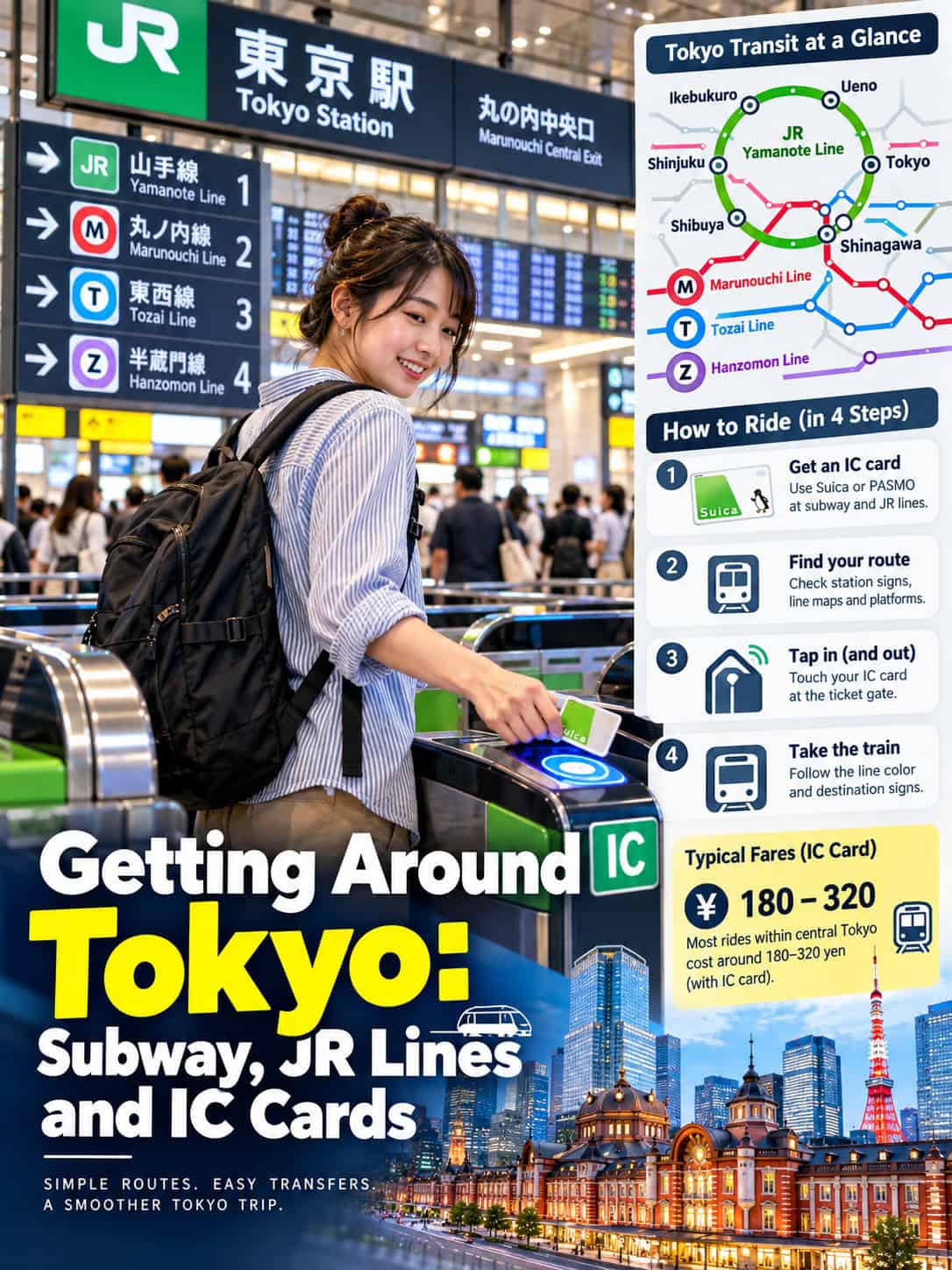
Getting around Tokyo looks intimidating on a map, but it follows a simple logic: you are dealing with JR East, two subway operators and a handful of private railways, and one IC card smooths over nearly all of them. This guide shows how the Yamanote Line, Tokyo Metro, Toei Subway and private lines fit together, how Suica and Pasmo compare, and when the Tokyo Subway Ticket beats tapping an IC card. For the bigger picture, start with our Tokyo overview.
Getting Around Tokyo: Quick Answer
| Question | Answer |
|---|---|
| Best way to pay for trains | An IC card such as Suica or Pasmo: tap in, tap out, no fare calculation |
| Subway lines | 13 lines: 9 Tokyo Metro and 4 Toei Subway |
| Yamanote Line | JR East loop connecting Tokyo Station, Shinjuku, Shibuya, Ueno and other hubs |
| Tokyo Metro fares | From ¥178 by IC card or ¥180 by paper ticket |
| JR East minimum fare | ¥160 cash after the March 2026 revision; IC fares are a few yen lower |
| Tokyo Subway Ticket | Metro and Toei only: ¥1,000 for 24 hours, ¥1,500 for 48 hours, ¥2,000 for 72 hours |
Getting Around Tokyo by Train: Who Runs What
Tokyo feels overwhelming because it is not one network. Tokyo Metro runs nine subway lines (Ginza, Marunouchi, Hibiya, Tozai, Chiyoda, Yurakucho, Hanzomon, Namboku and Fukutoshin). Toei Subway, run by the city government, adds four more (Asakusa, Mita, Shinjuku and Oedo). JR East runs the above-ground lines, including the Yamanote loop and the Chuo and Sobu lines that cross the city. Private railways such as Odakyu, Keio, Tokyu, Tobu, Keisei and Keikyu bring passengers in from the suburbs and the airports.
Because they are separate companies, a paper ticket does not automatically cover a trip that changes operators. Switching between Tokyo Metro and Toei with paper tickets needs a transfer ticket, while an IC card charges the combined fare automatically when you tap out. Tokyo Metro regular tickets are valid only on the day of purchase and become invalid after you leave the gates, which is one more reason to carry a card.
Which Line to Use: Routes from Shinjuku, Shibuya, Asakusa and Tokyo Station
Use JR lines for the big hubs, the subway for neighborhoods the loop misses, and private lines when you leave the city center. These examples show how the choice plays out on common trips.
| Trip | Best option | Notes |
|---|---|---|
| Shinjuku to Tokyo Station | JR Chuo Line Rapid, or the Marunouchi Line | The Chuo Rapid takes roughly 15 minutes; both are covered by an IC card |
| Shibuya to Shinjuku | JR Yamanote Line | A short hop on the loop with trains every few minutes |
| Shibuya to Asakusa | Ginza Line, Tokyo Metro | Direct ride of roughly half an hour; the IC fare falls in the ¥252 band |
| Shinjuku to Asakusa | Marunouchi Line to Ginza, then the Ginza Line | Both lines are Tokyo Metro, so the Subway Ticket covers the trip |
| Tokyo Station to Asakusa | Marunouchi Line to Ginza, then the Ginza Line | Tokyo Station is on the Marunouchi Line, so no JR fare applies |
| Shinjuku to the Odakyu line for Hakone | Odakyu private line from Shinjuku Station | Not covered by the Subway Ticket; see the Hakone guide below |
Planning day trips? The Hakone transport guide and the Mount Fuji guide explain the private-line and bus options, and the airport guide covers Narita and Haneda transfers.
Getting Around Tokyo with an IC Card: Suica vs Pasmo
An IC card is the simplest way to ride. You tap on the reader when you enter and again when you exit, and the correct fare is deducted regardless of the operator. Suica and Pasmo work the same way and are interchangeable on trains and buses, and the nationwide network also includes Icoca and several regional cards. Here is how the visitor options compare.
| Card | Cost and deposit | Validity | Good to know |
|---|---|---|---|
| Welcome Suica | No deposit; the card is sold with a balance | 28 days from the purchase date | Not refundable, including any balance left over |
| Tourist Pasmo | ¥2,000 at Narita; ¥1,000 to ¥10,000 at Haneda; no deposit | 28 days from the purchase date | Sold at Haneda and Narita airports; leftover balance is not refunded |
| Regular Suica or Pasmo | Includes a refundable ¥500 deposit | Reusable; top up on later trips | Availability has varied, so check the station or airport counters; refunds go through the issuer |
| Welcome Suica Mobile | No deposit; iPhone and Apple Watch only | Up to 180 days | No physical card needed; not available on Android |
Tourist Pasmo is real and sold at the two main airports, so it is a convenient pick if you land at Haneda or Narita and want a no-deposit card straight away. Welcome Suica works the same way for a short stay. If you travel a lot or come back often, a regular card avoids the 28-day clock. Whichever you choose, set aside enough balance at the start, since cards can be topped up with cash at station machines.
An IC card pays the base fare only. It does not replace extra tickets for limited express trains, Green Car seats, Shinkansen or reserved-seat airport trains, which need their own ticket. Welcome Suica also cannot be used for one continuous journey between different regional areas; you must leave the gates and re-enter. Refunds, where available, go through the card’s original issuer.
Many train and subway lines in and around Tokyo also let you tap a contactless credit card at the gate, but not JR lines, the Keisei Line or the Tokyo Monorail, and only certain Tobu and Seibu lines. That gap includes the Yamanote Line, so an IC card is still the one payment that works on every operator.
Getting Around Tokyo: IC Card or Tokyo Subway Ticket?
The Tokyo Subway Ticket gives unlimited rides on all Tokyo Metro and Toei Subway lines for 24, 48 or 72 hours from first use. It does not cover JR lines, private railways or buses. The numbers below use Tokyo Metro IC fares of about ¥178 to ¥252 per ride for typical trips.
| Option | Price (adult) | Covers | Works out cheaper when |
|---|---|---|---|
| IC card (Suica or Pasmo) | Pay per ride | JR, Metro, Toei, private lines and buses | You take fewer than about five subway rides a day or use JR lines a lot |
| Tokyo Subway Ticket 24 hours | ¥1,000 | Metro and Toei only | You take five or more subway rides in 24 hours |
| Tokyo Subway Ticket 48 hours | ¥1,500 | Metro and Toei only | You take about eight or more subway rides across two days |
| Tokyo Subway Ticket 72 hours | ¥2,000 | Metro and Toei only | You take about ten or more subway rides across three days |
Here is how that plays out. Four short rides at ¥178 to ¥209 come to ¥712 to ¥836, so the IC card is cheaper than the 24-hour pass. Five rides at ¥209 to ¥252 cost ¥1,045 to ¥1,260, so the pass breaks even or saves a little. Six rides in a packed day of Shibuya, Asakusa and the waterfront can save ¥250 to ¥500. Over three days, a pass of ¥2,000 beats ten to twelve subway rides at around ¥209, which would cost about ¥2,090 to ¥2,510.
If your plan leans on the Yamanote Line, which is JR and not covered, the IC card is almost always the better choice. The Subway Ticket is sold only to visitors, so bring your passport when you buy it at a Tokyo Metro pass office, a station tourist information counter or a store such as Bic Camera. Tokyo Metro explains the pass on its English site, and you can buy it as a QR ticket online. The 24-hour clock starts from first use, so activate it in the morning of a full sightseeing day.
For a day that mixes JR and the subway, look at the Tokyo One-Day Ticket instead: ¥1,720 for adults and ¥860 for children, valid for one day on JR East trains within Tokyo’s 23 wards (the Yamanote Line included), all Tokyo Metro and Toei Subway lines, Toei buses, the Toden Arakawa tram and the Nippori-Toneri Liner. It is sold at reserved seat ticket machines at major JR East stations in the 23 wards, at most Tokyo Metro and Toei stations, and in the Suica app.
The Yamanote Line: Tokyo’s Main Artery
If you learn one line, make it the Yamanote Line, the JR East loop that circles central Tokyo. Tokyo Station, Shinjuku, Shibuya, Shinagawa, Ueno and Ikebukuro all sit on it. The full loop covers about 34.5 km across 30 stations and takes roughly an hour, though you will almost never ride all of it. Trains run frequently in both directions, so boarding the wrong direction usually just means a longer ride to the same station.
How Fares Work in Tokyo
Fares scale with distance, and IC fares are a few yen cheaper than paper tickets. On Tokyo Metro, a short ride costs ¥178 by IC card or ¥180 by paper ticket, rising to ¥209 or ¥210 for 7 to 11 km, ¥252 or ¥260 for 12 to 19 km, ¥293 or ¥300 for 20 to 27 km and ¥324 or ¥330 for 28 to 40 km. Toei Subway fares run a little higher, from ¥180 to ¥430 by paper ticket. A trip that switches between Tokyo Metro and Toei gets a ¥70 discount on the combined fare.
JR East raised fares in March 2026 for the first time since the company was privatized. The minimum cash fare on lines such as the Yamanote went from ¥150 to ¥160, with the IC fare a few yen lower. For planning, figure on roughly ¥160 to ¥250 per ride for typical city trips and more for long cross-city journeys.
Practical Tips for Riding
Large stations like Shinjuku and Tokyo Station post numbered exits, and picking the right one before you walk can save a long detour. Platform screen doors are standard on most Tokyo Metro lines, and locals queue at marked positions. Rush hour, roughly 7:30 to 9:30 in the morning and 5:30 to 7:30 in the evening on weekdays, is genuinely crowded on the Yamanote Line and the busiest Metro lines, so avoid it with luggage if you can. Subway trains run from about 5:00 a.m. until around midnight, and the last trains leave between roughly 11:30 p.m. and 12:30 a.m. depending on the line and station, so plan late evenings around them.
For routes, rely on the official line maps posted in stations and on the Tokyo Metro and Toei sites, plus a navigation app such as Google Maps or Japan Transit Planner for real-time platforms and transfers. If you need data for the apps, see the eSIM guide; for timing your trip, the seasons guide. Heading beyond the city by bullet train? The Shinkansen guide and the rail pass guide cover those tickets, and the cash guide explains topping up with yen.
Frequently Asked Questions
Should I get Suica or Pasmo as a tourist in Tokyo?
Either works the same on trains, subways and buses across Tokyo, and both are accepted across much of Japan. Choose Welcome Suica or Tourist Pasmo for a short stay with no deposit, or a regular Suica or Pasmo if you want a card you can top up on later trips.
Is there a special Pasmo for tourists?
Yes. Tourist Pasmo is a visitor card sold at Haneda and Narita airports. It has no deposit, is valid for 28 days from the purchase date and cannot be refunded, so leftover balance is lost.
Do I need separate tickets for Tokyo Metro and Toei Subway?
Not with an IC card, which charges the correct combined fare automatically. Paper tickets need a special transfer ticket for trips that cross between the two operators.
Is the Tokyo Subway Ticket worth buying?
It pays off on busy sightseeing days with about five or more subway rides in 24 hours, or about eight or more rides across 48 to 72 hours. It does not cover JR lines, so check your route first.
What is the Yamanote Line and do I need to ride the whole loop?
It is the JR East loop line connecting Tokyo Station, Shinjuku, Shibuya, Shinagawa, Ueno and Ikebukuro. You ride short segments between hubs rather than the full loop of about an hour.
Can I use my Suica card outside Tokyo?
Yes, within the nationwide IC card network of Suica, Pasmo, Icoca and several others. Welcome Suica works across areas but not for one continuous trip between different areas, so you must exit and re-enter the gates.
Can I use an Android phone for Suica instead of a physical card?
Not easily as a visitor. Welcome Suica Mobile is for iPhone and Apple Watch, so Android users should plan on a physical card.
What happens if I go through the wrong exit at a big station?
Nothing breaks, but you may face a long walk. Stations like Shinjuku are huge, so check the numbered exit signs on the platform before you head up.
Bottom Line
Getting around Tokyo becomes easy once you see it as a few operators sharing one tap-in, tap-out system. Pick up a Welcome Suica or Tourist Pasmo, use the Yamanote Line as your mental map, and save the Tokyo Subway Ticket for days packed with subway rides.