By Nippon With Me EditorialPublished Updated
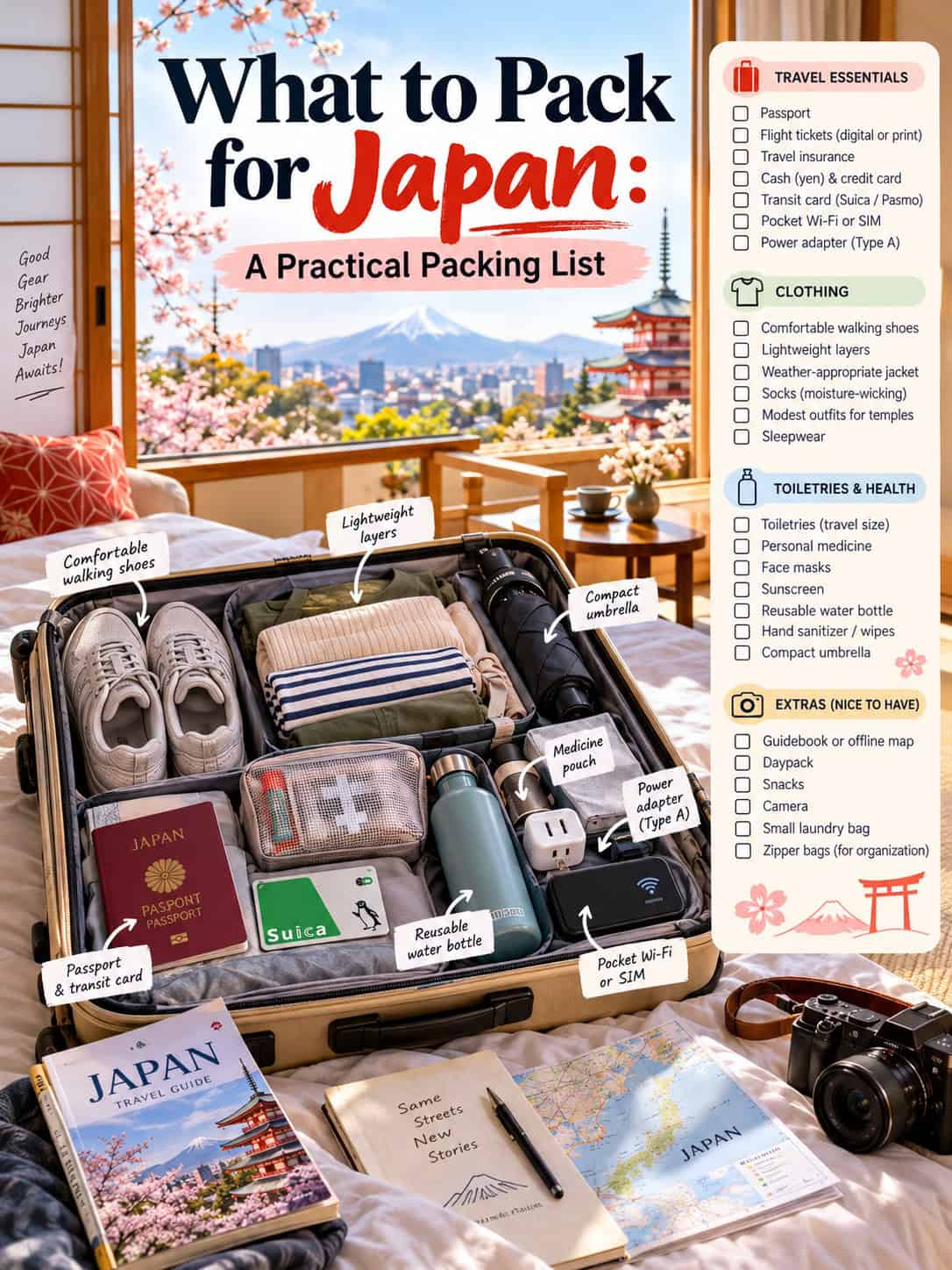
Use this Japan packing list to prepare for Tokyo, Kyoto, Osaka, Hokkaido or Okinawa. Start with comfortable walking shoes, weather-appropriate layers, a compatible travel adapter, medications and travel documents (see our Japan visa guide for entry rules). Then check Japan’s baggage, power-bank, food-import and medication rules before departure. The exact clothing you need depends more on the region and season than the country alone.
Japan Packing List: Quick Answer
| Question | Answer |
|---|---|
| Do I need a travel adapter? | Japan mainly uses Type A sockets and 100V power. US and Canadian two-flat-pin plugs usually fit, but grounded three-pin plugs may need an adapter; other countries generally need an adapter. |
| Best footwear | Comfortable walking shoes plus slip-on shoes or sandals — you’ll remove shoes often at temples, ryokan, and some restaurants |
| Should I pack toiletries? | Pack only what you need for day one; hotels provide basics and convenience stores sell everything else |
| What’s genuinely hard to find in Japan? | Strong deodorant/antiperspirant and plus-size Western clothing and shoe sizes |
| How should I pack my suitcase? | Light and compact — hotel rooms are small, and coin laundry is widely available |
Japan Packing List: Essentials Checklist
- Passport, entry documents, flight and accommodation confirmations
- Travel insurance details and copies of important documents
- Payment card, some Japanese yen and a backup payment method
- Smartphone, charger, charging cable and compatible plug adapter
- eSIM or SIM plan and offline maps
- Power bank in cabin baggage, subject to airline restrictions
- Comfortable walking shoes, socks and easy-to-remove footwear
- Seasonal clothes, rain protection and a lightweight day bag
- Prescription medicines in original packaging and necessary permits
- Hand towel, tissues, sunscreen and personal toiletries
- Reusable water bottle and foldable shopping bag
- Glasses, contact lenses and specialist items in your usual size
Keep medicines, valuables, batteries and documents in cabin baggage where airline rules permit. Photograph your passport identification page and store a secure offline copy.
Japan Travel Adapter and Electronics
Japan uses 100V electricity and predominantly Type A sockets with two flat pins. Type B grounded sockets also exist, but travellers should not assume every room offers one. Most US and Canadian two-pin chargers fit; grounded three-pin plugs may need an adapter. UK, European and Australian plug shapes generally need an adapter. Always check your device label for voltage compatibility. If a device label says INPUT 100–240V, 50/60Hz, a plug adapter normally suffices. A device rated only for 220–240V is not designed to work directly on Japan’s 100V supply, and a suitable voltage transformer may be necessary, but high-wattage heated devices such as hair dryers can be impractical or unsafe with ordinary travel converters.
One Japan-specific quirk: the power grid runs at 50Hz in eastern Japan (including Tokyo) and 60Hz in western Japan (including Osaka and Kyoto). This almost never matters for phone chargers, laptop chargers, or camera batteries, which handle either frequency automatically — it’s really only relevant for certain older or frequency-sensitive appliances, which you’re unlikely to be traveling with.
Beyond the adapter, pack your usual chargers and cables, a portable power bank (useful for long days of sightseeing and navigation), and headphones. For connectivity, you’ll want an eSIM, physical SIM, or pocket WiFi; our guide to Japan SIM cards and eSIMs compares the options. A Suica or Pasmo IC card — physical or, for iPhone users, the Welcome Suica Mobile app — handles trains, buses, and small purchases without needing cash each time.
Japan Travel Adapter Plug: Voltage and Socket Guide
| Feature | Japan standard | What to pack |
|---|---|---|
| Voltage | 100V | Check appliance input rating |
| Frequency | 50Hz eastern regions; 60Hz western regions | Check frequency-sensitive devices |
| Common socket | Type A, two flat pins | Type A adapter for non-compatible plugs |
| Grounded socket | Type B at some locations | Do not rely on universal availability |
| Modern phone/laptop chargers | Often rated 100–240V | Check label; usually adapter only |
| Hair dryers / heated tools | May draw high wattage | Use dual-voltage models or a hotel appliance |
Japan Travel Essentials: Power Banks on Flights
Keep lithium power banks in carry-on baggage, not checked luggage. On JAL and ANA flights, power banks rated over 100Wh and up to 160Wh are limited to two per passenger, anything above 160Wh is not allowed on board, and you can neither recharge a power bank nor use it to charge your phone during the flight; keep it within reach at your seat rather than in the overhead bin. A typical 20,000mAh bank with 3.7V nominal battery voltage holds about 74Wh, so check the printed Wh rating rather than relying only on mAh. Rules vary by airline, so confirm your carrier’s latest battery policy before departure.
Compare Japan eSIM data plans before landing.
What to Wear in Japan: Clothing by Season
Japan’s seasons are distinct and the right packing list changes significantly depending on when you visit.
Spring (March-May): Light layers and a packable rain jacket cover most of the season, with typical temperatures around 10-22°C. If cherry blossom viewing (hanami) is on your itinerary, a compact picnic mat is worth packing for sitting under the trees.
Rainy season (June-July): A compact, sturdy umbrella is close to essential during tsuyu, Japan’s rainy season — though decent umbrellas are also cheap and widely sold at any convenience store if you’d rather buy one there than pack one.
Summer (June-August): Lightweight, breathable clothing and comfortable sandals are the priority — August in cities can exceed 35°C with high humidity. A portable handheld fan (sold everywhere in Japan during summer) and sunscreen are worth having, though both are genuinely cheaper to buy locally than to pack. Typhoon season peaks around August-September, so a rain jacket or poncho is a reasonable backup even outside the main rainy season.
Autumn (September-November): Layering is the key strategy, since September can still be warm while November evenings turn cold. A mid-weight jacket covers most of the season comfortably.
Winter (December-February): Tokyo and central Japan run around 5-10°C, which calls for a proper winter coat, thermal base layers, and a warm hat and gloves. If your trip includes Hokkaido or ski resorts, pack serious cold-weather gear — temperatures there drop well beyond what’s comfortable in a city-weight coat.
Japan Packing List by Season and Region
| Season | Tokyo / Kyoto / Osaka | Different regional needs |
|---|---|---|
| Spring (Mar–May) | Layers, light sweater, rain jacket and comfortable shoes | Hokkaido and mountains stay colder; cherry-blossom evenings can be chilly |
| Summer (Jun–Aug) | Breathable clothes, sunscreen, hat, quick-dry layers and water bottle | Okinawa needs sun and beach protection; mountains require extra insulation |
| Autumn (Sep–Nov) | Layers and light-to-medium jacket; September can remain hot | Hokkaido foliage season arrives earlier; mountain nights cool quickly |
| Winter (Dec–Feb) | Coat, warm base layers, gloves and weatherproof footwear | Hokkaido and ski areas need insulated waterproof boots and winter gear; Okinawa is milder |
Japan spans subtropical islands, densely populated lowlands and snowy alpine regions. Check the forecast for every destination rather than using Tokyo temperatures for Hokkaido, Mount Fuji or Okinawa.
Average Temperatures in Sapporo, Tokyo and Naha
| Month | Sapporo (Hokkaido): high / low | Tokyo: high / low | Naha (Okinawa): high / low |
|---|---|---|---|
| January | -0.4°C / -6.4°C | 9.8°C / 1.2°C | 19.8°C / 14.9°C |
| April | 11.7°C / 3.4°C | 19.4°C / 9.8°C | 24.3°C / 19.1°C |
| August | 26.4°C / 19.1°C | 31.3°C / 23.5°C | 31.8°C / 26.8°C |
| October | 16.4°C / 8.0°C | 22.0°C / 14.8°C | 28.1°C / 23.5°C |
These are 30-year averages of daily highs and lows, and they show why a January trip that combines Tokyo and Sapporo needs two kinds of clothing: Tokyo afternoons near 10°C call for a city coat, while Sapporo stays below freezing even in the afternoon and needs thermal layers and snow boots. In Okinawa, a light jacket covers winter evenings, and even October feels like summer.
Japan Packing List Summer: Heat and Rain
Bring a breathable top for each day between laundry stops, a compact umbrella or rain shell, sunscreen, sunglasses, a hat and electrolyte or hydration supplies. Tokyo and Kyoto summers can be humid, so plan lightweight spare clothes. Some coastal regions experience typhoons in late summer and autumn.
Japan Packing List Winter: Snow and City Travel
Pack moisture-wicking base layers, a warm mid-layer and a wind-resistant coat. For Hokkaido, Nagano and ski areas, add insulated waterproof boots, traction suitable for snow, a warm hat and gloves. Tokyo or Kyoto winter visitors may not need heavy snow boots unless their itinerary includes snowy regions.
Footwear
Comfortable walking shoes matter more in Japan than almost anywhere else you might travel — expect to cover significant distances on foot and in train stations daily. Beyond your main walking shoes, pack slip-on shoes or sandals that are easy to remove: temples, traditional restaurants, ryokan, and some private homes all expect shoes off at the entrance, and fumbling with laces repeatedly throughout the day gets old fast. For winter travel, waterproof boots are worth it, and if you’re heading to snowy regions, slip-on traction grips for your shoe soles make icy sidewalks far less treacherous.
Toiletries and Medications
Pack light on toiletries. Most hotels provide basic shampoo, conditioner, and body wash, and convenience stores and drugstores sell travel-size versions of nearly everything else, so there’s little reason to haul full-size bottles. One genuine exception: strong deodorant or antiperspirant can be harder to find in Japan, where the local selection tends to skew milder than what many Western travelers are used to — if you have a brand you rely on, it’s worth packing your own supply rather than hoping to find an equivalent locally.
Japan generally permits up to one month’s supply of eligible prescription medicines for personal use without an Import Confirmation certificate, and up to two months of eligible non-prescription medicines. Larger quantities and some injectables require separate procedures. Narcotics, stimulant raw materials and certain ADHD medicines follow special rules; some substances are prohibited regardless of the prescription. Check each active ingredient with Japan’s Ministry of Health, Labour and Welfare before travel. A prescription or doctor’s letter does not replace a mandatory permit. Our Japan safety guide covers the rules in more detail.
A small cultural note worth packing around: many public restrooms in Japan don’t provide paper towels, and not everyone wants to rely on the electric air dryer. Locals commonly carry a small hand towel in their bag for exactly this reason — a compact one from home works fine, or you can pick one up cheaply almost anywhere once you arrive.
What to Pack for Japan: Medicine Import Rules
| Product | General personal-import amount without Import Confirmation |
|---|---|
| Eligible prescription medicine | Up to one month’s supply |
| Eligible over-the-counter medicine | Up to two months’ supply |
| External-use medicines | Up to 24 of each item, subject to classification |
| Approved prefilled self-injection kits | Up to one month’s supply, subject to conditions |
| Controlled substances and selected ADHD medicines | Different rules; advance permission or prohibition may apply |
Check the actual active ingredient, not just the brand. Some controlled narcotics and stimulant raw materials require separate government permission even for short trips, and certain drugs cannot be imported. For larger eligible medicine quantities, request a Yunyu Kakunin-sho before travelling. Preserve original packaging and the prescribing details.
What Not to Pack for Japan: Food and Agriculture Restrictions
Japan generally prohibits bringing most fresh fruits, vegetables, meat, ham, sausages, jerky and meat-containing meals in passenger baggage without the required quarantine documentation. Cooking, vacuum sealing or buying an item at an overseas duty-free shop does not automatically make it admissible. Breaking these rules can bring up to three years in prison or a fine of up to ¥3 million, so finish or throw away meat snacks and fruit before you land. If you have visited a farm or touched livestock shortly before the trip, stop at the Animal Quarantine counter on arrival to have your shoes and clothes disinfected. Certain specially processed foods have narrow exceptions, so do not assume an exception applies to a personal snack. Soil and many plants or seeds are restricted too. Buy food after clearing Japanese arrival inspections instead.
Practical Extras
Bring a reusable or foldable shopping bag — convenience stores and many retailers charge a small fee for plastic bags, and having your own avoids the daily nickel-and-diming; see our guide to money in Japan for cash and cards. Tap water is safe to drink throughout Japan, so a reusable water bottle is genuinely useful rather than buying bottled water constantly. If you tend to run larger than standard sizing, it’s worth knowing that plus-size Western clothing and larger shoe sizes can be genuinely difficult to find in Japanese stores, so packing what you need rather than planning to shop there is the safer approach.
Japan Travel Essentials: Daypack and Arrival Checklist
| Situation | Carry with you |
|---|---|
| Airport arrival | Passport, entry documents, hotel address, phone and payment cards |
| Train sightseeing day | Water, hand towel, charging cable, power bank and tissues |
| Temple and ryokan visits | Clean socks and easy-to-remove shoes |
| Rainy day | Compact umbrella, quick-dry layer and waterproof phone pouch |
| Winter city trip | Gloves, hat and warm layer for outdoor queues |
| Mountain excursion | Appropriate technical layers, footwear and route-specific gear |
A small daypack helps on trains and in compact cafés. Avoid packing oversized luggage for short urban excursions; use hotel storage where permitted.
Luggage Strategy
Hotel rooms in Japan, especially in city centers, tend to be compact, which makes a top-opening suitcase more practical than a clamshell-style bag that needs floor space to open flat. Pack lighter than you think you need to — coin laundry is widely available at hotels and standalone laundromats, so there’s rarely a need to bring enough clothing for an entire multi-week trip.
If your itinerary involves moving between multiple cities, consider Takkyubin, a luggage-delivery service run by Yamato Transport, useful between hotels. You drop your bags at a hotel reception, convenience store or service center and fill out a shipping form. The price depends on parcel size, weight, route and service type, and delivery times vary, so ask the hotel whether it accepts forwarded luggage and carry one day of necessities separately. On the Tokaido, Sanyo and Kyushu Shinkansen, luggage measuring 161–250 cm in total height + width + depth requires a reserved oversized-baggage space. There is no extra charge when the appropriate space is reserved with the ticket, but taking oversized luggage without one can trigger a ¥1,000 fee. Bags larger than 250 cm total are not permitted under the standard policy. The same reservation rule covers the Nishi-Kyushu Shinkansen to Nagasaki, and you can book the space at a JR ticket office, a reserved-seat ticket machine or online for the price of a regular reserved seat. Separately, each passenger may bring two pieces of luggage free of charge, each up to 30 kg, 250 cm in total dimensions and 200 cm in length.
Japan Packing List: Shinkansen Luggage Size Rules
| Sum of height, width and depth | Typical Tokaido / Sanyo / Kyushu Shinkansen rule |
|---|---|
| 160 cm or less | No oversized-baggage reservation generally required |
| 161–250 cm | Reserve an eligible seat or designated oversized luggage space in advance |
| Over 250 cm | Not accepted as ordinary carry-on baggage |
| 161–250 cm without required reservation | ¥1,000 baggage fee may be charged |
Measure external dimensions including protruding handles or wheels as the operator instructs. A reservation for an eligible oversized-baggage space has no additional charge beyond the associated reserved-seat ticket. Strollers, instruments and sports equipment have separate handling rules, and other Shinkansen lines can have different policies.
Compare Shinkansen routes and reserved train tickets.
Japan Packing List: Frequently Asked Questions
Do I need a voltage converter for Japan, or just a plug adapter?
For chargers marked 100–240V, a suitable plug adapter is usually enough. Japan uses 100V Type A sockets, and some Type B sockets exist. Three-pin grounded chargers may need an adapter even if they come from North America; high-wattage appliances need a separate voltage and power-rating check.
What specific items are hard to find in Japan and worth packing?
Strong deodorant or antiperspirant, plus-size Western clothing, and larger shoe sizes are the most commonly cited genuine gaps. Nearly everything else — toiletries, umbrellas, basic medication, phone chargers — is easy to buy locally.
Should I bring slip-on shoes for Japan?
Yes, it’s genuinely useful. You’ll remove your shoes at temples, ryokan, traditional restaurants, and some private spaces, and slip-on shoes or sandals save real time and hassle compared to shoes with laces.
How much luggage should I bring for a trip to Japan?
Pack light and plan to use hotel laundry where available. Hotel rooms are often compact and coin laundry is widely available. Courier luggage forwarding helps with multi-city travel but has size-based fees, booking cutoffs and variable delivery dates, so carry essentials for at least one night if shipping a suitcase ahead.
Do I need to pack an umbrella for Japan?
It’s useful during the rainy season (June-July) and typhoon season (August-September), but not essential to pack — decent umbrellas are cheap and sold everywhere, including convenience stores, so many travelers simply buy one on arrival if needed.
What should I pack for winter travel in Japan versus summer?
Winter calls for a proper coat, thermal layers, and a hat and gloves, with serious cold-weather gear if you’re visiting Hokkaido or ski resorts. Summer is the opposite — lightweight breathable clothing and sandals, since city temperatures can exceed 35°C with high humidity in August.
Can I buy toiletries and basic medication in Japan instead of packing them?
Yes, for almost everything. Convenience stores and drugstores carry travel-size toiletries, sunscreen, and common over-the-counter medication. Prescription medication is the exception — bring what you need along with your prescriptions, since availability and rules differ from your home country.
What’s the Takkyubin luggage forwarding service and is it worth using?
Takkyubin is a luggage-delivery service useful between hotels. The price depends on dimensions, weight, route and service type, and delivery times vary. Ask the hotel whether it accepts forwarded luggage and carry one day of necessities separately.
What are the absolute essentials on a Japan packing list?
Passport, eligible entry documents, payment cards, suitable shoes, weather layers, compatible charging equipment, approved medicine and internet access.
Do American travellers need a Japan plug adapter?
Most US two-pin Type A chargers fit. Three-pin grounded plugs may need an adapter, and all travellers must check the device’s voltage rating.
Does Japan use 110V or 220V electricity?
Japan uses 100V, with 50Hz in eastern areas and 60Hz in western areas. Modern 100–240V chargers commonly work with the correct plug.
What should I pack for Japan in spring?
Walking shoes, layered clothing, a light sweater, rain protection and an outer layer for cool evenings. Northern regions may need warmer gear.
Can I bring prescription medicine into Japan?
Many eligible prescriptions are permitted up to one month’s supply without Import Confirmation, but controlled or prohibited substances require separate review. Check ingredients before departure.
Can I bring beef jerky or fresh fruit into Japan?
Most meat products and fresh fruit are prohibited without quarantine requirements being satisfied, even when vacuum packed or purchased at an airport.
Can I bring a power bank into Japan by plane?
Usually yes in carry-on baggage, subject to airline capacity and quantity rules. Do not put loose lithium power banks in checked luggage.
What size suitcase needs a Shinkansen reservation?
On the Tokaido, Sanyo and Kyushu lines, a bag totalling 161–250 cm across three dimensions needs a designated oversized baggage space or eligible reservation.
Should I pack enough outfits for two weeks in Japan?
Usually not. Pack enough outfits for your planned laundry interval, then use hotel or local laundry where available.
Bottom Line
Use this Japan packing list to pack for your actual month and region. Bring walking shoes, layers, chargers, an appropriate Type A adapter, approved medicines and essential documents. Check airline battery rules, Japan’s food and medicine import restrictions and Shinkansen luggage dimensions before departure. Most basic toiletries, umbrellas and everyday supplies can be purchased locally. For season-by-season weather, see our best time to visit Japan guide.