By Nippon With Me EditorialPublished Updated
Mount Fuji dominates the horizon across much of central Japan, and most visitors experience it in one of two very different ways: a demanding overnight climb to the 3,776-metre summit, or a day trip built around finding the mountain’s best angle from a lake, a pagoda or a cable car. This Mount Fuji hiking guide explains the four summit trails, the confirmed 2026 access rules and the best Mount Fuji viewpoints. The 2026 climbing season ended on September 10, and official rules and booking dates for summer 2027 have not yet been announced. Visitors can still explore lower-elevation sights where local access permits.
Mount Fuji at a Glance
| Category | Details |
|---|---|
| Best for | Climbing Japan’s highest peak, or viewing it from the Fuji Five Lakes, Hakone, or a pagoda overlook |
| Climbing season | Officially July 1 to September 10, 2026 (Yoshida and Subashiri from July 1; Fujinomiya and Gotemba from July 10) |
| Ideal trip length | 1-2 days for viewing only; 1-2 days for a climb, including a night in a mountain hut |
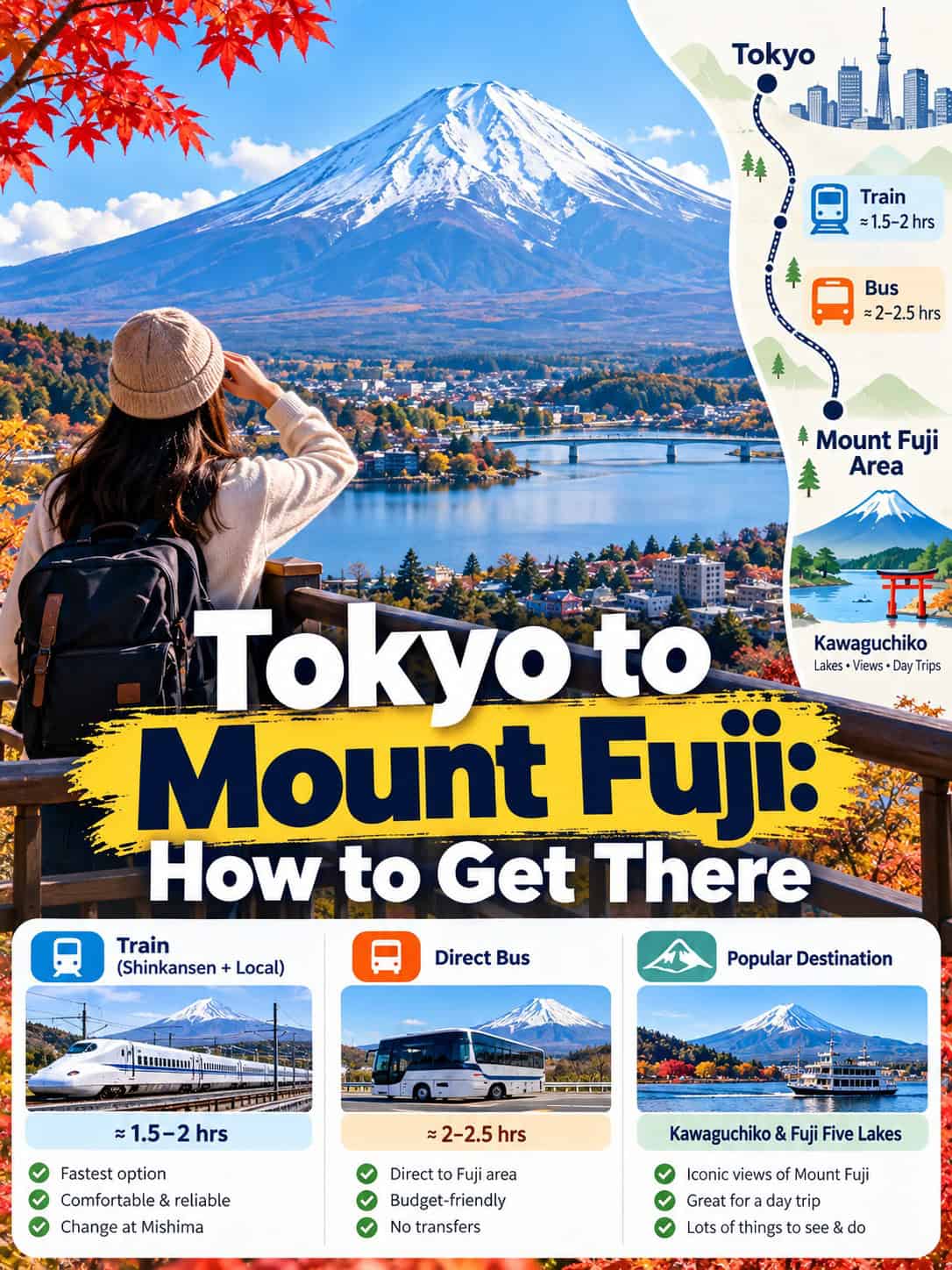
| Getting there | From Shinjuku: highway bus to Kawaguchiko, about 1 hour 45 minutes in light traffic; direct bus to the Yoshida 5th station runs only in climbing season |
| Climbing fee (2026) | ¥4,000 per person on all four summit trails; Yoshida advance booking is optional, while Shizuoka requires registration or on-site procedures |
| Best time to view | Winter often offers clearer air, especially in the morning; clouds and snow cover vary with actual weather |
| Currency | Japanese yen (¥) |
Mount Fuji Hiking: Season Rules and Next-Season Status
| Route | Confirmed 2026 season | Fee | Admission procedure |
|---|---|---|---|
| Yoshida | July 1–September 10 | ¥4,000 | Online reservation optional; gate admission subject to 4,000/day cap |
| Subashiri | July 1–September 10 | ¥4,000 | FUJI NAVI registration or on-site processing |
| Fujinomiya | July 10–September 10 | ¥4,000 | FUJI NAVI registration or on-site processing |
| Gotemba | July 10–September 10 | ¥4,000 | FUJI NAVI registration or on-site processing |
The 2026 summit climbing season is over, and official authorities have not yet announced the 2027 schedule or pricing. All four routes restricted entry without a mountain hut reservation between 2 PM and 3 AM during the 2026 season. Shizuoka required safety training and confirmation, while Yoshida imposed the 4,000-person cap. Outside the season the summit trails above the 5th stations are closed, and entering them is punishable by up to six months’ imprisonment or a fine of up to ¥300,000.
What the Mountain Is Like After the Season Ends
Once the huts close, the first-aid centers, toilets and huts are shut and cannot serve as shelter, and the signs, maps and guide ropes are taken down. Temperatures stay below freezing for most of the closed period and fall below -10°C from November to April, with average winds above 15 m/s and gusts that can exceed 40 m/s. Mobile reception is almost nonexistent once the temporary base stations are removed, and severe weather can make a rescue impossible. Between seasons, the viewing spots in this guide are the plan.
Mount Fuji’s Key Areas: Where to Go
The Fuji Five Lakes (Kawaguchiko and Around)
Lake Kawaguchiko is a major base for viewing Fuji, with hotels, ryokan, the panoramic ropeway and onward buses. The Fuji Subaru Line 5th Station serves the Yoshida climbing route, but simply staying by the lake does not put you at the trailhead.
Gotemba and the Shizuoka Side
The Shizuoka side has three distinct summit routes: Subashiri, Gotemba and Fujinomiya. Their approaches, ascent times, huts and transport differ, so choose the trailhead first rather than treating them as a single Gotemba route.
Hakone
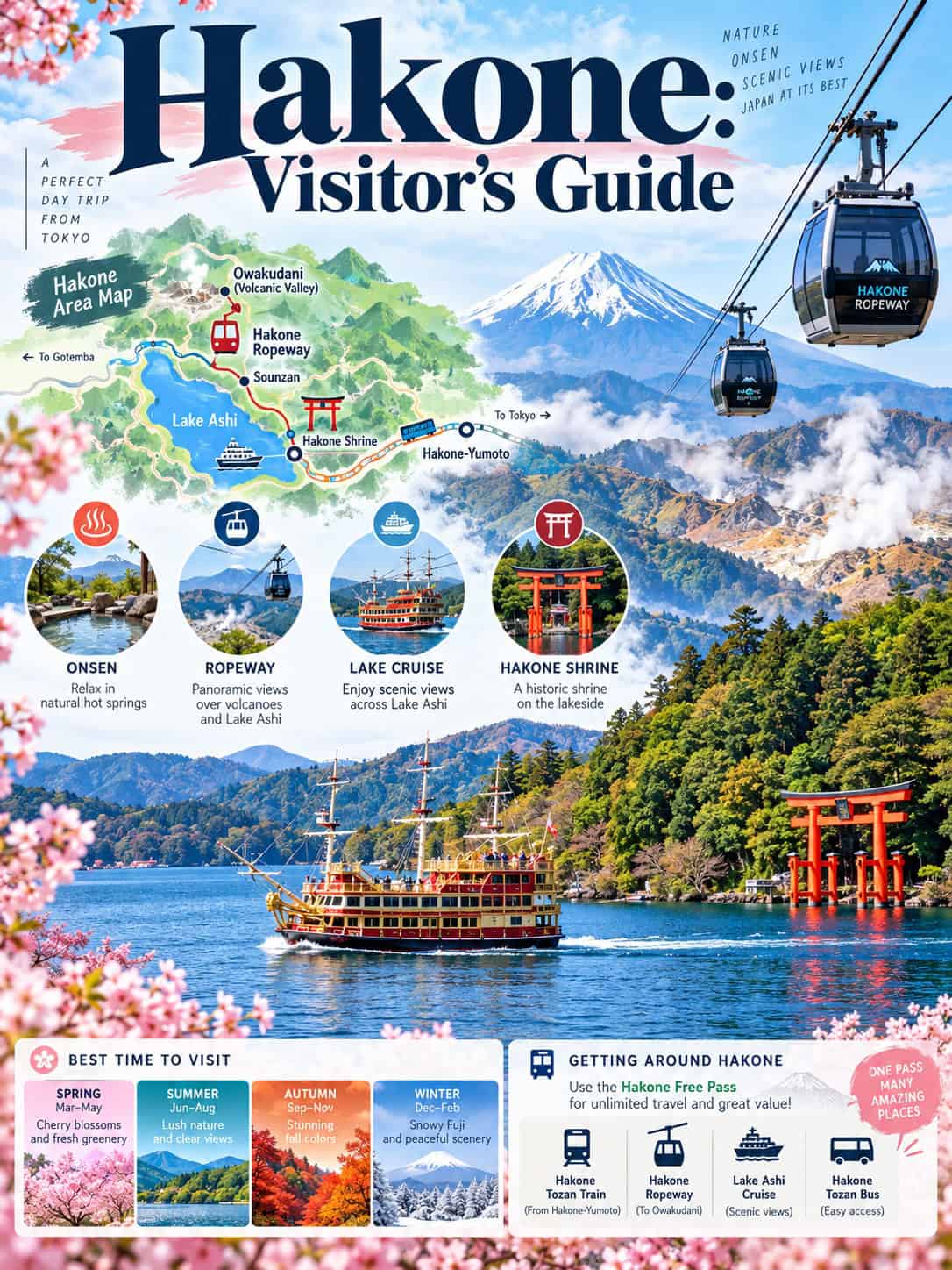
Technically a separate destination southeast of Fuji, but close enough that Lake Ashi’s shoreline is one of the most photographed Fuji viewpoints in the country, especially combined with Hakone Shrine’s lakeside torii gate. Our Hakone visitor guide is a natural pairing.
Top Things to Do Around Mount Fuji
Climbing the Yoshida Trail
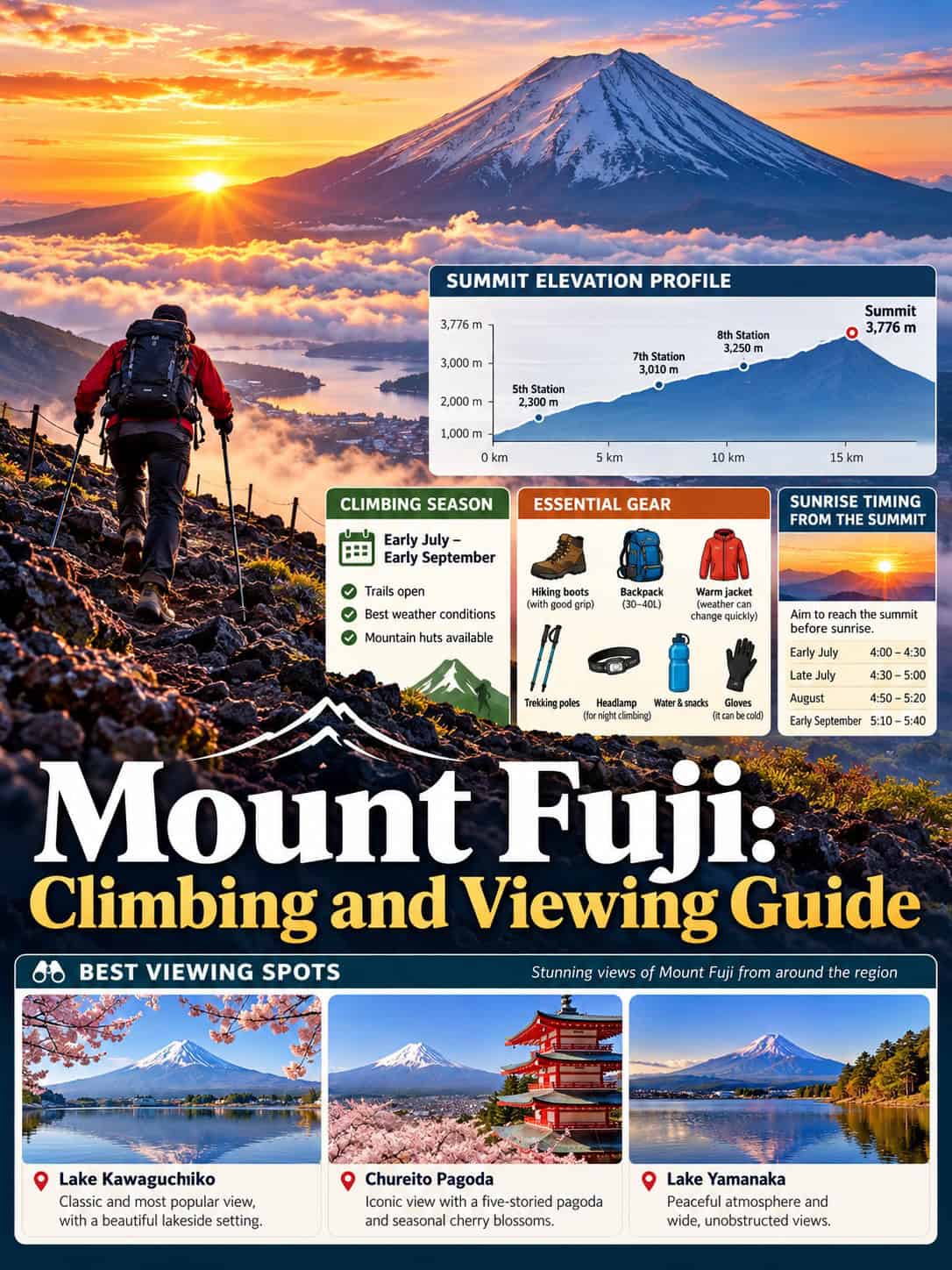
The Yoshida Trail starts at Fuji Subaru Line 5th Station, around 2,300 metres. Fujiyoshida City estimates 6 hours 40 minutes up and 3 hours 30 minutes down, excluding stops. Huts and an established descent route make this the most commonly chosen first summit climb, but altitude, fatigue and weather still demand preparation.
Chureito Pagoda
Chureito Pagoda stands within Arakurayama Sengen Park above Fujiyoshida. Visitors climb approximately 398 steps from near the shrine to the viewpoint, so allow time and suitable shoes. Ordinary park entry is free, although cherry blossom festivals may introduce visitor-management measures. Mornings often give clearer mountain views, but no hour guarantees visibility.
Oshino Hakkai
Oshino Hakkai has eight spring-fed ponds associated with Mount Fuji. Public paths around the village are accessible without a general admission ticket, while the privately managed museum area containing Sokonashi-ike may charge an additional fee, so verify it at the attraction.
Lake Kawaguchiko and the Panoramic Ropeway
Lake Kawaguchiko’s northern and northeastern shores offer well-known Fuji views in clear weather. The Mt. Fuji Panoramic Ropeway runs up Mt. Tenjo for elevated views over the lake. Its fare and operating hours may change, so confirm the current price and maintenance schedule before you go.
Hakone’s Lake Ashi
From Moto-Hakone on the lake’s southern shore, Mount Fuji lines up with Hakone Shrine’s red torii gate and the surrounding mountains on clear days — one of the most photographed combinations in the region, also visible from the lake’s sightseeing cruise boats.
Fuji-Q Highland
An amusement park in Fujiyoshida with some of Japan’s most intense roller coasters, set with Mount Fuji as a backdrop — a change of pace for travelers combining a theme park day with mountain views rather than spending the whole trip outdoors.
Best Views of Mount Fuji: Where to Go Without Climbing
| Viewpoint | What you see | Practical detail |
|---|---|---|
| Chureito Pagoda | Pagoda with Fuji backdrop | Approximately 398 steps; morning often clearer |
| Lake Kawaguchiko north shore | Mountain above the lake | Free public shore viewpoints; reflections need calm weather |
| Oshino Hakkai | Spring ponds and Mount Fuji | Public area generally free; museum area separate fee |
| Mt. Fuji Panoramic Ropeway | Elevated lake and mountain view | Ticket and maintenance hours vary |
| Lake Ashi, Hakone | Fuji across the lake when clear | Often better as a separate Hakone excursion |
| Fuji Subaru 5th Station | High-altitude slopes and regional view | Road and bus access can differ from summit-trail opening |
Plan a clear-morning viewpoint first and leave indoor museums, shopping or onsen for cloudier afternoon hours. These places are spread across separate transport routes, so a private guided outing may reduce transfers. For a hot-spring stay, see onsen hotels near Hakone and Mount Fuji.
If Clouds Hide the Mountain
Fuji can stay hidden for a whole day. Four indoor stops keep the day useful. The Yamanashi Mt. Fuji World Heritage Center in Fujikawaguchiko is free, and its north building is open all year (the south building is closed on the fourth Tuesday). The Fujisan Museum in Fujiyoshida charges ¥400 for adults and ¥200 for students. The Mt. Fuji Radar Dome Museum in Fujiyoshida, on the history of weather observation at the summit, charges ¥610 for adults and ¥410 for students. On the Shizuoka side, the Shizuoka Mt. Fuji World Heritage Center in Fujinomiya charges ¥300 for adults and includes a simulated climb.
Climbing Mount Fuji: Trails, Fees and Reservations
Four official summit trails operated in the 2026 season. All charged ¥4,000 per person. Entry between 2 PM and 3 AM required a confirmed mountain hut reservation, and trail rules differed by prefecture. The 2026 season has ended, and 2027 access dates and fees have not been announced.
Yoshida Trail (Yamanashi; Fuji Subaru Line 5th Station around 2,300 m): open July 1–September 10 in 2026. Official hiking estimate: 6h40 up and 3h30 down, excluding rests. A 4,000-climber daily admission cap applied and the 5th Station gate closed 2 PM–3 AM to climbers without hut reservations. Hut guests still paid the ¥4,000 entrance fee.
Subashiri Trail (Shizuoka; Subashiri 5th Station around 2,000 m): open July 1–September 10 in 2026. There was no prefectural daily cap. Authorities encouraged registration in FUJI NAVI, including e-learning and an entry permit; visitors without a smartphone could complete on-site procedures. All summit climbers paid the ¥4,000 fee.
Fujinomiya Trail (Shizuoka; high-altitude trailhead near 2,400 m): open July 10–September 10 in 2026. This is the shortest of the four routes by distance but includes steep, rocky ascent and descent on a shared route. The ¥4,000 fee, learning and entry procedures and the 2 PM–3 AM hut-booking restriction applied.
Gotemba Trail (Shizuoka; starting around 1,400 m): open July 10–September 10 in 2026. This longest route has fewer facilities and a demanding vertical ascent. It suits well-prepared hikers who have sufficient daylight, layers, water and verified return transport. The same Shizuoka entrance and registration rules applied.
In 2026, Yoshida climbers could reserve and pay the ¥4,000 fee online or complete admission at the 5th Station when space remained. For Shizuoka trails, FUJI NAVI supported pre-learning, registration, QR permits and payment; official information also permitted on-site procedures without a smartphone and payment on site. A hut reservation was a separate booking, not an included part of the entrance fee. Yoshida online reservations became subject to cancellation fees from two days after payment, and cancellations for personal reasons, including delayed public transport, were not refunded. Climbers without verified hut bookings could not enter the summit routes between 2 PM and 3 AM, and all routes could restrict inadequately equipped hikers. Carry waterproof layers, proper footwear and cold-weather clothing; mountain weather can turn severe even in summer.
Mount Fuji Climbing Guide: Which Trail Should You Choose?
| Trail | Starting elevation | Climbing character | Best suited to |
|---|---|---|---|
| Yoshida | About 2,300 m | Most facilities, separate descent path; official 6h40 up and 3h30 down, excluding stops | First-time climbers with adequate fitness |
| Subashiri | About 2,000 m | Forest lower down; joins Yoshida near upper mountain | Hikers who want a different ascent approach |
| Fujinomiya | About 2,400 m | Shortest distance but steep, rocky and shared ascent/descent | Fit hikers comfortable with steep terrain |
| Gotemba | About 1,400 m | Longest climb with fewer huts and significant vertical gain | Experienced, well-prepared hikers |
Travel time, altitude gain and mountain hut availability differ across routes. Wind, rain, crowds, stops and altitude can make actual hiking durations much longer.
Mount Fuji Trails Compared: Distance, Terrain and Facilities
| Trail | 5th Station elevation | Distance up / down | Terrain and facilities | Private cars in season |
|---|---|---|---|---|
| Yoshida | 2,305 m | 6.8 km / 7.0 km | Separate ascent and descent paths; the most huts of the four; first-aid centers at the 5th, 7th and 8th stations; the descent is a gentle zigzag gravel track that raises dust | Fuji Subaru Line restricted in peak weeks |
| Subashiri | 2,000 m | 6.9 km / 6.2 km | Forest at the start, then volcanic gravel; merges with Yoshida at the Original 8th station, which gets very crowded; the sandy descent drops about 700 m, so gaiters, a mask and sunglasses help; first-aid center at the 5th Station | Restricted in peak weeks |
| Fujinomiya | 2,400 m | 4.3 km / 4.3 km | Shortest route, about 1,320 m of climbing, steep, with falling-rock risk above the 7th station; up and down share one path and uphill climbers have priority; first-aid center at the 8th station | Restricted in peak weeks |
| Gotemba | 1,440 m (New 5th Station) | 10.5 km / 8.4 km | Longest route, about 2,300 m of climbing to the summit; few huts and no first-aid center; the descent includes a sandy slope of roughly 5 km where speed is hard to control | No restriction |
How to Climb Mount Fuji: Entry Checklist
- Choose an officially open trail and read its prefecture’s current rules.
- Reserve a hut separately if planning a two-day climb.
- Complete any registration and safety-learning requirements.
- Pay the climbing fee and save your entry confirmation offline.
- Check the summit forecast and volcanic activity notices.
- Bring layers, waterproofs, headlamp, gloves, trekking shoes, cash, water and food.
- Know your turnaround time and last descent bus.
On the Shizuoka routes in 2026, FUJI NAVI included an e-learning module and a test, and authorities provided an on-site option for climbers without smartphones. On-site registration at the 5th Station took about 30 minutes, with queues possible in peak season, so it ate into the time before the 2 PM cutoff. Online permits could be cancelled or changed free of charge until the day before entry, but not on the entry day itself.
Mountain Huts and Planning an Overnight Climb
Many hikers choose a two-day trip with a reserved mountain hut. Huts provide basic sleeping arrangements and may offer meals, but services and cancellation policies differ. Book the hut separately from trail entry, allow time to adjust to altitude and check sunrise timing and the last return bus. The summit sunrise is never guaranteed by weather. Yamanashi Prefecture asks climbers not to attempt a non-stop overnight climb without a hut stay (a “bullet climb”), and without a hut reservation the Yoshida gate stays closed from 2 PM to 3 AM anyway.
A hut reservation cannot be made without prior payment, and prices and booking timing differ by hut, so each hut has to be contacted directly. Each hut also sets its own check-in time; even with a booking, the council asks overnight guests to pass the 5th Station gate before 2 PM for safety. Climbing and shuttle buses do not run late at night, so working backward from the last bus is part of the plan. Crowds peak from late July to late August, especially on weekends and public holidays, and the council asks climbers to avoid weekends.
There is no official minimum age: most guided climbing tours accept children from fourth grade. The Yoshida entrance fee is a flat ¥4,000 for every age, including children.
Mount Fuji Hiking: Altitude, Health and Safety
At 3,776 metres, the summit can cause altitude sickness even in people who exercise regularly. Symptoms can include headache, nausea, dizziness and unusually strong fatigue. Do not ascend further if symptoms develop; descend if they worsen or do not improve. Severe breathlessness at rest, confusion or difficulty walking requires urgent help. Do not let a sunrise plan override a safety decision.
Mountain huts have limited space and may sell simple meals, water and toilet access. Carry cash and do not assume every hut accepts cards or has available beds. Some toilets on the upper Yoshida Trail ask for a tip, so keep coins handy. Check hut booking, cancellation terms, weather updates and the last bus before committing. Our guide to the best time to visit Japan compares the seasons.
What to Carry Above the 5th Station
The temperature falls about 0.6°C for every 100 m of climbing, and the summit can be close to 0°C before sunrise, so a long wait for the sun is where hypothermia starts. Plan the pack around cold, not around the heat at the trailhead.
- High-cut hiking boots with a stiff sole, and a pair of trekking poles
- Separate rain jacket and rain pants; huts sell only vinyl raincoats, and a mountaineering shop operates at the Fuji Subaru Line 5th Station
- Fleece, a down jacket, gloves and a neck warmer for the summit
- A headlamp with a spare battery and a pack of about 30 liters that leaves your hands free
- 1-2 liters of water and high-calorie snacks; extra water is sold at the huts, so there is no need to carry all of it from the start
- Garbage bags, because there are no trash cans on the trails or in the huts, and a portable toilet as a precaution
- A written climbing plan, and a mobile battery for the phone that holds your entry permit
- Gaiters, a dust mask and goggles for the sandy descents
Tents and campfires are not allowed, so every overnight stay means a hut. Left luggage is generally not available on the mountain, and uphill climbers always have priority on the trail.
Mount Fuji Climbing Cost: Minimum Known Expenses
| Item | 2026 amount |
|---|---|
| Summit trail entry | ¥4,000 per person |
| Kawaguchiko–Fuji Subaru 5th Station bus, one way | ¥2,000 |
| Same bus, return | ¥3,400 |
| Shinjuku–Fuji 5th Station highway bus, one way | ¥4,800 from July 1, 2026 |
| Hut, meals, water, toilets | Separate price; verify per provider and date |
A climber travelling from Kawaguchiko could expect a minimum of ¥7,400 in entry fee plus return bus fare before paying for a hut, equipment, food or local transfers. Confirm any changed 2027 rates when announced.
Where to Stay
Kawaguchiko has by far the widest choice of hotels and ryokan, many with direct lake or mountain views, and is the natural base for both viewing and for climbing the Yoshida Trail.
Gotemba or Fujinomiya suit travelers climbing one of the Shizuoka-side trails, cutting out the transfer across to the northern side.
Climbers tackling an overnight ascent should book a mountain hut directly rather than treating it as a hotel substitute — space is limited and reservations are essential in midsummer.
Getting to Mount Fuji
The Shinjuku–Kawaguchiko highway bus officially lists approximately 1 hour 45 minutes in light traffic and ¥2,200 one way. Congestion can extend the trip. Confirm the current route price and seat reservation before departure. Rail travellers can use JR to Otsuki and change to Fujikyu Railway for Kawaguchiko, and selected Fuji Excursion services run through from Shinjuku. Check the current total fare, limited-express surcharge and seat availability. A national JR Pass does not cover the private Fujikyu Railway portion between Otsuki and Kawaguchiko. The official Shinjuku–Fuji 5th Station highway fare was ¥4,800 for rides from July 1, 2026, with a reference duration of 2h35. Fujikyu Bus priced the Kawaguchiko–Fuji Subaru Line 5th Station route at ¥2,000 one way or ¥3,400 return in 2026, taking about 50–60 minutes. Some 5th Station sightseeing buses can operate outside the summit climbing season when roads are open; this does not mean the summit trail is open. During the peak weeks of the climbing season the Fuji Subaru Line has been closed to private cars, and drivers switch to a shuttle bus or taxi at Fujisan Parking in Fujiyoshida; the exact dates are set each year. Other access roads have their own seasonal restrictions.
Mount Fuji Hiking: Transport and Tickets from Tokyo
| Connection | 2026 published fare | Notes |
|---|---|---|
| Shinjuku → Kawaguchiko highway bus | ¥2,200 one way | Approx. 1h45 in favourable traffic |
| Shinjuku → Fuji Subaru Line 5th Station | ¥4,800 one way from July 1 | Approx. 2h35, check seasonal departures |
| Kawaguchiko → 5th Station | ¥2,000 one way | Return ¥3,400, valid for two days |
| JR + Fujikyu Railway | Fare depends on trains | Change at Otsuki unless using a through service |
Fujikyu Railway is a private railway. A national JR Pass does not cover the Otsuki–Kawaguchiko private section, and limited-express surcharges may apply. Some bus services to the 5th Station run after the climbing season if roads remain open, but summit trails remain closed.
Compare train connections to Mount Fuji or look at private transfer options.
Getting Around the Fuji Five Lakes Area
Local buses and trains serve Lake Kawaguchiko, Fujiyoshida, Oshino Hakkai and other Fuji Five Lakes attractions, but these places do not all lie on one single hourly bus route. Chureito Pagoda is near Shimoyoshida Station on Fujikyu Railway; a lake sightseeing bus may follow a different itinerary. Compare the actual lines and number of rides before buying a day pass.
Best Time to Visit Mount Fuji
The confirmed 2026 summit season ran July 1–September 10 on Yoshida and Subashiri, and July 10–September 10 on Fujinomiya and Gotemba. Official summit trails are now closed, and trail dates and rules for 2027 have not yet been announced. Lower-elevation transport and sightseeing sometimes remain open independently of summit access. For viewing, winter often brings clearer air, while summer humidity frequently hides the summit in cloud even on an otherwise sunny day at lake level. Spring brings cherry blossoms to frame the mountain at spots like Chureito Pagoda and Kawaguchiko’s northeastern shore; autumn brings red foliage with similarly variable visibility.
A Simple 2-Day Mount Fuji Starting Point
Day 1 (viewing): Leave Tokyo early for Fujiyoshida. Visit Chureito Pagoda first, continue to Oshino Hakkai, then go to Lake Kawaguchiko and the Panoramic Ropeway if visibility and opening hours permit. These sites require separate train or bus connections, so do not expect one direct sightseeing loop.
Day 2–3 (summit hike, in an officially open season only): Travel to the Yoshida 5th Station, climb at a comfortable pace to a reserved hut, rest overnight, then continue to the summit if weather and fitness allow and descend in time for return transport. The overnight climb needs its own schedule, separate from a full sightseeing day. Our guide on getting from Tokyo to Mount Fuji has the transport details.
Travelers visiting outside the climbing season simply repeat day 1’s pattern at a different lake or add Hakone’s Lake Ashi as a second viewing day instead of a summit attempt.
Mount Fuji Travel Guide: Two Different Itinerary Choices
Two-Day Fuji Viewing Itinerary (No Summit Hike)
Day 1: Travel from Shinjuku to Fujiyoshida. Visit Chureito Pagoda, Oshino Hakkai and the Kawaguchiko lakeshore, allowing transfer time between them.
Day 2: Check Fuji visibility early, ride the panoramic ropeway if open, or explore other lakes and hot springs. Return to Tokyo after an unhurried day.
Two-Day Summit Climb (Official Open Season Only)
Day 1: Travel to your chosen 5th Station, adjust to altitude, climb to a booked mountain hut and rest.
Day 2: Continue toward the summit if conditions permit, then descend with sufficient time for the final bus. Do not add a full day of sightseeing around several lakes to the same two-day climbing plan.
For offline directions, weather information and transport updates, compare Japan eSIM data plans. Download key route information in advance because mountain connectivity can fail.
Food Near Mount Fuji
Yoshida udon — thick, chewy noodles in a miso-and-soy broth topped with cabbage and horse meat — is Fujiyoshida’s signature dish. Houtou, a wide flat noodle simmered with vegetables in a miso-based soup, is the broader Yamanashi regional specialty and a common sight around Kawaguchiko. On the mountain itself, huts sell simple hot meals, instant noodles, and snacks at prices that climb with the altitude. For dishes across the country, see our Japanese food guide.
Practical Tips for First-Time Visitors
Book any mountain hut well ahead of a summer weekend climb, since huts on the busiest trail fill first, and check the current season’s Yoshida admission and Shizuoka registration rules. Altitude affects most climbers to some degree; pacing the ascent and spending a night at a hut rather than pushing straight through reduces the risk of altitude sickness. For viewing trips, Mount Fuji is famously shy, so do not build an entire day around a single viewpoint without a backup plan. Private cars cannot always reach the 5th stations in season, so budget time for the bus or shuttle connection. Our Japan packing list covers cold-weather layers, and our Kamakura day trip guide suggests another easy escape from Tokyo.
Prefer a guided day to piecing together trains and buses? The Mount Fuji & Hakone Day Tour from Tokyo can be booked in advance.
Frequently Asked Questions
Do I need a reservation to climb Mount Fuji?
The 2026 Yoshida system accepted optional advance reservations or on-site admission if capacity remained, with a ¥4,000 fee and a 4,000-person daily cap. Shizuoka offered FUJI NAVI QR registration and also on-site processing without a smartphone. The 2026 season ended September 10; check the rules again when 2027 information is announced.
How long does it take to climb Mount Fuji?
For the Yoshida Trail, Fujiyoshida City estimates 6 hours 40 minutes up and 3 hours 30 minutes down, excluding stops. Other routes differ, and weather, crowds and altitude can add hours. Splitting the climb across two days with a mountain hut stay is both safer and the standard approach.
Can I see Mount Fuji without climbing it?
Yes — Chureito Pagoda, Oshino Hakkai, Lake Kawaguchiko’s shoreline and ropeway, and Hakone’s Lake Ashi are all popular viewing spots reachable as day trips, with no climbing required.
When is the best time to see Mount Fuji clearly?
Winter (December to February) often offers clearer air and better odds of an unobstructed view, especially in the morning. Summer humidity frequently hides the summit behind haze or cloud even on clear-seeming days at lake level.
Is Mount Fuji open to climb year-round?
No. Climbing above the 5th stations is officially restricted to the climbing season. In 2026 that ran July 1–September 10 on Yoshida and Subashiri and July 10–September 10 on Fujinomiya and Gotemba. Huts, rescue posts and trail markers are removed outside this window.
Which Mount Fuji trail is best for a first-time climber?
The Yoshida Trail is the usual recommendation for first-timers because of its huts, support infrastructure and straightforward access from Tokyo, though it is also the most crowded of the four.
Can I drive to the Mount Fuji trailheads?
Private-car restrictions vary by route and season. In 2026, the Fuji Subaru Line, Fuji-Azami Line and Fuji Skyline had periods of restrictions that required shuttle or public transport, while the Gotemba 5th Station had different access conditions. Check the official road opening and restrictions for your date.
Is Mount Fuji open for hiking right now?
No. The 2026 summit climbing season ended September 10. The summit trails are closed; lower-altitude sightseeing may remain possible wherever roads and local paths are officially open.
How much does Mount Fuji hiking cost?
The 2026 entrance fee was ¥4,000 on all four routes. The Kawaguchiko–Subaru 5th Station round-trip bus cost ¥3,400. Hut accommodation and equipment cost extra.
Do I need the FUJI NAVI app?
Shizuoka’s 2026 system used FUJI NAVI for registration, learning and an entry QR code. Climbers without smartphones could instead complete on-site procedures. Check whether this changes for 2027.
Can I hike Mount Fuji without a mountain hut?
During 2026 official opening hours, daytime admission without a hut was possible under the trail rules and the Yoshida daily cap. Entry from 2 PM to 3 AM required a confirmed hut reservation.
Where are the best views of Mount Fuji?
Chureito Pagoda, Lake Kawaguchiko, Oshino Hakkai and some Hakone viewpoints offer famous perspectives. Visibility depends on cloud, haze and weather.
Can I visit the Mount Fuji 5th Station outside summer?
Sometimes. Fujikyu operates sightseeing buses beyond the summit season when roads are open. The 5th Station access road can close because of snow, and reaching the station does not permit hiking a closed summit trail.
How much is the bus from Tokyo to Mount Fuji?
The official Shinjuku–Kawaguchiko highway fare was ¥2,200 one way; the 2026 Shinjuku–Fuji Subaru 5th Station fare was ¥4,800 from July 1. Confirm current fares and departure dates.
Bottom Line
Mount Fuji hiking requires an officially open trail, the applicable entrance fee and suitable mountain equipment. The 2026 season ended September 10, and 2027 rules await confirmation. For an easier trip, spend a day around Lake Kawaguchiko, Chureito Pagoda and Oshino Hakkai, with a backup plan for cloudy weather.