By Nippon With Me EditorialPublished Updated
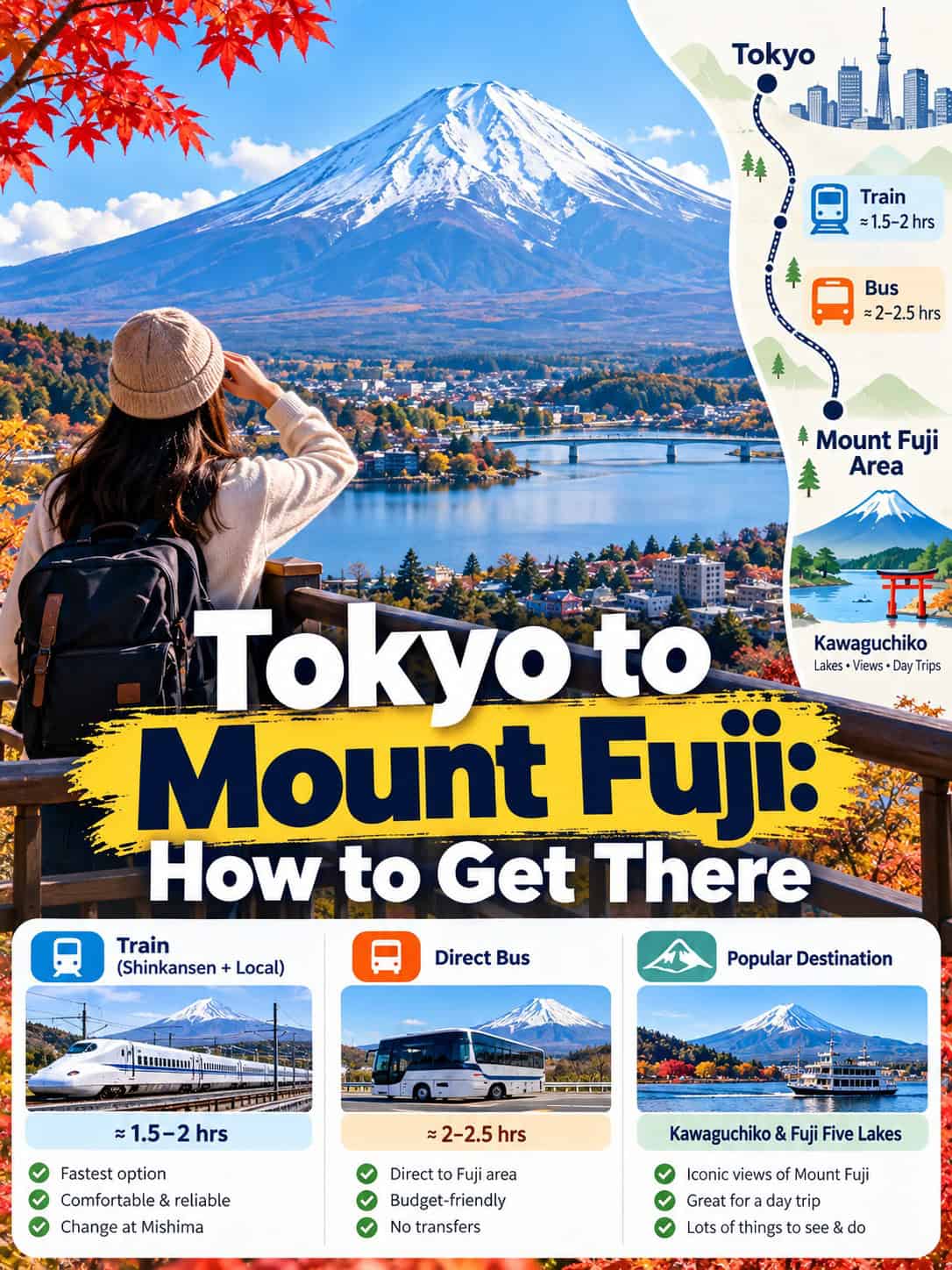
Traveling from Tokyo to Mount Fuji? Our Tokyo guide covers the starting point. First choose your destination: Lake Kawaguchiko for lake views, Chureito Pagoda for a classic photograph, Lake Yamanakako for quieter scenery, or Fuji Subaru Line 5th Station for high-altitude sightseeing. Compare the direct Shinjuku highway bus, the Fuji Excursion train, connections via Otsuki and seasonal fifth-station buses, with fares and day-trip plans.
Tokyo to Mount Fuji: Quick Transport Answers
| Question | Answer |
|---|---|
| Easiest option, no transfers | Highway bus from Shinjuku (Busta Shinjuku) to Kawaguchiko Station — about 1 hour 45 minutes, ¥2,200 |
| Fastest, no-transfer train option | The Fuji Excursion limited express, direct from Shinjuku to Kawaguchiko, all seats reserved |
| Does the Japan Rail Pass cover any of it? | Only the JR Chuo Line leg (Shinjuku–Otsuki); the Fujikyuko Railway on to Kawaguchiko is a separate private line, not covered |
| Is there a rail pass? | JR Tokyo Wide Pass is ¥16,000 for 3 consecutive days and covers eligible JR East and Fujikyu rail services, but not the highway bus or Tokaido Shinkansen. |
| Will you actually see the mountain? | Not guaranteed — Fuji is often hidden by cloud or haze, most reliably visible on clear winter and autumn mornings |
Tokyo to Mount Fuji: Bus vs Train Fare Comparison
| Route | Adult one way | Scheduled time | Best for |
|---|---|---|---|
| Shinjuku → Kawaguchiko bus | ¥2,200 | Approx. 1h45, traffic permitting | Cheapest direct lake transfer |
| Shinjuku → Kawaguchiko Fuji Excursion | ¥4,200 | Fastest around 1h54 | Predictable train travel |
| Shinjuku → Fuji Subaru Line 5th Station bus | ¥4,800 | Approx. 2h25 | High-altitude viewpoint or seasonal summit trailhead |
| Kawaguchiko → 5th Station bus | ¥2,000; return ¥3,400 | Approx. 50–60 minutes | Visitors already at the lake |
| Shinjuku → Oshino Hakkai bus | ¥2,500 | Approx. 2h07 | Spring ponds and village scenery |
| Shinjuku → Yamanakako Asahigaoka bus | ¥2,600 | Approx. 2h25 | Lake Yamanakako |
Always verify the departure that serves your specific stop, and note that the 5th Station is on the mountain, not beside Lake Kawaguchiko.
Compare train routes and tickets to the Fuji area.
Shinjuku to Kawaguchiko Bus: Cheapest Direct Option
Direct highway buses from Busta Shinjuku to Kawaguchiko Station cost ¥2,200 per adult one way (children ¥1,100), with approximately 1 hour 45 minutes of scheduled travel time in favorable traffic. Other stops include Fuji-Q Highland (¥2,200), the Chureito Pagoda area at Chuo Expressway Shimoyoshida (¥2,150), Oshino Hakkai (¥2,500) and Yamanakako Asahigaoka (¥2,600), though not every departure serves every stop. Seats are reserved, and frequency varies by destination, day and season, so consult the live departure list instead of assuming hourly service to every lake. Reserve especially for weekends, cherry blossom season, foliage season and summer, confirm the Busta Shinjuku boarding floor and arrive before the scheduled departure; buses may sell out. Budget extra time for highway traffic.
Fuji Excursion Train: Shinjuku to Kawaguchiko
The direct Fuji Excursion limited express connects Shinjuku with Kawaguchiko in about 1 hour 54 minutes, with stops including Tachikawa, Hachioji, Otsuki, Shimoyoshida, Fujisan and Fuji-Q Highland. Fujikyu Railway publishes a ¥4,200 adult one-way total from Shinjuku to Kawaguchiko: ¥2,580 basic fare plus ¥1,620 limited-express charge. A seat reservation is normally required, and IC balance alone does not cover the limited-express surcharge. The operator publishes four regular round trips daily, with some additional seasonal services. The direct train costs ¥2,000 more one way than the standard Kawaguchiko highway bus, but avoids road congestion. If seats sell out, take JR from Shinjuku to Otsuki and transfer to Fujikyu Railway.
Kawaguchiko Train from Tokyo: Transfer at Otsuki
Take a JR Chuo Line train from Shinjuku to Otsuki, then change to Fujikyu Railway for Kawaguchiko. JR limited-express trains can reduce the first leg to around 70 minutes but require a limited-express ticket; ordinary trains may take longer or need an additional change. Fujikyu Railway lists a ¥1,170 basic one-way fare between Otsuki and Kawaguchiko. Compare total JR fare and train connections for your departure, not just the private-railway portion.
The national Japan Rail Pass covers eligible JR Chuo services as far as Otsuki, but not the privately operated Fujikyu Railway to Kawaguchiko. The JR Tokyo Wide Pass has broader coverage and includes Fujikyu Railway. Limited-express seat conditions still apply, so use your actual ticket or accepted IC payment method rather than assuming every train permits purchase onboard. See our Japan Rail Pass guide for the wider picture.
Tokyo to Fuji Five Lakes: Is JR Tokyo Wide Pass Worth It?
The JR Tokyo Wide Pass costs ¥16,000 per adult or ¥8,000 per child aged 6–11, valid for three consecutive days. It covers eligible JR East trains and the Fujikyu Railway Line, including relevant Fuji Excursion services, but excludes highway buses and the Tokaido Shinkansen. A regular Fuji Excursion return totals ¥8,400 without a pass, and a Shinjuku–Kawaguchiko highway bus return costs ¥4,400, so neither trip alone justifies this ¥16,000 pass. A pass may become worthwhile only if you add other eligible rail excursions within the same three consecutive days, such as Nikko or Izu; extra charges apply on specified premium Fujikyu Railway services, so calculate the actual fares before buying.
Tokyo to Fuji Five Lakes: Local Transport and Viewpoints
Kawaguchiko Station is the transport hub for the lake area. The Mt. Fuji Panoramic Ropeway on nearby Mount Tenjo offers views across the lake and toward Fuji when clouds permit; check its current fare and maintenance calendar. Fuji-Q Highland has its own Fujikyu Railway stop and selected direct highway bus services. Entry to the park itself is free; you pay only for the rides, with ride tickets or a ride pass. Lake Yamanakako has no railway station: direct Shinjuku buses reach Yamanakako Asahigaoka for ¥2,600 adult one way, with a typical scheduled journey of around 2 hours 25 minutes. Local sightseeing buses also link Fujiyoshida, Oshino Hakkai and Yamanakako, but frequencies differ by route and date.
Tokyo to Mount Fuji Day Trip: Choose Your Sightseeing Stop
| Destination | Best arrival point | What to do |
|---|---|---|
| Lake Kawaguchiko | Kawaguchiko Station | Lakeshore photographs and panoramic ropeway |
| Chureito Pagoda | Shimoyoshida Station + uphill walk | Classic pagoda and Fuji composition; many stairs |
| Oshino Hakkai | Oshino Hakkai highway/local bus stop | Spring ponds and village streets |
| Fuji-Q Highland | Fuji-Q Highland rail/bus stop | Amusement park |
| Lake Yamanakako | Asahigaoka / local lakeshore stops | Open lake and mountain viewpoints |
| Fuji Subaru Line 5th Station | Dedicated mountain bus | High-elevation viewpoint, mountain facilities when open |
These stops are not all connected by one sightseeing route. Chureito Pagoda is closer to Shimoyoshida Station than to Kawaguchiko Station; Oshino Hakkai and Yamanakako need separate bus routes. Check return schedules before committing to multiple destinations.
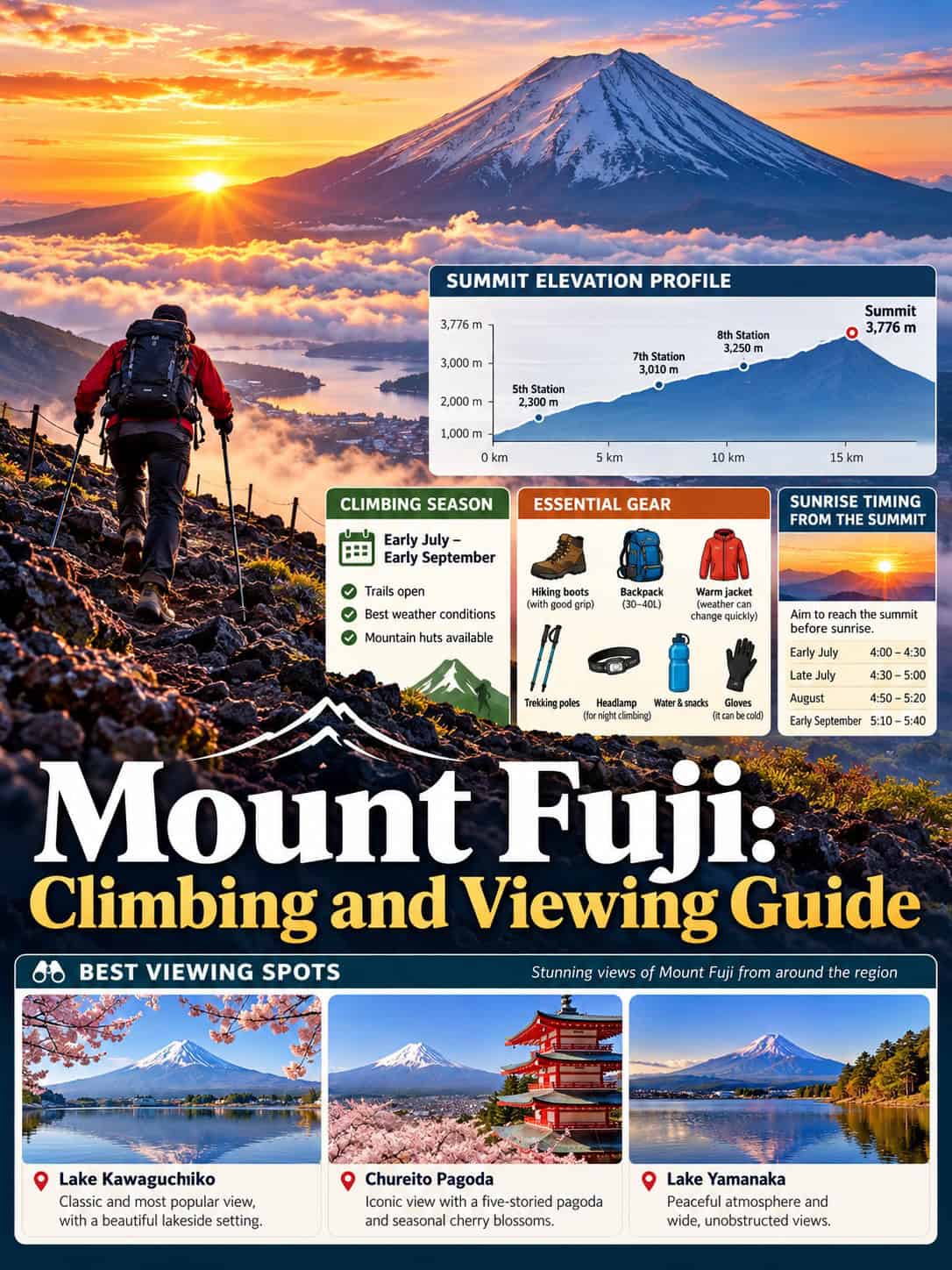
The Fuji Subaru Line 5th Station is different from Kawaguchiko Station and is not the summit. Kawaguchiko–5th Station buses cost ¥2,000 one way or ¥3,400 return and take about 50–60 minutes, and a direct Shinjuku–5th Station bus costs ¥4,800 one way (about 2 hours 25 minutes) when it runs seasonally. The direct bus runs in the summer season through August 31; from September 1 to October 31, the Shinjuku buses to the 5th Station run via Kawaguchiko Station. The ¥3,400 round-trip ticket from Kawaguchiko (child ¥1,700) is valid on the day of first use and the following day, so you can go up one day and come down the next, and it can also be used from Fujisan (Mt. Fuji) Station. Visiting the fifth station outside the summit climbing season does not permit climbing closed trails; for the climb itself, see our Mount Fuji hiking guide.
How to Get to Mount Fuji 5th Station from Tokyo
- Direct: Reserve a seasonal Shinjuku–Fuji Subaru Line 5th Station bus (¥4,800 one way, children ¥2,400, approximately 2h25).
- Via Kawaguchiko: Arrive by bus or train, then take the local 5th Station bus for ¥2,000 one way or ¥3,400 return.
- Check road conditions: Snow, wind or road closures can suspend fifth-station buses even when a timetable is published.
- Know the difference: The 5th Station remains a sightseeing destination when the road is open, but summit trails are open only in the official climbing season.
Fuji Five Lakes Bus Passes: Which Ticket Saves Money?
The two-day Mt. Fuji & Fuji Five Lakes Passport has a ¥4,700 adult version covering the entire Otsuki–Kawaguchiko Fujikyu Railway section plus eligible local buses, and a ¥3,300 version covering eligible buses plus a shorter local rail section. Limited-express supplements are extra. For visitors staying around Kawaguchiko, the Red, Green and Blue sightseeing bus passes (¥1,500 for one day or ¥2,000 for two) may be more economical. The Fujiyoshida–Oshino–Yamanakako bus products are separate, so confirm availability and coverage before purchasing. None of the local passes includes your highway bus from Tokyo.
Tokyo to Fuji Five Lakes: Local Bus Pass Comparison
| Ticket | Adult cost | Coverage |
|---|---|---|
| Red/Green/Blue sightseeing bus, 1 day | ¥1,500 | Kawaguchiko, Saiko, Motosuko route group |
| Red/Green/Blue sightseeing bus, 2 days | ¥2,000 | Same local route group |
| Mt. Fuji & Fuji Five Lakes Passport, rail + buses | ¥4,700 / 2 days | Otsuki–Kawaguchiko Fujikyu line plus eligible local buses |
| Mt. Fuji & Fuji Five Lakes Passport, limited rail + buses | ¥3,300 / 2 days | Specified shorter rail coverage and buses |
| JR Tokyo Wide Pass | ¥16,000 / 3 days | JR East regional rail plus Fujikyu, not local highway buses |
For two or three local stops, compare the exact single bus fares before choosing a sightseeing pass.
Tokyo to Mount Fuji via Shin-Fuji: Shizuoka Alternative
On the Tokaido Shinkansen toward Kyoto or Osaka, Mount Fuji may be visible from the E-side window when skies are clear. Shin-Fuji Station in Shizuoka Prefecture is served by Kodama, not the fastest Nozomi trains, and onward sightseeing at Shiraito Falls or Fujinomiya requires separate local transport. Do not confuse Shin-Fuji with the Fujikyu line station named Fujisan.
Best Time for Tokyo to Mount Fuji Day Trip: Visibility
It’s worth setting expectations honestly: Mount Fuji is frequently hidden by cloud or haze, even on days that look clear at lake level, and this holds especially true in summer when heat haze builds up. Mornings are generally more reliable than afternoons, since cloud tends to form around the summit as the day warms, and winter and autumn are usually considered the clearest seasons overall, with lower humidity cutting down on haze. There’s no guarantee either way, so it’s worth building a little flexibility into your plans if seeing the peak itself matters to you.
Tokyo to Mount Fuji Day Trip: Practical Schedule
07:00–08:30: Leave Shinjuku on a booked early bus or Fuji Excursion train.
09:00–11:30: Walk around Lake Kawaguchiko and try an early lakeshore viewpoint while Fuji is more likely to be clear.
11:30–13:00: Lunch and the Panoramic Ropeway if it is operating and the summit is visible.
13:00–15:30: Add one nearby attraction, such as the north-shore lake area or a separate trip to Shimoyoshida for Chureito Pagoda. Avoid combining too many widely separated sites.
16:00–18:30: Return to Tokyo on a reserved bus or train; allow longer for peak weekend traffic.
Tokyo to Mount Fuji: Sample Return Costs
| Round trip from Shinjuku | One adult | Two adults |
|---|---|---|
| Highway bus to Kawaguchiko | ¥4,400 | ¥8,800 |
| Fuji Excursion train | ¥8,400 | ¥16,800 |
| JR Tokyo Wide Pass (3 days) | ¥16,000 | ¥32,000 |
| Local 1-day Red/Green/Blue bus pass, extra | ¥1,500 | ¥3,000 |
A one-day Fuji round trip alone does not justify the JR Tokyo Wide Pass at these fares. The train may still save time on heavily congested roads.
Compare private transport options if visiting several dispersed viewpoints.
A guided alternative to the bus and train routes is the Mount Fuji & Hakone Day Tour from Tokyo, which can be booked ahead.
Tokyo to Mount Fuji: Frequently Asked Questions
What’s the easiest way from Tokyo to Mount Fuji?
The Shinjuku highway bus to Kawaguchiko Station is the simplest option for most travelers: no transfers, about 1 hour 45 minutes in favorable traffic, ¥2,200 one way, departing from Busta Shinjuku.
Does the Japan Rail Pass cover the trip to Kawaguchiko?
Only partly. It covers eligible JR Chuo services as far as Otsuki, but not the private Fujikyu Railway on to Kawaguchiko. JR Tokyo Wide Pass covers eligible travel on both portions.
Is there a direct train from Shinjuku to Kawaguchiko?
Yes. The Fuji Excursion limited express runs direct with no transfer, four regular round trips a day, with reserved seats, for a total fare of ¥4,200 one way.
Does JR Tokyo Wide Pass cover the Fuji Excursion train?
Yes, it covers eligible Fuji Excursion rail travel on the JR and Fujikyu lines. The adult 3-day pass costs ¥16,000 and does not cover the highway bus or Tokaido Shinkansen.
Can I reach Yamanakako by train?
No. Take a direct Shinjuku–Yamanakako highway bus when scheduled (¥2,600 to Asahigaoka), or use local buses from the Fujiyoshida or Kawaguchiko area.
Should I book the bus or train in advance?
Yes, especially for weekends, cherry blossom season, autumn foliage season and summer, when seats on both the bus and the Fuji Excursion can fill up closer to the date.
How much is Tokyo to Kawaguchiko by bus?
The Shinjuku highway bus fare is ¥2,200 adult one way, or ¥4,400 for a standard return at the same fare.
How much is the Fuji Excursion train?
Fujikyu Railway lists ¥4,200 one way from Shinjuku to Kawaguchiko, including the ¥2,580 basic fare and ¥1,620 limited-express fee.
Can I go from Tokyo directly to Mount Fuji 5th Station?
Yes, when the seasonal Shinjuku highway bus runs: direct through August 31, then via Kawaguchiko Station from September 1 to October 31. The fare is ¥4,800 one way; a route via Kawaguchiko is also possible.
Is Chureito Pagoda at Kawaguchiko Station?
No. The pagoda is nearer Shimoyoshida Station and requires an uphill walk with many steps.
How much is the Mount Fuji 5th Station bus from Kawaguchiko?
¥2,000 adult one way or ¥3,400 return, with about 50–60 minutes of road travel. The service may be suspended in bad weather.
Can I take the Fuji Excursion train without booking?
It is a limited express with reserved seats, so reserve in advance for popular travel dates and check any special seat-ticket policies directly with the operator.
Can you do Mount Fuji as a day trip from Tokyo?
Yes for Lake Kawaguchiko and nearby viewpoints. A summit climb is a separate, substantially longer mountain itinerary.
How do I get to Fuji-Q Highland?
Most Shinjuku highway buses stop at Fuji-Q Highland (about 1 hour 40 minutes, ¥2,200) before continuing to Kawaguchiko Station, and it also has its own stop on the Fujikyu Railway Line.
Will I definitely see Mount Fuji from Kawaguchiko?
Not guaranteed. The mountain is often obscured by cloud or haze, especially in summer. Clear winter and autumn mornings tend to offer the best odds.
Bottom Line
For Kawaguchiko, the ¥2,200 Shinjuku highway bus is generally the most economical direct option, while the ¥4,200 Fuji Excursion offers a faster, traffic-independent rail alternative. For the Fuji Subaru Line 5th Station, use the separate direct bus or transfer at Kawaguchiko. Choose a clear day and verify local bus times before your return journey. Spring and autumn weather matter for views, so see our best time to visit Japan guide, and if you want to soak after a Fuji day, see the best onsen hotels near Hakone and Mount Fuji. Our guide to getting around Tokyo and Hakone guide help you plan the rest of the trip.