By Nippon With Me EditorialPublished Updated
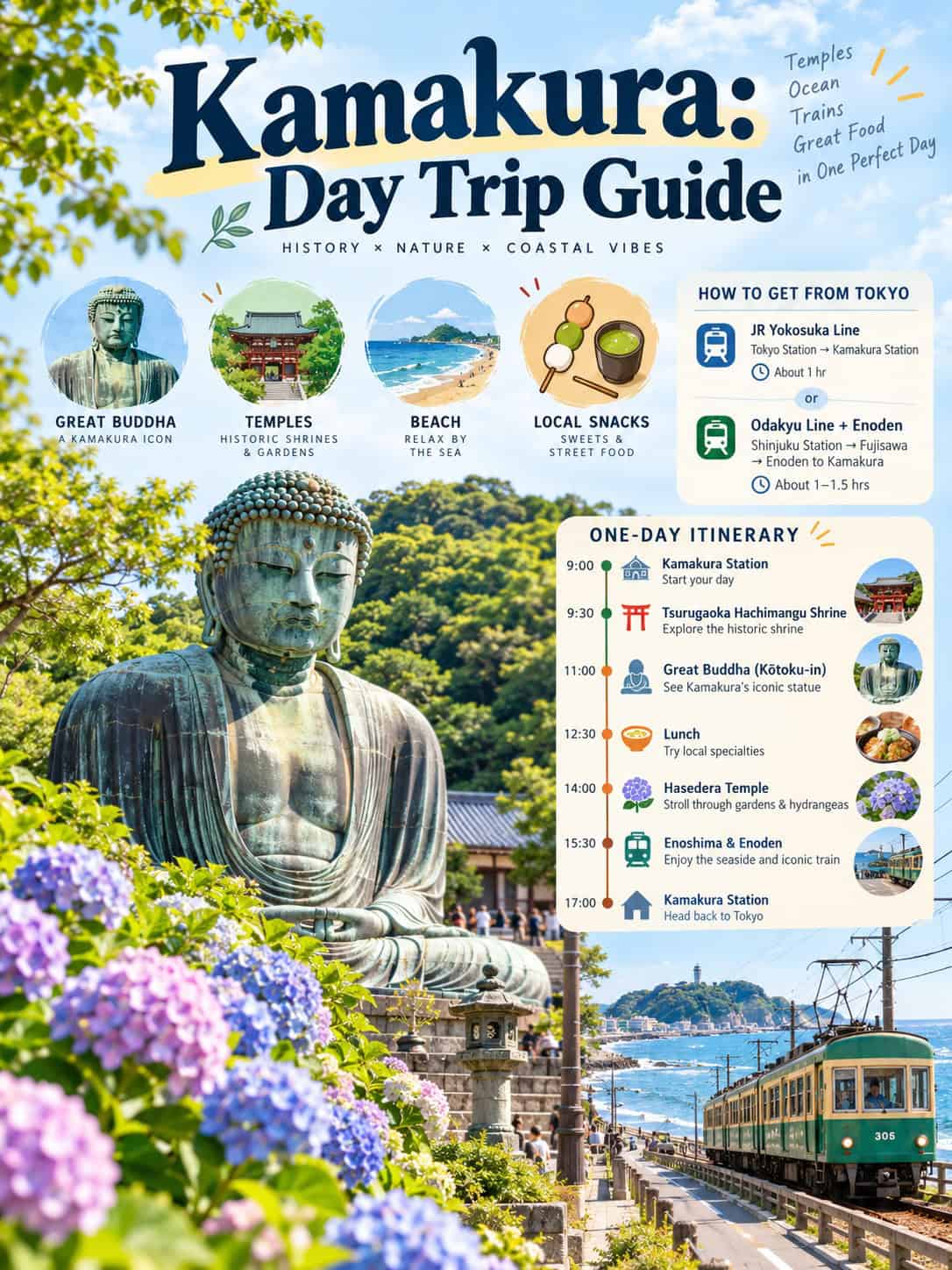
A Kamakura day trip from Tokyo brings you to the Great Buddha, hillside Zen temples, Shinto shrines and a scenic coastal railway in about an hour. This guide covers entrance fees, train fares and a realistic one-day route, with optional stops at Hokokuji, Kita-Kamakura and Enoshima. The bronze Great Buddha stands about 11.3 metres tall without its pedestal.
Kamakura Day Trip: Essential Planning Facts
| Category | Details |
|---|---|
| Best for | The Great Buddha, Zen temples, a bamboo grove, and a coastal tram ride, all in one day from Tokyo |
| Ideal trip length | 1 full day, or 2 days to add Enoshima Island and the Kita-Kamakura temples without rushing |
| Getting there | From Tokyo Station: JR Yokosuka Line, just under an hour direct to Kamakura Station |
| Getting around | The Enoden tram line links Kamakura Station to Hase and on to Enoshima; the center is walkable |
| Best time to visit | June for Hase-dera’s hydrangeas; late March to early April for cherry blossoms; weekdays for smaller crowds |
| Currency | Japanese yen (¥) |
Kamakura Day Trip: Entrance Fees
| Attraction | Adult price | Key visiting hours |
|---|---|---|
| Great Buddha / Kotoku-in | ¥300; statue interior +¥50 | 08:00–17:30 Apr–Sep; until 17:00 Oct–Mar |
| Hase-dera | ¥400 | 08:00–17:30 Apr–Jun; until 17:00 Jul–Mar |
| Tsurugaoka Hachimangu | Main grounds free | 06:00–20:00 |
| Tsurugaoka Treasure Hall | ¥200 | 09:00–16:00 (check special closures) |
| Hokokuji bamboo garden | ¥400; matcha +¥600 | 09:00–16:00; tea ticket by 15:30 |
Seasonal flower-viewing fees, special exhibitions and closures may differ. Do not assume every temple visit requires a ticket.
Explore Kamakura tours and admission tickets.
Kamakura’s Key Areas: Where to Go
Kita-Kamakura
The quieter, forested station one stop before Kamakura Station itself, home to several of the city’s “Five Great Zen Temples,” including Engakuji and Kenchoji.
Kamakura Station and Komachi-dori
The town’s commercial center, anchored by Tsurugaoka Hachimangu shrine and the narrow shopping street Komachi-dori, lined with snack stalls and souvenir shops.
Hase
A seaside district reached by the Enoden line, home to the Great Buddha at Kotoku-in and the hydrangea-lined grounds of Hase-dera.
Things to Do in Kamakura: Great Buddha and Temples
Great Buddha (Kotoku-in)
The Great Buddha at Kotoku-in is a bronze statue of Amida Buddha. Casting began around 1252, and the figure is about 11.3–11.4 metres tall without its base. Admission is ¥300 for adults and ¥150 for children aged 6–12, plus ¥50 per person to visit the hollow interior. Preschool children enter free. Open 8:00 AM–5:30 PM April–September and 8:00 AM–5:00 PM October–March, with last main entry 15 minutes before closing. The statue interior closes at 4:30 PM, with last entry at 4:20 PM.
Hase-dera
Hase-dera is a hillside temple known for a large Kannon statue, hydrangeas and coastal views. Admission is ¥400 for adults or ¥200 for children aged 6–11. The temple opens 8:00 AM–5:30 PM in April–June (last admission 5:00 PM) and 8:00 AM–5:00 PM in July–March (last admission 4:30 PM). Hydrangea season in June can bring long queues and separate arrangements for the flower-viewing route. Entry cannot be reserved in advance, so arriving at the 8:00 AM opening is the practical way around the queues.
Tsurugaoka Hachimangu
Tsurugaoka Hachimangu is Kamakura’s major Shinto shrine, around a ten-minute walk from Kamakura Station’s east exit. Main shrine grounds are free, with the gates open 6:00 AM–8:00 PM year-round. The Treasure Hall charges ¥200 for adults or ¥100 for elementary-school children. Museum charges and opening hours differ from the main grounds.
Engakuji
The highest-ranked of Kamakura’s Five Great Zen Temples, just outside Kita-Kamakura Station, with a large bell designated a national treasure. Admission is ¥500 for adults and ¥200 for elementary and junior-high pupils. The gate opens at 8:30am and closes at 4:30pm from March to November or 4:00pm from December to February, and the grounds empty by 5:00pm or 4:30pm. Open daily, apart from occasional closures for typhoons or snow.
Kenchoji
Japan’s oldest dedicated Zen training monastery, founded in 1253, with a garden behind the main hall attributed to the same designer as several famous Kyoto gardens. Admission is ¥500 for adults and ¥200 for elementary and junior-high pupils, paid in cash; open daily 8:30am-4:30pm.
Meigetsuin
Nicknamed Ajisaidera, or “Hydrangea Temple,” for the roughly 2,500 hydrangeas — about 95% of them the blue Hime Ajisai variety — that crowd its approach through June. The main hall’s circular window frames the inner garden, which otherwise opens to visitors only during two short windows each year, the iris bloom and the autumn foliage, for an extra ¥500. Admission is ¥500 for high-school age and older and ¥300 for elementary and junior-high pupils; hours run 9:00am-4:00pm most of the year, extending to 8:30am-5:00pm in June to handle the hydrangea crowds.
Hokokuji’s Bamboo Grove
Hokokuji’s bamboo garden contains approximately 2,000 bamboo stalks and opens 9:00 AM–4:00 PM. Entry costs ¥400 for high-school-age visitors and older or ¥200 for elementary and junior-high pupils. Matcha with a sweet costs an additional ¥600, and tea tickets are sold until 3:30 PM. The garden closes December 29–January 3 and may also close because of weather.
Zeniarai Benten
Zeniarai Benzaiten Ugafuku Shrine is known for a spring where visitors wash coins as a good-fortune custom. You can walk uphill to it from the Sasuke area in roughly 20–30 minutes from Kamakura Station. The Daibutsu hiking trail offers an alternative approach but is not mandatory. Confirm current opening hours locally.
Where to Stay
Most visitors treat Kamakura as a day trip and base themselves in Tokyo, which keeps travel simple given the roughly hour-long direct train connection. Planning time in the capital too? Our Tokyo travel guide covers the main areas.
Travelers who want a slower pace, or who plan to add Enoshima and the Kita-Kamakura temples as a second day, will find a smaller selection of hotels and ryokan around Kamakura Station and near the coast toward Hase.
Getting to Kamakura
The JR Yokosuka Line runs directly from Tokyo Station to Kamakura in just under one hour, for roughly ¥1,040 one way. From Shinjuku, choose a Zushi-bound Shonan-Shinjuku Line departure for a through service or transfer at Ofuna when needed. Check the exact fare, destination and operating train for your date.
Kamakura Travel Guide: JR, Odakyu and Enoden Fares
| Journey | Fare | Journey time / use |
|---|---|---|
| Tokyo–Kamakura JR Yokosuka | About ¥1,040 one way | Just under one hour |
| Shinjuku–Kamakura JR | About ¥1,040 one way | About one hour; check through train |
| Odakyu Enoshima-Kamakura Freepass | ¥1,640 from Shinjuku | Includes specified Odakyu round trip + Enoden |
| Enoden Kamakura–Hase | ¥200 one way | About five minutes |
| Enoden Kamakura–Enoshima | ¥260 one way | About 23 minutes |
| Enoden Noriorikun pass | ¥800 | Unlimited Enoden journeys for one day |
Noriorikun is an Enoden-only pass; it does not include JR from Tokyo. The Odakyu Freepass and JR tickets are alternatives rather than items to buy together for the same journey.
The Odakyu Freepass is valid for one day, and the day you buy it counts as day one. From Shinjuku it costs ¥1,640 for adults and ¥430 for children aged 6 to 11; children under 6 need no ticket. A version that starts at Fujisawa costs ¥810 for adults and ¥410 for children. The Romancecar limited express is not covered: a reserved seat to Katase-Enoshima adds ¥750 for adults and ¥380 for children one way from Shinjuku. Buy a digital ticket online (smartphone only) or a paper ticket at the Odakyu Sightseeing Service Center or a station vending machine. One digital purchase covers up to four tickets, and everyone on it must travel together. Enoden buses are not part of the pass and need their own day ticket.
Compare train routes to Kamakura.
Getting Around Kamakura
Enoden connects Kamakura and Fujisawa via Hase and Enoshima along a ten-kilometre line. A ride from Kamakura to Hase costs ¥200 and takes about five minutes, and a ride from Kamakura to Enoshima costs ¥260 and takes about 23 minutes. Its Noriorikun day pass costs ¥800 for adults and ¥400 for children. Kita-Kamakura is a JR station rather than an Enoden stop. Use local buses to reach Hokokuji.
Best Time to Visit Kamakura
June brings peak hydrangea season, especially along Hase-dera’s hydrangea path and the approach to Meigetsuin, though waits lengthen accordingly. Cherry blossoms peak in late March to early April along the Dankazura approach to Tsurugaoka Hachimangu, with an early-blooming Kawazu-zakura variety at the shrine starting as early as February. Autumn foliage peaks at Engakuji in late November. Weekdays, particularly Tuesday through Thursday, are noticeably calmer than weekends; on a weekend visit, arriving before 9am or staying past 3pm avoids the heaviest crowds at the main sights. Our guide to the best time to visit Japan compares the seasons.
A Simple 1-Day Kamakura Itinerary
8:15–9:15 AM: Start with Tsurugaoka Hachimangu, then stroll through Komachi-dori. Some shops may open later in the morning.
9:30–10:30 AM: Ride Enoden from Kamakura to Hase (¥200, around five minutes) and walk approximately ten minutes to Kotoku-in for the Great Buddha.
10:45 AM–12:30 PM: Visit Hase-dera (¥400 adult), then have lunch nearby. Raw shirasu availability depends on fishing season and weather.
1:15–2:45 PM: Return toward Kamakura Station and take a bus or taxi to Hokokuji for its bamboo grove (¥400). Buy the optional matcha ticket (¥600) before 3:30 PM.
3:15 PM onward: Return to central Kamakura or ride Enoden to Shichirigahama for the sea view. Check the sunset time for your season, since winter daylight ends early.
Travelers with a second day can spend it on Kita-Kamakura’s Zen temples (Engakuji, Kenchoji, Meigetsuin) in the morning and Enoshima Island in the afternoon, rather than rushing both into one day. Visiting in June adds an extra layer of planning, since Hase-dera and Meigetsuin’s hydrangea paths both draw long waits at midday — arriving at opening time or saving them for a weekday noticeably shortens the queue.
Kamakura Day Trip Itinerary: Realistic Timing
In June, Hase-dera hydrangea queues can exceed the available time, so skip Hokokuji if necessary. Enoshima and the Kita-Kamakura Zen temples fit better into a separate second day.
If It Rains
Leave the Daibutsu forest trail for another day, since it turns slippery after rain, and skip the steep walk up to Zeniarai Benten. Stay on the Enoden line instead: Kamakura to Hase is about five minutes for ¥200, and the Great Buddha’s hollow interior (¥50, last entry 4:20 PM) and Hase-dera’s own Kannon museum give you something under a roof. Save Enoshima for a dry day, because the Iwaya Caves can close when the sea is rough.
Day Trip Extension: Enoshima Island
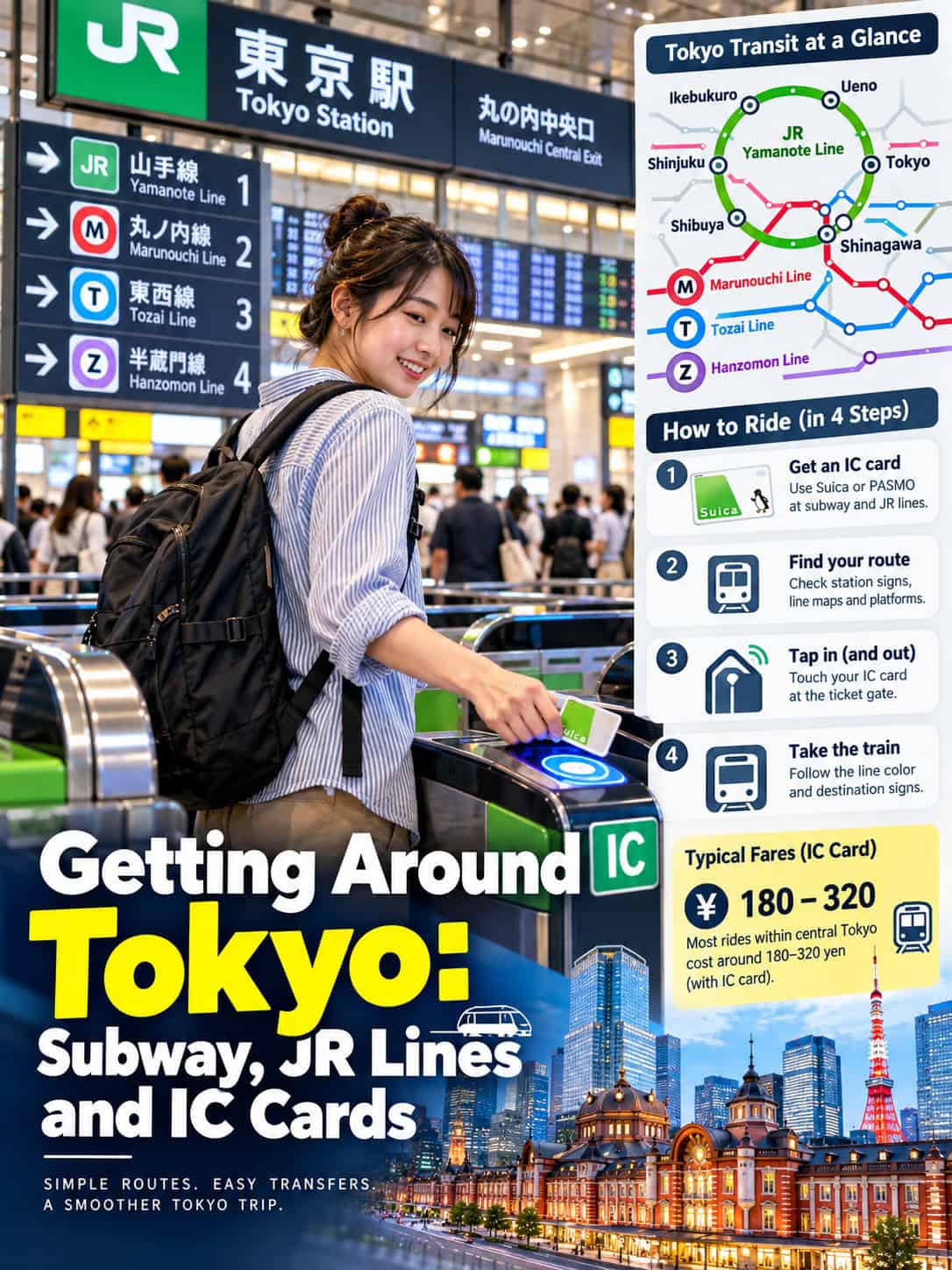
Enoden reaches Enoshima Station from Kamakura in approximately 23 minutes for ¥260 one way. From the station, walk over the bridge to the island. Enoshima Shrine, Samuel Cocking Garden, the Sea Candle and the Iwaya Caves are separate attractions. The Iwaya Caves occupy Enoshima’s southern cliffs and can close or change hours because of sea conditions. Each has its own ticket, and combination tickets are cheaper than buying the pieces one by one; the prices are in the table below. See how to get around Tokyo for train lines and IC cards.
Enoshima Admission Prices
| Ticket | Adult | Child | Notes |
|---|---|---|---|
| Samuel Cocking Garden | Free | Free | Free from 9:00 AM to 5:00 PM; evening entry is paid and only on event days |
| Sea Candle observation tower | ¥800 | ¥400 | Inside the garden |
| Enoshima Escar (all 3 sections) | ¥500 | ¥250 | Escalators up the island hill |
| Sea Candle Set (garden, tower, Escar) | ¥1,100 | ¥550 | Cheaper than the separate tickets |
| Iwaya Caves | ¥500 | ¥200 | Adult means age 13 and older, child ages 7 to 12; candles are handed out free at the first cave |
| Iwaya Caves and Sea Candle Set (no Escar) | ¥1,110 | ¥500 | For visitors who will walk up the hill |
| Enoshima 1 Day ticket | ¥1,550 | ¥700 | Includes the Iwaya Caves |
On the Enoshima combination tickets, adult means junior-high students and older and child means elementary-school pupils. The garden and tower are part of the same grounds, so the Sea Candle Set is the usual choice for anyone who wants the view from the top.
Food in Kamakura
Shirasu-don is a rice bowl topped with whitebait, served fresh or cooked. Kamakura City states that the local shirasu fishing closure runs from January 1 to March 10 each year. Fresh local raw shirasu therefore depends on both the permitted season and the day’s catch, while cooked or preserved whitebait may remain available when fishing stops. Komachi-dori is the place to graze on street snacks between temple visits; follow shop signs about eating while walking. For more dishes to try across the country, see our Japanese food guide.
Practical Tips for First-Time Visitors
Weekends and the June hydrangea season can bring queues at Hase-dera, Kotoku-in and Komachi-dori. Start early when possible. Zeniarai Benten can be reached on foot via the Sasuke neighbourhood without hiking the Daibutsu trail. Wear comfortable shoes for its steep approach. The Daibutsu trail itself is an unpaved forest path connecting Kita-Kamakura to the Great Buddha area, and it turns slippery after rain. Compare the Odakyu Freepass with a direct JR round trip and the ¥800 Enoden-only pass: the Freepass can save money from Shinjuku if you include Enoshima, while JR is usually faster if Kamakura alone is the goal. See our packing list for Japan for comfortable walking shoes and our guide to money in Japan for cash at small temples. If you are still planning the trip from abroad, our Japan visa requirements guide explains which passports need a visa.
Kamakura Day Trip: Budget for One Adult
| Expense | Price |
|---|---|
| JR Tokyo–Kamakura return | ¥2,080 |
| Enoden Kamakura–Hase return | ¥400 |
| Great Buddha admission | ¥300 |
| Hase-dera | ¥400 |
| Hokokuji bamboo garden | ¥400 |
| Total (excluding food and local buses) | ¥3,580 |
| With optional Hokokuji matcha | ¥4,180 |
This illustrative sum assumes JR one-way prices of about ¥1,040 and a Hase return on Enoden. Extra Enoden stops, buses, food, seasonal admission or guided tours cost more.
Things to Do in Kamakura: Safety and Local Etiquette
Follow temple photography rules, avoid blocking Komachi-dori shops and do not stand on railway crossings for coastal train photos. Kamakura City cautions that collecting certain shellfish, seaweed or octopus along its shore can infringe local fishery rights.
For maps, transport updates and navigation, compare mobile data packages for Japan.
Frequently Asked Questions
Can Kamakura be visited as a day trip from Tokyo?
Yes — it’s the single most common day trip from Tokyo, with a direct train of under an hour from Tokyo Station and enough sights clustered close together to cover the highlights comfortably in a day.
How do I get from Tokyo to Kamakura?
The JR Yokosuka Line runs directly from Tokyo Station to Kamakura Station in just under an hour for roughly ¥1,040. From Shinjuku, the JR Shonan Shinjuku Line covers the same route in about an hour, though only some trains run through without a transfer at Ofuna.
Is the Enoshima-Kamakura Free Pass worth buying?
The Odakyu Freepass can save money from Shinjuku when you use its included round-trip route and several Enoden rides. It is not automatically the cheapest from every Tokyo station or on every itinerary. Compare it with a direct JR round trip and the ¥800 Enoden-only pass.
When is the best time to see the hydrangeas in Kamakura?
June is peak hydrangea season, especially along Hase-dera’s hydrangea path and the approach to Meigetsuin in Kita-Kamakura. Expect waits that can exceed an hour at the busiest viewing points during the peak.
Can I combine Kamakura and Enoshima in one day?
It’s possible but rushed — most travelers who want to see both comfortably split them across two days, spending one day on Kamakura’s temples and the Great Buddha and a second on Enoshima.
Which Kamakura temple is best for hydrangeas?
Hase-dera’s hydrangea path and Meigetsuin’s approach in Kita-Kamakura are the two best-known spots, both peaking in June. Both also draw the longest waits of the year during that peak, so an early-morning or weekday visit helps.
What is Kamakura’s local food specialty?
Shirasu-don is a local whitebait rice bowl. Kamakura’s annual shirasu fishing closure runs January 1–March 10, so fresh local raw whitebait is seasonal and catch-dependent.
Do I need to pay to enter Tsurugaoka Hachimangu?
No — the main shrine grounds are free to enter and open 6:00am to 8:00pm. Only certain auxiliary buildings and museums on the grounds charge separate admission.
How much does it cost to see the Kamakura Great Buddha?
Adult admission to Kotoku-in is ¥300, and the hollow statue interior is another ¥50. Children aged 6–12 pay ¥150 for main admission.
How far is the Great Buddha from Hase Station?
The Enoden guide estimates a ten-minute walk. Hase-dera is about a five-minute walk from the same station.
Is the Enoden day pass worth it?
Noriorikun costs ¥800. Compare it with ordinary fares of ¥200 Kamakura–Hase and ¥260 Kamakura–Enoshima. It does not cover JR travel from Tokyo.
How much is Hokokuji bamboo garden?
Adult admission costs ¥400 and an optional matcha tea set costs another ¥600. Tea ticket sales stop at 3:30 PM.
When is local whitebait fishing closed?
Kamakura City lists the shirasu fishing closure from January 1 through March 10 annually.
Do you have to hike the Daibutsu Trail to reach Zeniarai Benten?
No. Visitors can walk uphill from the Sasuke neighbourhood without using the forest hiking route.
Bottom Line
A Kamakura day trip is more enjoyable when you choose three or four main sights and leave time for trains, walks and temple closing hours. Add a second day for Enoshima and Kita-Kamakura if you want a more complete visit.