By Nippon With Me EditorialPublished Updated
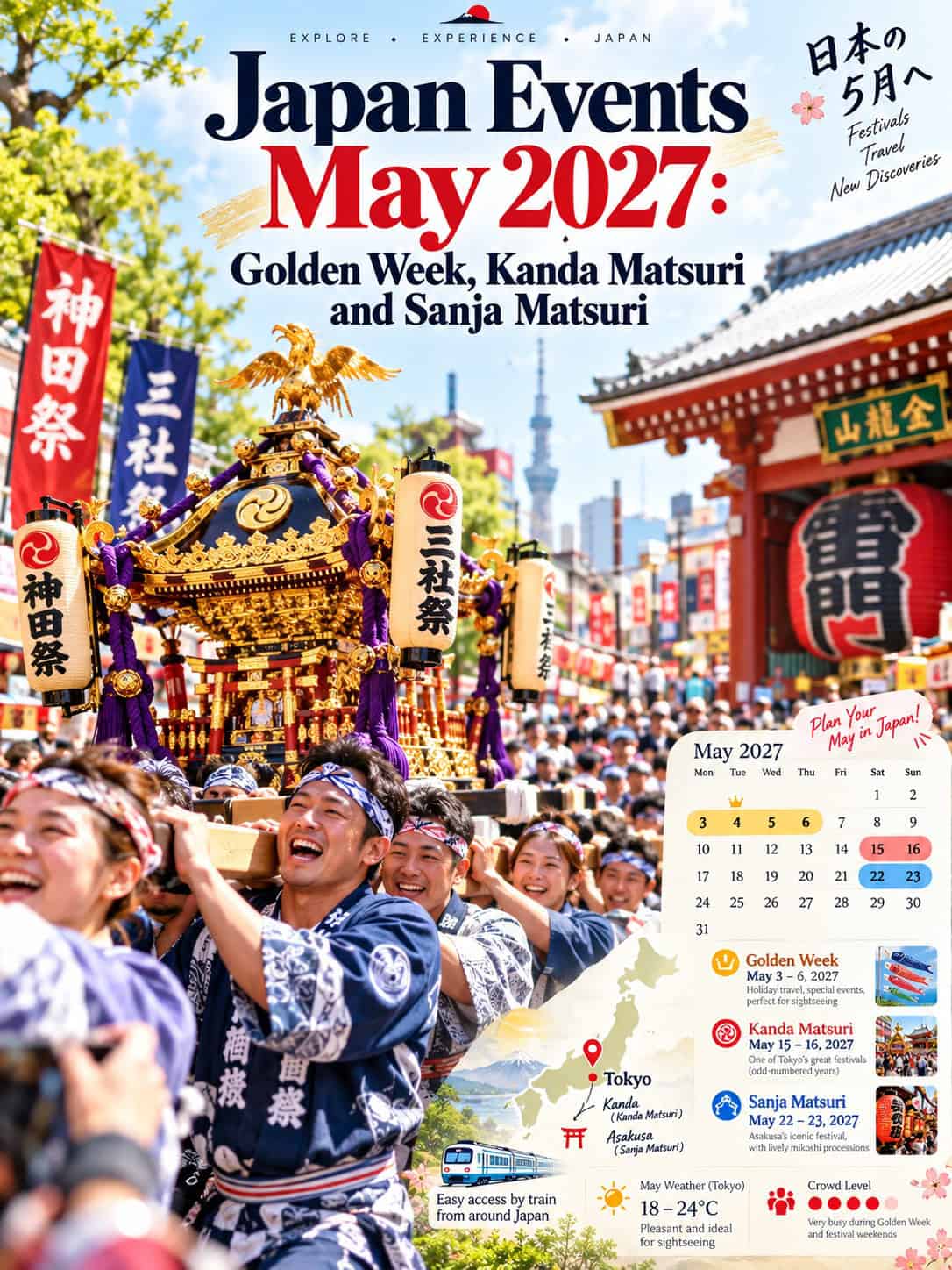
May is Japan at its busiest and its most festive. If you are planning things to do in Japan in May, the month opens with Golden Week, the country’s most crowded holiday run, and carries on with some of its most dramatic street festivals: Kanda Matsuri and Sanja Matsuri in Tokyo, Aoi Matsuri in Kyoto and Hakata Dontaku in Fukuoka. Below you will find each event with its status, how Golden Week really works for travelers, a comparison of Tokyo, Kyoto and other regions, and how to book trains and hotels. Several dates follow the calendar or the festival organizers, so each one is marked Confirmed or TBC.
Things to Do in Japan in May at a Glance
| Date | Event | Location | Status |
|---|---|---|---|
| Around May 1–5 | Golden Week national holidays (May 3, 4 and 5) | Nationwide | Confirmed (fixed dates) |
| Around May 3–4 | Hakata Dontaku Festival | Fukuoka | TBC, normally May 3–4 |
| Mid-May, odd years | Kanda Matsuri (main festival) | Kanda, Tokyo | TBC, check the shrine |
| May 15 | Aoi Matsuri | Kyoto | Confirmed (rain date May 16) |
| Third weekend of May | Sanja Matsuri | Asakusa, Tokyo | Expected, around May 21–23 |
| Until late May | Fuji Shibazakura Festival | Fuji Five Lakes, Yamanashi | Expected, peak bloom early to mid May |
Golden Week Japan: How the Holiday Run Works
Golden Week is a cluster of national holidays: Showa Day on April 29, Constitution Day on May 3, Greenery Day on May 4 and Children’s Day on May 5. Japan Golden Week is the single busiest domestic travel period of the year, so trains, flights and hotels run at or near capacity and major attractions see their heaviest crowds. The exact length of the break depends on how the weekend falls each year.
Children’s Day is marked by koinobori, carp-shaped streamers flown outside homes, along with kashiwa mochi, rice cakes wrapped in oak leaves, and traditional iris-leaf baths. For travelers, the practical lesson is simple: reserve early, or avoid the peak days. Our national holiday calendar shows how the dates shift from year to year.
Golden Week tips: queues, trains and booking
- Book reserved shinkansen seats and hotels as soon as your dates are fixed, because this is the one week when sold-out options are common even months ahead.
- If your dates are flexible, travel just before or just after the holiday run, when prices and crowds drop.
- Expect long queues at big attractions and on popular routes, and carry an IC card to skip ticket lines, as our subway and JR basics explain.
- For intercity trips, see the bullet train walkthrough and check reserved-seat availability early.
Tokyo Festivals May: Kanda Matsuri and Sanja Matsuri
Kanda Matsuri
Status: TBC. Where: Kanda, Nihonbashi and Akihabara, centered on Kanda Shrine. Kanda Matsuri is one of Tokyo’s three great festivals, and the full-scale version is held only in odd-numbered years, with a smaller version in even years. In main years, around 200 mikoshi portable shrines are carried through the streets over the festival weekend, with a costumed Edo-style procession. Because the program and exact days change from year to year, treat any specific schedule as unconfirmed and check the official Kanda Shrine announcement before you book non-refundable travel.
Sanja Matsuri
Status: Expected, usually on the third weekend of May, around May 21–23 in the coming cycle. Where: Asakusa Shrine next to Senso-ji. Sanja Matsuri is Tokyo’s most raucous festival: roughly 100 neighborhood mikoshi converge near Kaminarimon gate and are carried through the streets by energetic crowds. The Friday opens with a costumed parade, and Saturday afternoon is the most crowded window, so arrive early or aim for Sunday morning for a calmer look. The festival is free to watch. Confirm the dates each year with the shrine.
Best Japan May Festivals Beyond Tokyo
Aoi Matsuri in Kyoto
Status: Confirmed, May 15 each year, moved to May 16 if it rains. Several hundred participants in Heian-era court dress process from the Kyoto Imperial Palace to Shimogamo Shrine and on to Kamigamo Shrine, led by an imperial messenger on horseback. Paid viewing seats are sold in advance along parts of the route, while the approach to Shimogamo Shrine offers a free alternative if you arrive early.
Hakata Dontaku in Fukuoka
Status: TBC. The festival is normally held on May 3 and 4, with a pre-event on May 2, so it overlaps Golden Week. Costumed groups parade through Hakata, there is a flower-float parade, and many free performance venues open across the Hakata and Tenjin areas. Check the organizers’ announcement for the confirmed dates, and see our neighborhood notes for Fukuoka for the city.
Fuji Shibazakura Festival
The moss-pink carpets in the Fuji Five Lakes area usually reach their fullest color in early to mid May and fade by late May. Early May overlaps the Golden Week crowds, so a weekday visit in the second half of the month is calmer.
Tokyo, Kyoto or Other Regions in May?
| Region | May highlights | Best for | Watch out for |
|---|---|---|---|
| Tokyo | Kanda Matsuri (odd years), Sanja Matsuri | Energetic street festivals and mikoshi crowds | Very crowded on festival Saturdays |
| Kyoto | Aoi Matsuri on May 15 | A slow, formal historical procession | Hotels and viewing seats sell out |
| Fukuoka and Kyushu | Hakata Dontaku, normally May 3–4 | A large free city festival over Golden Week | Overlaps the busiest holiday days |
| Yamanashi | Fuji Shibazakura Festival | Pink flower carpets with Mt. Fuji views | Weekend traffic and Golden Week crowds |
If you cannot choose, compare the cities in our head-to-head of the two capitals.
Where to Stay for May Events
Any major hub works for Golden Week, but expect to pay well above normal rates and book far ahead. For Kanda Matsuri, a base near Akihabara or Kanda keeps the shrine and the parade routes within walking distance. For Sanja Matsuri, Asakusa is the obvious choice, because the festival fills the neighborhood all weekend. For Aoi Matsuri, central Kyoto near the Imperial Palace works best. See our picks for Tokyo stays for Tokyo options and Kyoto in depth for the old capital.
Things to Do in Japan in May: What to Prioritize
Sanja Matsuri is the strongest single event for spectacle, while Aoi Matsuri offers the opposite: a slow, elegant procession with a reliable fixed date. Kanda Matsuri is worth real effort in a main-festival year, but wait for the shrine’s announcement before locking in plans. Above all, if you travel during Golden Week, have your reservations in hand before you arrive. For the months on either side, see the April calendar and the June calendar.
Frequently Asked Questions
What are the best things to do in Japan in May?
The best things to do in Japan in May are to catch a major festival such as Sanja Matsuri, Aoi Matsuri or Kanda Matsuri, enjoy flower displays like the Fuji Shibazakura Festival, and plan around Golden Week.
When is Golden Week in Japan?
Golden Week runs around the national holidays of April 29, May 3, May 4 and May 5, and the peak is usually May 1–5. The length of the break depends on how the weekend falls.
Should I avoid Japan during Golden Week?
Not necessarily, but it is the busiest domestic travel period, so book trains and hotels well in advance or travel just before or after it.
Is Kanda Matsuri held every year?
The full-scale festival is held in odd-numbered years, with a smaller version in even years. Check the official Kanda Shrine announcement for the program.
When is Sanja Matsuri?
It is held on the third weekend of May, with the exact dates confirmed each year by Asakusa Shrine. It is free to watch.
Is May a good month to visit Japan?
Yes, outside Golden Week. Mid-to-late May offers comfortable temperatures, good flower viewing and lighter crowds than the holiday run or cherry blossom season.
Bottom Line
Among all the things to do in Japan in May, the first choice is to pick a lane: ride out Golden Week for the energy of a country on holiday, or time your trip for the second half of the month, with Aoi Matsuri’s elegance and Sanja Matsuri’s chaos and far more breathing room. Whichever you choose, book early, because this is one of the most in-demand months on the calendar.