By Nippon With Me EditorialPublished Updated
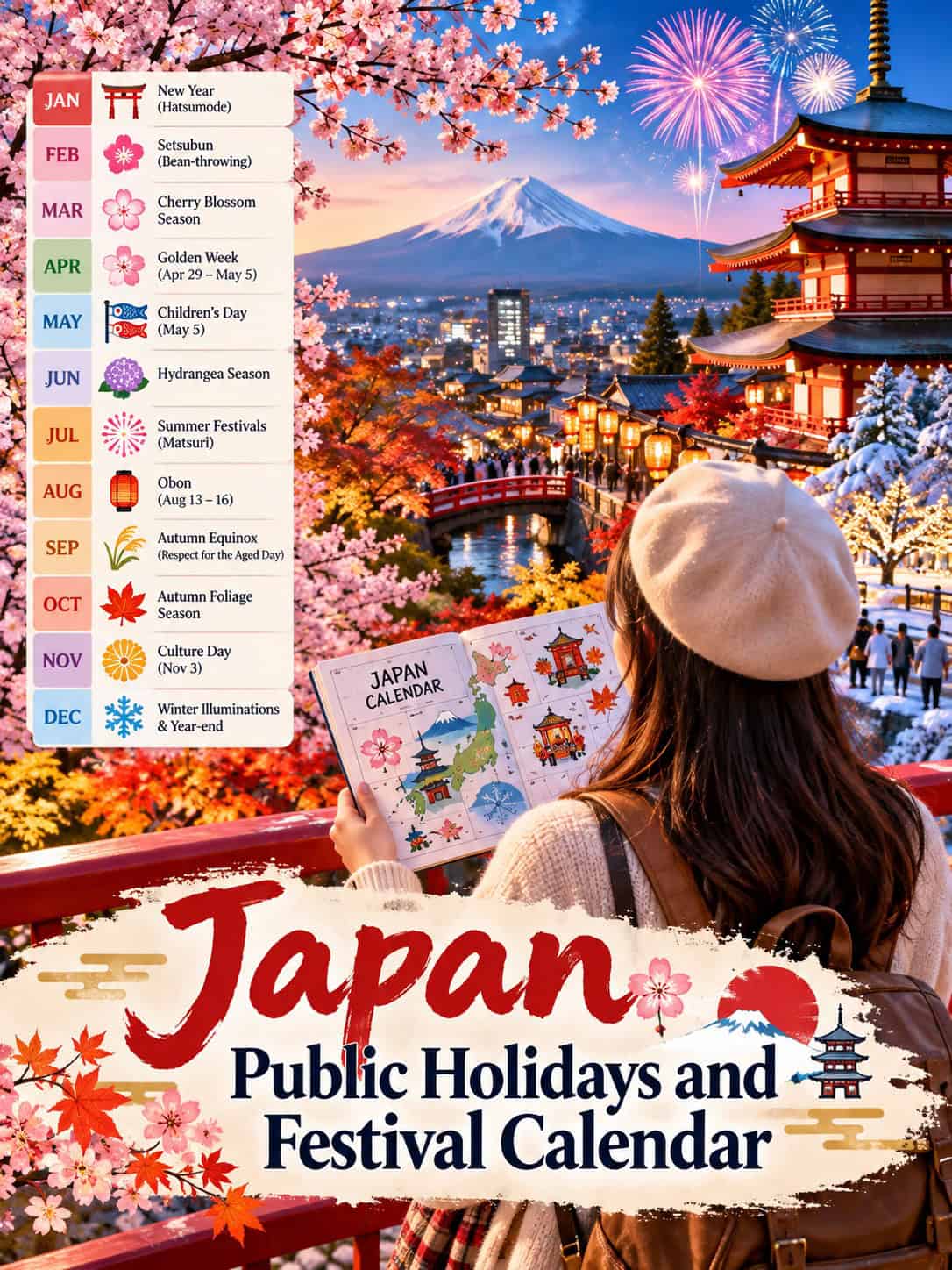
Japan national holidays include 16 official holidays each year, but the busiest travel periods are concentrated around Golden Week, Obon and New Year. These dates can affect rail reservations, hotel availability and the opening hours of some businesses. Knowing which weeks these are, and which festivals are worth building an itinerary around, makes the difference between fighting the crowds and planning around them.
Japan National Holidays: Quick Answer
| Question | Answer |
|---|---|
| Busiest travel period | Golden Week (April 29-May 5) — four holidays packed into one week, plus Obon in mid-August and the New Year period |
| Is Obon an official holiday? | No, but most of Japan travels during it anyway, so it behaves like one |
| What actually closes for New Year? | Banks, government offices, and most small restaurants/shops, roughly December 29-January 3 |
| Do holidays affect train travel? | Yes — reserved Shinkansen seats sell out, and some trains go reservation-only during peak periods |
| Should I avoid visiting during holidays? | Not necessarily, but book accommodation and reserved seats well ahead if your trip overlaps one |
Japan National Holidays: Official Calendar
| Date | Holiday |
|---|---|
| Friday, January 1 | New Year’s Day |
| Monday, January 11 | Coming of Age Day |
| Thursday, February 11 | National Foundation Day |
| Tuesday, February 23 | Emperor’s Birthday |
| Sunday, March 21 | Spring Equinox |
| Monday, March 22 | Substitute holiday for Spring Equinox Day |
| Thursday, April 29 | Showa Day |
| Monday, May 3 | Constitution Memorial Day |
| Tuesday, May 4 | Greenery Day |
| Wednesday, May 5 | Children’s Day |
| Monday, July 19 | Sea Day |
| Wednesday, August 11 | Mountain Day |
| Monday, September 20 | Respect for the Aged Day |
| Thursday, September 23 | Autumn Equinox |
| Monday, October 11 | Sports Day |
| Wednesday, November 3 | Culture Day |
| Tuesday, November 23 | Labor Thanksgiving Day |
The table shows the 2027 calendar: 16 national holidays plus Monday, March 22. Under Japan’s holiday law, when a national holiday falls on a Sunday, the nearest following day that is not already a holiday becomes a day off, which is why Spring Equinox on Sunday, March 21, produces a free Monday. A day sandwiched between two national holidays also becomes a day off. The Monday holidays create five three-day weekends in 2027: January 9–11, March 20–22, July 17–19, September 18–20 and October 9–11. Domestic travel jumps on these weekends, and Nozomi trains on the Tokaido–Sanyo Shinkansen run reserved-only on the January and March ones, so book Shinkansen seats for those dates as you would for a peak period.
Most of these pass without much disruption for tourists — banks and offices close, but shops, restaurants, and attractions stay open as usual. The exceptions worth planning around are the clusters below, where several holidays land close together or where custom overrides the official calendar entirely.
Japan National Holidays: Golden Week Travel Tips
Japan Golden Week 2027 runs from April 29 to May 5, with national holidays on April 29 and May 3–5: Showa Day, Constitution Memorial Day, Greenery Day and Children’s Day. The weekend of May 1-2 sits between the holidays, and while April 30 isn’t an official holiday with no substitute day applying in 2027, many people take it as paid leave anyway, turning the stretch into a seven-day break.
This is domestic travel on a national scale. Expect the heaviest outbound congestion from the evening of April 28 through April 30, and the return rush concentrated on May 4-5, worst on the 5th itself. If you need to change cities mid-trip, May 2-3 tend to be calmer. Sightseeing crowds peak May 3-5 even on days when the trains themselves are less packed.
Hotel rates climb and popular accommodation in cities like Kyoto and Tokyo can sell out months ahead — booking three to six months in advance is a reasonable target if your trip falls in this window. Restaurants, especially for dinner May 3-5, are worth reserving ahead rather than walking in. Shops, museums, temples, and convenience stores stay open and busier than usual; it’s banks, post office counters, and government offices that close on the four holiday dates themselves. Standard Shinkansen reserved-seat sales usually begin at 10:00 a.m. Japan time one month before departure. On the Tokaido–Sanyo Shinkansen, some online ticket products go on sale at 5:30 a.m. one year before the boarding date, so a Golden Week seat can be secured well before the one-month rush.
Japan National Holidays and the Unofficial Obon Break
Obon is a Buddhist festival honoring ancestors, observed with grave-cleaning, food offerings at home altars, and evening community dances. It isn’t a government public holiday, but it functions as one of Japan’s three busiest domestic travel periods regardless, because so many people take leave to return to their hometowns.
Many areas observe Obon around August 13–16, while some communities observe it in July. Okinawa follows a lunar-calendar tradition, so its observance dates vary by year. Mid-August is a busy domestic travel period, but the busiest departure and return dates depend on the annual calendar and transport schedules.
During selected peak travel periods, Nozomi trains on the Tokaido–Sanyo Shinkansen operate with reserved seating only. The reserved-only window usually opens several days before the peak and runs through the return rush, while Hikari and Kodama trains keep their non-reserved cars. Hotels in popular areas sell out and raise rates, especially around festivals like Tokushima’s Awa Odori (August 12-15), one of Japan’s largest dance festivals. Small restaurants, family-run ryokan, and independent shops may close for several days, so it’s worth checking hours before counting on a specific place. Mid-August heat and humidity in Tokyo, Kyoto, and Osaka add another reason to plan activities for early morning or evening. If your schedule is flexible, Tokyo’s own mid-July Obon avoids the August transport peak. And if you are in Japan during the August rush itself, big cities like Tokyo and Osaka are noticeably quieter than usual as residents leave, so staying put in one city is far easier than crossing the country.
Japan National Holidays: New Year Closures
The New Year period is the one stretch where “everything closes” is closer to true than at any other time of year, even though January 1 is the only public holiday on the list. The practical shutdown runs from around December 29 through January 3, with December 28 as the last normal working day and January 4 marking a return to business as usual.
Government offices close for the full stretch, and bank counters shut from December 31 through January 3 (branch ATMs may run reduced holiday hours, though convenience-store ATMs generally keep working). Almost all small, independently run restaurants and shops close, especially on January 1 itself. Larger department stores vary — some close January 1-2, while others reopen as early as January 2 — so it’s worth checking a specific store rather than assuming either way. Many museums close for several days around the New Year, often including January 1.
Many convenience stores, chain restaurants, hotels and ryokan remain open during the New Year period, but individual locations may reduce their hours or close for selected dates. Shrines and temples not only stay open but get genuinely crowded, since hatsumode — the year’s first prayer visit — is one of the most widely observed New Year customs. Large commercial complexes at major train stations typically reopen from January 2, and aquariums and observation decks tend to stay open throughout. For the 2026–2027 New Year period, Nozomi trains on the Tokaido–Sanyo line are reserved-seat-only from December 25 through January 5. The same rule returns for the next two long weekends, January 9–11 and March 20–22, while Hikari and Kodama trains keep their non-reserved cars throughout.
Japan National Holidays and Major Festivals
Beyond the big three travel clusters, a few recurring festivals are worth checking against your dates, even though they don’t close anything down.
Tanabata celebrates the once-a-year meeting of two star-crossed lovers represented by the stars Vega and Altair, marked with bamboo branches hung with colorful paper wishes and streamers. Most of the country observes it on July 7, but Sendai holds its much larger version August 6-8, a date it has kept since 1928 to preserve the festival’s original seasonal timing — one of Tohoku’s three great summer festivals, alongside the Nebuta and Kanto festivals.
Shichi-Go-San, meaning “Seven-Five-Three,” falls every year on November 15. Families with children turning three, five, or seven dress them in traditional kimono and hakama and bring them to a shrine for blessings — a striking, very photogenic custom to catch if you’re visiting a shrine in mid-November, though it’s a family occasion rather than a public event with programming.
Seasonal highlights like cherry blossom season and the autumn koyo leaves, along with named festivals such as the Sapporo Snow Festival and Kyoto’s Gion Matsuri, are covered in more depth in our guide to the best time to visit Japan.
The Sapporo Snow Festival 2027 is scheduled for February 4–11 across its main festival sites. The Odori Park, Susukino and Tsudome sites all run on the same dates, and the closing day, Thursday, February 11, is also National Foundation Day. As this is a festival rather than one of Japan’s national holidays, it belongs in the event calendar rather than the official holiday table.
How Japan National Holidays Affect Tourists
The practical impact of Japanese holidays on a trip comes down to three things: trains, accommodation, and a handful of closed counters. Standard reserved-seat sales generally open one month before travel, although some online advance booking options are available earlier. During Golden Week, Obon and New Year, compare options and reserve popular departures early. Hotel rates rise and availability tightens in popular cities during the same windows, often months in advance for Golden Week specifically.
Day-to-day sightseeing is rarely affected — shops, restaurants, temples, and attractions stay open through nearly all public holidays, Golden Week and Obon included. The real closures are narrower than the headline “holiday” suggests: banks, government offices, and some small independent businesses, concentrated mainly around the New Year.
Japan National Holidays: When to Avoid Crowds
Not necessarily. None of these periods make Japan unsafe or unworkable to visit — they just mean more competition for trains, rooms, and restaurant tables, plus a livelier, more crowded atmosphere in general. If flexibility allows it, shifting a trip a week or two outside Golden Week or Obon gets you calmer trains and lower hotel prices for largely the same weather and scenery. If your dates are fixed and happen to land on one of these windows, the fix is simply to book transport and accommodation earlier than you otherwise would, and to treat hatsumode crowds at shrines or Golden Week sightseeing crowds as part of the experience rather than an obstacle.
Bottom Line
Japan national holidays are easiest to plan around when you allow extra time for three busy periods: Golden Week (April 29–May 5), Obon (around mid-August) and New Year (roughly December 29–January 3). Reserve accommodation early and check train booking windows and peak-period seating rules for your dates. Everything else on the holiday calendar is worth noting but rarely worth rerouting a trip around.
Related Guides
- Tokyo: The Complete Guide
- Kyoto: The Complete Guide
- Japan Visa Guide: Who Needs One and How to Apply
- Best Time to Visit Japan: Cherry Blossoms, Autumn Leaves and Seasons
Frequently Asked Questions
How many public holidays does Japan have per year?
Japan has 16 national public holidays. Most pass with little effect on tourists beyond closed banks and government offices — the exceptions are the clusters around Golden Week, Obon, and the New Year, which affect train availability and hotel prices.
When exactly is Golden Week?
Golden Week 2027 runs April 29 to May 5 and includes four national holidays. April 30 is a regular weekday; taking it off creates a longer continuous break for travelers who also have the weekend off.
Is Obon an official public holiday in Japan?
No. Obon isn’t on the government’s list of public holidays, but it functions as one of the country’s three busiest travel periods because so many people take personal leave to return to their hometowns for it.
What actually closes in Japan over New Year?
Banks, government offices, and most small independent restaurants and shops close roughly December 29 through January 3, with January 1 itself the quietest day for small businesses. Convenience stores, major fast-food chains, hotels, and shrines and temples stay open throughout.
Do I need to reserve train seats in advance during Japanese holidays?
Yes, if you want a guaranteed seat on popular routes. Standard reserved-seat sales usually open one month before travel, although selected online services accept earlier reservations. On announced peak dates, Nozomi services on the Tokaido–Sanyo line operate with reserved seating only, while Hikari and Kodama keep their non-reserved cars.
What is Shichi-Go-San and when does it happen?
Shichi-Go-San (“Seven-Five-Three”) is a family celebration held every November 15 for children turning three, five, or seven, who are dressed in traditional kimono and brought to a shrine for blessings. It’s not a public holiday, but it’s a striking sight for visitors at shrines in mid-November.
Should I book hotels further in advance if my trip overlaps a Japanese holiday?
Yes. For Golden Week specifically, booking three to six months ahead is a reasonable target in popular cities, since accommodation in tourist areas can sell out that far in advance. Obon and the New Year period also see tighter availability and higher rates, though usually with less lead time needed than Golden Week.
Which Japanese holiday period is best to avoid if I want a quieter trip?
Golden Week (late April-early May) is the single most disruptive period for trains and hotel prices nationwide. Obon (mid-August) is a close second. The New Year period is quieter for sightseeing crowds but has the most small-business closures. Shifting a flexible trip by even a week or two outside these windows noticeably reduces both crowds and costs.