By Nippon With Me EditorialPublished Updated
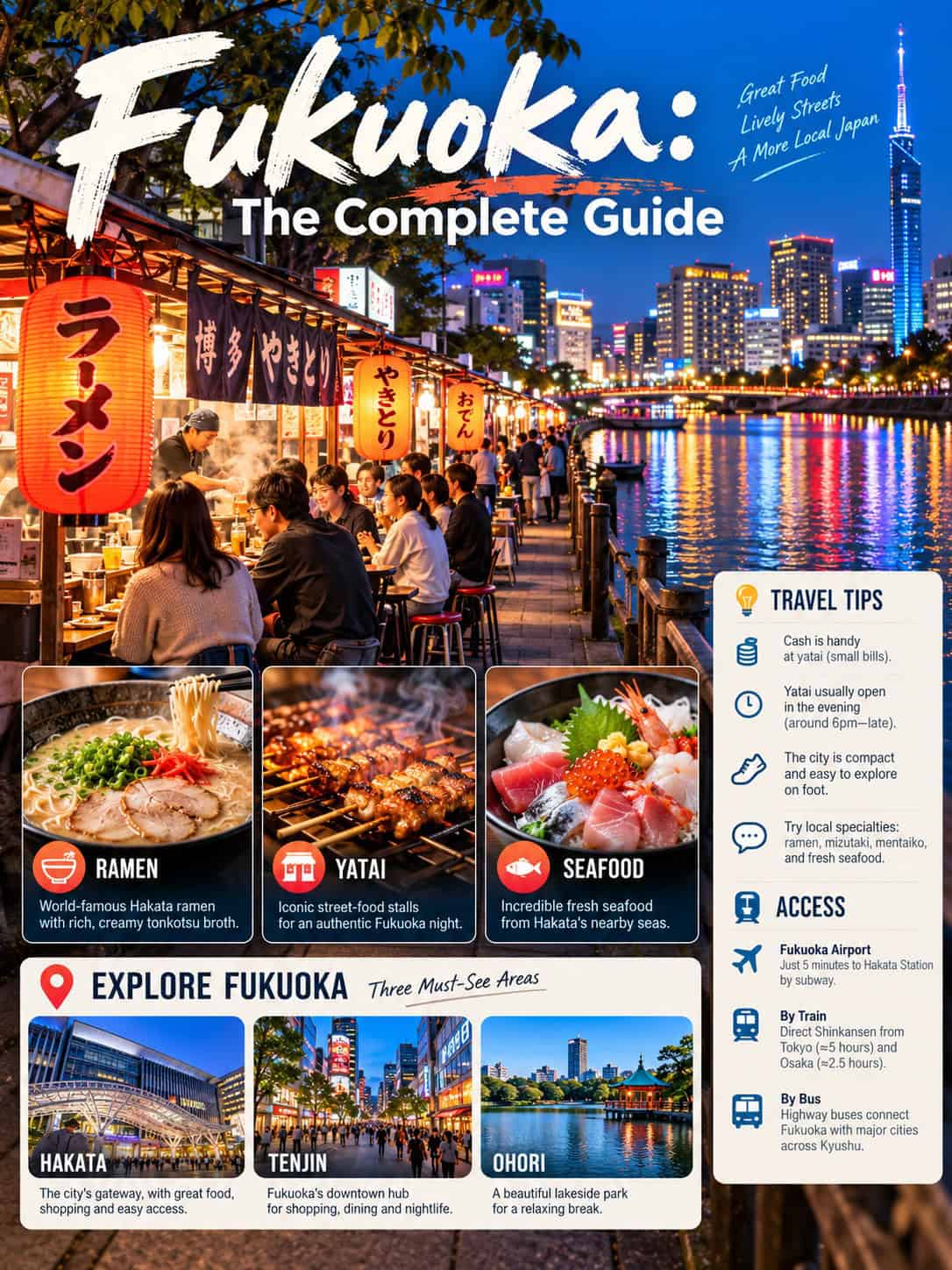
Fukuoka sits closer to Seoul than to Tokyo, and that shows in its food stalls and its role as Japan’s gateway to Asia. This guide covers the best things to do in Fukuoka, a one-day and two-day itinerary, a comparison of Hakata and Tenjin as places to stay, and realistic logistics for the airport, Dazaifu and Itoshima.
Things to Do in Fukuoka at a Glance
| Category | Details |
|---|---|
| Best for | Yatai food stalls, a castle-ruins park, a historic learning shrine and a relaxed big-city pace |
| Ideal trip length | 1 to 2 days in the city; add a half day for Dazaifu |
| From the airport | Subway to Hakata in about 5 minutes and to Tenjin in about 10 to 12 minutes |
| Getting around | Fukuoka City Subway plus Nishitetsu trains and buses |
| Best time | Late January to early March for plum blossoms, early April for Ohori Park cherry blossoms, July for Hakata Gion Yamakasa |
Hakata vs Tenjin: Where to Stay in Fukuoka
| Hakata | Tenjin | |
|---|---|---|
| Airport access | About 5 minutes by subway from the domestic terminal | About 10 to 12 minutes by subway |
| Shinkansen and trains | Directly at Hakata Station | Short subway ride to Hakata |
| Nightlife | Quieter, with izakaya around the station | Main shopping and nightlife district, near Nakasu |
| Typical 3 to 4 star room (2 adults) | Roughly ¥10,000 to ¥25,000 per night, medians about ¥14,000 to ¥18,000 | Roughly ¥9,000 to ¥27,000 per night, medians about ¥13,000 to ¥17,000 |
| Best for | Arrival day, early trains, Dazaifu by subway and train | Shopping, Ohori Park and evenings out |
Hotel prices come from a sample of 3 and 4 star hotels across several seasons and vary with events and holidays, so treat them as ranges. Autumn and festival weekends sit at the high end. For options, see our Fukuoka hotel guide.
Top Things to Do in Fukuoka
1. Ohori Park and the Fukuoka Castle Ruins
A park of roughly 40 hectares built around a large pond that was once part of Fukuoka Castle’s moat. A walking path of about 2 km circles the water, with three tree-covered islands linked by stone bridges. The park is free and open around the clock, while the Japanese Garden inside charges ¥250 for adults and ¥120 for children under 15. The garden is closed on Mondays (the next day if Monday is a national holiday) and closes at 5 PM from October to April and at 6 PM from May to September, with the last entry 15 minutes earlier. The castle, begun by Kuroda Nagamasa in 1601, survives only as ruins above the park, and cherry blossoms arrive in early April.
2. Kushida Shrine
A shrine near Canal City, best known as the spiritual center of the Hakata Gion Yamakasa festival each July, when teams race decorated floats through the streets. The grounds are free to visit and make an easy first stop in Hakata.
3. Canal City Hakata
A shopping and entertainment complex built around an indoor canal, with a fountain show every 30 to 60 minutes. The Ramen Stadium inside reopened in April 2026 after renovation, with a lineup of shops from several regions, so check the current list before you go. It is about a 10-minute walk from Hakata Station, or two minutes from Kushida Shrine-mae subway station.
4. Nakasu and the Yatai Stalls
Nakasu is a small island between Hakata and Tenjin, one of Kyushu’s largest entertainment districts, known after dark for its riverside yatai stalls. See the yatai note below for hours and caveats.
5. Fukuoka Tower
A 234-meter tower in Momochi with an observation deck 123 meters up, looking over the city and Hakata Bay. Adult admission is about ¥1,000, elementary and junior high school students pay ¥500 and children aged 4 and up pay ¥200, and it is open daily from about 9:30 to 22:00, with last entry around 21:30. It is a trip of its own: the nearest subway station is a walk of about 20 minutes, so a bus is easier. Check the hours before you go because entry can close early on busy days.
A One-Day Plan for Things to Do in Fukuoka
| Time | Stop | Getting there |
|---|---|---|
| Morning | Ohori Park | Ohori Koen Station on the Airport Line; stroll the loop and castle ruins |
| Midday | Kushida Shrine | Subway toward Hakata, then a short walk |
| Afternoon | Canal City Hakata | Short walk from Kushida Shrine; late lunch at Ramen Stadium |
| Evening | Nakasu yatai | Walk or a short ride; yatai usually open from about 6 pm |
A Two-Day Fukuoka Itinerary
Day 1 follows the one-day route above. On Day 2, go to Fukuoka Tower and Momochi Seaside Park in the morning, then take a half-day trip to Dazaifu in the afternoon. If you prefer a quieter day, swap Fukuoka Tower for Dazaifu in the morning and keep the afternoon free.
If It Rains or the Heat Is Too Much
Rain takes most of the point out of Ohori Park and the view from Fukuoka Tower, and some yatai stay closed in rain or storms. On a wet day, spend the morning under one roof at Canal City and its Ramen Stadium, then take the Dazaifu trip for the afternoon and finish in the Kyushu National Museum, which is closed on Mondays. In summer heat, walk Ohori Park and Dazaifu in the morning and keep Fukuoka Tower for the evening, when it is open until 10 PM (last entry 9:30 PM).
Yatai in Fukuoka: Hours and Caveats
Yatai are small mobile food stalls that serve ramen, skewers and oden, with roughly 100 stalls across the city, concentrated in Nakasu, Tenjin and Nagahama. Some open as early as 6 pm, but most open between 6:30 and 7 pm and close around midnight. Each stall sets its own days off, many of them irregular, and some stay closed in rain or storms, so do not plan your only dinner around one stall. Most yatai take cash only (about one in ten accepts cards), only a few take reservations, and you are expected to order at least one drink and one dish per person. Seating is limited, so a group of two or three fits best, and since the stalls are small and have no toilets, leave luggage at your hotel or in a station locker. For the full picture, see our Fukuoka food guide.
Getting to Fukuoka and Airport Transfers
| From | Route | Time |
|---|---|---|
| Fukuoka Airport (domestic terminal) | Subway to Hakata or Tenjin | 5 to 12 minutes |
| Fukuoka Airport (international terminal) | Free shuttle bus to the domestic terminal, then subway | 25 to 35 minutes to Hakata |
| Tokyo | Shinkansen to Hakata, or a flight | About 5 hours by train, about 2 hours by air |
| Osaka | Shinkansen to Hakata | About 2 hours 20 minutes |
The subway runs from about 5:30 am until around midnight, so late arrivals may need a taxi. For fares and rail passes, see the rail pass guide, and the Kyushu itinerary for onward travel.
Getting Around Fukuoka
The Fukuoka City Subway Airport Line connects the airport, Hakata, Tenjin and Ohori Koen in one run. Nishitetsu trains and buses cover routes the subway does not, including Dazaifu. An adult one-day ticket for all three subway lines (Airport, Hakozaki and Nanakuma) costs ¥640, or ¥320 for elementary school children, and is valid from the first to the last train of the day. Fukuoka is compact enough that a rental car is unnecessary for the main sights.
The Fukuoka Tourist City Pass covers one day of unlimited bus, train, subway and ferry rides: ¥2,500 for adults and ¥1,250 for children in Fukuoka City, or ¥2,800 and ¥1,400 for the version that adds Dazaifu. Only overseas visitors on a short-stay visa can buy it, with a passport, at counters such as Hakata Bus Terminal, the Hakata Station General Information Center, Nishitetsu Fukuoka (Tenjin) Station and the bus terminals at Fukuoka Airport. It is not valid on the Dazaifu Liner Bus Tabito. The ¥640 subway ticket covers the subway only, so the pass makes sense on a day that also includes buses, the ferry or the Dazaifu trip.
What Sightseeing Costs in Fukuoka
| Item | Adult | Younger visitors | Notes |
|---|---|---|---|
| Ohori Park | Free | Free | Castle ruins above the park |
| Ohori Japanese Garden | ¥250 | ¥120 under 15 | Closed Mondays |
| Fukuoka Tower | ¥1,000 | ¥500 elementary and junior high, ¥200 ages 4 and up | Open to 10 PM |
| Dazaifu Tenmangu grounds | Free | Free | Museums on the grounds charge separately: see venue |
| Kyushu National Museum | ¥700 | ¥350 high school and university | Closed Mondays |
| Subway one-day ticket | ¥640 | ¥320 elementary school | All three subway lines |
| Tourist City Pass with Dazaifu | ¥2,800 | ¥1,400 | Overseas visitors only |
More Things to Do in Fukuoka: Dazaifu and Itoshima Day Trips
Dazaifu Tenmangu
A shrine dedicated to Sugawara no Michizane, the deified scholar and god of learning, with over 6,000 plum trees that usually bloom from late January into early March, depending on the weather. Reach it from Nishitetsu Fukuoka (Tenjin) Station in about 25 to 40 minutes, usually changing at Futsukaichi, with a fare of roughly ¥480 each way. Some sightseeing trains run directly on selected days. The shrine is a short walk from Dazaifu Station and is free to enter. The grounds open around 6:30 AM and close at 6:30 PM from December to March, 7:30 PM from June to August and 7 PM in the other months; the museums on the grounds stop admitting visitors at 4 PM.
Getting to Dazaifu
| From | Route | Time |
|---|---|---|
| Nishitetsu Fukuoka (Tenjin) Station | Nishitetsu Tenjin-Omuta Line, change at Nishitetsu-Futsukaichi to the Dazaifu Line | About 30 minutes |
| Hakata Station | Bus from Hakata Bus Terminal next to the station, running frequently | About 40 minutes |
| Hakata Station | Subway to Tenjin, walk to Nishitetsu Fukuoka Station, then the Nishitetsu line | About 50 minutes |
| Fukuoka Airport | Bus from outside the international terminal; tickets at the Bus Information Counter in arrivals | About 25 minutes |
At the change, use Nishitetsu-Futsukaichi Station, not JR Futsukaichi Station; the two are under 15 minutes apart on foot. From Dazaifu Station the shrine is a 5-minute walk and the Kyushu National Museum is a 10-minute walk. The museum is the rainy-day add-on: adult admission is ¥700 (¥350 for high school and university students), hours are 9:30 AM-5:00 PM with last entry at 4:30 PM, and it is closed on Mondays (the next day when Monday is a national holiday).
Itoshima: Only If You Have the Time
Itoshima’s beaches and Shiraito Falls are realistic only with careful planning. By train, go to Chikuzen-Maebaru and then use local buses that can be infrequent, or take a highway bus to Sakurai Futamigaura in about an hour. Return buses may run every 30 to 60 minutes, so build in waiting time or consider a tour.
Best Time for Things to Do in Fukuoka
Late January to early March brings plum blossoms at Dazaifu, and early April brings cherry blossoms to Ohori Park. July’s Hakata Gion Yamakasa festival fills the streets around Kushida Shrine. Summer is hot and humid, and winter is comparatively mild. See the seasons guide.
Frequently Asked Questions
How long does it take to get from Fukuoka Airport to the city?
The subway reaches Hakata Station in about 5 minutes and Tenjin in about 10 to 12 minutes. The subway station is attached to the domestic terminal, while international arrivals use a free shuttle bus first, so allow 25 to 35 minutes from the international terminal to Hakata.
Should I stay in Hakata or Tenjin?
Stay in Hakata for the shortest airport and Shinkansen connections, and in Tenjin for shopping, nightlife and easy access to Ohori Park. Hotel prices are similar, so choose by transport and atmosphere.
Are the yatai stalls open every night?
No. Stalls are independent and set their own hours and days off. Most open between 6:30 and 7 pm and close around midnight, but days off are irregular and some stalls stay closed in rain or storms, so keep a backup plan.
Can Dazaifu be visited as a day trip from Fukuoka?
Yes. It is about 25 to 40 minutes by Nishitetsu train from Tenjin, usually with a change at Futsukaichi, and fits into a half day. Some sightseeing trains run direct on selected days.
Is Itoshima a realistic day trip without a car?
It is possible but slower than Dazaifu. You need a train to Chikuzen-Maebaru or a highway bus, then local buses that can be infrequent, so choose one or two sights or join a tour.
How many days do I need in Fukuoka?
One full day covers Ohori Park, Kushida Shrine, Canal City and Nakasu. Two days lets you add Fukuoka Tower and Dazaifu without rushing.
How do I get from Tokyo to Fukuoka?
By Shinkansen it takes about 5 hours, and flying takes roughly 2 hours in the air. Airport transfers narrow the gap, so compare door-to-door time and fares.
Bottom Line
Fukuoka rewards travelers who give it more than a layover. Stay in Hakata for transport or Tenjin for evenings, spend a day on Ohori Park, Kushida Shrine, Canal City and Nakasu, and add Dazaifu if you have another half day. For nearby cities, see the Nagasaki guide.