By Nippon With Me EditorialPublished Updated
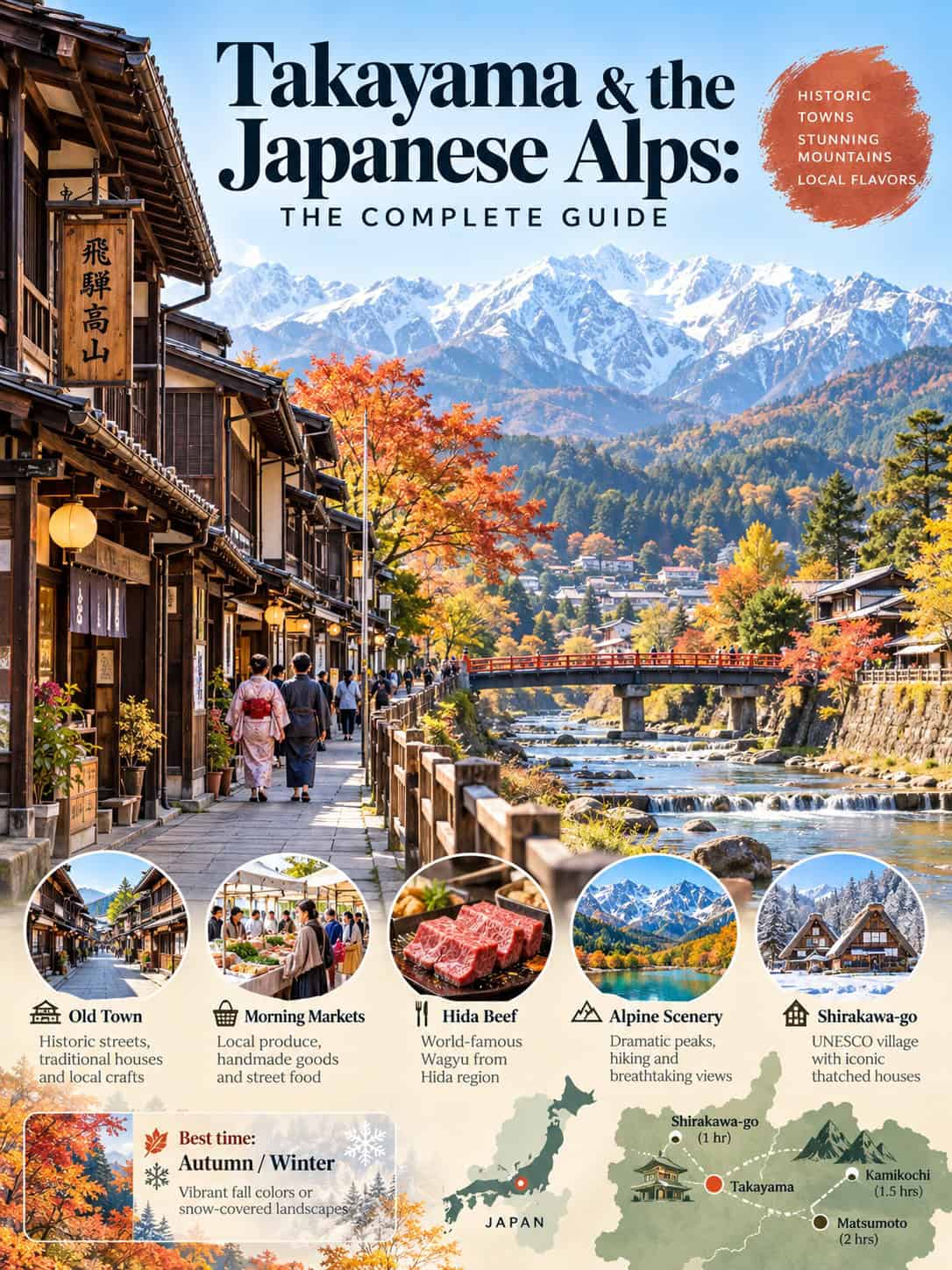
Discover things to do in Takayama, including Sanmachi Suji Old Town, two morning markets, Takayama Jinya, Hida Folk Village and the historic spring and autumn festivals. This Takayama travel guide also covers a separate day trip to Shirakawa-go or Kamikochi, depending on the season, with sightseeing costs, transport and a realistic two- or three-day route, including the seasonal closure and private-car ban that catch some first-time visitors off guard.
Things to Do in Takayama: Quick Planning Facts
| Category | Details |
|---|---|
| Best for | Preserved Edo-period streets, Hida beef, mountain scenery, a slower pace than Japan’s major cities |
| Ideal trip length | 2 days in Takayama, or 3 days with a day trip to Kamikochi |
| Getting there | From Nagoya: JR Hida limited express, ~2.5 hours; From Tokyo: several routes, 4.5-5.5 hours |
| Getting to Kamikochi | Bus only (private cars banned); open mid-April to mid-November only |
| Best time to visit | April-May and October-November for comfortable weather and color; winter brings snow and fewer crowds |
| Currency | Japanese yen (¥) |
Takayama’s Districts: Where to Go
Sanmachi Suji Old Town
The historic merchant quarter at the heart of a Takayama visit, its narrow streets lined with dark-wood Edo-period buildings now holding sake breweries, craft shops, and restaurants. Most first-time visitors spend the bulk of a day here.
Takayama Station Area
Takayama Station and the adjacent Nohi Bus Center provide convenient access to hotels and regional buses. Both morning markets lie within the historic town, roughly 10 to 15 minutes’ walk from the station, rather than directly beside the platforms.
Hida Folk Village Area
A short bus or taxi ride from central Takayama, this outlying area is built around Hida Folk Village’s open-air collection of relocated traditional farmhouses, with mountain views in every direction.
Things to Do in Takayama: Old Town and Museums
Sanmachi Suji Old Town
Free to wander at any time, this is Takayama’s best-preserved stretch of Edo-period streetscape, with several sake breweries offering tastings and dark-wood merchant houses now serving as shops and small museums. Our Kanazawa travel guide makes a natural pairing.
Takayama Jinya
A former government office building dating to the Edo period, one of the only such buildings still standing in Japan. Admission is ¥500 for individual adults (free for visitors aged 18 and under), with hours running 8:45am to 5:00pm from April through October and 8:45am to 4:30pm from November through March; closed December 29 through January 3. The ticket window closes 30 minutes before the building does.
Takayama’s Morning Markets
Takayama has two free-to-browse morning markets. The tourist office lists Jinya-mae Market at 7 AM–noon in April–October and 8 AM–noon in November–March. Miyagawa Market runs 7 AM–noon in April–November and 8 AM–noon in December–March. Stall numbers can drop to about ten in rain or winter, and the markets wind down by early afternoon, so visit early.
Hida Folk Village (Hida no Sato)
Hida Folk Village displays more than 30 traditional buildings, including gassho-zukuri farmhouses relocated from around the Hida region, many with steep thatched roofs built to shed heavy snow. Admission is ¥700 for adults and ¥200 for elementary or junior-high students, and it opens 8:30 AM–5 PM daily. A visit takes roughly two hours, and a Sarubobo Bus connection takes around ten minutes from the station; the fare is ¥210 one way from the Nohi Bus Center to the Hida-no Sato-Shita stop, and the village is open every day of the year.
Kamikochi
Kamikochi is a scenic high-altitude valley around 1,500 metres above sea level, framed by the Hotaka mountain range, with Kappabashi Bridge, Taisho Pond and walks along the Azusa River. Entry to the valley is free. Private cars cannot enter the central visitor zone, so use a bus or authorised taxi. Regular sightseeing transport typically runs from mid-April until November 15, and exact opening dates and winter access arrangements should be checked each year.
Takayama’s Sake Breweries
Several working sake breweries sit directly inside Sanmachi Suji Old Town, recognizable by the ball-shaped cedar bundles (sugidama) hanging over their entrances, which darken over the brewing season as a visual sign the sake inside is maturing. Most offer small, inexpensive tastings and sell bottles on the spot, and a short walk between two or three breweries makes for an easy, free-to-browse addition to an old town visit.
Where to Stay
Near Takayama Station is the most practical base, within easy walking distance of the old town and close to the bus terminal for day trips.
Sanmachi Suji Old Town has a small number of traditional ryokan and guesthouses for travelers who want to stay inside the historic streets themselves.
Travelers planning a Kamikochi day trip sometimes base themselves in Matsumoto instead, given Matsumoto’s own direct bus connections to the valley — worth weighing against staying in Takayama if Kamikochi is the main draw. Our Matsumoto travel guide is another good stop in the Alps.
Getting to Takayama
From Nagoya, the JR Hida limited express covers the route in about 2.5 hours, with fares around ¥5,610 unreserved or ¥6,140 reserved. From Tokyo, there’s no single best route: the Tokaido Shinkansen to Nagoya followed by the JR Hida takes about 4.5 hours for around ¥16,000 (partly covered by the Japan Rail Pass); the Hokuriku Shinkansen to Toyama followed by the JR Hida takes 4 to 5 hours for a similar fare, though only a couple of daily connections make the trip in close to 4 hours; a train-and-bus combination via Matsumoto takes about 5.5 hours for around ¥11,020; and a highway bus direct from Busta Shinjuku (run by Keio and Nohi Bus) takes about 5.5 hours for around ¥8,000, with an overnight option on some schedules.
Takayama Travel Guide: Train and Bus Options
| Route | Approximate duration | Adult fare |
|---|---|---|
| Nagoya to Takayama, JR Hida | 2h30 | About ¥5,610 unreserved or ¥6,140 reserved |
| Nagoya to Takayama, highway bus | 2h30–2h45 | Check the operator’s current fare |
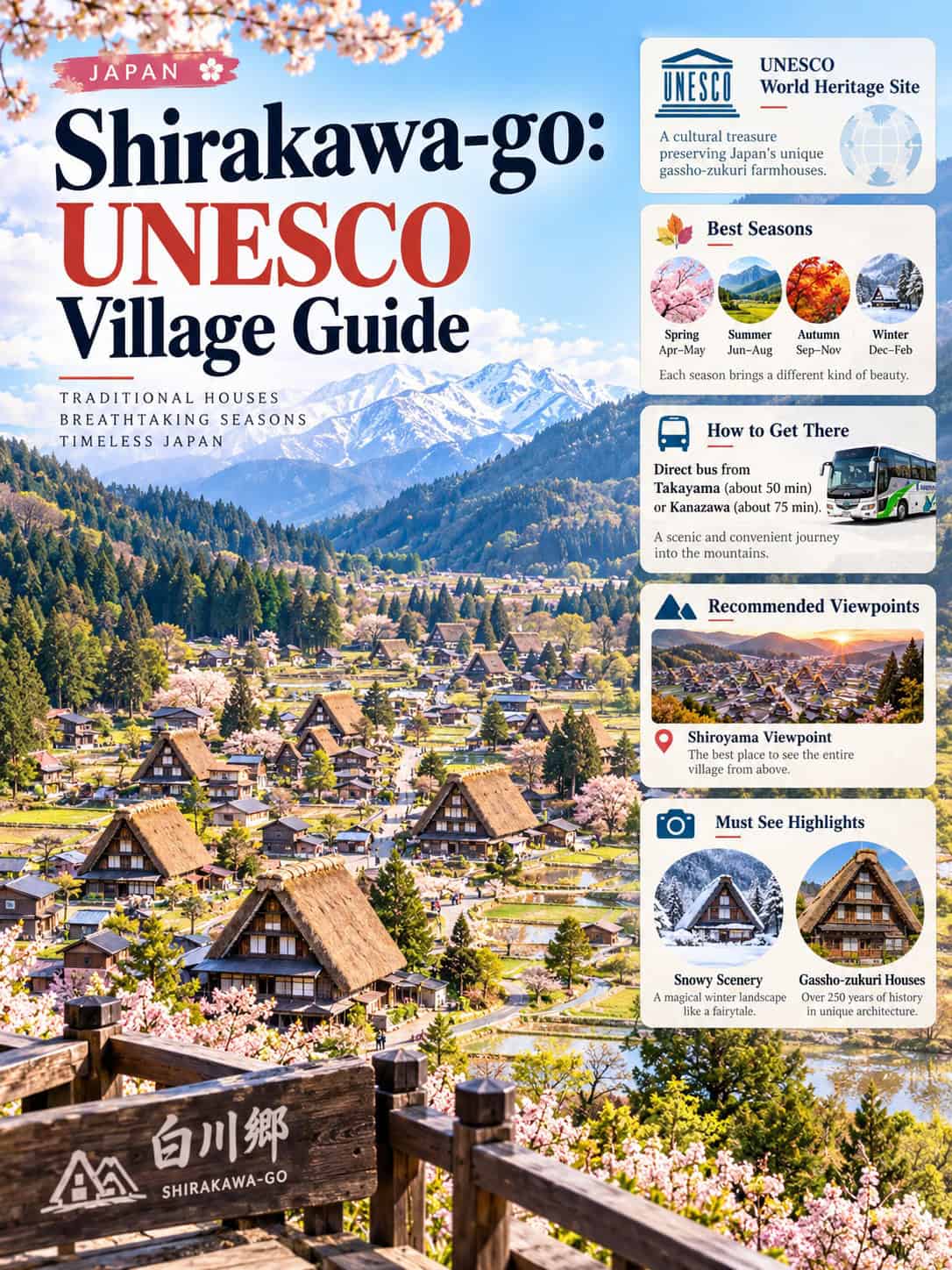
| Takayama to Shirakawa-go, bus | 50 minutes | ¥2,800 one way |
| Shirakawa-go to Kanazawa, bus | About 75 minutes | ¥2,800 one way |
Takayama has no Shinkansen station. Compare JR Hida and highway bus schedules before deciding on an arrival city. Some Nohi buses require reservations; those departures can be booked one month ahead, and mobile tickets work only on the unreserved buses. Nohi Bus also runs through to Kanazawa Station West Exit for ¥4,200 one way from Takayama. Fares and timetables change on December 1, 2026, so the ¥2,800 and ¥5,600 figures here apply to rides before that date.
Check Japan train connections.
Getting to Kamikochi
Private cars are banned from Kamikochi’s central zone, so access is by bus or taxi only, typically after parking at a gateway town and transferring. From Takayama, use the Nohi Bus connection via Hirayu Onsen, where a transfer is required; the through ticket costs ¥3,000 one way or ¥5,800 round trip (valid 7 days) for adults, and the ride takes about 90 minutes, the last 30 of them from Hirayu Onsen. Every seat is first come, first served, so busy days such as Obon and the autumn holidays can mean waiting for a later bus. From Matsumoto, the Matsumoto Electric Railway reaches Shin-Shimashima (30 minutes), followed by a bus to Kamikochi (about 60 minutes), and a few direct buses also run from Matsumoto Bus Terminal, with reservations opening about a month ahead. Regular Kamikochi buses and facilities run from mid-April to November 15, so these routes do not operate in winter.
Children under 12 pay the child fare on the through bus from Takayama, which is ¥1,500 one way or ¥2,900 round trip, and infants under 1 ride free. A round trip between Hirayu Onsen and Kamikochi alone is ¥2,800. Buy tickets in advance at the window or vending machine at the Takayama Nohi Bus Center or Hirayu Onsen; if those are closed, you can pay on board. Pets are not allowed in Kamikochi except guide and assistance dogs, and bear spray must be sealed in a plastic bag and stored in the luggage trunk rather than carried on a seat.
Japanese Alps Travel Guide: Kamikochi Planning
From Kamikochi Bus Terminal, walk to Kappabashi Bridge for river and mountain views. Taisho Pond takes longer to reach. Start early if you plan to return to Takayama on the same day, and note that valley admission is free while bus fares are not.
Browse Japanese Alps sightseeing tours.
Getting Around Takayama
Central Takayama, including Sanmachi Suji Old Town, Takayama Jinya, and both morning markets, is entirely walkable from the station. Hida Folk Village is a short bus or taxi ride from the station for travelers who’d rather not walk the roughly 25-30 minutes each way. See our Shirakawa-go guide for the thatched-roof village nearby.
Walking times from Takayama Station: about 15 minutes to Miyagawa Morning Market, 17 minutes to the Kusakabe Folk Museum and the Yoshijima Heritage House, and 20 minutes to the Festival Floats Exhibition Hall. The Higashiyama Walking Course is about 4 km long, running from Ryuunji Temple to Shiroyama Park, and its start is a 20-minute walk from the station.
Best Time to Visit Takayama and the Japanese Alps
Visit Takayama on April 14–15 for the spring Sanno Festival or October 9–10 for the autumn Hachiman Festival. Cherry blossoms often peak in mid-to-late April in town, and higher-elevation foliage starts earlier in autumn than leaves in the city. Kamikochi’s regular visitor season runs approximately from mid-April to November 15, subject to annual notices, and summer is comfortably cooler in Takayama than in Japan’s major lowland cities. Winter brings snow and fewer visitors to the old town; regular Kamikochi buses and tourist facilities close, although specialist winter mountain travel is a different matter from normal sightseeing.
Things to Do in Takayama by Season
| When | Highlights | Planning tip |
|---|---|---|
| April 14–15 | Spring Takayama Festival | Book accommodation early |
| May–August | Markets, Kamikochi, green mountain scenery | Check seasonal buses |
| October 9–10 | Autumn Takayama Festival | Street closures are common |
| Late October–November | City autumn foliage | Mountain colours arrive earlier |
| December–March | Snowy Old Town and Hida Folk Village | No ordinary Kamikochi tourist bus |
A Simple 2-Day Takayama Starting Point
Day 1: One of the morning markets at opening time, then Sanmachi Suji Old Town through the late morning and afternoon, including a sake brewery stop, followed by Takayama Jinya.
Day 2: Visit Hida Folk Village in the morning, then explore the Higashiyama temple district or spend more time in Sanmachi. Give Kamikochi its own Day 3 rather than beginning a mountain valley excursion after lunch.
Travelers adding Kamikochi should treat it as effectively its own day given the bus transfers involved, which is why a 3-day visit is the more comfortable version of this itinerary rather than squeezing it into day 2.
If It Rains in Takayama
The morning markets and the old town streets are outdoors, so on a wet day put the indoor sights first: Takayama Jinya, the Festival Floats Exhibition Hall, the Kusakabe Folk Museum and the Yoshijima Heritage House. Hida Folk Village is an open-air collection, so it suits a drier day. From December to February the Kusakabe and Yoshijima buildings close on Tuesdays, and they close 30 minutes earlier than in the warmer months.
Takayama Old Town: Two-Day Walking Itinerary
Day 1, 8 AM: Browse a morning market, then visit Takayama Jinya. Walk Nakabashi Bridge, Sanmachi Suji and nearby brewery shops, then try Hida beef or local ramen at lunch.
Day 2, 8:30 AM: Tour Hida Folk Village, return to the centre and follow the Higashiyama walking route or visit craft shops. Allow time to collect luggage before departure.
Optional Day 3: Make a full-day bus excursion to Kamikochi or Shirakawa-go. Choose one rather than squeezing both into the same day.
Things to Do in Takayama: Simple Budget
| Item | Adult amount |
|---|---|
| Takayama Jinya | ¥500 |
| Hida Folk Village | ¥700 |
| Both museums combined | ¥1,200 |
| Shirakawa-go bus, return | ¥5,600 optional |
Food, accommodation, in-town transfers and Kamikochi bus fares are additional costs.
Takayama Sightseeing Admission and Hours
Beyond Takayama Jinya and Hida Folk Village, there are three more paid sights nearby that are worth knowing about when you plan a rainy or off-season day. Prices are per person, with the child rates the venues list.
| Sight | Adult | Child | Hours | Closed |
|---|---|---|---|---|
| Takayama Jinya | ¥500 | Free for ages 18 and under | 8:45 to 17:00 April to October, 8:45 to 16:30 November to March | December 29 to January 3 |
| Hida Folk Village | ¥700 | ¥200 (elementary and junior high) | 8:30 to 17:00 | Open all year |
| Takayama Festival Floats Exhibition Hall | ¥900 | ¥550 senior high, ¥450 junior high | 9:00 to 17:00 March to November, 9:00 to 16:30 December to February | See venue |
| Kusakabe Folk Museum | ¥500 | ¥300 (elementary and junior high) | 9:00 to 16:30 March to November, 9:00 to 16:00 December to February | Tuesdays from December to February |
| Yoshijima Heritage House | ¥500 | ¥300 (elementary and junior high) | 9:00 to 17:00 March to November, 9:00 to 16:30 December to February | Tuesdays from December to February; December 29 to January 1 |
Day Trip: Kamikochi
A Kamikochi day trip from Takayama means an early start, since the Hirayu Onsen transfer alone takes about an hour before the final bus leg into the valley, but it rewards travelers with some of the Japanese Alps’ most accessible high-mountain scenery, including the Kappabashi suspension bridge and marked trails along the Azusa River. Because regular buses run only from mid-April to November 15, this day trip is not possible in winter, and travelers visiting then should plan around Takayama and Hida Folk Village instead. Our guide to the best time to visit Japan compares the seasons.
Food in Takayama
Hida beef, a wagyu variety raised in the surrounding Hida region, is the area’s signature food, commonly served as skewered grilled cubes from old-town street stalls or as a full sukiyaki or steak dinner at a restaurant. Takayama ramen (also called Hida ramen), a soy-based broth with thin curly noodles, is a distinct regional style worth trying alongside the more famous beef. The old town’s sake breweries, recognizable by the cedar balls (sugidama) hanging outside, often offer small tastings, since the region’s cold mountain water and climate suit sake production well.
Practical Tips for First-Time Visitors
Kamikochi’s regular season ends in mid-November and reopens in mid-April, which is easy to miss when planning around Takayama alone, so travelers set on seeing both should check the current season’s exact reopening date. The private-car ban at Kamikochi applies to everyone, including rental cars, so the drive there always ends at a gateway parking lot followed by a bus or taxi transfer. Reservations for the Matsumoto-side Kamikochi buses open about a month ahead and are worth booking early during the April–May and October–November peaks. For rail passes and packing, see our Japan Rail Pass guide and Japan packing list, and read our Japanese food guide for Hida beef and other regional dishes.
Things to Do in Takayama: Frequently Asked Questions
How many days do I need for Takayama?
Two full days covers Takayama’s old town, Takayama Jinya, and Hida Folk Village comfortably. Adding a Kamikochi day trip is better treated as a third day, given the bus transfers involved.
Can I drive to Kamikochi?
No — private cars, including rental cars, are banned from the valley entirely. Access is only by bus or taxi after parking at a gateway town like Hirayu Onsen or Shin-Shimashima.
Is Kamikochi open year-round?
Not for ordinary tourist visits. The main buses and visitor facilities normally operate from about mid-April until November 15; winter alpine access requires special preparation and should not be confused with standard sightseeing.
What’s the best way to get to Takayama from Tokyo?
There’s no clear single best option — the train via Nagoya or Toyama takes around 4.5 to 5 hours for about ¥16,000, while the direct highway bus from Shinjuku takes about 5.5 hours for roughly ¥8,000. The choice mostly comes down to budget versus travel time.
Is Takayama worth visiting if I’m also going to Shirakawa-go?
Yes — the two are commonly paired, since Takayama is the most practical base for a Shirakawa-go day trip, but Takayama’s own old town, Hida Folk Village, and food scene are substantial enough to deserve dedicated time on their own.
Do I need to book Kamikochi bus seats in advance?
Reservations are not needed on the Nohi Bus connection from Takayama via Hirayu Onsen, but the Matsumoto-side buses do take reservations, opening about a month ahead. Book early during the spring and autumn peaks.
What are the best things to do in Takayama?
Explore Sanmachi Suji, both morning markets, Takayama Jinya and Hida Folk Village. Add Higashiyama’s temples if you have more time.
What time do Takayama morning markets open?
The tourist office lists morning opening at 7 AM in warmer months and 8 AM in winter, with closing at noon. The exact seasonal cutoff differs by market.
How much is Hida Folk Village admission?
¥700 for adults and ¥200 for elementary and junior-high pupils, with daily hours of 8:30 AM–5 PM.
When are the Takayama festivals?
The spring Sanno Festival takes place April 14–15 and the autumn Hachiman Festival October 9–10 each year.
How much is the bus to Shirakawa-go?
Nohi Bus lists ¥2,800 one way from Takayama, with some departures requiring reservations.
Can you visit Takayama in winter?
Yes. The town and Hida Folk Village remain open attractions, but standard Kamikochi visitor buses stop for winter.
Bottom Line
Takayama rewards two days focused on Sanmachi Old Town, the morning markets, Takayama Jinya and Hida Folk Village. Add a third day for Kamikochi during its visitor season or for the UNESCO village of Shirakawa-go.