By Nippon With Me EditorialPublished Updated
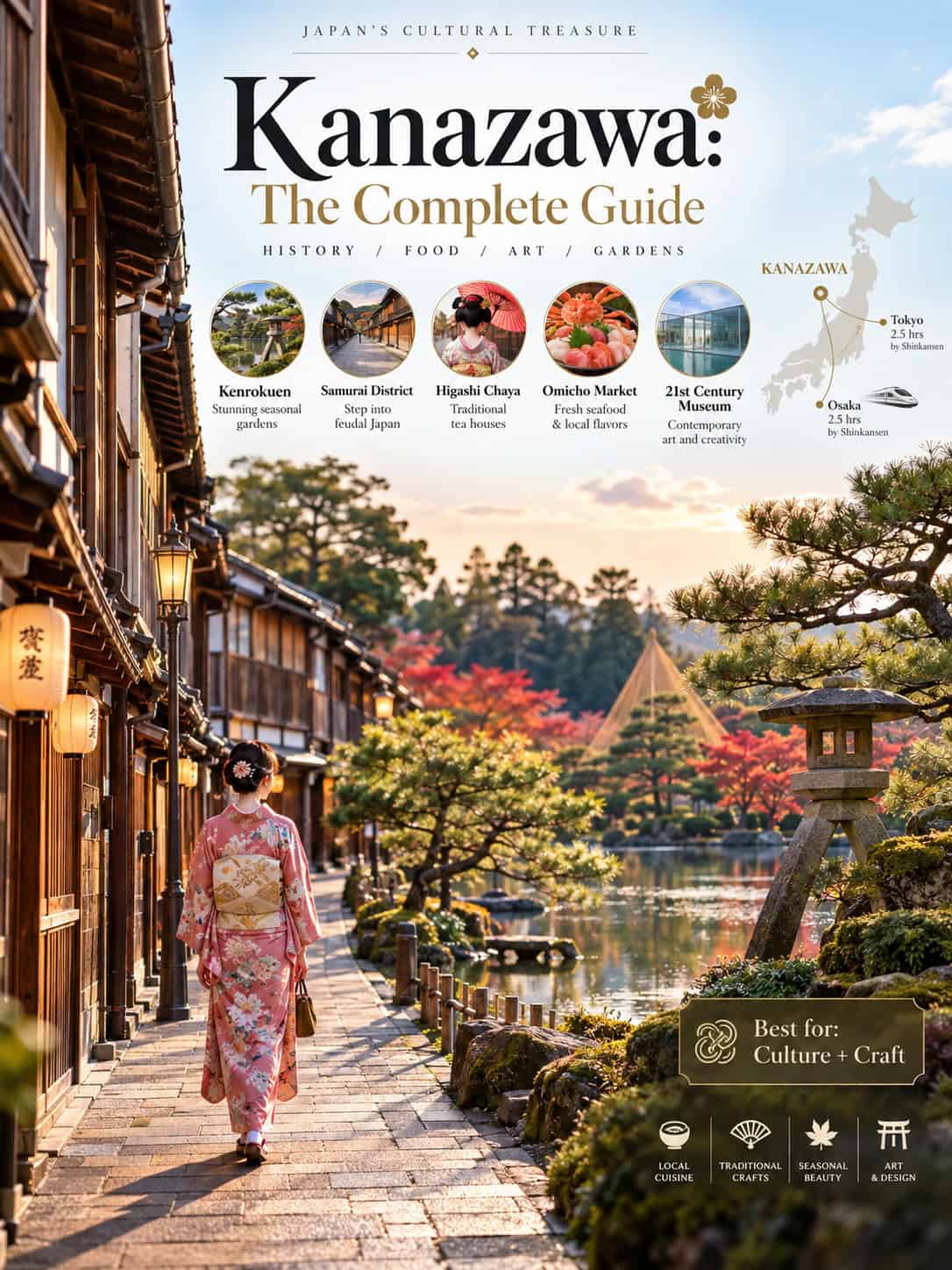
Kanazawa escaped the wartime bombing that reshaped most of Japan’s big cities, so its samurai lanes, geisha teahouses and castle grounds remain largely intact. This guide covers the best things to do in Kanazawa, from Kenrokuen Garden to Omicho Market, with a walkable one-day route, a two-day plan, a transport table for Tokyo, Kyoto and Osaka, and a comparison with Kyoto.
Kanazawa at a Glance
| Category | Details |
|---|---|
| Best for | Historic gardens, samurai and geisha districts, seafood, contemporary art, gold leaf craft |
| Ideal trip length | 2 days; 1 long day works if you pick the highlights |
| Getting there | Tokyo: direct Hokuriku Shinkansen. Kyoto and Osaka: Thunderbird to Tsuruga, then the Shinkansen |
| Getting around | Walking plus the Kanazawa Loop Bus (¥220 per ride) |
| Best time | April for cherry blossoms, November for autumn color, winter for snow and fewer crowds |
The Best Things to Do in Kanazawa: Districts at a Glance
Kenrokuen and the Castle Area
The historic core, with Kenrokuen Garden and Kanazawa Castle Park facing each other across the moat. Most first-time visitors spend the morning here.
Higashi Chaya District
A preserved geisha teahouse district with wooden lattice facades, now holding cafes, gold leaf shops and a few teahouses open to visitors.
Nagamachi Samurai District
A former samurai quarter with earthen walls and narrow lanes near the city center, including the Nomura Samurai Family Residence.
Omicho Market Area
Kanazawa’s main market district, built around seafood from the Sea of Japan and said to date back about 300 years.
Nishi Chaya District
A smaller, quieter counterpart to Higashi Chaya on the other side of the river, with a similar teahouse streetscape and fewer visitors.
Top Things to Do in Kanazawa
1. Kenrokuen Garden
Counted among Japan’s three great gardens, Kenrokuen was developed over nearly two centuries by the Maeda clan and includes ponds, streams and Japan’s oldest fountain powered by natural water pressure. Adult admission is ¥320, children aged 6 to 17 pay ¥100 and visitors aged 65 and over enter free with ID. Hours are 7:00 to 18:00 from March to mid-October and 8:00 to 17:00 from mid-October through February, every day of the year. Early-morning entry is free through the Renchi-mon and Zuishinzaka gates only: from 4:00 in April through August, from 5:00 in March, September and October, and from 6:00 from November to February. You must be out of the garden 15 minutes before regular opening. Special evening openings happen in some seasons. The ticket gate takes cash only, and a Kenrokuen+1 ticket at ¥500 covers the garden plus one other cultural facility in the city.
2. Kanazawa Castle Park
The former seat of the Maeda clan, partly rebuilt after a series of fires. The park grounds are free. Entering the reconstructed Hishi Yagura, Gojukken Nagaya storehouse and Hashizume-mon Tsuzuki Yagura costs about ¥320 for adults, with hours of about 9:00 to 16:30 and last entry at 16:00. Children aged 6 to 17 pay ¥100, infants are free, and visitors aged 65 and over enter free with ID.
3. Omicho Market
A covered market of roughly 170 to 185 stalls selling seafood, produce and prepared food, with counter restaurants serving sushi and rice bowls. It is free to wander, shops generally open around 9:00, and many close by late afternoon. Some vendors close on Wednesdays and Sundays, so check before planning your lunch here.
4. Higashi Chaya District and Its Teahouses
Several preserved teahouses are open to visitors, some to view their interiors and others for tea and sweets. Gold leaf shops and gold-dusted treats are a local specialty, since Kanazawa produces most of Japan’s gold leaf. Two of the best-known interiors are SHIMA (¥500 for adults and ¥300 for ages 16 and under, open every day from 9:30 to 17:30 from March to November and until 17:00 from December to February) and Kaikaro (¥750 for adults, ¥500 for ages 7 to 18, free under age 6, open 10:00 to 17:00 on irregular closing days). Tea and sweets cost extra at both. From the Loop Bus, get off at Hashiba-cho, about a 5-minute walk away.
5. Nagamachi and the Nomura Samurai Family Residence
This restored samurai home has an attached garden regarded as one of the city’s finest. Admission is ¥550 for adults, with hours of 8:30 to 17:30 from April to September and 8:30 to 16:30 from October to March, last entry 30 minutes before closing. It closes on December 26 and 27 and the first days of January, and cards are not accepted.
6. 21st Century Museum of Contemporary Art
A circular, glass-walled museum best known for “The Swimming Pool” installation. Part of the building and some exhibitions are free, while special exhibitions and the underwater section of the pool need tickets, and the underground space has its own same-day waiting list. Advance reservations are not accepted: join the list online or at the machine by the Honda Street entrance from 9:00 until 17:30 (19:30 on Fridays and Saturdays), then go to Exhibition Room 6 when your number is called. Time underground is limited to 5 minutes. The museum is scheduled to close from May 6, 2027 until March 2028. Check the museum’s calendar for closing days and for any temporary closures.
7. Oyama Shrine
A shrine to Maeda Toshiie, the clan founder, noted for a three-story gate that mixes Japanese, Chinese and Dutch influences. The grounds are free and a short walk from Omicho Market and the castle area.
8. Nishi Chaya District
A calmer alternative to Higashi Chaya if you want a similar streetscape with less crowding, easy to add on a second day.
A One-Day Kanazawa Route on Foot and by Loop Bus
This route follows Omicho Market, Kenrokuen, the castle, Higashi Chaya and Nagamachi. Distances are approximate, and the Kanazawa Loop Bus (¥220 per ride, with a day pass available at ¥800) fills the longer gaps.
| Time | Stop | Getting there |
|---|---|---|
| 8:30-10:30 | Omicho Market | Start with breakfast or an early seafood bowl; stalls open around 9:00 |
| 10:45-12:30 | Kenrokuen Garden | About a 20-minute walk from the market, or a short Loop Bus ride |
| 12:30-14:00 | Kanazawa Castle Park | Next to Kenrokuen across the moat; the gates connect the two on foot |
| 14:30-16:30 | Higashi Chaya District | Loop Bus from the castle area, or a walk of 20 to 30 minutes |
| 16:30 onward | Nagamachi | Loop Bus or taxi back toward the center; the Nomura residence closes at 16:30 or 17:30 |
One tip for winter and shoulder-season days: the Nomura residence closes at 16:30 from October to March, so swap Nagamachi earlier in the day if you want to go inside.
What the One-Day Route Costs
Most of the day is free, and the paid stops are the garden, the castle buildings, a teahouse interior and the Nomura residence. Prices below are per adult and per child where a child price is listed.
| Stop | Adult | Child | Good to know |
|---|---|---|---|
| Omicho Market | Free to enter | Free to enter | Meals and snacks are extra |
| Kenrokuen Garden | ¥320 | ¥100 (ages 6 to 17) | Cash only; free before opening at two gates |
| Kanazawa Castle Park buildings | ¥320 | ¥100 (ages 6 to 17) | Grounds are free; buildings open 9:00 to 16:30 |
| SHIMA teahouse, Higashi Chaya | ¥500 | ¥300 (16 and under) | Tea and sweets cost extra; open every day |
| Kaikaro teahouse, Higashi Chaya | ¥750 | ¥500 (ages 7 to 18) | Free under age 6; tea costs extra; closed on irregular days |
| Nomura Samurai Family Residence | ¥550 | See venue | Cards not accepted |
| 21st Century Museum | See venue | See venue | Some areas are free; the Swimming Pool underground needs a ticket |
| Kanazawa Loop Bus | ¥220 per ride | ¥110 per ride | Day pass ¥800 for adults and ¥400 for children |
If It Rains in Kanazawa
Rain does not have to cancel the day, because the best wet-weather stops are indoors. Swap the garden walk for the reconstructed castle buildings (¥320, open 9:00 to 16:30), the Nomura residence (¥550), and the teahouse interiors in Higashi Chaya, where SHIMA is open every day and Kaikaro is open 10:00 to 17:00. The 21st Century Museum has free areas and is a good fit for the afternoon. Then do Kenrokuen in whatever dry spell you get, since the garden is open every day of the year.
1-Day and 2-Day Kanazawa Itineraries
| Plan | What to do |
|---|---|
| 1 day | Omicho Market, Kenrokuen, the castle park and Higashi Chaya, then dinner back near the station. Skip the museum and Nagamachi unless you are quick. |
| 2 days, Day 1 | Kenrokuen and the castle in the morning, Omicho Market for lunch, Oyama Shrine on the way, then the 21st Century Museum in the afternoon |
| 2 days, Day 2 | Nagamachi and the Nomura residence in the morning, then Higashi Chaya for teahouses, gold leaf and an early dinner. Swap in Nishi Chaya if you prefer quiet. |
Getting to Kanazawa from Tokyo, Kyoto and Osaka
The Hokuriku Shinkansen reaches Kanazawa directly from Tokyo, but Kyoto and Osaka need a transfer. The Thunderbird limited express no longer continues to Kanazawa, so you ride it to Tsuruga and change to the Shinkansen. Timetables change every March, so check the current schedule, and note that Japan Rail Pass holders still need a seat reservation on the Shinkansen leg.
| From | Route | Typical time | Notes |
|---|---|---|---|
| Tokyo | Kagayaki on the Hokuriku Shinkansen, direct | About 2.5 hours | Reserved fares are around ¥14,000-15,000; check the current fare |
| Kyoto | Thunderbird to Tsuruga, then the Shinkansen | About 2 hours | Roughly ¥6,500-7,700 depending on ticket type; the transfer at Tsuruga is short |
| Osaka | Thunderbird to Tsuruga, then the Shinkansen | A little under 3 hours | The Thunderbird leg alone is about 85 minutes; confirm the total fare when booking |
If you are weighing the city against other regions, the Tokyo-Kyoto bullet train guide and the rail pass guide explain ticketing, and the Takayama guide and the Shirakawa-go guide show a natural onward route into the mountains.
Getting Around Kanazawa
The Kanazawa Loop Bus circles the main sights, including Kenrokuen, the castle, Omicho Market and both chaya districts, at ¥220 per ride. The Right Loop runs every 15 minutes and the Left Loop every 20 minutes, roughly from 8:30 to 18:00, and both accept nationwide IC cards such as Suica and ICOCA as well as contactless credit cards. Both loops start at the East Gate of Kanazawa Station, and the child fare is ¥110. A day pass costs ¥800 and pays for itself in about four rides. The child pass is ¥400, and it is valid only on the day of purchase. It also covers downtown local route buses and the Flat Bus, and gives discounted admission to 27 attractions. Passes are not sold on board, so buy one at the Tourist Information Center in Kanazawa Station or at the Hokutetsu bus center at the West Exit. Central Kanazawa is also compact enough that most historic districts are better explored on foot than from a bus window.
Kanazawa vs Kyoto: Which Should You Choose?
| Question | Kanazawa | Kyoto |
|---|---|---|
| Size and crowds | Small and relaxed | Large with big crowds at major temples |
| Signature sights | Kenrokuen, castle park, samurai lanes, chaya districts | Temples, shrines, Gion, wide range of gardens |
| Food | Fresh Sea of Japan seafood, jibuni, gold leaf sweets | Kaiseki, tofu, matcha, broad dining scene |
| Best for | 2 relaxed days and a slower pace | 4 or more days with many day trips |
Pick Kanazawa if you want a manageable castle town, and Kyoto if you want depth and variety. Many travelers combine them: the Tokyo vs Kyoto guide and our Kyoto guide help you plan the Kyoto side.
Best Time for Things to Do in Kanazawa
April brings cherry blossoms to Kenrokuen and the castle grounds, and November brings strong autumn color, so both are the busiest months. Summer is warm and humid. Winter brings real snow, especially striking against Kenrokuen’s yukizuri rope supports, and far fewer visitors. See the seasons guide for how this fits the rest of Japan.
Food in Kanazawa
Kaisen-don, a seafood rice bowl, is the signature dish, best at Omicho Market’s counter restaurants. Nodoguro (blackthroat seaperch) is a prized local fish, and jibuni, a duck or chicken stew thickened with flour, is a traditional specialty. Gold leaf soft-serve in Higashi Chaya is a photogenic regional novelty.
Where to Stay
Near Kanazawa Station is the most practical base, with the Shinkansen and Loop Bus connections. The Kenrokuen and castle area suits travelers who want to walk to the main sights, and Higashi Chaya offers a few atmospheric guesthouses inside the old streets.
Practical Tips for First-Time Visitors
Carry some cash for Kenrokuen and the Nomura residence. Older guides still describe a direct Thunderbird to Kanazawa that no longer exists, so double-check routing before booking tight connections. Winter visitors should pack for real snow and cold.
Frequently Asked Questions
How many days do I need in Kanazawa?
Two days covers the main sights comfortably. One full day works if you stick to Kenrokuen, the castle, Omicho Market and one historic district.
Is there still a direct train from Kyoto or Osaka to Kanazawa?
No. Since the Hokuriku Shinkansen reached Tsuruga in 2024, the Thunderbird limited express ends there, and you transfer to the Shinkansen for the final leg to Kanazawa. Kyoto takes roughly two hours in total and Osaka a little over two and a half.
How much does Kenrokuen Garden cost?
Adult admission is ¥320, children aged 6 to 17 pay ¥100 and visitors aged 65 and over enter free with ID. Hours run 7:00 to 18:00 from March to mid-October and 8:00 to 17:00 for the rest of the year. Early-morning entry before opening is free at designated gates.
Is Kenrokuen Garden worth visiting if I have seen other famous Japanese gardens?
Yes. It is counted among Japan’s three great gardens, and its scale, history and seasonal changes, especially the winter yukizuri ropes, set it apart from smaller temple gardens.
Is Kanazawa walkable, or do I need the Loop Bus?
The center is compact, and the chaya districts and Nagamachi suit walking. The Loop Bus covers longer gaps, such as between Kenrokuen and Omicho Market or the station.
Is Kanazawa a good destination in winter?
Yes, if you do not mind cold and snow. Kenrokuen’s rope-supported pines are a winter sight, and crowds are much smaller than in spring and autumn.
Should I visit Kanazawa or Kyoto?
Choose Kyoto for the widest range of temples and day trips, and Kanazawa for a smaller, calmer city with a famous garden, a castle park, samurai lanes and seafood. They pair well as a Kyoto and Kanazawa route.
Bottom Line
Kanazawa rewards travelers who want a slower, historic alternative to Tokyo, Kyoto and Osaka. Two unhurried days cover the gardens, districts and seafood without rushing.