By Nippon With Me EditorialPublished Updated
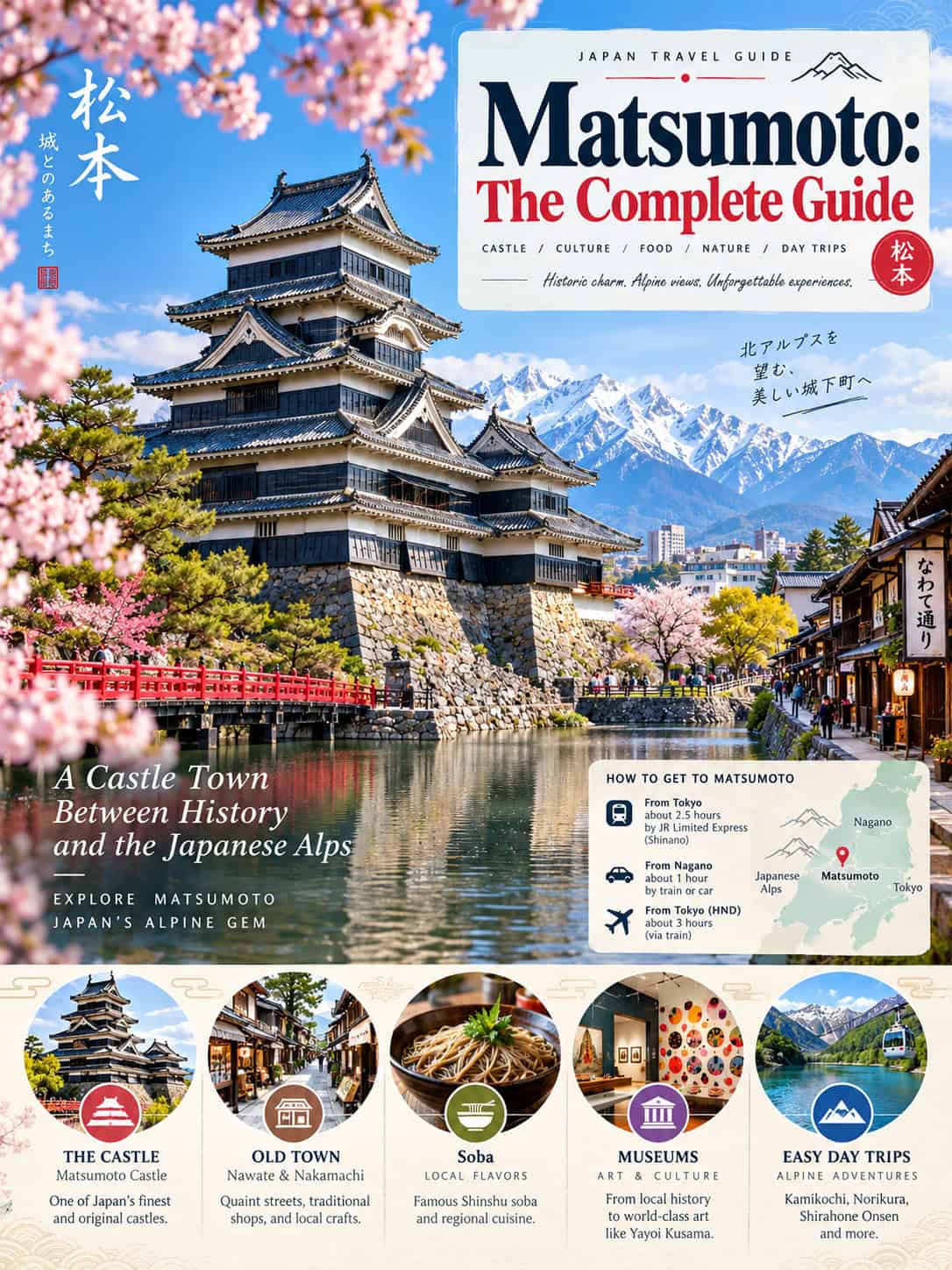
Matsumoto sits in the heart of Nagano Prefecture, with one of Japan’s most photogenic original castles rising from a moat and the Northern Alps behind it. This guide puts the castle at the center of the best things to do in Matsumoto, adds Nakamachi Street, Nawate-dori and the City Museum of Art, and shows how to reach the city from Tokyo and Nagano and how to use it as a one-night stop before the Japanese Alps.
Things to Do in Matsumoto at a Glance
| Priority | Sight | Time needed |
|---|---|---|
| Must see | Matsumoto Castle | 1.5 to 2 hours, including the queue |
| Easy add-on | Nakamachi Street and Nawate-dori | 1 to 2 hours |
| If you like art | Matsumoto City Museum of Art (Yayoi Kusama) | 1 to 1.5 hours |
| If time allows | Timepiece Museum, onsen, mountain trips | Half a day or more |
| Question | Answer |
|---|---|
| Ideal stay | 1 day for the city, or 1 night as a stop before the Alps |
| Getting there | Azusa limited express from Shinjuku in about 2.5 hours |
| Getting around | Walkable from Matsumoto Station, generally 15 to 20 minutes to the main sights |
| Best for | A National Treasure castle, merchant streets, Kusama connection and Alps access |
Top Things to Do in Matsumoto
1. Matsumoto Castle: The Crow Castle
Matsumoto Castle was completed around 1594 and is the oldest surviving five-tiered, six-story castle keep in Japan. Its dark exterior earned it the name Crow Castle, and it is one of Japan’s original castles and a National Treasure. It was built as a working fortress, with few windows, many small openings for watching and shooting, and larger openings for dropping stones. A hidden floor sits halfway up the keep, and the wooden stairs are steep by design.
Castle Tickets, Hours and Entry Rules
Admission is ¥1,200 with an online e-ticket and ¥1,300 for a paper ticket on the day, and children aged 6 to 15 pay ¥400. A standard ticket covers the castle only, and children aged 5 and under enter free. Combination tickets sold online only (not at the ticket office) add a second sight: ¥1,500 for an adult with the City Museum or ¥1,700 with the Museum of Art. The castle with the Former Kaichi School costs ¥1,600 for adults and ¥600 for children and is valid for 2 days, and a four-place combination costs ¥2,600 for adults and is valid for 3 days. The castle is open 8:30 to 17:00 with last entry at 16:30, and closes only on December 29 to 31. Hours are extended in peak periods: during Golden Week (April 29 to May 5) the castle opens 8:00 to 18:00 with last entry at 17:30, and summer hours are longer too. Visitor numbers can be capped during Golden Week and the mid-August Obon holiday. E-tickets are timed in 30-minute slots and cannot be changed or refunded, so choose carefully.
Castle Stairs and Crowds
The original stairs are steep and narrow: reaching the sixth floor takes about 140 steps, with a maximum gradient of 61 degrees, and there is no elevator. Allow 45 to 60 minutes inside the keep. Visitors remove their shoes and carry them in the bags handed out at the entrance, so wear socks and comfortable clothing. The keep is not easy for those with limited mobility, and entry can slow down at peak times. A weekday morning is the easiest time to avoid queues, and cherry blossom season and autumn weekends are busiest.
Volunteer guides give free tours of the castle park, and English-speaking guides from the ALSA volunteer interpreters association are stationed at the castle from 10:00 to 15:00 year-round, except the year-end and New Year holidays, Golden Week and Obon. Ask at their waiting area at the park entrance on the day, or apply at least two weeks ahead. The tours run by the castle’s own guide group do not go inside the keep.
The castle also has a long history of survival: after the Meiji Restoration it was sold at auction and nearly demolished until local residents campaigned to save it. Its Ninomaru Garden occupies the site of a former residence that burned.
2. Nakamachi Street
Nakamachi grew up in the Edo period as a merchant district on the old road toward Zenkoji Temple. Many buildings are kurazukuri storehouses with white-and-black namako walls. Today the street mixes craft shops, cafes and restaurants, and a morning market runs every Saturday from April through December, starting at 9:30. It is small and the stalls can sell out within about 10 minutes, so arrive at the start.
3. Nawate-dori (Frog Street)
Nawate-dori runs along the Metoba River between the river and the castle moat. It is nicknamed Frog Street because kajika frogs once sang along the river at night. A 1959 flood destroyed the street, and in 1972 locals created a frog deity to revive it. Ceramic frogs are still sold by shopkeepers along the street, and it is a pleasant place for lunch and souvenirs. The street is pedestrian-only every day of the year, so it suits strollers and wheelchairs, and Nakamachi is about a 1-minute walk away.
4. Matsumoto City Museum of Art and Yayoi Kusama
Matsumoto is the hometown of Yayoi Kusama, born there in 1929. The museum shows her work “The Place for My Soul” as a year-round display. It is open 9:00 to 17:00 with last entry at 16:30 and is closed on Mondays and over the New Year holiday. Collection Exhibition tickets are ¥700 online and ¥800 at the counter, with special exhibitions priced separately. The museum is about 12 minutes on foot from Matsumoto Station.
5. Matsumoto City Timepiece Museum
A short walk from the castle area, this museum displays approximately 110 clocks and watches from different eras. It is a small, quirky option if you want a lighter stop. Admission is ¥500 for adults and ¥200 for children. It is open 9:00 to 17:00 with last admission at 16:30, and closed on Tuesdays (the next day if Tuesday is a holiday) and from December 29 to January 3.
6. Matsumoto Folk Craft Museum
This small museum has about 800 pieces on permanent display, including Japanese water jars, lacquerware, chests and folk toys, plus Korean white porcelain and textiles from around the world. Adult admission is ¥500, and junior high school students and younger enter free. It is open 9:00 to 17:00 and closed on Tuesdays (the next business day if Tuesday is a holiday) and from December 29 to January 3. To get there, take the Utsukushigahara Onsen Line bus from Matsumoto Bus Terminal, about 12 minutes, then walk 3 minutes.
7. Former Kaichi School
The Former Kaichi School is another National Treasure in Matsumoto. Built in 1876, it is a Meiji-era school in a Western-influenced style that reflects Japan’s push to modernize, and it sits on the same Town Sneaker North Course as the castle. Admission is ¥600 with a digital ticket or ¥700 on site, and ¥300 for elementary and junior high school students. It is open 9:00 to 17:00 with last entry at 16:30, and closed on the third Tuesday of each month from March to November, every Tuesday from December to February, and from December 29 to January 3 (the closure moves to the next day if it falls on a holiday). From the station, ride the North Course about 13 minutes and walk 1 minute, or walk about 25 minutes. Shoes come off at the entrance, eating and drinking are not allowed inside, and the upper floors are reached by stairs only.
Getting Between the Sights in Matsumoto
The main sights in the center are 15 minutes or less on foot from the station, and the Town Sneaker city buses cover the same stops if you prefer to ride. The buses leave from the rotary in front of the Castle Exit (East Exit) of Matsumoto Station. The city buses, including the Town Sneaker, take IC cards such as Suica and contactless Visa or JCB cards (Mastercard is not accepted), so you do not need cash. If you do pay cash, the buses cannot change bills other than ¥1,000 notes and give no change, so carry coins or ¥1,000 notes.
| From Matsumoto Station | On foot | By bus |
|---|---|---|
| Matsumoto Castle | About 15 minutes | Town Sneaker North Course, about 10 minutes to the Matsumoto Castle/City Hall Front stop |
| Nakamachi Street | About 15 minutes | Town Sneaker East Course, about 5 minutes to the Nakamachi/Kura Chic Museum stop |
| Nawate-dori | About 15 minutes | North Course to Daimyo-cho (about 5 minutes, then 2 minutes on foot) or East Course to Matsumoto City Museum (about 3 minutes, then 3 minutes on foot) |
| Timepiece Museum | About 15 minutes | East Course from the Castle Exit, about 3 minutes, then 5 minutes on foot |
| Folk Craft Museum | – | Utsukushigahara Onsen Line from Matsumoto Bus Terminal, about 12 minutes, then 3 minutes on foot |
Nawate-dori and Nakamachi are neighbors, so you can walk between them in about a minute. The Town Sneaker PLUS 24-Hour Pass combines 24 hours of unlimited rides on the buses to Asama and Utsukushigahara onsen with admission to Matsumoto Castle and the Former Kaichi School.
What the Paid Sights Cost
| Sight | Adult | Child |
|---|---|---|
| Matsumoto Castle | ¥1,200 online, ¥1,300 on site | ¥400 (ages 6 to 15); free for ages 5 and under |
| Matsumoto City Museum of Art, collection exhibition | ¥700 online, ¥800 at the counter | See venue |
| Matsumoto City Timepiece Museum | ¥500 | ¥200 |
| Matsumoto Folk Craft Museum | ¥500 | Free for junior high school students and younger |
| Nakamachi Street and Nawate-dori | Free | Free |
| All four paid sights, online prices | ¥2,900 | See venue |
Special exhibitions at the Museum of Art are priced separately.
More Things to Do in Matsumoto: Onsen and Mountain Trips
Matsumoto is the main gateway to the Northern Japan Alps, but these extra things to do in Matsumoto need transfers and planning, so they should not be treated as part of a quick city visit. Asama Onsen and Utsukushigahara Onsen are the hot spring options around the city, and they work well as an evening soak after a day of walking. Asama Onsen is about 20 minutes by local bus from the Castle Exit bus stop, and Utsukushigahara Onsen is about 20 minutes by local bus from Matsumoto Bus Terminal. The Utsukushigahara Highland bus leaves from the Alps (West) Exit and runs only on specific days, mainly weekends and holidays, from mid-June to late September.
| Trip | How to get there | Notes |
|---|---|---|
| Kamikochi | Train to Shin-Shimashima then a bus, or the direct bus from Matsumoto Bus Terminal | Open roughly mid-April to mid-November; buses require advance reservations; private cars are banned beyond the Kama Tunnel |
| Utsukushigahara Highland | Seasonal bus from Matsumoto Station | Limited timetable that changes by season; check before planning |
| Takayama | Bus or train via the mountains | Allow most of a day; see the Takayama guide |
| Nagano and Zenkoji | Shinano limited express, about 50 minutes | Easy half-day or day trip |
For Kamikochi, direct buses leave Matsumoto Bus Terminal at 5:30 and 10:15, at ¥5,000 and ¥4,600 one way for adults. The cheaper route is the Kamikochi Line train to Shin-Shimashima (¥710, cash only) and then the bus (¥3,100), about ¥3,800 in total. The direct bus takes about 1 hour 30 minutes, and the train and local bus together take about 1 hour 40 minutes. Every Matsumoto to Kamikochi bus needs a reservation, which opens one month ahead and sells out, and only one-way tickets exist, with no round-trip discount. No Matsumoto to Kamikochi buses run from mid-November to mid-April.
For onward travel, the Takayama and Alps guide and the Shirakawa-go guide show what comes next.
A One-Day Plan for the Best Things to Do in Matsumoto
| Time | Stop | Notes |
|---|---|---|
| 8:30 | Matsumoto Castle | Arrive at opening to avoid the queue |
| 11:00 | Nakamachi Street | Walk through kurazukuri buildings and craft shops |
| 12:30 | Nawate-dori | Lunch by the Metoba River, frog souvenirs |
| 14:30 | City Museum of Art | About 12 minutes on foot from the station, or a short bus ride |
| 18:00 | Dinner | Try toji soba or basashi |
Things to Do in Matsumoto on a One-Night Stop Before the Alps
If you are heading into the mountains, a single night is enough. Arrive by mid-afternoon, see the castle exterior and Nakamachi in the evening light, and have dinner in town. Next morning, visit the castle at opening, then catch your bus or train onward to Kamikochi, Takayama or Nagano. Book Kamikochi buses early, since every seat needs a reservation, and remember that they do not run from mid-November to mid-April.
If you arrive with luggage, JR Matsumoto Station has coin lockers in six places: the Welcome Center on the 3rd floor, the Castle Exit side on the 2nd floor, and the Castle Exit and the Alps Exit on the 1st floor. The station has no luggage storage counter. The castle’s Honmaru Garden also has coin lockers, and the Castle Management Office stores bags that do not fit for a fee.
Getting to Matsumoto
| From | Route | Time | Notes |
|---|---|---|---|
| Tokyo | Azusa limited express from Shinjuku | About 2.5 hours | Reserve a seat in the ordinary car or buy an unreserved-seat ticket and take any vacant seat; about ¥6,700 one way |
| Nagano | Shinano limited express | About 50 minutes | Check the current timetable |
| Nagoya | Shinano limited express | About 2 hours | Roughly hourly; confirm fare when booking |
Highway buses from Shinjuku, Narita Airport, Nagoya, Osaka and Takayama run to Matsumoto Bus Terminal, a 2-minute walk from the station, and are usually the best-value option. From Osaka or Kyoto, the usual rail route is the Tokaido Shinkansen to Nagoya and then the Shinano, which has unreserved seating but is worth reserving ahead. Shinshu Matsumoto Airport has direct flights from Sapporo, Fukuoka and Kobe, and it is about 30 minutes from the city by shuttle bus or taxi.
Rail pass holders can use these trains, so the rail pass guide helps you decide, and the Kanazawa guide shows a nearby alternative. The Tokyo guide covers the departure city.
Food in Matsumoto
Toji soba, where noodles are dipped into a bubbling hotpot, is the signature dish. Basashi, raw horse meat sashimi, is a long-standing local specialty, with a cooked hot-pot version for those who prefer it. Sanzoku-yaki is Matsumoto’s marinated fried chicken. Temari balls, made from wound fabric and silk thread, are a classic folk-craft souvenir.
Best Time to Visit
Spring brings cherry blossoms around the moat, and autumn adds color in the surrounding mountains. Summer is festival season, with events such as the Tenjin Matsuri in late July and Matsumoto Bon Bon in early August. Winter is quieter, with the castle sometimes dusted in snow, but mountain access such as Kamikochi closes. See the seasons guide for the wider picture.
If It Is Cold or Snowy
Winter in Matsumoto is sunny with little rain or snow, but temperatures drop below freezing and cold mornings and evenings freeze the roads, so wear warm clothing and non-slip shoes. Snow does not always settle, so a snow-covered castle is a bonus rather than a promise. You climb the keep in your socks, so bring warm ones. If you are driving toward Kamikochi, Norikura, Utsukushigahara or Shirahone Onsen, snow chains are advised, and public transport is the easier choice. Several sights close around New Year: the Timepiece Museum and the Folk Craft Museum from December 29 to January 3, the Museum of Art over the New Year holiday, and the castle from December 29 to 31.
Frequently Asked Questions
How do I get to Matsumoto from Tokyo?
Take the Azusa limited express from Shinjuku Station. It takes about 2.5 hours, you can reserve an ordinary-car seat or buy an unreserved-seat ticket for any vacant seat, and a reserved one-way fare is around ¥6,700. Book ahead on weekends and holidays.
How do I get to Matsumoto from Nagano or Nagoya?
From Nagano, the Shinano limited express takes around 50 minutes. From Nagoya, the same train takes about two hours. Check the current timetable and fare before booking.
How much does it cost to visit Matsumoto Castle?
Admission is ¥1,200 with an online e-ticket and ¥1,300 for a paper ticket on the day, with children aged 6 to 15 paying ¥400. The castle is open 8:30 to 17:00, with last entry at 16:30, and closes December 29 to 31.
Are the stairs in Matsumoto Castle steep?
Yes. The original wooden stairs are steep and narrow by design, and the keep can be crowded at busy times. Wear comfortable socks and expect a slow queue on peak days.
Why is Matsumoto Castle called the Crow Castle?
Its dark, almost black exterior earned it the nickname. It is one of Japan’s original castles and a National Treasure.
Can I visit Kamikochi from Matsumoto?
Yes, between about mid-April and mid-November. Use the train to Shin-Shimashima plus a bus or the direct bus from Matsumoto Bus Terminal. Buses require advance reservations, and private cars are banned beyond the Kama Tunnel.
Is Matsumoto worth a one-night stop before the Japanese Alps?
Yes. One night lets you see the castle and Nakamachi in the evening and morning and then continue to Kamikochi, Takayama or Nagano the next day without a rushed transfer.
What food should I try in Matsumoto?
Toji soba, basashi (raw horse meat sashimi) and sanzoku-yaki (marinated fried chicken) are the signature dishes.
Bottom Line
Matsumoto pairs one of Japan’s most striking original castles with old merchant streets and a surprising art pedigree, and it works well as either a full day or a one-night stop before the Alps.