By Nippon With Me EditorialPublished Updated
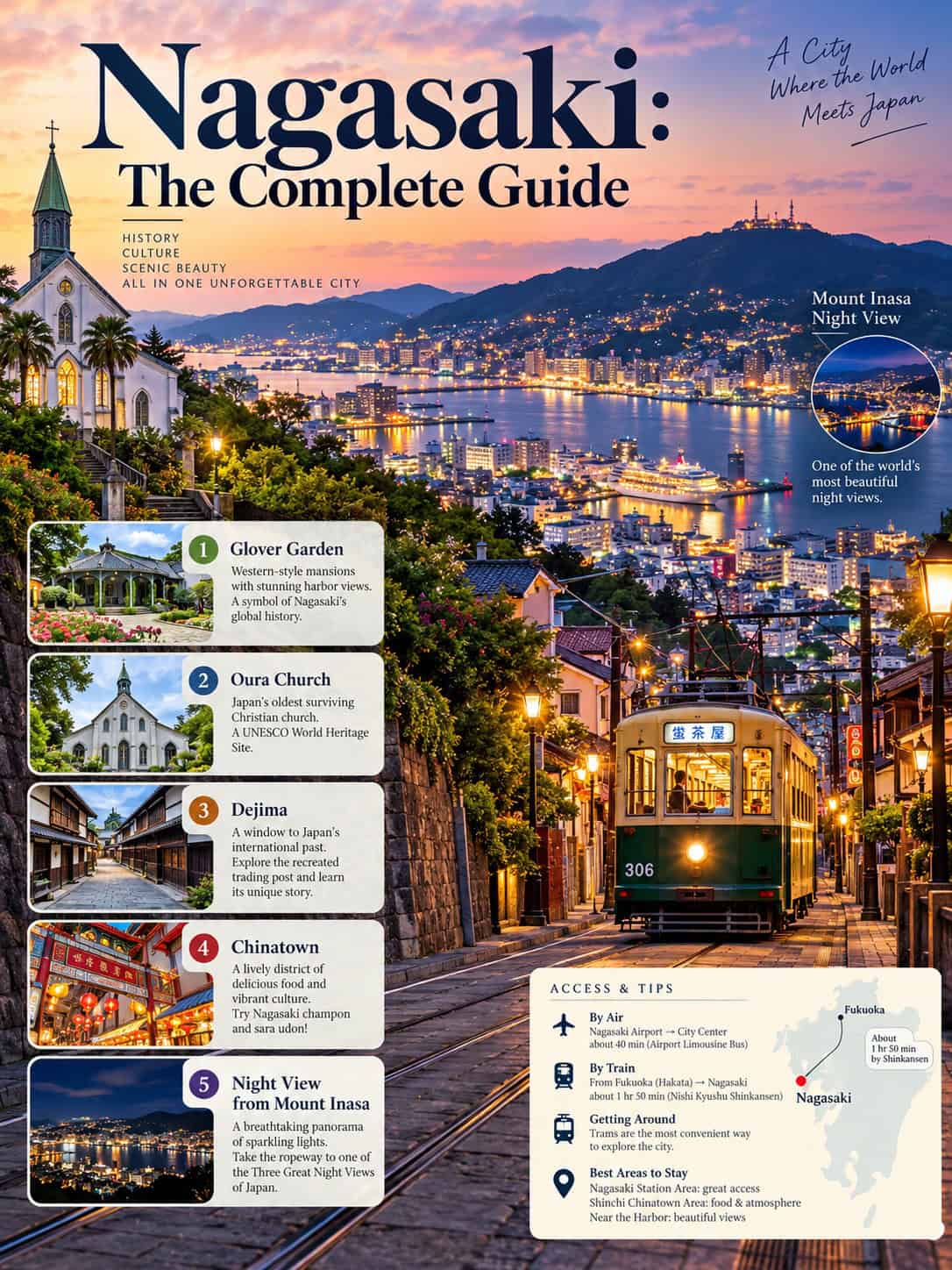
The best things to do in Nagasaki combine moving World War II memorials with the city’s long history as an international trading port. This Nagasaki travel guide covers the Atomic Bomb Museum, restored Dejima, Glover Garden, Mount Inasa and a practical two-day route.
Things to Do in Nagasaki at a Glance
| Category | Details |
|---|---|
| Best for | Atomic bomb history, Dutch/Portuguese trading-post heritage, a hillside foreign settlement, and one of the world’s top-ranked night views |
| Ideal trip length | 2 days |
| Getting there | Nishi-Kyushu Shinkansen from Hakata (Fukuoka) via a cross-platform transfer at Takeo-Onsen, about 90 minutes total |
| Getting around | Nagasaki Electric Tramway (4 lines), flat fare ¥150, one-day pass ¥600 |
| Best time to visit | Spring and autumn for comfortable walking weather; early August for Peace Park memorial events (also the most crowded, solemn period) |
| Currency | Japanese yen (¥) |
Things to Do in Nagasaki: Peace Park and Atomic Bomb Museum
On August 9, 1945, at 11:02 a.m., the atomic bomb nicknamed “Fat Man” detonated over Nagasaki’s Urakami district, roughly three days after Hiroshima. Nagasaki Peace Park now sits near the hypocenter, anchored by the Peace Statue, a large bronze figure with one hand pointing skyward (symbolizing the threat of nuclear weapons) and the other extended horizontally (symbolizing peace). The Nagasaki Atomic Bomb Museum, near Peace Park and the hypocenter, documents the bombing, its consequences and the history of nuclear weapons through photographs, recovered objects and testimony. Adult admission to the permanent exhibition is ¥200; high-school students and younger visitors enter free. Visiting the hypocenter area and museum together typically takes 2-3 hours, and most visitors describe it as a sobering, essential counterpart to Hiroshima’s Peace Memorial Park rather than a repeat of the same experience.
Things to Do in Nagasaki: Explore Historic Dejima
During Japan’s period of restricted foreign trade, Nagasaki became an important gateway for commerce and knowledge from abroad. Dejima, a fan-shaped artificial island built in the 1630s, was used to regulate trade with foreign merchants. Portuguese traders were moved to Dejima in 1636 and expelled from Japan in 1639. Dutch merchants relocated there in 1641, and the trading post remained an important point of contact with Europe during the Edo period. Dejima’s restored buildings are open to visitors; adult admission is ¥1,100.
After 1858, land reclamation absorbed the island into the mainland, and a 1904 harbor redesign obscured its original footprint entirely — today its outline is marked by rivets in the surrounding streets. Dejima was designated a national historic site in 1922, and restoration work, which stalled for decades after starting in 1953, resumed seriously in 1996. Roughly ten buildings had been reconstructed by 2006, with six more plus the Omotemon Bridge added in 2017; the project continues today, with long-term plans to eventually re-excavate a surrounding canal and make Dejima an island again.
Things to Do in Nagasaki: Glover Garden and Oura Church
On a hillside overlooking Nagasaki Harbour, Glover Garden is an open-air museum of late 19th- and early 20th-century Western-style mansions, many relocated here from Nagasaki’s former foreign settlement. Its centerpiece, Glover House, is described as the oldest surviving Western-style house in Japan, built for Thomas Blake Glover, a Scottish merchant who helped Japan industrialize during the Meiji era, including by introducing early shipbuilding and modern weaponry. Adult admission to Glover Garden is ¥1,300.
Just outside the garden stands Oura Church, a Catholic church built in 1864, described as the oldest standing church in Japan and recognized as a UNESCO World Heritage Site. Together, Glover Garden and Oura Church form the clearest physical record of Nagasaki’s role as Japan’s main gateway to Western trade, religion, and technology in the 19th century.
Nagasaki Attractions: Megane Bridge and the Dutch Slope
Megane Bridge (“Spectacles Bridge”) crosses the Nakashima River in central Nagasaki and is said to be the oldest stone arch bridge in Japan, alongside Nihonbashi in Edo and Kintaikyo in Iwakuni. Built in 1634 by the Chinese monk Mokusunyoujo of Kofukuji Temple’s second generation, its name comes from the way its two arches and their reflection in the water together resemble a pair of spectacles. It’s designated an Important Cultural Property and remains a popular, easy stop for anyone walking between Chinatown and the historic district.
The Dutch Slope, a cobblestone street near the former foreign settlement, is lined with former residences built for Westerners in the Meiji era and offers an easy, atmospheric walk connecting several of Nagasaki’s historic sites on foot.
Things to Do in Nagasaki: Mount Inasa Night Views
Mount Inasa’s summit observation platform sits 333 meters above the city, with a glass-enclosed, circular, domed lookout offering a 360-degree view over Nagasaki’s harbor and surrounding hills. A ropeway departing from Fuchi Shrine carries visitors to the top. In 2021, the viewpoint was selected as one of the Top 3 Night Views in the World, alongside Shanghai and Monaco — a reflection of how the bowl-shaped harbor geography scatters the city’s lights across the hillsides in a way flatter cities can’t replicate.
Nagasaki Attractions: Chinatown and Local Food
Nagasaki’s food culture reflects its centuries as a trading port. Champon, a noodle soup loaded with pork, squid, clams, prawns, oysters, cabbage, and bean sprouts, is said to have been created in the Meiji era by a Chinese restaurant owner looking to make a healthful, filling meal for Chinese students studying in the city. Sara udon (“plate noodles”) comes in two main styles — one with thin, crispy fried noodles, the other with the thicker, softer noodles used in champon — both topped with a similar mix of ingredients. Castella, a soft sponge cake with a layer of granulated sugar on the bottom, traces back to Portuguese missionaries in the 16th century; the original recipe proved too tough for Japanese tastes, and local confectioners adapted it into the version sold today as a classic Nagasaki souvenir. For more regional specialties, see our Japanese food guide. Shippoku cuisine, a shared-table dining style blending Chinese, Portuguese, and Dutch influences, typically features sashimi, lightly boiled fish, Nagasaki-style tempura, and braised pork served family-style around a round table.
Getting to Nagasaki by Train or Bus
The Nishi-Kyushu Shinkansen (Kamome) runs between Takeo-Onsen and Nagasaki. From Hakata (Fukuoka), take the Relay Kamome limited express to Takeo-Onsen, then transfer across the platform to the Kamome Shinkansen for Nagasaki. Check the current timetable and platform information before departure. The full journey from Hakata to Nagasaki takes roughly 90 minutes, down from about two hours before the line opened. A direct highway bus from Fukuoka Airport or Hakata runs about 2 hours 20 minutes to 2 hours 30 minutes, a slower but transfer-free alternative. If you are combining both cities, use our four-day Kyushu itinerary or read the Fukuoka travel guide before choosing your route.
Getting Around Nagasaki
The Nagasaki Electric Tramway runs four lines (1, 3, 4, and 5) connecting most major sights, including Nagasaki Peace Park, Glover Garden, Dejima, and Sofukuji Temple, with Nagasaki Station serving as the main interchange. The flat fare is ¥150 per ride for adults (¥80 for children), and a one-day pass costs ¥600 (¥300 for children), covering unlimited rides roughly between 6:10 a.m. and 11:40 p.m. — worth it if you’re visiting three or more sights spread across the city in a day.
Things to Do in Nagasaki: A Simple Two-Day Itinerary
Day 1: Start at Nagasaki Peace Park and the Atomic Bomb Museum in the morning, then take the tram to Dejima and walk through its restored buildings in the early afternoon. Finish with Megane Bridge and a stroll through Nagasaki Chinatown for dinner.
Day 2: Spend the morning at Glover Garden and Oura Church on the hillside above the harbor, then walk the Dutch Slope back toward the city center. In the evening, take the ropeway up Mount Inasa to catch the night view before it gets too late.
Best Time for Things to Do in Nagasaki
Spring (March-May) and autumn (October-November) bring the most comfortable weather for walking between Nagasaki’s hillside sights. Early August draws solemn memorial crowds around the August 9 bombing anniversary — meaningful if that history is part of why you’re visiting, but also the most crowded and emotionally heavy period at Peace Park. Summer is hot and humid; winter is mild by Japanese standards but can be damp.
Practical Nagasaki Travel Guide Tips
Nagasaki’s historic sights are spread across hillsides and require genuine walking and some uphill stretches, particularly around Glover Garden and the Dutch Slope — comfortable shoes matter more here than in flatter cities. The Nagasaki Electric Tramway’s one-day pass is worth buying at the Nagasaki Station tourist office if you’re planning to hit more than two or three sights. If you are choosing a base, see our Nagasaki hotels guide for areas near the station, Chinatown and the historic hillside. If visiting the Peace Park and Atomic Bomb Museum, budget time to sit with what you’ve seen rather than rushing straight to the next stop — many visitors find it genuinely affecting. Castella makes a far more packable souvenir than most Japanese regional sweets, since it travels well and is sold in resealable tins throughout the city.
Final Tips for Visiting Nagasaki
The best things to do in Nagasaki span the Peace Park memorial sites, historic Dejima, Glover Garden and the Mount Inasa panorama. Two days give you time to see these without rushing.
Frequently Asked Questions About Things to Do in Nagasaki
What happened in Nagasaki on August 9, 1945?
At 11:02 a.m., the United States dropped an atomic bomb nicknamed “Fat Man” over the city’s Urakami district, roughly three days after the Hiroshima bombing. Nagasaki Peace Park and the Atomic Bomb Museum now document this history near the hypocenter.
How do I travel from Fukuoka to Nagasaki?
From Hakata, take the Relay Kamome limited express to Takeo-Onsen and transfer to the Nishi-Kyushu Shinkansen for Nagasaki. The train journey generally takes around 90 minutes; direct highway buses are another option.
What was Dejima, and can I still visit it?
Dejima was an artificial island built in the 1630s where Dutch (and earlier Portuguese) traders were confined for nearly two centuries as Japan’s only legal channel to the West. It’s now a restored historic site with reconstructed buildings, though restoration work is still ongoing.
Is Glover Garden one of the best Nagasaki attractions?
Yes. Glover Garden has preserved and relocated Western-style houses overlooking Nagasaki Harbour, including the Former Glover House. Adult admission is ¥1,300.
How do I get around Nagasaki once I’m there?
Nagasaki trams connect many major sights. The adult flat fare is ¥150 per ride; if you plan several journeys, compare the cost with the current day-pass price.
Is Mount Inasa’s night view really world-class?
It was selected as one of the Top 3 Night Views in the World in 2021, alongside Shanghai and Monaco, thanks to Nagasaki’s bowl-shaped harbor geography scattering city lights across surrounding hillsides.
What food should I try in Nagasaki?
Champon (a loaded noodle soup), sara udon (“plate noodles” in crispy or soft versions), Castella sponge cake, and shared-table Shippoku cuisine are all distinctly Nagasaki, reflecting the city’s centuries as a trading port with Chinese, Portuguese, and Dutch influences.
How many days should I spend in Nagasaki?
Two days covers the essentials comfortably — Peace Park and the Atomic Bomb Museum, Dejima, Megane Bridge, and Chinatown on one day, and Glover Garden, Oura Church, and Mount Inasa’s night view on the other.