By Nippon With Me EditorialPublished Updated
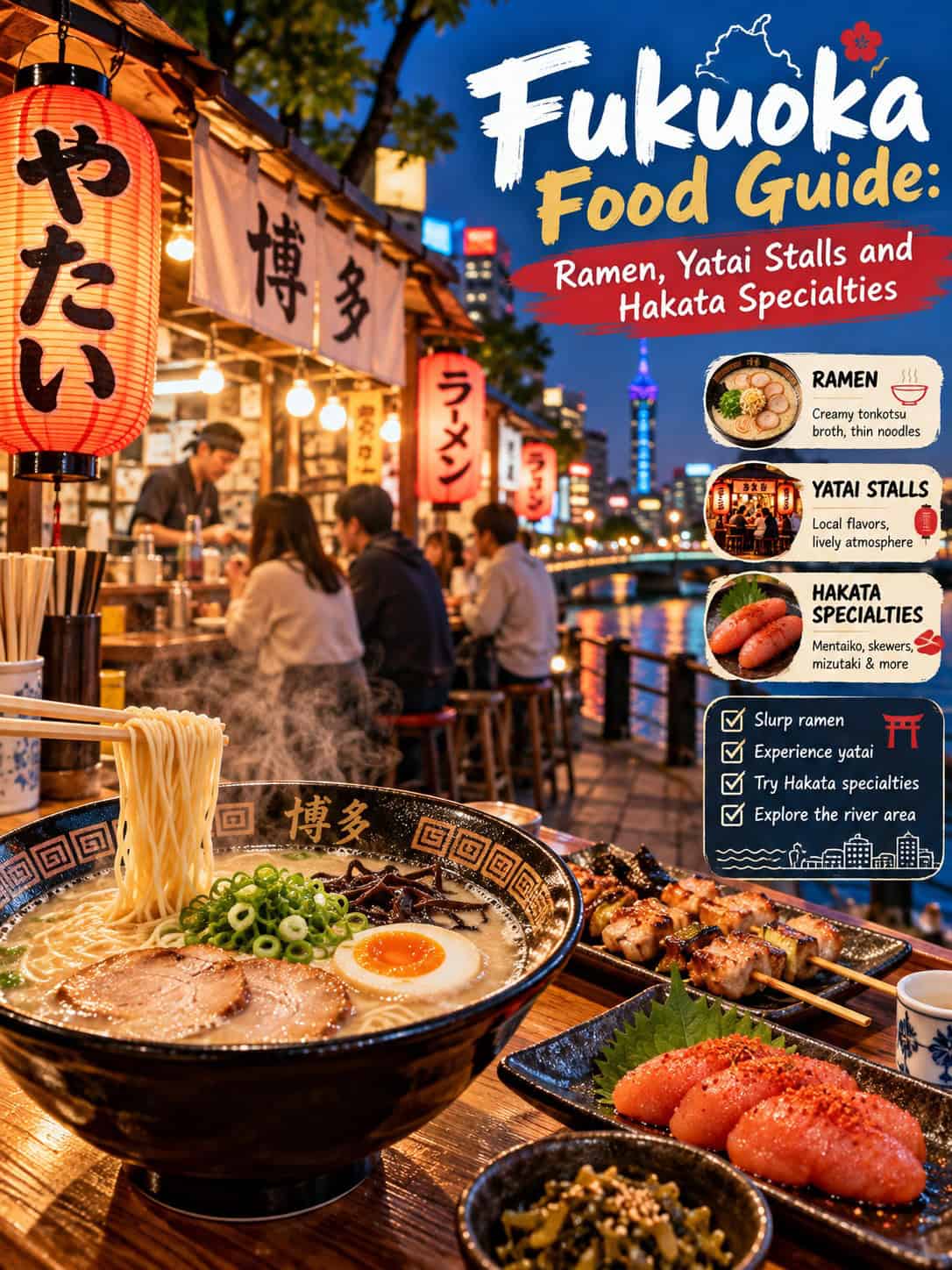
Fukuoka food is built around a few things you will not find done the same way anywhere else: Hakata tonkotsu ramen with its thin noodles and free-form refills, open-air yatai stalls on the sidewalk, motsunabe offal hot pot and spicy cod roe called mentaiko. If you are wondering what to eat in Fukuoka, start with those four, add goma saba (sesame mackerel) at an izakaya, and leave an evening for yatai hopping. This guide explains each one, how to order and where to look. For the city as a whole, see Fukuoka: The Complete Guide.
Fukuoka Food at a Glance
| Dish | What it is | Where to look | Relative budget |
|---|---|---|---|
| Hakata ramen | Tonkotsu (pork bone) ramen with thin, straight noodles | Ramen shops everywhere, yatai stalls in Nagahama, Nakasu and Tenjin | Low |
| Yatai meal | Open-air stall dining: ramen, yakitori, oden and more | Nakasu, Tenjin, Nagahama | Low to medium per round |
| Motsunabe | Offal hot pot in shoyu or miso broth, finished with noodles | Izakaya and specialty restaurants | Medium |
| Mentaiko | Spiced, salted cod roe, eaten with rice or in pasta | Hakata Station, the airport, supermarkets | Low for a snack, medium as a gift |
| Goma saba | Raw mackerel marinated in a sesame-soy dressing | Izakaya menus | Medium |
Fukuoka Yatai Stalls: The City’s Food Culture
The Fukuoka yatai stalls are small open-air food stalls with a counter and a handful of folding stools. They set up on the street in the evening and serve ramen, yakitori, oden and similar dishes. Fukuoka is unusual in that around 100 of these stalls still operate under a city license, far fewer than in the past but still part of everyday life. They cluster in Nakasu and Tenjin, the two areas most visible to visitors, and in the smaller, more local Nagahama district near the old fish market.
Yatai licenses are not simply inherited. A city ordinance introduced in 2013 set clear rules for the stalls, and since then free slots are filled through public recruitment, with applicants competing and ranked by a selection process. That is why the scene has been actively preserved rather than left to fade.
Tenjin vs Nakasu vs Nagahama
| Area | Feel | Best for | How to visit |
|---|---|---|---|
| Nakasu | Riverside, the most visible and tourist-friendly cluster | A first yatai experience | Walk up in the evening; Nakasu stalls are commonly listed as running from about 6pm until around 2am, but hours vary by stall |
| Tenjin | Near the main shopping and business district | An easy stop after shopping or dinner plans | Expect a short wait at popular stalls |
| Nagahama | Smaller and more local, near the old fish market | Ramen, the area where kaedama is said to have started | Go for a late bowl of ramen |
Fukuoka yatai stalls do not take reservations, and English is limited, so treat it as a drop-in, point-and-gesture experience. Bring cash, check the price board before ordering, and ask about any seating charge up front. Hopping between two or three Fukuoka yatai stalls and eating one dish or drink at each is a normal way to do it, and a full round usually takes an hour or so per stall. Opening hours and queues change, so check the official yatai information before you go.
Fukuoka Food Staple: Hakata Ramen and Tonkotsu Explained
What to eat in Fukuoka first? Hakata ramen, the Fukuoka style of tonkotsu ramen: a rich, milky pork-bone broth with very thin, straight noodles. The noodles are low in water and cook in under a minute, which is why the bowl is small and the noodles are meant to be eaten quickly. Most shops let you choose firmness, from soft (yawa) and regular (futsu) to firm (kata) and extra-firm (barikata). First-timers do well with kata or futsu.
Then comes kaedama, the noodle refill. Order a fresh portion into your existing broth before you finish the first, so the broth stays hot, and leave enough soup in the bowl for the refill. The custom is said to have started at Nagahama, where market workers wanted a quick meal. Do not expect a broth top-up, only more noodles.
The cloudy tonkotsu broth itself is usually traced to Kurume, another city in Fukuoka Prefecture, where the shop Sankyu is credited with discovering the milky broth in 1947 when a pork-bone soup was accidentally left on the heat too long. Fukuoka City’s Hakata ramen grew from that tradition. Two of Japan’s best-known ramen chains also come from here: Ippudo, founded in Fukuoka’s Daimyo district in 1985 and taken abroad from 2008, and Ichiran, which began as a Fukuoka ramen stall in 1960 and is known for its solo booths.
Motsunabe Fukuoka Locals Love
Motsunabe Fukuoka style starts with motsu, which means offal, usually beef or pork intestine, and motsunabe is the hot pot built around it, cooked at the table in a shoyu broth with garlic and chili or in a milder miso version. Eat the offal and vegetables first, usually cabbage and garlic chives, and finish with noodles in the remaining broth. Motsunabe is a reliable part of the Fukuoka izakaya scene and does not need a famous address.
Fukuoka Mentaiko: Popularized Here, Not Invented Here
Mentaiko, spiced and salted cod roe, did not originate in Fukuoka. It comes from Korea, where roe was long salted and dried, and later chili was added. It reached Japan through the Busan-Shimonoseki route and gained a following after the war. Fukuoka’s genuine claim is commercializing it for Japanese tastes: Toshio Kawahara, founder of the company behind Aji no Mentaiko, began selling it in 1949. Eat it over rice, in onigiri or folded into mentaiko pasta, and buy it as a packable souvenir at Hakata Station or the airport, and that is what to eat in Fukuoka to take home.
Why Hakata and Fukuoka Are Both the Right Name
The modern city of Fukuoka was formed in 1889 when two adjoining towns merged: Fukuoka, the old samurai district, and Hakata, the old merchant and port district. Fukuoka became the city’s name, but Hakata lives on in the district, the main train station, the local dialect and the ramen style that grew from its old market stalls.
Other Fukuoka Food Specialties
Local tradition, backed by a monument at Jotenji Temple, credits the monk Shoichi Kokushi with bringing noodle-flour techniques to Hakata in 1241, and the city presents itself as the birthplace of udon and soba in Japan. Treat that as local tradition rather than an undisputed national fact. Goma saba, raw mackerel in a sesame-soy-mirin dressing, is a common Hakata izakaya order, especially in the cooler months. For other regions, see our Japanese food guide, and Nagasaki’s champon is a Nagasaki dish rather than a Hakata one.
Getting to Fukuoka Food Fast
Fukuoka Airport is unusually close to the city: the subway reaches Hakata Station in about five minutes and Tenjin in around fifteen, so you can land and be at a yatai the same evening. Choose a base with our guide to the best hotels in Fukuoka, and combine the city with Nagasaki using our Kyushu itinerary.
Frequently Asked Questions About Fukuoka Food
What are yatai in Fukuoka?
Yatai are small open-air food stalls that set up in the evening, with counter seating for a handful of people, serving ramen, yakitori, oden and similar dishes.
What should I eat in Fukuoka?
Hakata tonkotsu ramen, a yatai meal, motsunabe, mentaiko and goma saba are the main Fukuoka dishes.
Where are the best yatai in Fukuoka?
Nakasu and Tenjin are the most visible clusters, and Nagahama is a smaller, more local area known for ramen, so choose among the Fukuoka yatai stalls by area. Stalls change, so check the official yatai information.
What is Hakata ramen?
Hakata ramen is Fukuoka-style tonkotsu ramen with a milky pork-bone broth and thin straight noodles, usually with a choice of firmness.
What is kaedama?
Kaedama is a noodle refill you can order into your existing broth, a custom said to have started at Nagahama’s ramen stalls.
Is mentaiko from Fukuoka?
Mentaiko originated in Korea. Fukuoka’s role was commercializing and popularizing it in Japan from 1949.
Are Ippudo and Ichiran from Fukuoka?
Yes. Ippudo opened in Fukuoka in 1985 and Ichiran began as a Fukuoka ramen stall in 1960.
Is yatai food cash only?
Bring cash and expect limited English. Check the price board before ordering and ask about any seating charge.