By Nippon With Me EditorialPublished Updated
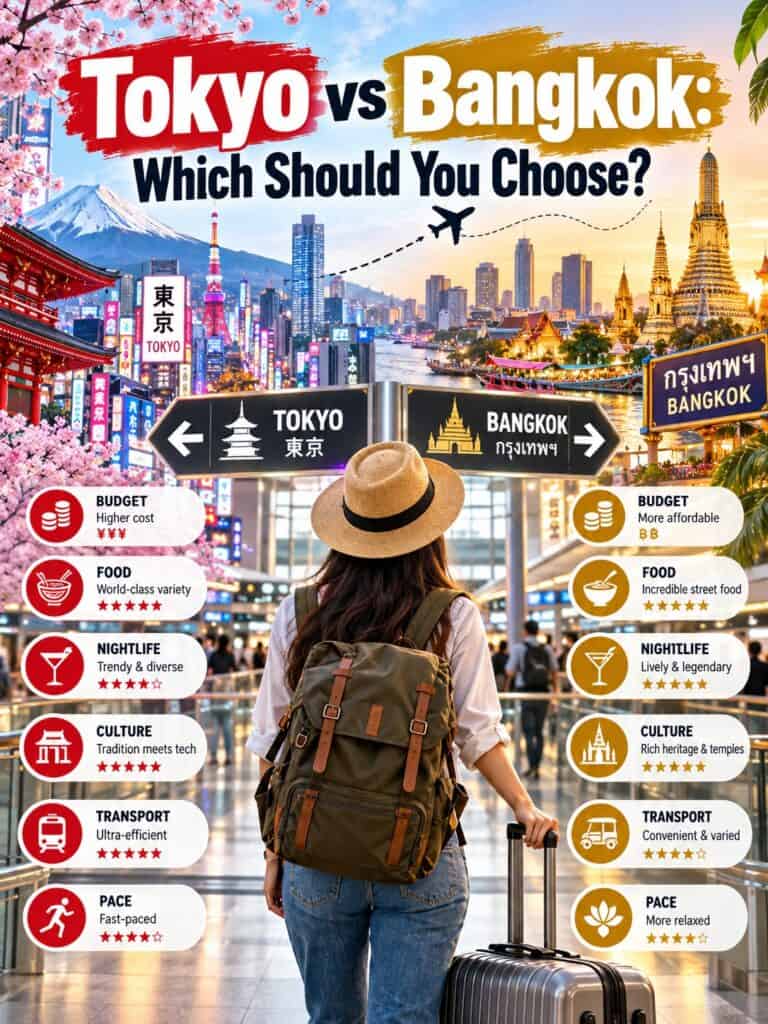
Tokyo vs Bangkok is a choice between two different city experiences. Tokyo offers efficient trains, neighbourhoods packed with sights, Japanese food and four distinct seasons. Bangkok offers tropical weather, lively markets, temples, rooftop views and generally lower everyday costs. Compare visa rules, transport, sightseeing budgets and travel seasons before deciding. Both are excellent first stops in Asia, and plenty of travelers end up doing both on the same long-haul trip rather than picking one over the other.
Quick Answer
| Question | Answer |
|---|---|
| Which is cheaper? | Bangkok is usually cheaper for accommodation, local meals and some activities, but there is no reliable universal 50% price difference. |
| Which has the longer visa-free stay? | For many eligible US/EU/Australian travellers Japan allows up to 90 days, while Thailand revised its tourist visa exemptions from September 15, 2026; exact eligibility and stay duration depend on passport and bilateral arrangements. |
| Which is better for travellers avoiding heat? | Tokyo in spring or autumn; Bangkok remains hot throughout the year, although November–February is generally more comfortable. |
| Which has the bigger tourism boom? | Japan recorded 42,683,600 international arrivals in 2025. National arrival totals cannot establish that central Bangkok is less crowded than Tokyo. |
| Can I combine both on one trip? | Yes — nonstop flights take roughly six to seven-and-a-half hours, and pairing them is a common Asia-trip pattern |
Tokyo vs Bangkok: Side-by-Side Comparison
| Factor | Tokyo | Bangkok |
|---|---|---|
| Best for | Japanese culture, rail travel, seasonal scenery | Temples, markets, river trips, tropical city break |
| Typical daily spending | Generally higher, varies by travel style | Generally lower, especially casual meals |
| Weather | Four seasons, chilly winter, humid summer | Warm to hot all year; monsoon rainfall |
| Rail travel | Dense JR, Metro, Toei and private networks | BTS/MRT plus boats and road vehicles |
| Food | Sushi, ramen, soba, tempura | Pad kra pao, boat noodles, som tam, curries |
| Day trips | Kamakura, Nikko, Mount Fuji region | Ayutthaya, markets, Kanchanaburi |
| Entry requirements | Passport-specific visa exemption or visa | Passport-specific visa exemption plus TDAC |
| Airport options | Haneda (HND), Narita (NRT) | Suvarnabhumi (BKK), Don Mueang (DMK) |
Both offer excellent restaurants and luxury accommodation. The better choice depends on your preferred climate, budget and travel style, not a universal winner.
Two Megacities, Two Different Rhythms
Tokyo is a vast metropolitan region with extensive rail connections and very different neighbourhoods (see our complete Tokyo guide). Population rankings depend on whether a source counts the city, metropolitan region or continuous urban area, so it is safest not to call one boundary definition universally the world’s largest. Bangkok’s administrative city and wider urban region use different population boundaries. For visitors, its defining transport trade-off is busy road traffic alongside BTS Skytrain, MRT, express boats and river ferries. Use rail and boats when road congestion would make taxis unpredictable. Neither style is objectively better — it’s a genuine personality difference, and it’s worth being honest with yourself about which one you’d actually enjoy for a week rather than assuming “organized” always wins.
Cost: Bangkok Is Still Cheaper, But the Gap Has Narrowed
Bangkok often costs less than Tokyo for local food, transport and accommodation, particularly outside luxury districts. However, location, hotel standards, exchange rates and travellers’ choices change the difference substantially. Compare a similar hotel class and the same number of paid attractions rather than claiming that all Bangkok trips cost exactly half as much. Currency exchange rates fluctuate and do not translate directly into identical changes in hotel or restaurant costs. Tokyo offers value through ramen shops, convenience stores and rail passes; Bangkok often offers cheaper local meals and a wider range of low-cost accommodation. Check current costs in one currency when planning your exact dates, and read how money works in Japan before you go.
Bangkok vs Tokyo: Daily Travel Budget Examples
| Expense per person | Tokyo planning range | Bangkok planning range |
|---|---|---|
| Simple breakfast | ¥500–1,000 | ฿60–150 |
| Local lunch | ¥900–1,500 | ฿70–180 |
| Casual dinner | ¥1,500–3,000 | ฿150–400 |
| City train trip | Depends on operator and distance | Depends on operator and distance |
| Hotel room | Compare by actual booking date | Compare by actual booking date |
Food figures are indicative planning ranges, not surveyed averages or official fixed tariffs. Check current metro and rail fares with the operators, convert currencies at your booking-date rate and compare like-for-like hotels.
Japan vs Thailand Travel: Hidden Budget Differences
Include airport transfers, accommodation taxes where applicable, temple tickets, international roaming, baggage fees and travel insurance. Tokyo can be efficient without taxis, while Bangkok’s ride-hailing and cross-city road trips can add time and cost in traffic.
Tokyo vs Bangkok: What the Big Sights Cost and When They Close
Entry fees at the headline sights are where the two cities differ most in practice, because Tokyo’s best-known temple and shrine are free while Bangkok’s are ticketed. Prices are in each city’s own currency.
| Type of sight | Tokyo | Bangkok |
|---|---|---|
| Main historic temple site | Senso-ji: free | Grand Palace: 500 baht for foreigners, including Wat Phra Kaew and the Queen Sirikit Museum of Textiles; tickets are sold from 8:30 a.m. to 3:30 p.m. |
| Second temple or shrine | Meiji Shrine: free, open daily | Wat Pho: 300 baht, open 8 a.m. to 7:30 p.m.; children under 120 cm (4 feet) enter free |
| Museum | Tokyo National Museum: ¥1,000, free under 18 and over 70; closed Mondays | Queen Sirikit Museum of Textiles: included in the Grand Palace ticket |
| Closing days | Tokyo National Museum, Ueno Zoo and Shinjuku Gyoen: closed Mondays | Grand Palace: open daily |
Both cities enforce dress rules at their major temples. The Grand Palace turns away sleeveless shirts, vests, see-through tops, short or hot pants, mini skirts, tight pants and torn pants, and Wat Pho does not allow shorts, although long trousers are fine. Wat Pho also runs a traditional massage school on site, open the same hours as the temple, where massages start at 340 baht for 30 minutes.
Tokyo or Bangkok: Visa Rules and Arrival Forms
Visa-free access to Japan depends on nationality and passport type. US and Australian tourists and many European travellers generally receive up to 90 days; certain British, Irish and European passport holders can apply to extend beyond 90 days under specific conditions. Not every European passport or travel document has identical eligibility, and tourism does not allow paid work. Ninety days is the common allowance, but some nationalities are granted 15, 30 or 180 days instead. Thailand implemented revised tourism visa exemptions on September 15, 2026, after the Royal Gazette announcement of August 31. The general 60-day exemption was withdrawn and a 30-day exemption applies to the revised eligible-country list; some countries have separate bilateral arrangements or shorter schemes. The revised scheme covers 60 listed countries and territories and allows up to 30 days; an extension of up to another 30 days is possible, but it is granted solely at the immigration officer’s discretion. Check the Thai consular list for your passport rather than assuming a flat 30 days for every nationality or a universal land-entry rule. For many visa-exempt travellers, Japan’s ordinary 90-day entry can be longer than Thailand’s revised general 30-day tourist exemption. For a seven- or fourteen-day holiday, however, the bigger practical differences are entry documentation, costs, climate and flight connections. Check the exact permitted stay stamped or recorded on arrival.
Tokyo or Bangkok: Visa and Arrival Checklist
| Requirement | Japan | Thailand |
|---|---|---|
| Visa-free tourism | Many eligible passports up to 90 days; exceptions and extensions apply | Revised general 30-day exemption from Sep 15, 2026 for eligible passports; other agreements may differ |
| Arrival form | Use applicable immigration/customs declarations; Visit Japan Web optional digital procedure where supported | Free Thailand Digital Arrival Card (TDAC) required for non-Thai arrivals passing immigration |
| TDAC timing | Not applicable | Submit within the 3 days before arrival, including arrival day |
| Where to check | Japanese embassy or Ministry of Foreign Affairs | Royal Thai Embassy, consular rules and Immigration Bureau |
Complete Thailand’s TDAC only through the official free immigration website; it is not a visa. The form is on the Immigration Bureau site at tdac.immigration.go.th. At the immigration counter you show the QR code from the confirmation, on a phone or as a printout. Most details can be corrected afterward with the Update Arrival Card function, but a wrong name, passport number, nationality or date of birth needs a new submission instead. All travellers, including children, must be included when entering Thailand, while airside passengers who do not pass immigration are exempt. For Japan, see our Japan visa guide, and always check actual passport-specific entry conditions before buying flights.
Food: Formal Range in Tokyo, Street-Level Reward in Bangkok
Both cities are genuinely great food destinations, just structured differently. Tokyo’s food scene has an unmatched ceiling — sushi counters, regional ramen styles, izakaya, and formal kaiseki dining that can run tens of thousands of yen per person — alongside excellent, cheap everyday options like convenience-store meals and neighborhood ramen shops. Bangkok excels at accessible food such as pad kra pao, boat noodles, som tam and mango sticky rice, alongside specialist restaurants and fine dining. Khao soi is more strongly associated with Northern Thailand than Bangkok, although some city restaurants serve it. Tokyo is particularly strong for sushi, shoyu ramen, tempura, yakitori and specialist counters. Both cities have affordable and premium options; compare menu prices by location.
Tokyo vs Bangkok: What to Eat First
| Meal | Tokyo | Bangkok |
|---|---|---|
| Signature casual dish | Shoyu ramen, soba, tonkatsu | Pad kra pao, boat noodles, pad thai |
| Food market | Tsukiji Outer Market | Yaowarat Chinatown street food |
| Evening meal | Yakitori and izakaya | Night markets, riverside restaurants |
| Special occasion | Omakase sushi or kaiseki | Thai tasting menus or fine dining |
| Vegetarian caution | Dashi and fish broth in apparently vegetable dishes | Fish sauce and shrimp paste in apparently vegetable dishes |
Tokyo suits visitors interested in regional Japanese techniques and sushi culture — start with our Tokyo food guide. Bangkok offers high variety at street-food prices, but also has acclaimed high-end restaurants. Dietary requirements need explicit ingredient checks in both cities.
Weather: Neither Is Great in Peak Summer
Tokyo has cool winters, spring cherry blossoms, hot humid summers and comfortable autumn periods. Bangkok is tropical, with a relatively dry season around November–February, a hot season around March–May and a wetter season around June–October. Average Bangkok daytime highs remain near 32°C even in January, while Tokyo January highs average around 10°C. Heavy rain does not necessarily last all day. Choose Bangkok from November to February if you want tropical warmth and lower rainfall. Choose Tokyo in April–May or October–November for generally milder walking weather, while accounting for blossoms, autumn tourism and variable rain. No destination offers guaranteed clear skies or low crowds.
Thailand vs Japan Travel: Weather by Month
| Months | Tokyo | Bangkok |
|---|---|---|
| December–February | Cold, generally drier, shorter daylight | Warm, relatively dry; popular travel window |
| March–May | Cherry blossoms and comfortable spring, warming in May | Hot season, especially April |
| June–August | Rainy period followed by hot, humid summer | Monsoon showers and consistently high humidity |
| September–October | Rain or typhoon effects possible; cooling into autumn | Often rainy; monitor local flooding |
| November | Autumn foliage and mild-to-cool air | Generally improving dry-season conditions |
Reference average daily highs: Tokyo January around 10°C and August around 31°C; Bangkok January about 32°C and April about 35°C. These are historical climatological benchmarks, not a forecast. Bangkok remains a hot city even in its so-called cool season.
Nightlife and Shopping
Tokyo offers Shinjuku izakaya streets, Shibuya clubs, karaoke and bar districts; Bangkok has rooftop bars, Chinatown food streets, Sukhumvit entertainment and lively night markets. Kabukicho, Patpong and Nana are specific nightlife areas rather than summaries of either city’s full evening culture. Check cover charges, posted prices and transport home. Tokyo is strong for electronics, Japanese brands, department stores and neighbourhood fashion in Ginza, Shibuya and Harajuku. Bangkok combines inexpensive markets such as Chatuchak with major shopping malls around Siam and Sukhumvit. Tokyo does not exclusively offer premium shopping, and Bangkok does not exclusively offer bargain shopping.
Tokyo vs Bangkok: Transport and Airport Practicalities
| Question | Tokyo | Bangkok |
|---|---|---|
| Fastest way around | JR, Metro, Toei and private railways | BTS/MRT and selected river services |
| Train ticket example | Tokyo Metro offers a 24-hour pass covering Tokyo Metro lines only | MRT and BTS fares depend on distance and operator |
| Airport decisions | Haneda closer to central Tokyo for many trips; Narita farther out | BKK Airport Rail Link; DMK rail/road connections |
| Last service | Rail networks generally stop overnight | Rail networks generally stop overnight |
| Common mistake | Confusing Tokyo Metro with JR and Toei coverage | Assuming BTS, MRT and airport lines share every ticket |
Tokyo is usually easier to cross by train during traffic-heavy periods; see getting around Tokyo by subway and JR lines. In Bangkok, plan hotel location close to a useful BTS or MRT station, especially if sightseeing in multiple districts. From Narita, the Keisei Skyliner reaches Keisei Ueno in as little as 41 minutes. Both cities have airport codes and terminals that affect transfer choices, and our Narita and Haneda airport guide explains the Tokyo side.
Arriving at Suvarnabhumi, the Airport Rail Link station is on Level B1 of the main terminal and runs from 5:30 a.m. to midnight. Public taxis queue on Level 1 between Gates 4 and 7, around the clock, with a queue ticket; the airport adds a 50 baht surcharge, paid directly to the driver, on top of the meter. An airport bus, route S1, goes to Khao San Road from 6 a.m. to 8 p.m.
Compare flights to Tokyo and Bangkok. Check airport transfer options.
Safety: Different Kinds of Risk
Tokyo has reliable drinking-water infrastructure and extensive public transport, but visitors should still watch for nightlife billing scams, heat illness, natural hazards and crowded-station risks. Safe drinking water in Japan is a practical advantage over routine tap-water consumption in Bangkok. Bangkok is commonly visited without serious incidents, but travellers should watch for road accidents, misleading attraction-closure claims, taxi overcharging and theft. Drink appropriately treated, bottled or filtered water rather than assuming all taps are safe for drinking. Use seat belts where provided and consider rail instead of crossing heavy traffic unnecessarily. Both cities are manageable destinations with different risks. Tokyo visitors should account for earthquakes, extreme summer heat and occasional nightlife scams; Bangkok visitors should pay special attention to road traffic, tropical heat and tourist-targeted pricing scams. No city’s risk profile is negligible.
Crowds and Tourism Numbers
Japan received 42,683,600 international visitors in 2025, according to JNTO, a national record. This figure counts the whole country, not Tokyo alone. Kyoto has revised its accommodation tax and Mount Fuji uses seasonal climbing-access fees, but neither policy measures Tokyo city crowds directly. Thailand experienced fluctuations in international arrivals during 2025. Avoid using country-level annual totals to claim Bangkok attractions are uncrowded, or attributing the national change to one cause without comparing official nationality-level and destination-level data. Crowds vary sharply by neighbourhood, date and attraction. Tokyo’s Shibuya, Asakusa and major theme parks can be busy; Bangkok’s Grand Palace, Chatuchak and popular riverfront destinations also attract large crowds. Book by your specific itinerary rather than relying on country-wide arrival rankings.
Combining Both on One Trip
Tokyo and Bangkok can be combined on a longer itinerary, with nonstop flights typically taking around six to seven-and-a-half hours depending on airport pair and direction. Check whether flights use Narita (NRT) or Haneda (HND) in Tokyo and Suvarnabhumi (BKK) or Don Mueang (DMK) in Bangkok; transfer times and airline terminals differ. Japan is two hours ahead of Thailand.
Tokyo and Bangkok Two-City Itinerary: 10 Days
Days 1–4, Tokyo: Explore Shibuya, Shinjuku, Asakusa and one choice of Ueno, teamLab or a nearby day trip. Stay near a rail station and check attraction reservations.
Day 5: Fly Tokyo–Bangkok. Allow time for international airport transfers, immigration and the two-hour time-zone change.
Days 6–9, Bangkok: Visit the Grand Palace area, Wat Pho, the Chao Phraya River, Chinatown, Chatuchak on a weekend, and a possible Ayutthaya excursion.
Day 10: Depart Bangkok, allowing plenty of time for airport traffic and any onward international connection.
If you have fewer than seven days in total, select just one city to avoid losing a substantial portion of the trip to flying and transfers.
Compare Japan eSIM data plans and check separate Thailand data coverage before departure.
Frequently Asked Questions
Is Bangkok cheaper than Tokyo?
Bangkok is generally cheaper for comparable local meals and many accommodation options, but there is no fixed half-price rule. Your actual costs depend on hotel area, exchange rates, restaurants and paid attractions.
How long can I stay in Japan or Thailand without a visa?
For many eligible travellers, Japan offers up to 90 days without a visa; selected nationalities have additional extension provisions. Thailand revised general tourist visa exemptions from September 15, 2026, including a 30-day scheme, but bilateral agreements and passport-specific rules may differ. Thailand also requires a free Digital Arrival Card within three days before arrival.
Which city has better food?
Different strengths rather than a clear winner. Tokyo has a higher ceiling with formal dining like kaiseki and sushi; Bangkok’s street food and night markets offer excellent food at a much lower price per dish.
Is Tokyo or Bangkok better for hot weather?
Bangkok stays hot year-round, including average January highs around 32°C; November–February is generally drier. Tokyo offers cooler spring and autumn weather, while its July and August can be hot and humid.
Is Bangkok safe to visit?
Bangkok is a major tourism city, but road traffic, scams, heat and petty theft deserve attention. Tokyo has different concerns, including earthquakes and nightlife overcharging. Use normal precautions in either city.
Which country is more crowded with tourists right now?
Japan registered 42.7 million visitors nationwide in 2025, but national totals do not directly compare the crowds in central Tokyo and Bangkok. Both cities have crowded tourist districts.
Can I visit both Tokyo and Bangkok on one trip?
Yes, with a nonstop flight typically around six to seven-and-a-half hours depending on airports and direction. Ten days allows a useful taste of both, and many travellers use Bangkok as a second leg on a longer trip that also includes Japan.
Is Tokyo or Bangkok better for a first-time solo traveler?
Both are well regarded for solo travel. Tokyo offers polished, orderly ease; Bangkok offers low-cost flexibility with a bit more vigilance needed around common tourist scams.
Tokyo vs Bangkok: Which is cheaper for a week?
Bangkok is generally more affordable, especially for local food and many hotels. Compare identical accommodation standards and your actual flight dates instead of assuming a 50% price gap.
Bangkok vs Tokyo: Which is better for families?
Tokyo offers efficient rail access, theme parks and seasonal activities; Bangkok offers warm-weather resorts nearby, temples and family-friendly hotels. Choose by travel season and children’s interests.
Is Tokyo or Bangkok better in December?
Bangkok is warm and generally in its drier season. Tokyo is cold but often clear, with winter illuminations and seasonal events.
Is Tokyo or Bangkok better in April?
Tokyo offers spring sightseeing and possible cherry blossoms, while Bangkok enters one of its hottest periods. April is preferable in Tokyo for travellers avoiding heat.
Do I need a Thailand Digital Arrival Card?
Yes, if you are a non-Thai national entering Thailand through immigration. Submit the free TDAC within three days before arrival, including arrival day.
Can US travellers visit Japan or Thailand without a visa?
US passport holders commonly qualify for Japan’s 90-day tourist exemption. Thailand revised its general exemption in September 2026; check the current passport-specific Thai rules, including any separate arrangements.
Can I drink tap water in Tokyo or Bangkok?
Tokyo municipal tap water is generally safe to drink. In Bangkok, use suitably filtered or bottled drinking water rather than relying on untreated tap water.
Which city has better street food?
Bangkok is especially known for Thai street-food markets and affordable cooked dishes; Tokyo has market snacks, ramen, yakitori and casual sushi. Food preference matters more than a universal ranking.
Bottom Line
Choose Tokyo for rail-based sightseeing, Japanese food, distinct seasons and day trips; choose Bangkok for tropical weather, temples, river travel and generally lower costs. Check your passport-specific entry terms, the full accommodation budget and actual trip dates. If you have enough time, a direct flight can connect both without treating either destination as universally better. Weighing other Asian options? Compare Japan vs South Korea too.