By Nippon With Me EditorialPublished Updated
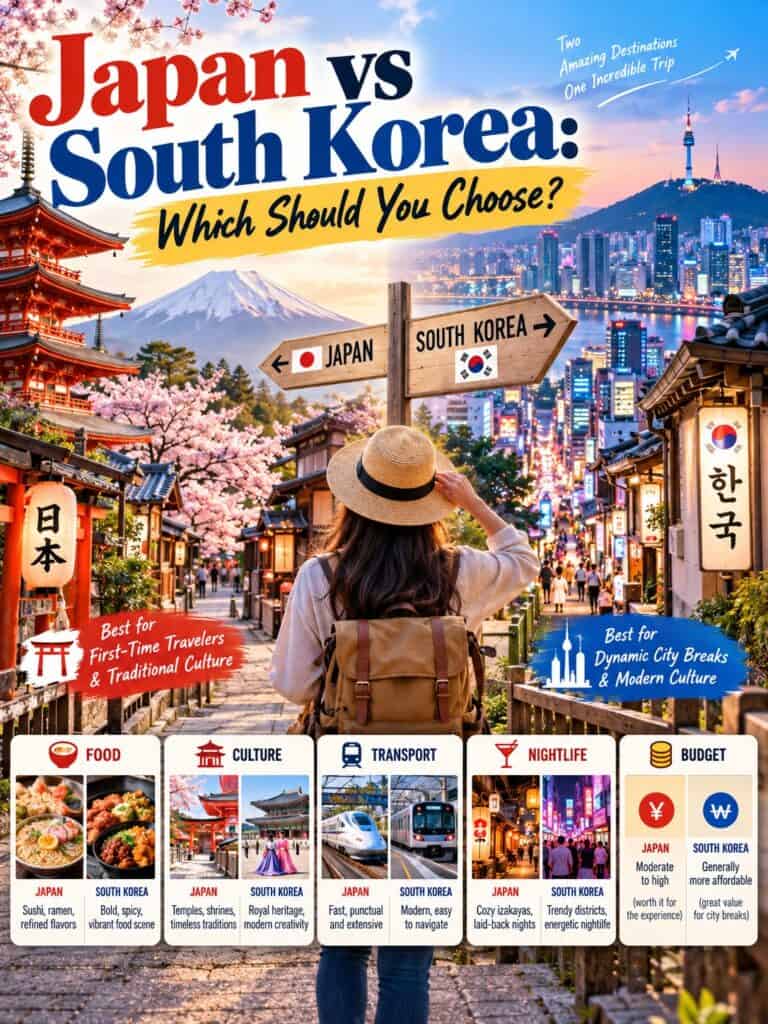
South Korea vs Japan is one of the most common choices for a first Asia trip, and the honest answer depends on what you want. Japan suits travelers who want deep tradition, a famous rail network and very varied food, while South Korea suits those drawn to Seoul’s pop culture, shared-table food and a more compact trip. If you are still choosing between Japan or South Korea, the table below gives a quick verdict by trip type, and the sections after it compare cost, visas, transport, food, weather and how to combine both.
South Korea vs Japan: Quick Verdict by Trip Type
| Trip type | Leans toward | Why |
|---|---|---|
| First visit to Asia | Japan, by a small margin | Very easy to navigate, with wide choice of regions. Korea is also very manageable and compact, especially for a short trip |
| Budget | Compare, do not assume | Korea often has cheaper hotels, but the gap depends on dates, city and exchange rates |
| Food | Both, in different styles | Japan has huge range from counters to street food. Korea is built around shared tables, barbecue and street-food alleys |
| History and temples | Both | Kyoto and Nara in Japan, Gyeongju and Seoul palaces in Korea |
| Pop culture | Depends on the interest | Anime and games in Japan, K-pop, K-drama and beauty culture in Korea |
| Winter holiday | Depends on the activity | Japan has famous powder skiing in Hokkaido and the Alps, while Seoul is colder and drier |
Japan or South Korea: The Short Answer
Choose Japan if you want the broadest mix of regions, rail travel and food variety on one trip. Choose South Korea if you want a compact, energetic trip centered on Seoul, with easy day trips. If you are undecided, both countries are close enough to combine, see the section below.
Is South Korea Cheaper Than Japan? Costs for a 7-Day Trip
Do not decide on exchange rates alone, because prices of hotels, trains and food move with season and demand. The fairest way to answer is to price the same trip in both countries under the same conditions: a 7-day trip for one person, a similar mid-range hotel class, the same number of restaurant meals, local transport in the main city, and two intercity trips in each country.
| Cost category | What to compare | What usually differs |
|---|---|---|
| Hotels (7 nights) | Mid-range rooms in Seoul vs Tokyo or Osaka for the same dates | Often a larger difference than any other category, and Korea tends to be cheaper, but check your dates |
| Food | Daily mix of cheap local meals and a few sit-down dinners | Usually close. Both offer very cheap and very expensive options |
| City transport | A week of subway and bus rides | Both are efficient and affordable, with an IC card or transport card helping |
| Intercity trips | Seoul to Busan by KTX vs Tokyo to Kyoto by bullet train, plus one extra trip each | Japan is often pricier for long rail trips, and passes may or may not pay off |
| Attractions | Temples, palaces, museums, theme parks | Usually modest in both, with a few expensive exceptions |
| Flights | From your home city | Depends on your departure point and season, so compare real quotes |
Use live prices for your dates. For Japan basics, see our guides to money in Japan and the Japan Rail Pass.
Japan Rail Pass holders cannot ride the Nozomi and Mizuho Shinkansen on the pass alone. A separate special ticket covers them on the Tokaido and Sanyo Shinkansen, and the pass itself is sold through the official Japan Rail Pass reservation website or a travel agency overseas.
Visas and K-ETA: Japan vs South Korea Entry Rules
Entry rules depend on your passport and the date of travel, so check them shortly before you go. Do not assume that a rule for one nationality applies to another.
| Topic | Japan | South Korea |
|---|---|---|
| Typical short tourist stay | Many nationalities can enter without a visa for short stays, often up to 90 days, but the length and conditions depend on the passport | Many nationalities can enter without a visa for short stays, with conditions that depend on the passport |
| Electronic authorization | No electronic travel authorization is required now, but Japan has announced a future one, so check before you travel | K-ETA is normally required for visa-free visitors, but a temporary exemption has covered travelers from a set of countries, extended to the end of 2026 |
| What can change | Entry rules and new authorization systems | The K-ETA exemption and its country list, which is set for a limited period |
| Official source | Japan Ministry of Foreign Affairs visa page | Korea K-ETA portal and the Korean foreign ministry notices |
Visa-free entry and K-ETA are two different things. Visa-free means you do not need a visa. K-ETA is an electronic travel authorization that some visa-free visitors must obtain before boarding unless their country is currently exempt. See our Japan visa guide for Japan details, and check the official Korean portal before you fly to Korea.
Korea also asks arriving visitors to fill in an online e-Arrival card. It can be submitted up to three days before arrival (Korean time), and a successfully submitted card does not have to be shown at immigration. Travelers from countries covered by the K-ETA exemption can still apply for a paid K-ETA voluntarily, and an approved K-ETA removes the arrival-card step.
Customs and Arrival Paperwork: Japan vs South Korea
South Korea asks for a customs declaration form only if you carry items to declare. It can be filed online through the Korea Customs Declaration for Travelers app or the customs website, in English or Korean, and the QR code it produces is scanned at the auto-gate. The form asks for personal details such as name, address and passport number, and a family traveling together files one form. A K-ETA application carries a fee, and the fee is non-refundable. Foreigners aged 17 and older give fingerprints and a photo at immigration, while children under 17 do not, and travelers aged 19 and younger cannot claim the alcohol or cigarette allowance. In Japan, cash or equivalent worth more than ¥1 million must be declared. Duty-free allowances for adults compare like this.
| Item | Japan | South Korea |
|---|---|---|
| Alcohol | 3 bottles of about 760 cc each, roughly 2.28 liters in total | Up to USD 400, limited to 2 bottles and 2 liters in total |
| Tobacco | 200 cigarettes, or 50 cigars, or 250 grams of other tobacco | 200 cigarettes |
| Perfume | 2 ounces, about 56 ml | About 60 ml |
| Other goods | Overseas market value under ¥200,000 in total; items worth under ¥10,000 each do not count toward the total | Total purchases up to USD 800 |
Transport: Japan Rail vs KTX, Maps and Getting Around
- Intercity trains: Japan has the Shinkansen and JR network, and South Korea has the KTX high-speed train linking Seoul with Busan and other cities.
- City transit: both have excellent subways, with transport cards that work on buses and trains.
- Maps: Google Maps handles Japanese transit well. In Korea, its walking directions are limited, so many visitors download Naver Map or a similar local app. Naver Map works in Korean, English, Chinese (Simplified) and Japanese on Android and iOS.
- Language: signage at major stations is good in both, and Seoul has more English spoken at tourist-facing places than much of Japan.
For Japan transport, see getting around Tokyo and the Tokyo to Kyoto Shinkansen guide.
Japan vs Korea Food
Japan vs Korea food is a matter of style, not quality. Japan offers high-end counter dining, cheap ramen and excellent convenience-store food, and is as good eating alone as in a group. Korean food centers on shared tables: barbecue, stews, fried chicken with beer and busy street-food alleys. See our Japanese food guide for what to eat in Japan.
Weather and Best Time: Japan vs Korea Travel Seasons
- Spring: both have cherry blossom seasons. Japan’s bloom moves from south to north over several weeks, while Korea’s tends to be shorter and more concentrated.
- Autumn: a very good season in both countries, with comfortable weather and colorful leaves.
- Winter: Seoul is generally colder and drier than Tokyo, while Hokkaido and the Japan Alps offer major snow.
- Typhoons: both can be affected in late summer and early autumn, so check forecasts for your dates.
See our best time to visit Japan for month-by-month details.
Connectivity and Staying Online
Both countries have reliable mobile coverage and eSIM options. For Japan, see Japan SIM cards and eSIMs. For Korea, compare local SIM and eSIM options before you arrive.
Japan vs Korea Tourism: Crowds and Pop Culture
Japan has become a very popular destination, and some famous places such as parts of Kyoto manage crowds with measures that change over time. Korea is also growing in popularity, especially around Seoul. In both, going early and booking popular experiences ahead helps. Pop-culture trips differ: Japan offers anime, games and long-established fan locations, while Korea offers K-pop, K-drama sets and beauty shopping.
Combining Both in One Trip
Combining both is practical. Osaka to Busan is a short flight, usually under two hours, and Tokyo to Seoul is roughly two and a half hours by air. Flights are the simplest option.
There is also a ferry between Busan and Fukuoka. Conventional ferry service has operated on this route, with daytime and overnight sailings, but schedules change and the fast hydrofoil service has been suspended or reduced at times. Check the current operators and timetables before you plan around a ferry, and keep a flight as your backup.
On the Hakata–Busan route, New Camellia’s adult one-way fares since October 1, 2026 start at ¥15,000 in 2nd class and ¥17,000 in a 2nd-class sleeper. Hakata departures add a fuel surcharge of ¥1,400, the international tourism tax of ¥3,000 and, for ages 12 and over, a ¥500 terminal fee. The old round-trip and student discounts ended on September 30, 2026. Some Hakata departures sail overnight: boarding closes at 8 p.m. and arrival in Busan is planned from about 7:30 a.m.
Check-in for those night departures runs from 6 p.m. to 7 p.m. at Hakata Port.
South Korea vs Japan FAQ
Japan or South Korea for first-time visitors?
Both work well. Japan is a little easier to build a varied multi-city trip around, while South Korea is compact and works very well for a shorter trip centered on Seoul.
Is South Korea cheaper than Japan?
Often for hotels, but not always, and food costs are usually close. Compare prices for your own dates rather than relying on exchange rates.
Do I need a visa for Japan or South Korea?
It depends on your passport. Many nationalities can enter both for short stays without a visa, but South Korea may require K-ETA unless your country is covered by its temporary exemption. Check the official sites before you travel.
What is K-ETA?
An electronic travel authorization required by South Korea for many visa-free visitors, unless their country is currently exempt.
Which is better for food, Japan or Korea?
Different styles. Japan has a huge range from counter dining to cheap noodles, and Korea is built around shared meals and street food.
Which is colder in winter, South Korea or Japan?
Seoul is generally colder and drier than Tokyo, while Japan offers major snow regions such as Hokkaido.
Can I visit Japan and South Korea on the same trip?
Yes. Osaka to Busan and Tokyo to Seoul are short flights, and a ferry connects Busan and Fukuoka but schedules vary.
Which is easier to navigate without speaking the language?
Both are manageable. Japan has strong transit signage and Google Maps support, and Korea has more English at tourist places in Seoul but needs a local map app for walking directions.
For a closer look at Japan before you decide, start with our Tokyo guide and our Kyoto vs Osaka comparison.