By Nippon With Me EditorialPublished Updated
Osaka runs louder, cheaper and more food-obsessed than Tokyo or Kyoto, and locals are proud of all three. This Osaka travel guide starts with the best things to do in Osaka, then covers the districts, a one-day and a two-day itinerary, where to stay, how to get in and when to visit. If you only have a day or two, the table of Osaka tourist attractions below is your shortlist.
Things to Do in Osaka: Top 10 Attractions at a Glance
| Attraction | Plan on | Nearest station | Free or paid |
|---|---|---|---|
| Dotonbori and the Glico sign | About 2 hours, best after dark | Namba | Free to walk |
| Osaka Castle and park | 2 to 3 hours | Osakajokoen (JR Loop Line) or Tanimachi 4-chome | Park is free; the keep is paid |
| Kuromon Ichiba Market | About 1 hour | Nippombashi | Free to enter; pay for food |
| Shinsekai and Tsutenkaku Tower | 1.5 to 2 hours | Dobutsuen-mae or Ebisucho | Streets are free; the tower is paid |
| Universal Studios Japan | A full day | Universal City | Paid |
| Osaka Aquarium Kaiyukan | 2 to 3 hours | Osakako | Paid |
| Umeda Sky Building observatory | About 1 hour | Osaka or Umeda | Paid |
| Abeno Harukas observatory | About 1 hour | Tennoji or Abeno | Paid |
| Shitennoji Temple | About 1 hour | Shitennoji-mae Yuhigaoka | Grounds are free; inner areas are paid |
| Shinsaibashi arcade | 1 to 2 hours | Shinsaibashi | Free to walk |
Most things to do in Osaka are easy to cover on foot and by metro, and most of this list sits on the Midosuji Line or a short ride from it. These Osaka tourist attractions are free or paid as marked. Check current opening hours and ticket prices on each attraction’s own page before you go.
Things to Do in Osaka: Osaka Tourist Attractions in Detail
Dotonbori and the Glico Sign
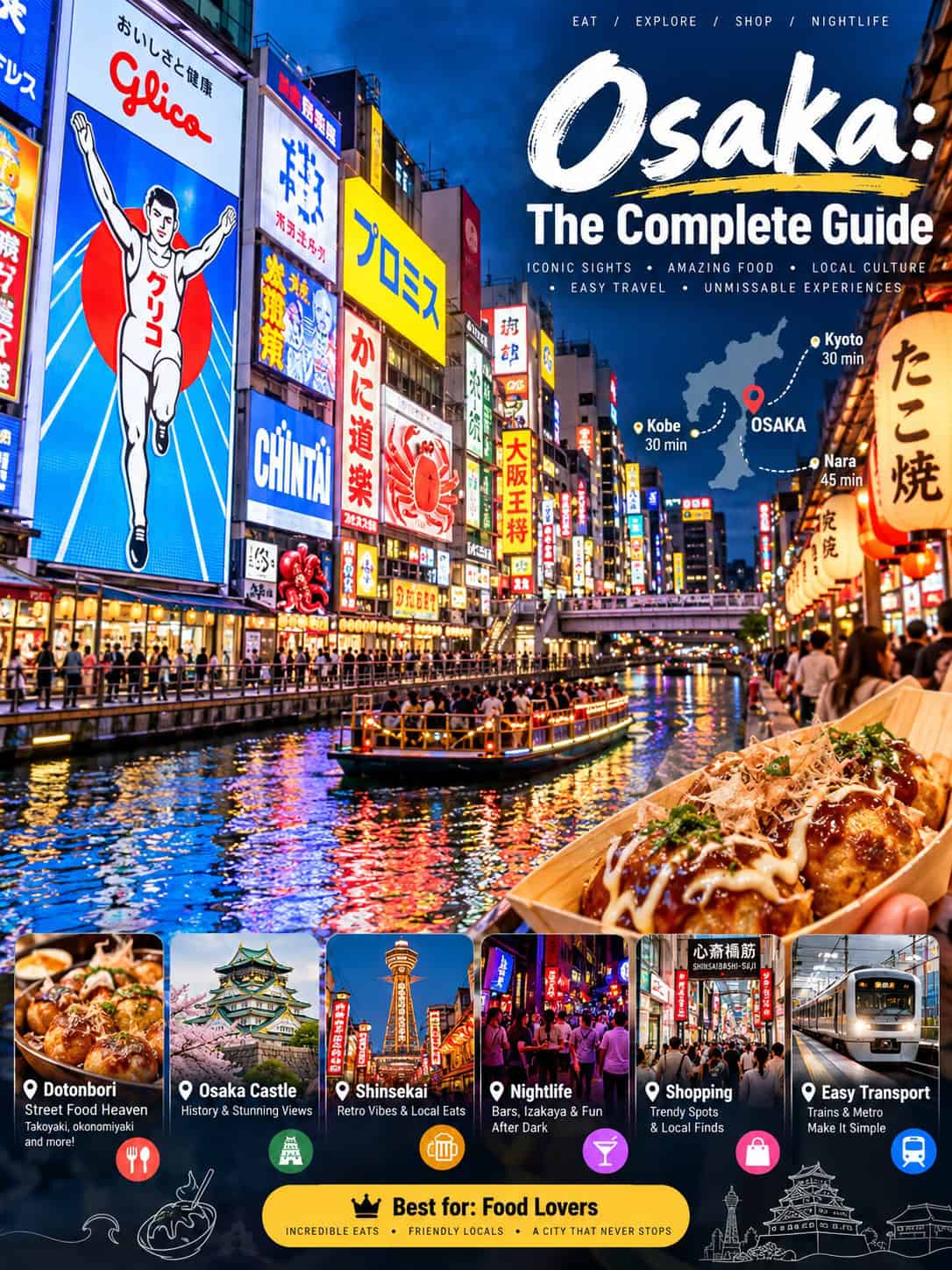
Walking the canal at night, when every sign is lit, is the most Osaka thing to do and costs nothing. The giant Glico Running Man is the city’s most photographed spot. It is also the easiest place to eat well without planning ahead, with takoyaki and okonomiyaki stalls on both sides of the canal.
Osaka Castle
The keep is a reconstruction set inside a large moated park. The museum and observation floor are ticketed, while the surrounding park is open at all hours and free to walk. The museum costs ¥1,200 for adults and ¥600 for high school and university students with proof of student status, and junior high school students and younger enter free with proof of age. It is open 9:00am to 6:00pm with last admission at 5:30pm, and closed from December 28 to January 1. Spring is the best time for cherry blossoms along the moat.
Universal Studios Japan
Treat it as a full day. It has Super Nintendo World and a Harry Potter area alongside standard rides, and it uses dynamic pricing, so check the live calendar for your date. Our full theme-park day planner covers tickets and queues.
Osaka Aquarium Kaiyukan
One of the largest aquariums in the world, built around a central tank with whale sharks and viewed from a descending spiral walkway. Allow two to three hours.
Shinsekai and Tsutenkaku Tower
A deliberately retro district built around the Tsutenkaku Tower and known for its dense cluster of kushikatsu restaurants. The streets are the real draw, with a slightly rougher, old-Osaka feel.
Kuromon Ichiba Market
A covered market street near Namba specializing in fresh seafood, wagyu skewers and seasonal fruit, eaten straight from the stall. Go before the midday crowd.
Abeno Harukas Observatory
Same-day admission to the observatory is ¥2,200 for visitors aged 15 and older and ¥900 for children aged 6 to 14, while children aged 5 and under enter free. Last admission is 30 minutes before closing, so an evening visit needs an earlier arrival than the closing time suggests.
Admission and Hours for Osaka’s Indoor and Skyline Sights
The Kaiyukan, the Umeda Sky Building and Abeno Harukas are the three paid stops that work in the evening or in bad weather.
| Sight | Adult | Child | Hours |
|---|---|---|---|
| Osaka Aquarium Kaiyukan | ¥2,700 | ¥1,400 | 10:00am to 8:00pm; final admission one hour before closing; hours vary by season |
| Umeda Sky Building observatory | ¥2,000 | ¥500 | 9:30am to 10:30pm |
| Abeno Harukas observatory | ¥2,200 | ¥900 | 9:00am to 10:00pm all year; last admission 30 minutes before closing |
Kaiyukan ticket prices differ by season. At Abeno Harukas there is no re-entry once you leave the observatory, and bought tickets cannot be refunded or reissued, so pick a clear evening before you buy.
Osaka’s Districts: Where to Go
- Dotonbori and Namba: nightlife, food and the Shinsaibashi arcade, all within walking distance.
- Shinsaibashi: a covered shopping arcade that leans toward daytime shopping.
- Umeda and Kita: the northern business and transit core around Osaka Station, with the Umeda Sky Building and Grand Front Osaka.
- Shinsekai: retro streets around Tsutenkaku Tower.
- Osaka Castle area: a green, quieter district with the castle park.
- Tennoji and Abeno: Abeno Harukas, Tennoji Park, the zoo and Shitennoji, one of Japan’s oldest Buddhist temples.
Osaka Itinerary: Things to Do in Osaka in One and Two Days
One day: the classic route
Start at Osaka Castle in the morning, then take the metro to Kuromon Ichiba Market for lunch. Spend the afternoon in Shinsekai for kushikatsu and the tower, and finish with Dotonbori after dark. This route links the four big sights in one logical loop.
Two days: add a theme park or the bay
Keep day one as above. On day two, spend a full day at Universal Studios Japan, or choose the Kaiyukan aquarium and the nearby bay area for a calmer alternative. Most visitors extend this to three or four days to add a Kyoto or Nara day trip, both well under an hour away.
If It Rains in Osaka
Swap the outdoor stops (the Osaka Castle park, the Shinsekai streets and the Dotonbori canal walk) for covered ones. The Kaiyukan is an indoor visit at ¥2,700 for adults, Kuromon Ichiba Market and the Shinsaibashi arcade are covered, and the Osaka Castle Museum is an indoor visit at ¥1,200. Keep the observatories for a clear evening, since the views are the whole point.
Where to Stay: Namba, Umeda or Universal City
| Area | Best for | Trade-off | Rough trip to Universal City |
|---|---|---|---|
| Namba and Dotonbori | First-timers who want food, nightlife and shopping on foot | Louder and busier at night | About 25 to 30 minutes with one change |
| Umeda and Kita | A calmer base with strong rail links for Kyoto, Kobe and Shinkansen connections | Less nightlife on the doorstep | About 20 minutes |
| Universal City | Theme-park days with an early start | Few other sights nearby | Walking distance |
| Shin-Osaka | Easy bullet-train access | Less atmosphere | About 30 minutes |
Travel times are approximate, so check the live timetable. For specific hotels by district, see our where-to-sleep picks by district.
Getting to Osaka
From Tokyo, the Tokaido Shinkansen runs frequent direct trains to Shin-Osaka. Nozomi trains take roughly 2.5 hours and Hikari trains, which are Japan Rail Pass eligible, take around 3 hours. From Kansai Airport, the Nankai Rapi:t limited express reaches Namba in about 38 minutes, and JR’s Haruka suits travelers heading to Shin-Osaka or Kyoto. Details are in our airport transfers by rail. From Kyoto, frequent JR and Hankyu trains take well under an hour, as the short rail hop to the old capital explains.
Getting Around Osaka
The Osaka Metro’s Midosuji Line is the main north-south spine, linking Shin-Osaka, Umeda, Namba and Tennoji. The Osaka Amazing Pass bundles unlimited one-day metro rides with free entry to many attractions, including the castle keep, so compare it with your planned sightseeing before you buy. The standard pass costs ¥3,500 for one day or ¥5,000 for two consecutive days, with a pass day running from 3:00am to 2:59am the next morning. It covers the Osaka Metro, most Osaka city bus routes, the New Tram and the Hankyu, Hanshin, Keihan, Kintetsu and Nankai trains mainly running within Osaka City, plus about 40 sightseeing spots. The pass is digital and needs account registration, so set it up before a busy day. Tap “Start Using” only after 3:00am on the day you want to ride, because a ticket started between midnight and 2:59am stops working at 3:00am. For rail passes across the country, see pass-or-no-pass planning.
Osaka Metro Lines and Station Access
The Osaka Metro runs nine lines: Midosuji, Tanimachi, Yotsubashi, Chuo, Sennichimae, Sakaisuji, Nagahori Tsurumi-ryokuchi, Imazatosuji and the New Tram. For Osaka Castle, the closest Metro options are Tanimachi 4-chome Station (Exit 1-B on the Tanimachi Line, Exit 9 on the Chuo Line) and Morinomiya Station (Exits 1 and 3-B on the Chuo Line). The JR Loop Line stops at Morinomiya and Osakajokoen. For the Kaiyukan, ride the Chuo Line to Osakako Station and leave by Exit 1, about a five-minute walk. Tsutenkaku Tower is a 3-minute walk from Ebisucho Station on the Sakaisuji Line or 6 minutes from JR Shin-Imamiya Station on the Loop Line. The Umeda Sky Building is a 7-minute walk from JR Osaka Station and 9 minutes from Hankyu Osaka-Umeda Station or Osaka Metro Umeda Station.
| Pass | Adult | Child | Covers |
|---|---|---|---|
| Enjoy Eco Card | ¥820 on weekdays, ¥620 on weekends and holidays | ¥310 | Unlimited rides for one day on all Osaka Metro and Osaka City Bus lines, except buses to IKEA Tsuruhama and Universal Studios Japan, airport buses and on-demand buses |
| Osaka Amazing Pass, 1 day | ¥3,500 | ¥3,500 | Osaka Metro, most Osaka city bus routes, the New Tram, selected Hankyu, Hanshin, Keihan, Kintetsu and Nankai trains, and about 40 sightseeing spots |
The Enjoy Eco Card covers transport only, so it suits a day built around the Midosuji Line and a few paid stops, while the Amazing Pass bundles attractions. The Enjoy Eco Card does not cover the bus to Universal Studios Japan.
Best Time to Visit Osaka
Spring, from early April to early June, is generally the best window, with cherry blossoms in early April and lighter crowds than Tokyo or Kyoto apart from the short Golden Week surge. Autumn, from late September to mid-November, is a close second and the busiest season. Summer is hot and humid, with a rainy season in June, although the Tenjin Matsuri on July 24 and 25 is a major draw. Winter is quiet and cold, best for illuminations and New Year shrine visits. For the wider picture, see season-by-season timing.
Day Trips From Osaka
Kobe, known for its wagyu beef and the Harborland waterfront, is about 30 minutes away by train. Himeji, home to one of Japan’s best-preserved original castles, is roughly an hour away and suits a half-day detour. Nara is under an hour away too, covered in our deer-park day trip notes.
Food in Osaka
Osaka calls itself the “Kitchen of Japan”, and its food culture centers on affordable, casual dishes: takoyaki (battered octopus balls), okonomiyaki (savory pancakes) and kushikatsu (deep-fried skewers, with a shared dipping sauce you must not double-dip). Dotonbori and Kuromon Ichiba Market are the two most reliable spots to sample all three, and our takoyaki, okonomiyaki and canal-side food goes deeper.
Practical Tips for First-Time Visitors
Whatever things to do in Osaka you choose, and whichever Osaka tourist attractions you add, remember that the city is casual and talkative compared with Tokyo or Kyoto, and food stalls are less formal about queueing and standing while you eat. Universal Studios Japan sells out on popular dates, so book tickets and any Express Pass ahead. If you are weighing it against the old capital, see our head-to-head with the old capital, and for a longer route, the ten-day route with Kyoto and Tokyo.
Frequently Asked Questions
What are the best things to do in Osaka?
Walk Dotonbori at night, visit Osaka Castle, eat at Kuromon Ichiba Market, explore Shinsekai and spend a day at Universal Studios Japan or the Kaiyukan aquarium.
How many days do I need in Osaka?
Two to three days cover the main districts and either Universal Studios Japan or the aquarium. One full day works if you mainly want Dotonbori, the castle and street food.
Is Osaka or Kyoto better for a first visit to Kansai?
They serve different purposes. Kyoto is for temples and traditional culture, while Osaka is for food, nightlife and theme parks. Most itineraries include both, because they are under an hour apart.
Do I need to book Universal Studios Japan tickets in advance?
Yes, especially for weekends, holidays and school breaks, when tickets can sell out and prices rise under dynamic pricing.
Which area is best to stay in Osaka?
Namba suits first-timers who want food and nightlife, Umeda suits a calmer base with strong rail links, and Universal City suits theme-park days.
Is Osaka expensive compared with Tokyo?
Osaka is generally somewhat cheaper for food and casual dining, though hotels in popular districts can cost as much in peak seasons. Many of its best experiences, such as walking Dotonbori at night, cost nothing.
Bottom Line
The best things to do in Osaka reward travelers who come hungry and leave the itinerary loose. Anchor the visit around one theme-park or aquarium day and one unstructured day of food and walking, and the city does most of the rest.