By Nippon With Me EditorialPublished Updated
Osaka street food goes beyond takoyaki and okonomiyaki: explore Dotonbori snack shops, Kuromon Ichiba seafood, Shinsekai kushikatsu and local dishes such as kitsune udon, negiyaki and butaman. Osaka’s nicknames say it all: tenka no daidokoro, “the nation’s kitchen,” and kuidaore, roughly “eat until you go broke.” This Osaka food guide compares areas, practical opening times and indicative costs, with a walkable route around Namba and a second food stop in Shinsekai.
Osaka Street Food: Quick Answer
| Question | Answer |
|---|---|
| What’s the one dish to eat in Osaka? | Takoyaki is a signature Osaka snack. Shops commonly trace its modern form to the 1930s, but official Osaka tourism notes that accounts of its invention differ. |
| What’s the famous “no double-dipping” rule? | At counters with communal sauce, never re-dip a bitten skewer. Many restaurants now provide individual sauce bottles or portions; follow the shop’s method. |
| Is Dotonbori worth visiting for food or just photos? | Both — it has genuinely good takoyaki and okonomiyaki shops alongside the famous signage, though it’s touristy and crowded |
| What’s Kuromon Ichiba Market like now? | Kuromon Market has roughly 150 shops along a 580-metre arcade. Compare displayed prices before buying seafood, fruit or wagyu. |
| How does Osaka okonomiyaki differ technically from other styles? | Everything — cabbage, batter, protein — gets mixed into one batter before cooking, unlike Hiroshima’s layered build |
Osaka Street Food: What to Eat and Where
| Food | Best area to explore | What to expect |
|---|---|---|
| Takoyaki | Dotonbori / Namba | Octopus-filled batter balls; very hot inside |
| Okonomiyaki | Namba / Dotonbori | Griddled cabbage pancake with custom toppings |
| Kushikatsu | Shinsekai / Janjan Yokocho | Fried skewers, often sold individually or as sets |
| Fresh seafood | Kuromon Ichiba Market | Scallops, sushi, seafood bowls; check displayed prices |
| Negiyaki | Juso / Umeda | Green-onion pancake, often seasoned with soy sauce |
| Butaman | Namba / major stations | Steamed pork buns from 551 Horai and other shops |
| Kitsune udon | Central Osaka udon restaurants | Udon noodles with sweet fried tofu |
| Hakozushi | Traditional Osaka sushi shops | Pressed, rectangular sushi |
For a first visit, start around Namba for takoyaki and okonomiyaki, visit Kuromon in daylight and head to Shinsekai for kushikatsu later.
Osaka Street Food in Dotonbori: The Signage Is Real, So Is the Food
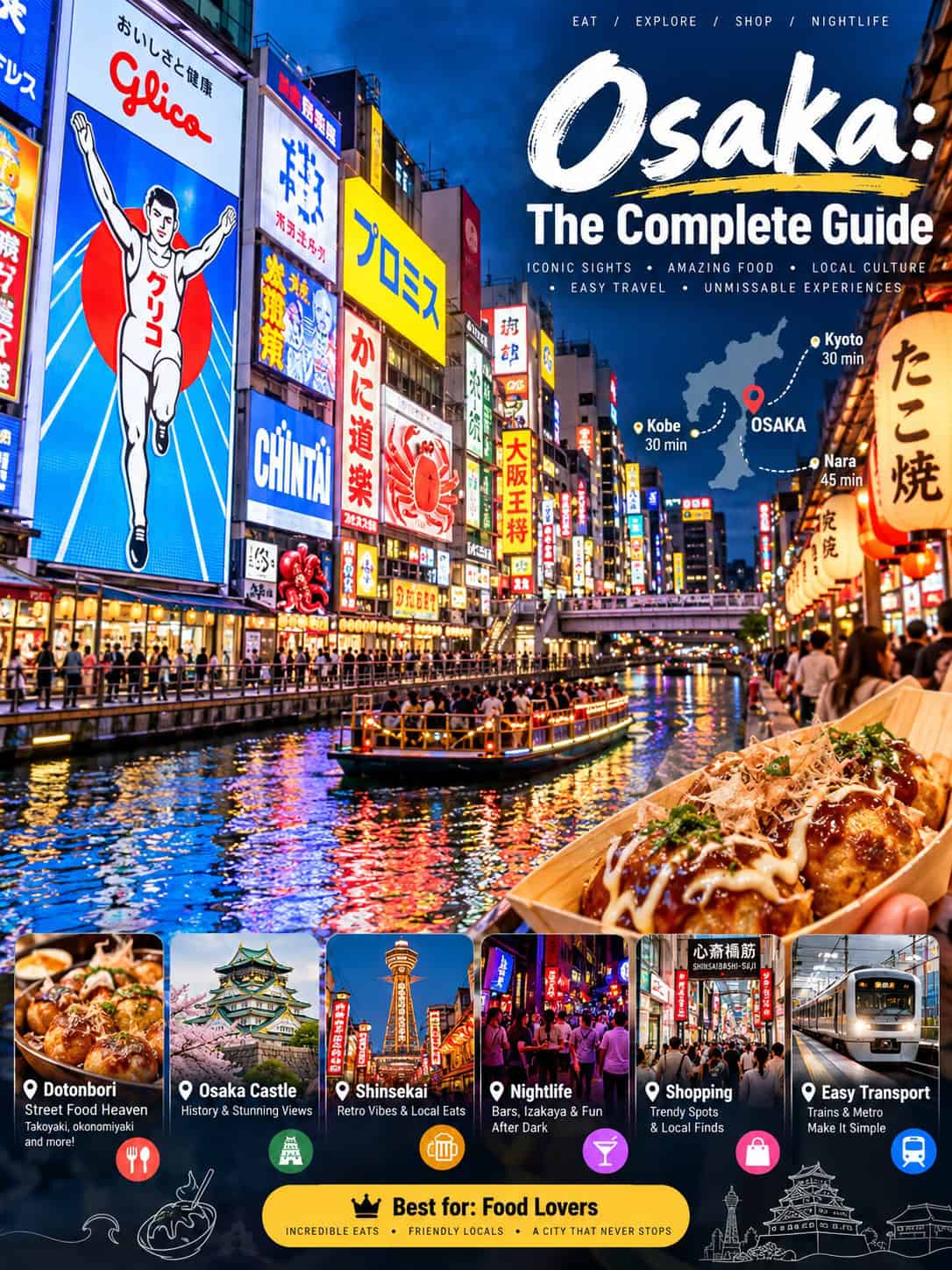
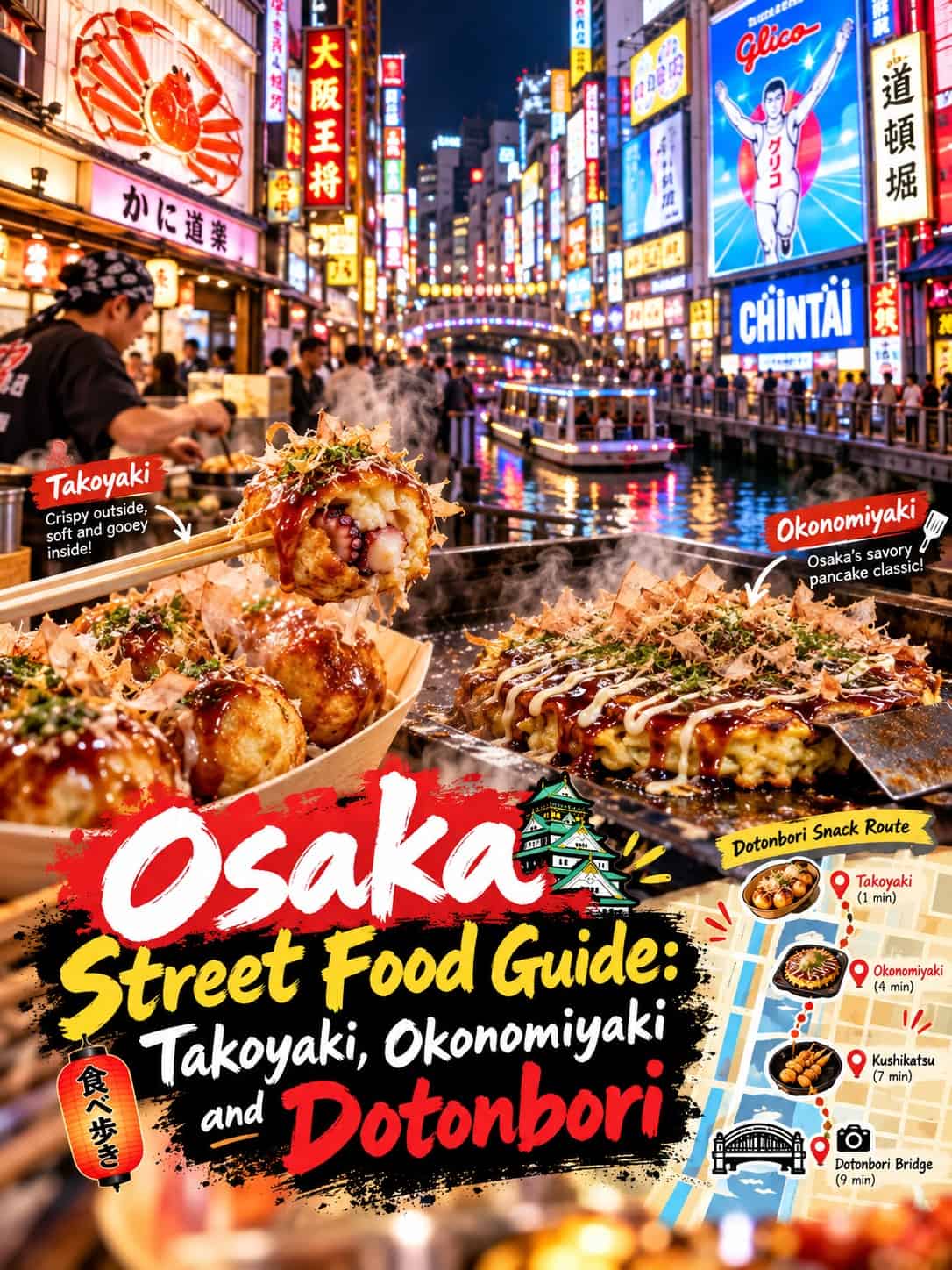
Dotonbori is Osaka’s canal-side entertainment and dining strip in Namba, built along a waterway dug in the early 1600s that became the city’s official entertainment district under the Tokugawa Shogunate. Most people know it for the giant animated Glico Running Man sign, installed in 1935 and now on its sixth, LED version since 2014, standing just west of Ebisubashi bridge. The oversized 3D food signage around it is part of the draw in its own right: a mechanized crab outside Kani Doraku dating to 1960, gold dragon signs at the 24-hour Kinryu Ramen locations, and a handful of other giant signboards for octopus and other dishes along the strip. One well-known landmark that’s no longer there: the puffer-fish lantern outside the old Zuboraya restaurant, which closed permanently in 2020 after decades in business — if you’re looking for it from an old photo, it’s gone. Dotonbori is busiest from late afternoon into the night and can feel overwhelming; weekday mornings are the realistic way to see it without the crowds. The food itself holds up past the photo ops — this is where some of Osaka’s most established takoyaki and okonomiyaki shops operate, not just a backdrop.
Dotonbori Street Food: Best Access and Timing
Dotonbori sits near Namba Station, which Osaka’s official tourism site lists as its main public-transport gateway. Restaurants along the canal set their own hours and holidays; the district itself has no single opening or closing time. Visit around late afternoon for a meal before the busiest neon-lit period, or after dark if the atmosphere matters most. Our Osaka travel guide covers the city’s main neighbourhoods.
Best Food in Dotonbori: A Practical Ordering Plan
Try one shareable takoyaki order, then split an okonomiyaki meal or a small kushikatsu plate rather than buying a full serving at every stop. Check whether the venue offers takeaway, counter space or indoor seats. Large queues at a famous sign do not automatically prove a better meal.
Osaka Street Food Icon: Takoyaki
Takoyaki developed in Osaka in the early twentieth century. Aizuya credits its founder Tomekichi Endo with creating octopus-filled takoyaki in 1935, but Osaka’s official tourism guide says there are several theories about the dish’s origins, including links with choboyaki and radioyaki. Aizuya remains a historically important Osaka shop. Dotonbori and Namba have many takoyaki shops, including Kukuru and Juhachiban. Expect menu prices to vary by portion, filling and topping; an illustrative visitor budget is ¥700–1,100 for a portion. Check the current menu before ordering and eat in the designated area rather than blocking pedestrians.
Best Takoyaki Osaka: Places to Compare
| Shop | Neighbourhood | Why compare it |
|---|---|---|
| Kukuru | Dotonbori | Easy central stop and familiar sauce-covered style |
| Juhachiban | Dotonbori | Popular alternative near other food stalls |
| Wanaka | Namba area | Well-known Osaka shop with several formats |
| Aizuya | Locations including Tamade | Historic shop associated with the 1935 origin claim |
Locations, menus and opening hours differ by branch, so check the current shop listing before making a dedicated detour. The Osaka tourism board also lists the Dotonbori Konamon Museum, near Namba Exit 14, with free museum admission and a paid food-replica workshop.
Osaka-Style Okonomiyaki: The All-Mixed Technique
Osaka’s okonomiyaki is built differently from the layered Hiroshima version: cabbage, batter, egg, and your chosen protein all get mixed together before hitting the griddle, producing one dense, cohesive pancake rather than distinct layers. It’s finished with okonomiyaki sauce, Japanese mayo, bonito flakes, and dried seaweed, and often ordered alongside a plate of yakisoba noodles. How hands-on you get depends on the restaurant — some shops cook it entirely for you, while others hand you the raw batter on a hot plate at your table and let you flip and finish it yourself, usually with staff ready to step in if you ask. Dotonbori has well-known okonomiyaki spots tucked just off the main strip, and it’s worth hunting one out specifically rather than assuming every okonomiyaki shop you pass is equally good.
Best Okonomiyaki Osaka: How to Choose a Restaurant
Some venues cook okonomiyaki at the counter; others provide a table griddle. Popular central names include Mizuno and Chibo, while negiyaki specialists such as Yamamoto offer a green-onion alternative. Review current menus if you avoid pork, seafood or bonito flakes. If you need somewhere to stay, see the best hotels in Osaka.
What to Eat in Osaka If You Do Not Eat Meat
Takoyaki contains octopus, and standard okonomiyaki may contain pork, seafood, dashi or bonito flakes. Vegetable-looking kushikatsu may share cooking oil with meat or seafood. Ask staff about all ingredients and cross-contact before ordering; never assume that a dish is vegetarian simply because its main ingredient is cabbage.
Osaka Street Food at Kuromon Ichiba Market: Worth It, With Some Caution
Osaka’s official tourism board lists Kuromon Ichiba as a 580-metre market arcade with approximately 150 shops. Its origins date to around 1822–1823. Visitors can find seafood, fruit, prepared dishes and produce, with individual shops setting their own opening days and hours. Carry some cash for smaller stalls, but payment options vary. Visit in the morning or around lunch for the broadest food selection, and do not assume Wednesday is the quietest day, since some independent shops may close midweek.
Kuromon Market Food: Practical Visit
Nipponbashi Station is close to the market entrance, and central Namba is within walking distance. Allow one to two hours for browsing and a few food stops. Individual vendor hours differ, so arrive in the morning or early afternoon and do not rely on an evening market visit.
For wagyu skewers, scallops, seafood bowls and fruit, ask for the full price including tax before ordering. Some fresh seafood is priced by weight rather than per piece. Check for a designated eating space and dispose of packaging as requested. Our Japanese food guide covers regional dishes.
Osaka Street Food in Shinsekai: The Kushikatsu “No Double-Dipping” Rule
Shinsekai near Tsutenkaku Tower is Osaka’s retro, slightly gritty counterpart to Dotonbori’s polish, built up in the 1920s around cheap, filling food for laborers. It is known for kushikatsu: meat, seafood and vegetables fried on skewers. The traditional no-double-dipping rule applies where diners share a common sauce container. Some shops instead supply individual bottles or sauce portions, so follow the system at your restaurant. Where restaurants use a communal sauce container, dip a skewer only before taking a bite; if you want more sauce, use a clean piece of the supplied cabbage or ask staff for an approved serving method. Janjan Yokocho offers more kushikatsu counters nearby.
Shinsekai Kushikatsu: A First-Timer’s Order
Choose a small mixed set with vegetables, shrimp or meat, then add individual skewers after checking the menu. The traditional sauce rule avoids sharing saliva through communal dipping containers. At places that supply individual sauce bottles, use those instead. Visit Janjan Yokocho for more kushikatsu options around Shin-Imamiya and Dobutsuen-mae stations.
Other Osaka Street Food and Specialties Worth Seeking Out
Several Osaka street food dishes are easy to miss if you only stick to takoyaki and okonomiyaki. Beyond takoyaki, try negiyaki, a green-onion-rich variation of okonomiyaki usually brushed with soy sauce, and horumon-yaki, grilled offal served at selected yakiniku restaurants. Osaka has a long history with both. Kitsune udon, noodles topped with sweet fried tofu, is claimed by one long-running Osaka restaurant as a local invention, though it’s a claimed rather than universally agreed-upon origin story. And if you want something genuinely old-school and increasingly rare, look for hako-zushi, also called Osaka-zushi: pressed box sushi made by layering fish over vinegared rice in a wooden mold, traditionally eaten without soy sauce or wasabi since the flavors are meant to meld on their own, historically convenient because it traveled well into Dotonbori’s old theaters.
Osaka Local Dishes Beyond Takoyaki
| Dish | Ingredients | Where to look |
|---|---|---|
| 551 Horai butaman | Steamed bun with pork filling | Namba and major train stations |
| Ikayaki | Pressed squid snack cooked on a griddle | Department-store food halls, including Umeda |
| Kitsune udon | Udon with sweet fried tofu | Local udon shops |
| Negiyaki | Green-onion pancake | Negiyaki specialists |
| Hakozushi | Pressed Osaka-style sushi | Traditional sushi restaurants |
| Horumon-yaki | Grilled offal | Yakiniku restaurants around Tsuruhashi |
Osaka’s Michelin Scene, Briefly
The Michelin Guide Kyoto Osaka 2026 lists 81 starred restaurants in Osaka: three with three stars, 12 with two and 66 with one. Another 59 Osaka restaurants hold Bib Gourmand distinctions. These figures describe the 2026 selection, not a permanent count, and the casual food stalls in this article generally operate outside that ranking. Osaka’s food reputation rests as much on a ¥700 bag of takoyaki as on any tasting menu. For the capital’s food scene, see our Tokyo food guide.
Osaka Street Food Tour: A Half-Day Route
11:00 AM — Kuromon Ichiba: Start with seafood or a small market snack, allowing up to 90 minutes.
12:30 PM — Namba: Walk toward Dotonbori and try takoyaki or okonomiyaki. Save room for later stops.
2:00 PM — Hozenji Yokocho: Explore the quieter lanes and take a break.
4:30 PM — Shinsekai: Ride Osaka Metro to Dobutsuen-mae or nearby Shin-Imamiya and finish with kushikatsu.
This is a flexible eating route, so check menus and hours on the day. If you are comparing cities, our Kyoto vs Osaka guide helps you decide, and the Universal Studios Japan guide and Kansai Airport transfer guide cover the rest of the trip.
Explore guided Osaka food tours and cooking experiences.
Osaka Street Food: Frequently Asked Questions
Where was takoyaki invented?
Aizuya attributes modern takoyaki to its founder Tomekichi Endo in Osaka in 1935. Official Osaka tourism also acknowledges other theories about the dish’s origins.
What is the best Osaka street food for first-time visitors?
Try takoyaki, okonomiyaki and kushikatsu first, then explore negiyaki, kitsune udon or butaman.
Where can I eat Osaka street food near Namba?
Walk through Dotonbori for takoyaki and okonomiyaki, then visit Kuromon Market near Nipponbashi for seafood and fruit.
What’s the rule about double-dipping at kushikatsu counters?
Do not re-dip a bitten skewer in communal sauce. Use clean cabbage if the restaurant allows it, or the individual sauce bottle supplied at your table.
How is Osaka okonomiyaki different from Hiroshima’s?
Osaka mixes all the ingredients into one batter and cooks it as a single pancake, rather than layering them over noodles the way Hiroshima does.
Is Kuromon Ichiba Market worth visiting?
Yes, but compare displayed prices before ordering seafood, fruit or wagyu, since the market has become a major tourist stop. Its roughly 150 shops along a 580-metre arcade set their own hours.
What time does Kuromon Market open?
There is no single market-wide opening time. The official tourism website says hours and holidays differ by shop, so morning to early afternoon is a practical target.
Is Dotonbori street food expensive?
Prices vary by shop and portion. Famous locations may cost more; check the menu and whether tax or optional toppings add to the bill.
Can vegetarians eat Osaka okonomiyaki?
Sometimes. Ask whether the batter or toppings include dashi, pork, seafood or bonito flakes and check for shared cooking surfaces.
Is the Glico sign in Dotonbori still the original?
No. It has been replaced several times since 1935, and the current LED version dates to 2014.
What’s Shinsekai known for?
Kushikatsu skewers, a retro atmosphere built up in the 1920s, and Tsutenkaku Tower as its visual landmark.
Can I visit Osaka on a day trip from Kyoto?
Yes, easily. It is about 15 minutes by Shinkansen or under an hour by regular train, making it a comfortable day trip.
Can I join a guided Osaka food tour?
Yes. Guided visits commonly cover Dotonbori, Namba, Kuromon or Shinsekai. Compare exact food inclusions, dietary accommodation and meeting points.
Does Osaka have Michelin-starred restaurants?
Yes. Michelin Guide Kyoto Osaka 2026 lists 81 Osaka restaurants with at least one star: three with three stars, 12 with two and 66 with one.
Bottom Line
Osaka street food rewards eating with your hands while standing up as much as the city’s restaurants reward a reservation. Takoyaki, okonomiyaki, and kushikatsu aren’t a warm-up act before the real meal — in Osaka, they are the real meal, and the city has spent close to a century perfecting them.