By Nippon With Me EditorialPublished Updated
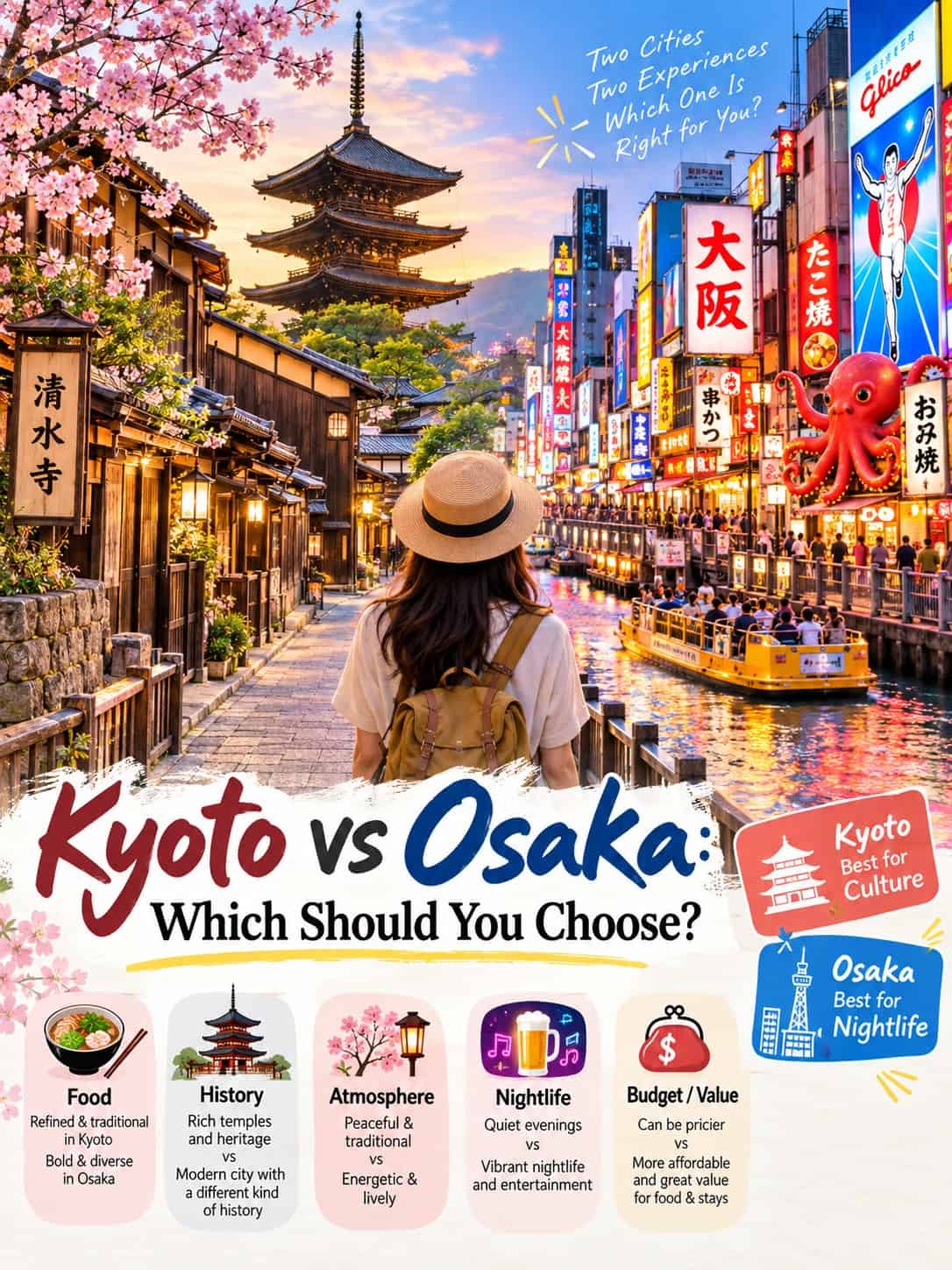
Kyoto vs Osaka is one of the first choices most Japan itineraries run into. The two cities sit about thirty minutes apart by train, but they feel like they belong to different decades. Kyoto is the former imperial capital, quiet and temple-dense, where the main event is a garden or a shrine. Osaka is Japan’s food and commerce hub, loud and street-level, where the evenings are the main event. Most travelers see both, so the real decision is where to sleep, how to split the days and which city’s version of Japan you want more of.
Kyoto vs Osaka: Quick Answer
| Question | Answer |
|---|---|
| Which is cheaper to stay in? | Osaka, generally, when you compare the same hotel class and season |
| Which has better food? | Osaka for variety and street food; Kyoto for kaiseki and traditional dining |
| Which has more temples and historic sites? | Kyoto, by a wide margin |
| Which is better for nightlife? | Osaka, though Kyoto has atmospheric evenings in Gion and Pontocho |
| Should I base in one and day-trip the other? | Either works. Basing in Osaka is the common budget choice |
Kyoto or Osaka at a Glance
| Factor | Kyoto | Osaka |
|---|---|---|
| Where to stay | Quieter, closer to temples, ryokan stays | Central transit hub with more hotel choice |
| Food | Kaiseki, tofu, matcha, traditional dining | Street food, okonomiyaki, takoyaki, kushikatsu |
| Nightlife | Calm evenings; Gion, Pontocho, Kiyamachi | Loud and late; Dotonbori, Namba |
| History | Temples, shrines, gardens, geisha districts | Osaka Castle and a handful of major landmarks |
| Kids and families | Railway Museum, Arashiyama, Nara day trip | Universal Studios Japan and Super Nintendo World |
| Day trips and transit | Easy rides to Nara and Osaka | Easy rides to Kyoto, Nara, Kobe and Himeji |
Two Cities Thirty Minutes Apart, Built Around Opposite Ideas
Kyoto was Japan’s imperial capital for over a thousand years, and it was largely spared the bombing that leveled much of the country in World War II, which is why it still has about 2,000 temples and shrines and a UNESCO World Heritage listing of 17 registered cultural properties spread across Kyoto, Uji and Otsu. Osaka’s identity runs in the opposite direction: historically Japan’s merchant and commercial hub, now a financial center and, by wide reputation among food writers, one of the best food cities in the world. If Kyoto is where Japan kept its past most intact, Osaka is where its present-day appetite and energy live.
Kyoto vs Osaka: What Osaka Does Better
Osaka’s case starts with food. Dotonbori’s neon-lit canal strip, the stalls of Kuromon Ichiba Market and casual institutions serving takoyaki, okonomiyaki and kushikatsu make it a city built for grazing rather than reservations. Our Osaka street food guide covers what to order. Osaka is also the home of manzai stand-up comedy and a lively entertainment scene, and it has Universal Studios Japan, Osaka Castle and the retro arcade sprawl of Shinsekai. Osaka ends up being the more purpose-built entertainment city of the two, day and night.
Osaka Castle, Kuromon and Dotonbori: Practical Details
The Osaka Castle museum is open 9 a.m. to 6 p.m., with the last entry at 5:30 p.m., and adult admission is ¥1,200. Children through junior high school get in free with proof of age, and visitors from overseas aged 15 or under need their passport. Its regular closure is December 28 to January 1. Kuromon Market has about 150 stores, wholesale and retail, and each sets its own hours and days off, so there is no single closing time. The same is true along Dotonbori, where the giant takoyaki sign, the Kani-Doraku crab restaurant and the Shochikuza theater line the canal and the Tombori Riverwalk follows the water.
Kyoto vs Osaka: What Kyoto Does Better
In the Kyoto vs Osaka debate, Kyoto’s case is depth of history rather than breadth of entertainment. Fushimi Inari’s gates, the Arashiyama bamboo grove, Kinkaku-ji and Gion’s geisha district are the images most visitors associate with traditional Japan, concentrated in one city more densely than almost anywhere else in the country. Kyoto is also the center of kaiseki dining, traditional ryokan inns and matcha culture. If you want slow, deliberate, traditional Japan rather than a fast, loud, modern version of it, Kyoto delivers something Osaka is not built to. See our Kyoto guide and the best ryokan in Kyoto for ideas.
Getting Around Kyoto: Stations, Passes and Fushimi Inari
Trains beat buses to Kyoto’s most popular shrine. From Kyoto Station, the JR Nara Line is the simplest route to Fushimi Inari. The first table shows where to get off for Fushimi Inari and for Osaka’s food streets, and the second covers the day passes that matter in Kyoto.
| Sight | Where to get off | Line | Time and walk |
|---|---|---|---|
| Fushimi Inari Taisha, from Kyoto Station | JR Inari Station | JR Nara Line | About 5 minutes by train (2 stations); rapid and local trains stop, and the red torii and main approach are right outside |
| Fushimi Inari Taisha, from Gion-Shijo | Fushimi Inari Station | Keihan line | About 22 minutes by train, then about a 5-minute walk east to the main approach; limited express trains do not stop here |
| Kuromon Market | Nippombashi Station | Osaka Metro Sennichimae Line | Right outside the station |
| Dotonbori | Namba Station | Nankai, Kintetsu, Osaka Metro Midosuji, Sennichimae and Yotsubashi lines | Right outside the station |
| Kyoto pass | Price | What it covers |
|---|---|---|
| Subway & Bus 1-Day Pass | ¥1,100 adult, ¥550 child | Subway, city buses and selected Kyoto Bus, Keihan Bus and West Japan JR Bus routes; some routes of those three operators are excluded. Valid for one day and sold on buses as well as at subway and bus information desks |
| Kyoto City Subway 1-Day Pass | ¥800 adult, ¥400 child | Subway only |
| Kyoto Bus Arashiyama/Sagano Free Ticket | ¥400 | A one-day Kyoto Bus ticket for Arashiyama and Sagano trips |
Kyoto vs Osaka Costs: Is Osaka Cheaper Than Kyoto?
Generally yes, but compare like with like. Osaka has more hotel stock for its demand, so rooms of the same class usually cost less than in Kyoto, and the gap widens during Kyoto’s cherry blossom and autumn leaf peaks, when its smaller hotel stock pushes rates up sharply. Food follows a similar pattern: a casual Osaka meal built around street food usually costs far less than a sit-down Kyoto kaiseki dinner, though Kyoto also has affordable noodle shops and casual lunches.
Kyoto also changed its accommodation tax in March 2026. The tax is charged per guest, per night, and the band depends on the accommodation charge per person: ¥200 under ¥6,000, ¥400 for ¥6,000–¥19,999, ¥1,000 for ¥20,000–¥49,999, ¥4,000 for ¥50,000–¥99,999 and ¥10,000 from ¥100,000. Before March the highest rate was ¥1,000 a night, so the new top bands are where the change is felt. For mid-range rooms the extra is small; it matters mostly at the luxury end. If you are weighing the budget, our Osaka hotel picks show what the other side offers.
Kyoto vs Osaka Crowds: A Different Kind of Busy
It is tempting to assume Osaka is the crowd-free alternative to overtouristed Kyoto, but that is not quite right. Osaka is among Japan’s most visited cities by foreign tourists, and its crowds spread across a bigger city with more hotel capacity and entertainment options. Kyoto’s crowds concentrate hard at a handful of famous temples and streets, which makes its crowding feel more acute. Kyoto has also been discussing higher bus fares for tourists. Early mornings and weekday visits help in both cities.
Nightlife and Evenings: Gion and Pontocho vs Dotonbori and Namba
Kyoto’s evenings are calmer rather than empty. Many traditional restaurants and shops close earlier than in Osaka, but Gion and Pontocho are atmospheric for an evening dinner, and the Kiyamachi area has bars that stay open later. Osaka’s evenings are the opposite: Dotonbori and Namba run loud and late, with izakaya, bars and street food stalls well after Kyoto has quieted down. If a livelier evening scene matters to your trip, that is a good argument for basing in Osaka, even if you spend your days in Kyoto. If you do walk Gion after dark, stay on the public streets: entering private properties and touching, chasing or photographing geiko and maiko without permission are against Kyoto’s visitor guidelines, which warn that violations may result in fines.
Kyoto vs Osaka for Families and Kids
Universal Studios Japan, home to Super Nintendo World, is the single biggest kid-focused draw either city offers, and it is reason enough for some families to pick Osaka as a base. Kyoto is not a family write-off, though: the Kyoto Railway Museum lets kids explore trains, Arashiyama has a monkey park and a scenic riverboat tour, and Nara’s deer park is an easy half-day trip that works well for younger children who would find an all-temple day slow going.
If It Rains: Which City Handles a Wet Day Better?
Fushimi Inari, the Arashiyama bamboo grove and the lanes of Gion are outdoor walks, so a wet day is easier on the Osaka side. The Osaka Castle museum is a solid indoor half-day, and a long lunch of takoyaki and kushikatsu around Dotonbori fills the rest. If you are based in Kyoto, plan the temple day for the clearer weather and use the wet day for the Osaka trip.
Stay in Osaka or Kyoto: A Plan for 1, 2 or 4 Nights
| Nights | If you choose one base | Suggested split |
|---|---|---|
| 1 night | Kyoto if you want an early start at the temples or a ryokan stay; Osaka if you want food and nightlife | Spend the night in the city whose evening you want, and visit the other by day |
| 2 nights | Osaka for budget and transit; Kyoto for slower exploring | One night in each city if you want both evenings |
| 4 nights | Either works for day trips | Two nights in Kyoto and two in Osaka, or three in Kyoto and one in Osaka |
Basing in Osaka and day-tripping into Kyoto is the more commonly recommended budget move. Osaka sits at a more central transit hub, with easy onward trips to Nara, Kobe, Himeji and beyond, and Kansai International Airport connects to both cities by train (the direct JR Haruka reaches Kyoto Station in about 80 minutes), as in our Kansai Airport guide. The one real advantage of basing in Kyoto is early access: staying overnight lets you reach busy sites like Fushimi Inari early, before day-trip crowds arrive. Kyoto generally rewards three to four days of its own, while Osaka’s core sights can be covered in about a day, making it the easier one to add on.
Moving between the cities is simple, and several lines serve the route. The JR Special Rapid takes about 30 minutes from Osaka Station to Kyoto Station. Hankyu runs from Osaka-Umeda to Karasuma or Kyoto-Kawaramachi in downtown Kyoto in about 45 minutes, and the Keihan Main Line links Yodoyabashi with Gion-Shijo or Sanjo in about 48 minutes by Limited Express. Our transport guide between the two compares the options, and our 10-day itinerary shows how to fit both into a longer trip. Arriving from Tokyo? See the bullet train guide.
Kyoto vs Osaka: Frequently Asked Questions
Is Osaka cheaper than Kyoto?
Usually yes, for both hotels and food, when you compare the same hotel class in the same season. Kyoto has less hotel stock for its demand, so rates climb sharply in cherry blossom and autumn leaf season. Kyoto’s accommodation tax also adds more at the top end, though it is small for mid-range rooms.
Should I stay in Kyoto or Osaka?
Stay in Osaka if budget, nightlife and central transit matter most. Stay in Kyoto if you want early access to famous sites before day-trippers arrive, or a traditional ryokan stay. Many travelers split their nights between both.
Is Kyoto or Osaka better for first-time visitors?
Kyoto suits first-timers who want temples, gardens and traditional Japan. Osaka suits those who want food, nightlife and entertainment. Most itineraries include both.
Which city has better food, Kyoto or Osaka?
Osaka has the broader, more casual food scene built around street food and local specialties. Kyoto’s food is narrower but distinctive, centered on kaiseki and traditional cooking.
Is nightlife better in Osaka or Kyoto?
Osaka has the livelier, later scene around Dotonbori and Namba. Kyoto’s evenings are calmer, with atmospheric dining in Gion and Pontocho and bars around Kiyamachi.
Is Osaka good for families?
Yes, largely because of Universal Studios Japan, with Super Nintendo World the biggest draw. Kyoto has family options too, including the Kyoto Railway Museum, Arashiyama and a nearby day trip to Nara’s deer park.
How far apart are Kyoto and Osaka?
About thirty minutes by JR train or roughly fifteen minutes by Shinkansen between Shin-Osaka and Kyoto, so a day trip in either direction is easy.
Does Osaka have historic sites like Kyoto?
Not at the same density. Osaka Castle is its main landmark, while Kyoto has around 2,000 temples and shrines and a large UNESCO World Heritage listing.
Bottom Line
Kyoto and Osaka are not really rivals so much as two different answers to what a trip to Japan should feel like: one slow, historic and temple-dense, the other fast, loud and food-driven. If budget, nightlife and convenient transit matter most, base in Osaka. If early access to Kyoto’s famous sites matters more than saving money, base in Kyoto. Either way, the short hop between them means you rarely have to choose only one.