By Nippon With Me EditorialPublished Updated
Japanese dining etiquette, train manners and bathing rules look intricate from the outside, but the reality for tourists is more forgiving than it sounds. Locals do not expect visitors to get every custom right, and small mistakes rarely cause offense. A handful of habits cover almost every situation you will meet: on trains, at the table, in an onsen and at a shrine.
Japanese Dining Etiquette and Other Customs: Quick Answer
| Question | Answer |
|---|---|
| Do I need to bow correctly? | No. A light nod is enough for tourists, and locals do not expect a formal bow. |
| Biggest train mistake to avoid | Taking phone calls or talking loudly in a crowded car. |
| Worst chopstick mistake | Sticking chopsticks upright in rice or passing food from chopsticks to chopsticks. Both recall funeral customs. |
| Can I wear swimwear in an onsen? | Usually not. Most baths require bathing without clothes after washing, although a few mixed baths provide special bathing garments (yuami-gi). |
| Do I tip in Japan? | Not in restaurants or taxis. Some private guides and interpreters accept an optional tip in an envelope. |
| What habit matters everywhere? | Keeping your voice down in shared, enclosed spaces. |
Japanese Customs for Tourists: Bowing Without Stress
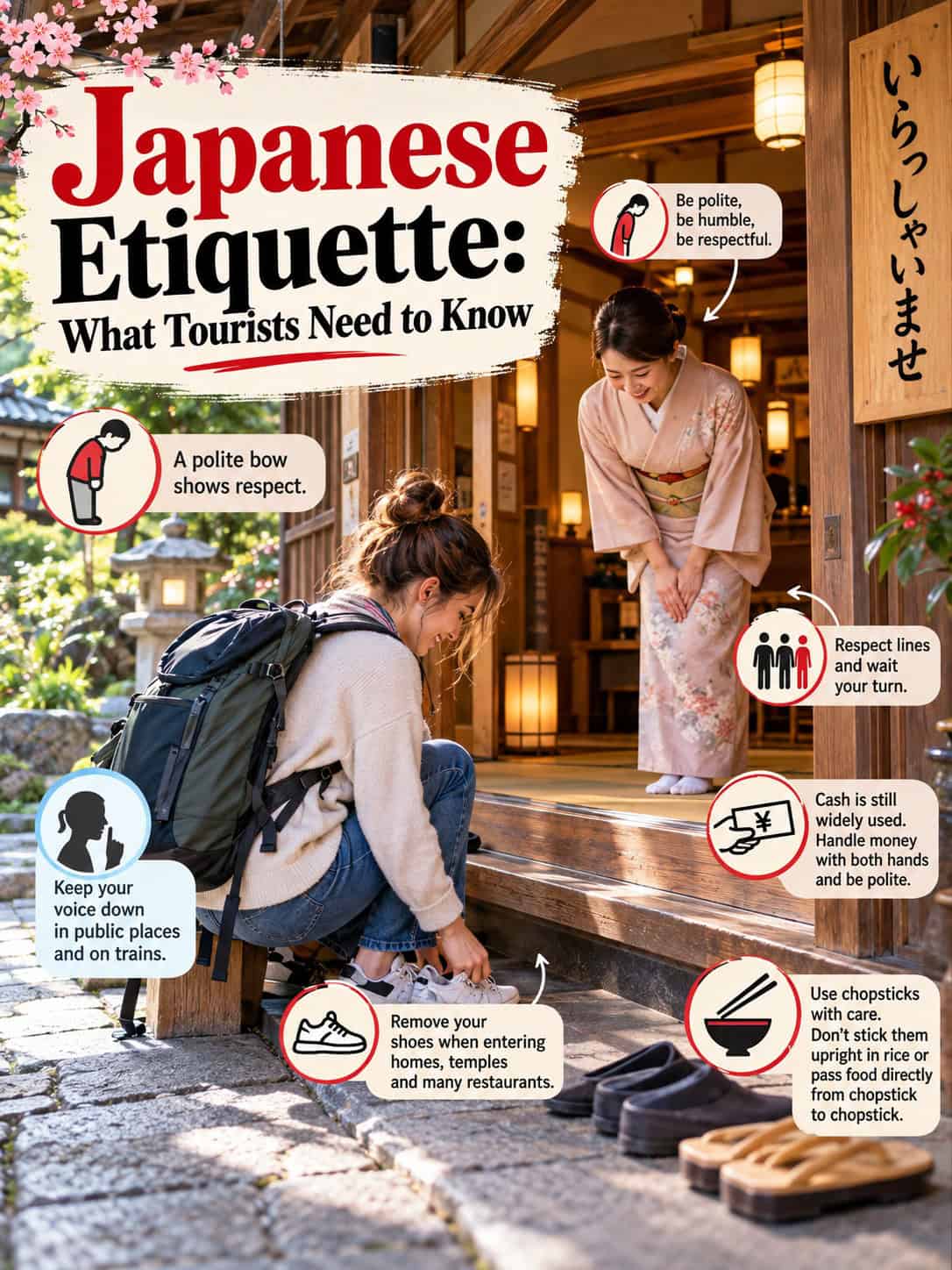
Japanese bowing (ojigi) has several depths: a casual eshaku of about 15 degrees for acquaintances and brief greetings, a 30–45 degree keirei for business settings or someone senior, and a deep bow of 45–70 degrees for serious apologies or solemn occasions. Tourists need none of this in full. A light nod when someone bows to you, when you say thank you or after a small apology covers nearly every situation. The one rule worth remembering is to bow back, even slightly, because standing still reads as more awkward than an imperfect bow. Let a Japanese person offer a handshake first.
Japan Train Etiquette: Phones, Priority Seats and Luggage
Japanese trains run on a quiet, orderly choreography that is easy to pick up. Avoid phone calls on local trains and subways. Put your phone on silent (“manner mode”), send a text instead. On the Shinkansen and other long-distance trains, step into the corridor between cars if you must take a call. Priority seats near the doors are for elderly passengers, pregnant women, people with disabilities and travelers with small children. Anyone can sit there when the car is empty, but you should give up the seat when someone who needs it boards.
Eating follows a split rule. Locals avoid it on local and commuter trains because of spills and odors, but it is completely normal on the Shinkansen, where buying an ekiben bento for your seat is part of the experience. Wait in the lines painted on the platform, let passengers exit before you board and keep your voice down in a packed car.
Luggage has real limits on the bullet train. JR Central asks passengers with bags measuring 161–250 cm in total to reserve a seat with an oversized baggage area on the Tokaido, Sanyo, Kyushu and Nishi Kyushu Shinkansen, and it does not accept bags above 250 cm as ordinary baggage. That seat costs nothing extra: it is in the last row of certain cars, with the space behind it reserved for your bag. Board with an oversized bag and no such reservation and you pay a ¥1,000 baggage fee. Bags up to 160 cm need no booking and go on the overhead rack, at your feet or in the baggage area on the deck. Measure your suitcase (length + width + height) before you book, and compare Japan train tickets and schedules with those rules in mind.
Japanese Dining Etiquette: Chopstick Rules That Matter
Chopstick etiquette has more rules than any other part of Japanese dining culture, but two matter far more than the rest. Never stick your chopsticks upright in a bowl of rice, and never pass food from your chopsticks to someone else’s. Both gestures recall funeral customs: upright chopsticks resemble incense offerings, and passing food chopstick to chopstick resembles transferring remains after cremation. These are the things not to do in Japan that Japanese diners notice most.
Beyond those two, build a few habits. Do not skewer food, point with your chopsticks or rub disposable wooden chopsticks together. Rest your chopsticks on the rest or horizontally across your plate. When you share a communal dish, use the serving chopsticks if the restaurant provides them, or turn your chopsticks around and use the clean end. You do not need to memorize every rule before you land: avoiding the two funeral-associated gestures handles most of the risk.
Japanese Dining Etiquette: Before, During and After the Meal
Say itadakimasu before you start eating and gochisosama when you finish. Both phrases thank the cook and the people involved in the meal, and staff appreciate hearing them. When the restaurant brings an oshibori (a damp towel), use it for your hands only, not for your face or neck. If you have a reservation, arrive on time or cancel well in advance, and go light on perfume: some restaurants have rules about it.
Japanese Dining Etiquette: Noodles, Sushi and Shared Dishes
Slurping noodles is acceptable in Japan, and you do not have to do it. Eat ramen while it is hot, at whatever pace suits you. You can eat nigiri sushi with your fingers or with chopsticks. Restaurants use different formats, from counter seats and ticket machines at the door to izakaya where plates arrive for the whole table to share, so watch how other guests order and pay. To explore what to order, see our Japanese food guide.
Japan Onsen Etiquette: Washing, Tattoos and Towels
Public baths (onsen and sento) follow one rule above all: wash thoroughly at the shower stations before you enter the water. Most baths require you to bathe without clothes, and men’s and women’s sections (marked 男 and 女) are usually separate. A few mixed baths provide special bathing garments called yuami-gi, so swimwear is not allowed in most places but not literally everywhere. Keep your small towel out of the bath: fold it and rest it on your head or beside the tub. Tie up long hair so it stays out of the water too. Keep conversation quiet, leave your phone away from the bathing area and do not take photos there.
Tattoo policies vary by facility. Some sento and onsen accept guests with tattoos, while others refuse them, and rules at a private bath depend on the property. Read the facility’s rules before you go, ask in advance if you are unsure and do not try to hide a tattoo at a bath that prohibits them.
Japan Temple Etiquette: Shrines and Temples Differ
Shrines and temples use different rituals, and tourists often mix them up. At a Shinto shrine, the standard routine is two bows, two claps and one bow. At a Buddhist temple, you normally pray quietly with your palms together and do not clap. Purify your hands at the water basin if one is available, follow posted instructions and keep your voice low. Ask permission before you photograph people, and respect signs that forbid photos inside buildings. For temples and old streets, see our Kyoto travel guide.
Shoes, Escalators and Everyday Habits
You remove your shoes inside temple buildings and at ryokan, many traditional restaurants and many private homes, and sometimes before stepping into a shop fitting room. Where slippers are set out, wear them instead. A genkan (entryway) and a shoe rack signal where to do it, and our packing list for Japan explains why slip-on shoes make the day easier.
Escalator customs differ by region. Tokyo riders traditionally stand on the left, while Osaka and the Kansai region stand on the right. Safety campaigns in many places now ask riders to stand still and not walk, so follow local signs and match the people around you. In Nagoya and Saitama Prefecture, local ordinances require riders to stand still on both sides, and at busy times two standing lines are normal wherever the escalator is wide enough. At ticket machines, food stalls and taxi stands, join the back of the visible line. Planning time in the capital too? Our Tokyo travel guide covers the main areas.
Japan Tipping Etiquette and Small Habits
Tipping is not expected in Japanese restaurants or taxis, so you do not need to calculate one. The Japan National Tourism Organization notes that some private guides and interpreters accept an optional tip, which you give in an envelope. Read our guide to money in Japan for cash, cards and ATMs.
Public trash cans are hard to find, so carry your trash until you reach a convenience store or your hotel. Most shops charge for plastic bags, so a small foldable bag is handy, and do not walk into a shop with food or drink bought elsewhere. If you give a gift to a host, a small omiyage (a souvenir, often food from your home region) is a thoughtful gesture, though a short-term visitor does not need to bring one. Our Japan safety guide covers common concerns.
Things Not to Do in Japan: What Tourists Worry About Too Much
Japanese people generally understand visitors who make an honest effort, and most small slips go unnoticed. You do not need to master bow depths, memorize every chopstick rule or worry about the side of the escalator. The habits that matter are the ones that affect other people directly: keeping your voice down in enclosed spaces, not blocking paths or doorways and avoiding the funeral-associated chopstick gestures and phone calls on crowded trains. Our guide to the best time to visit Japan compares the seasons.
Japanese Etiquette for Tourists: Frequently Asked Questions
What are the basics of Japanese dining etiquette?
Say itadakimasu before you eat and gochisosama when you finish, use your chopsticks without the funeral-associated gestures, and use the oshibori towel for your hands only. Locals will forgive small mistakes.
Do tourists need to bow correctly in Japan?
No. A light nod of the head is enough for everyday interactions, and the main rule is to bow back, even briefly, when someone bows to you. Formal bow depths belong to business and ceremonial situations tourists rarely meet.
What chopstick mistakes break Japanese dining etiquette?
Two matter most: never stick chopsticks upright in rice, and never pass food from your chopsticks to someone else’s. Both recall funeral customs. Smaller habits, such as pointing with chopsticks, matter less.
Is it rude to slurp noodles in Japan?
No. Slurping noodles is acceptable, and you do not need to do it. Eat at your own pace and do not feel pressure either way.
What is the most important train etiquette rule in Japan?
Keep your voice down and avoid phone calls in crowded cars. Give priority seats to elderly passengers, pregnant women, people with disabilities and anyone with small children.
Can I bring a large suitcase on the Shinkansen?
It depends on the size. JR Central requires you to reserve a seat with an oversized baggage area for bags measuring 161–250 cm in total on the Tokaido, Sanyo and Kyushu Shinkansen. Bags above 250 cm cannot travel as ordinary baggage.
Can I wear a swimsuit in a Japanese onsen?
Usually not. Most baths require you to wash first and bathe without clothes. A few mixed baths provide special bathing garments called yuami-gi, so check the facility’s rules before you go.
Will an onsen turn me away for tattoos?
Policies differ by facility. Some baths and sento accept guests with tattoos, while others refuse them. Read the bath’s rules in advance, and check whether a private bath has its own tattoo policy.
How do I behave at a shrine versus a temple?
At a shrine, the standard routine is two bows, two claps and one bow. At Buddhist temples, you normally pray quietly without clapping. Follow posted instructions and ask before photographing people.
Which side do I stand on a Japanese escalator?
People stand on the left in Tokyo and on the right in Osaka and the Kansai region, but safety campaigns ask riders to stand still and not walk. Follow local signs and match the people around you.
Does Japanese dining etiquette include tipping?
No. Tipping is not expected in restaurants or taxis. The Japan National Tourism Organization notes that some private guides and interpreters accept an optional tip in an envelope.
What happens if I make an etiquette mistake as a tourist in Japan?
Very little in most cases. Japanese people usually understand visitors who make an honest effort. Focus on the habits that affect people nearby: noise in enclosed spaces, blocked paths and the funeral-associated chopstick gestures.
Japanese Dining Etiquette: Key Takeaways
Japanese etiquette looks more complicated from the outside than it feels once you arrive. Keep a quiet voice on trains and in enclosed spaces, wash before an onsen bath, say itadakimasu and gochisosama at meals and avoid the two chopstick gestures tied to funeral customs. Everything else, from bow depth to the side of the escalator, is flexible or something you will absorb within a day of watching the people around you.