By Nippon With Me EditorialPublished Updated
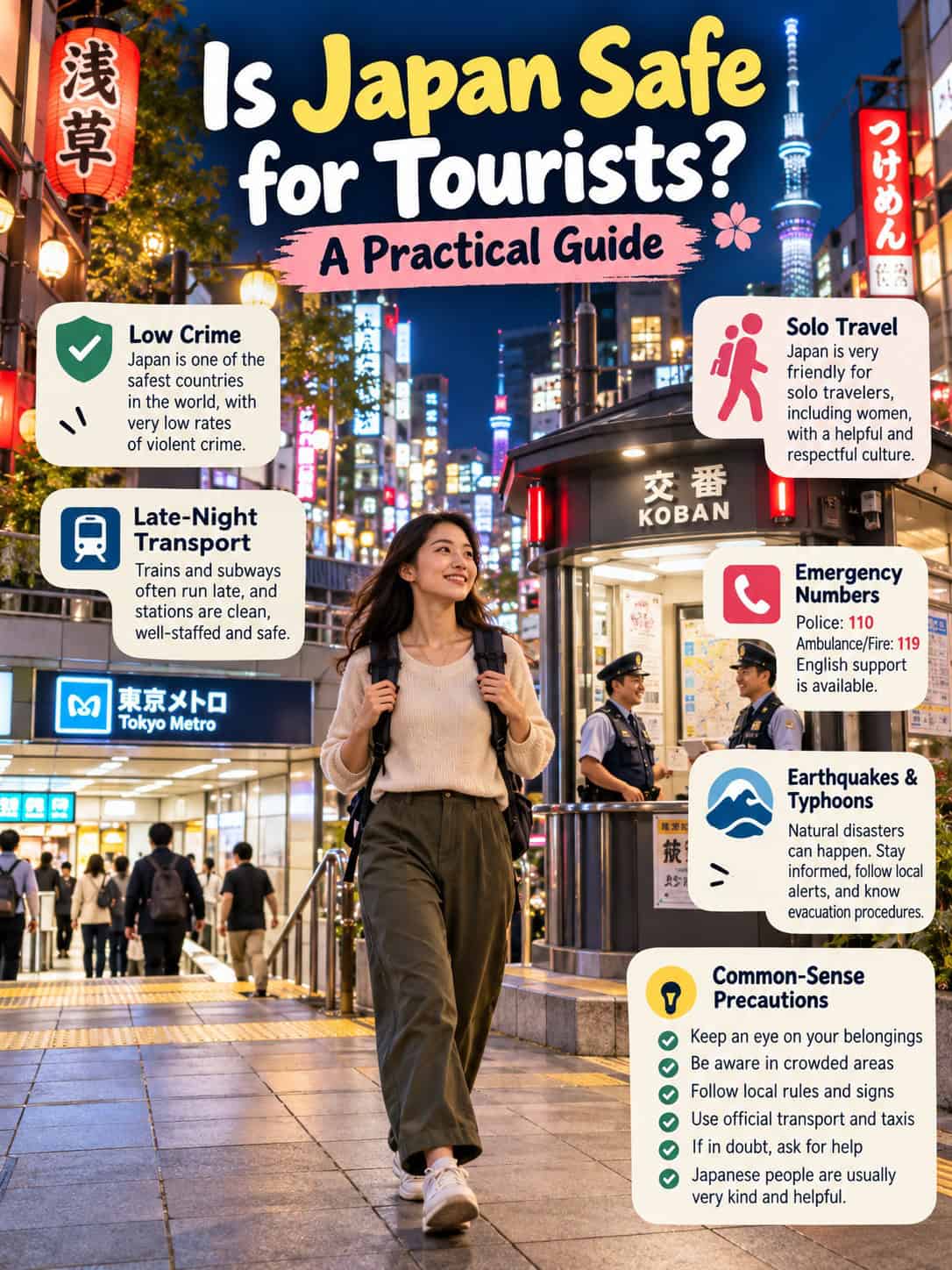
Is Japan safe to travel? Yes. The US State Department rates Japan Level 1: Exercise Normal Precautions, and Australia also advises normal safety precautions. Travellers should still prepare for earthquakes, typhoons, summer heat, nightlife scams and medication restrictions. This guide explains what to do before and during a trip.
Is Japan Safe to Travel? Quick Facts
| Question | Answer |
|---|---|
| Is Japan safe overall? | Yes — violent crime against tourists is rare, and major government travel advisories rate it at their lowest risk level |
| Important risks to prepare for | Earthquakes, typhoons, severe summer heat and selected nightlife scams |
| Where to be extra cautious | Kabukicho (Shinjuku) and parts of Roppongi at night — touts, fake bars, overcharging |
| Emergency numbers | 110 (police), 119 (fire/ambulance), 118 (coast guard) |
| Tourist-specific help | Japan Visitor Hotline: 050-3816-2787, 24/7 in English |
Japan Emergency Numbers: Save This Table
| Service | Number | When to use |
|---|---|---|
| Police | 110 | Crime or urgent police assistance |
| Fire and ambulance | 119 | Fire, serious injury, medical emergency |
| Japan Coast Guard | 118 | Emergency on or near the sea |
| JNTO Visitor Hotline | 050-3816-2787 | 24/7 tourist help in English, Chinese and Korean |
| JNTO from outside Japan | +81-50-3816-2787 | International dialling format |
| Non-urgent police consultation | #9110 | Availability and language depend on region |
For an immediate medical or fire emergency, call 119. Save your hotel address in Japanese so you can show or read it to the dispatcher.
Is Japan Safe for Tourists? Official Travel Advice
Violent crime against tourists in Japan is rare. The United States rates Japan at Level 1 on its four-level travel advisory scale — the lowest risk category, meaning “exercise normal precautions.” The UK Foreign Office describes Japan as “generally very safe,” and Australia’s advisory calls for “normal safety precautions,” its lowest tier as well. Outside a small number of nightlife districts described below, cities like Tokyo, Kyoto, and Osaka, along with rural Japan, are calm and low-crime by the standards of any country of comparable size. Planning time in the capital too? Our Tokyo travel guide covers the main areas.
That said, “safe from crime” and “safe from everything” aren’t the same thing. The more realistic risks for a visitor to Japan are natural disasters, a handful of targeted tourist scams, and a few legal rules that are stricter or different than what you’re used to — all covered below.
Japan Travel Safety: Earthquakes, Tsunamis and Weather
Japan sits on the Pacific Ring of Fire, so earthquakes are a genuine part of life there — most are minor and go unnoticed, but larger ones do happen. Modern Japanese buildings are built to strict seismic engineering standards, which is a major reason why earthquake damage in Japan is often far less severe than in countries with comparable quake magnitudes but older infrastructure.
During an earthquake, drop low, protect your head and take cover under sturdy furniture if available. Stay inside while the shaking continues rather than rushing for stairs or doors. When movement stops, check for hazards, follow staff directions and leave by a safe route if authorities advise evacuation. Outside, move away from glass, signs and damaged walls to a safe open area; do not stand in traffic.
Near the coast, a strong or prolonged earthquake is a reason to move immediately to high ground or a designated tsunami evacuation building; do not wait for a phone alert. Follow local tsunami warnings and stay away until authorities issue the all-clear. On trains and platforms, follow staff instructions and avoid platform edges. Do not assume every tsunami warning will arrive before a dangerous wave.
Typhoon activity usually peaks around July–September, although official advisories describe broader seasons. Heavy rain, flooding and landslides can disrupt trains and roads. During July–September, Japan can experience severe heat and heatstroke alerts, with temperatures above 35°C in some regions. Follow Japan Meteorological Agency forecasts and local evacuation orders. Before visiting Mount Fuji, Hakone, Aso or other volcanic areas, review Japan Meteorological Agency volcanic warnings and any trail closures.
Is Japan Safe to Travel During Typhoon Season?
| Hazard | Period or trigger | What to do |
|---|---|---|
| Earthquakes | Possible year-round | Take cover, follow JMA and local instructions |
| Tsunamis | After some offshore earthquakes | Leave coastal low ground immediately after strong or long shaking |
| Typhoons | Commonly peak July–September | Review JMA warnings and recheck trains and flights |
| Extreme heat | Especially July–September | Use cooling breaks, water and official heat alerts |
| Heavy rain and landslides | Rainy season and storms | Avoid closed trails, rivers and flooded roads |
| Volcanic activity | Location-specific | Follow trail restrictions and JMA volcano alerts |
Official JNTO Japan Safe Travel Information publishes earthquake, tsunami and eruption alerts, while JMA provides forecasts and warning maps. A regional warning can change even when the country’s overall travel-advice rating remains low.
Japan Emergency Numbers and Official Safety Apps
Save 110 for police, 119 for ambulance or fire and 118 for Japan Coast Guard emergencies. Non-urgent police advice may be available via #9110, but operation and language support vary by area. For a lost item or non-urgent incident, visit a nearby koban police box. In Tokyo, file a lost-property report at any koban or police station; the Metropolitan Police Department’s Lost and Found Center (0570-550-142, weekdays 8:30 a.m. to 5:15 p.m.) handles items handed in to Tokyo police, and you need your passport to collect one.
JNTO operates the Japan Visitor Hotline 24 hours a day, 365 days a year: 050-3816-2787 in Japan or +81-50-3816-2787 from abroad. Staff offer support in English, Chinese and Korean for accidents, illness, disasters and general tourist information. The hotline is not a substitute for 110 or 119 during a life-threatening emergency.
Download the free Safety tips app, supervised by the Japan Tourism Agency. It provides alerts for earthquakes, tsunamis, extreme weather, volcanic activity, evacuation information and heatstroke warnings in 14 languages. Enable notifications and location permissions. Also bookmark JNTO Japan Safe Travel Information and the JMA website; app messages depend on your internet connection and device settings. Our Okinawa travel guide covers the islands in more detail.
Japan Safety Tips App: Alerts in 14 Languages
The Japan Tourism Agency’s Safety tips app delivers push warnings for earthquakes, tsunamis, extreme weather, volcanic activity, evacuations and heatstroke in 14 languages, including English, Chinese and Korean. Beyond alerts, it includes response flowcharts that walk you through what to do next and communication cards you can show to staff or passers-by when you cannot explain the situation in Japanese.
Keep your phone charged and save important emergency details offline. For mobile internet when travelling across Japan, compare Japan eSIM data plans. An eSIM helps with maps and alerts but cannot guarantee connectivity during a disaster.
Is Tokyo Safe for Tourists? Nightlife and Common Scams
Japan’s scam landscape is narrower than many countries, but a few patterns are well-documented and worth knowing by name.
Fake bars in Kabukicho: Operators, sometimes connected to organized crime groups, lure tourists — often through dating apps or street touts — into bars with no visible pricing, then present bills running into hundreds or even thousands of dollars for a round of drinks. Loudspeakers in the area now specifically warn passersby about people inviting them out via dating apps. Avoid any bar a stranger invites you to, and never follow a tout off the street.
Inflated service charges: Legitimate izakayas typically add a modest per-person seating or service charge of a few hundred yen. A small number of establishments, mostly in high-tourist-traffic nightlife areas, have charged thousands of yen in undisclosed fees. Check the menu for a cover charge before sitting down, and ask if anything is unclear.
Shopping overcharges: Verify the scanned items and your receipt before leaving any shop.
“White taxis”: Unlicensed private drivers operate in Tokyo and Kyoto, posing as legitimate taxis. Stick to marked taxis, officially licensed ride-hailing apps, or trains and buses.
Tourist-area pricing: Check displayed prices, admission conditions and any photography charges before agreeing. A higher price is not always unlawful, but undisclosed charges deserve scrutiny. Decline unsolicited offers if you feel pressured.
Across all of these, the same habits apply: check prices before you commit to anything, use review platforms like Google Maps or Tabelog to vet restaurants and bars in advance, and treat any unsolicited invitation from a stranger — especially at night — with skepticism.
Is Japan Safe for Solo Female Travellers? Practical Advice
Kabukicho in Shinjuku and parts of Roppongi are Tokyo’s two main nightlife risk zones, where the scams above are concentrated along with touts, pushy bar staff, and occasional drink-spiking reports. Outside these specific pockets, Tokyo’s other districts, along with Kyoto, Osaka, and rural Japan generally, are calm even late at night by the standards of most major cities worldwide.
Sexual harassment, including groping on crowded trains, can occur. Some rail networks offer women-only carriages at particular hours; check station signs, as these cars are not universal. If harassment occurs, move toward staff or other passengers, report it at a station and contact 110 for urgent police assistance. Our guide to the best time to visit Japan compares the seasons.
Japan Solo Female Travel: Practical Safety Checklist
- Choose accommodation with good transport access and review the route back after dark.
- Use the women-only carriage if offered and convenient; look for station-specific signs.
- In nightlife areas, avoid street touts and drinks you have not watched staff prepare.
- Keep the hotel name, street address and emergency contact accessible offline.
- If someone harasses you, move to a staffed shop, station or koban; dial 110 if you need urgent police assistance.
Is Tokyo Safe for Tourists? Areas to Know
Tokyo is generally safe, including most ordinary streets and transport hubs. The US State Department specifically identifies nightlife incidents in Roppongi, Kabukicho, Shibuya and Ikebukuro, including spiked drinks, forced ATM withdrawals and inflated bar bills. In Osaka, the same bar and nightclub risks apply in the Shinsaibashi, Namba and Dotonbori entertainment areas, and both men and women have been targeted. Avoid following street promoters into unknown venues. Do not treat an entire district as unsafe at all hours.
Japan Travel Safety: Local Laws and Medicines
Japan strictly regulates cannabis, stimulants and controlled medicines. Japan’s Narcotics Control Department confirms that Adderall (amphetamine) cannot be imported even with a foreign prescription; Vyvanse (lisdexamfetamine) requires advance permission. For ordinary permitted prescription medicines, the Ministry of Health generally allows up to a one-month personal supply without an Import Confirmation certificate, but that exemption does not override separate controls. Verify the active ingredient, quantity and import permissions before departure. Japan applies strict drink-driving rules and immigration penalties for overstaying. Visitors must carry their passport at all times, so keep it on you rather than in the hotel safe. Follow private-property restrictions and photography signs in Kyoto’s Gion district. Our guide to Japanese etiquette explains the basic manners.
Bringing Medicines into Japan: Rules That Differ by Drug
| Medicine category | Official general rule |
|---|---|
| Ordinary permitted prescription drugs | Usually up to one month’s personal supply without Import Confirmation |
| Permitted prescription drugs above one month | Apply for Import Confirmation before travel |
| Adderall (amphetamine) | Prohibited even with a foreign prescription |
| Vyvanse (lisdexamfetamine) | Requires advance permission under stimulant raw-material rules |
| Controlled narcotic medicines | Special permit or prohibition depending on exact substance |
| Self-injection medicines and syringes | Specific personal-use rules; check the exact device and quantity |
Confirm a medicine by its active ingredient, not only by brand name. Use the Ministry of Health’s import guidance and the Narcotics Control Department; a regular prescription alone does not legalise a prohibited medicine.
Japan Travel Safety: Medical Care and Insurance
Tourists may need to pay for care in Japan, and costs depend on the hospital, treatment and insurance arrangements. Buy travel medical insurance that covers emergency treatment, hospitalisation and medical evacuation. Ask the insurer how to request direct billing or reimbursement; payment procedures differ between facilities. An ambulance called on 119 for a genuine emergency is free; the bill you face comes from the hospital for treatment. Pharmacies are widely available and well-stocked, though English-language support varies by location — the Japan Visitor Hotline above can help you find English-speaking medical care if needed.
Japan Travel Safety: Before-You-Go Checklist
Register your trip with your home country’s embassy or consulate if that service is available to you, so they can reach you in a large-scale emergency. Keep a physical copy of your passport details and emergency contacts separate from the originals. Download the Safety tips app and save the emergency numbers above before you leave home, not after you need them. Choose licensed taxis or well-known ride-hailing apps over unmarked cars, vet restaurants and bars through review sites before committing, and treat unsolicited invitations from strangers at night with healthy skepticism — especially in Kabukicho and similar districts. Finally, keep basic travel insurance details accessible on your phone in case of a medical issue. For the rest of your preparation, see our guide to money in Japan and Japan packing list.
Japan Travel Safety: Emergency Preparation in Five Minutes
Save 110, 119 and the JNTO hotline. Bookmark official JMA and JNTO alert pages. Enable Safety tips notifications, download an offline map, keep a copy of your travel insurance policy and note where your hotel displays evacuation instructions. Save both your emergency contact and your hotel’s Japanese address.
To reduce uncertainty during disruptions, check train schedules and connections before long journeys. For airport travel, compare pre-booked airport transfers when public transport is unavailable; our Tokyo airport guide covers the main options. Check cancellation and disruption rules before paying.
Japan Travel Safety: Three Decisions for Disruptions
| Situation | Action |
|---|---|
| Earthquake with strong shaking | Protect yourself, then check tsunami or evacuation warnings |
| Typhoon forecast before long rail journey | Check JMA alerts and the rail operator before leaving |
| Medical emergency | Call 119; contact your insurer after arranging immediate help |
Frequently Asked Questions
Is Tokyo safe for tourists at night?
Yes, for the most part — Tokyo is calm at night by the standards of most major world cities. The main exceptions are specific nightlife pockets like Kabukicho and parts of Roppongi, where tourist-targeted scams are concentrated.
What should I do if there’s an earthquake while I’m in Japan?
If you’re indoors, take cover under a table or protect your head and body, then open an exit route once the shaking stops. If you’re outside, move away from buildings toward open space. Follow staff or crowd instructions, and if you’re near the coast and the quake was strong, move to higher ground immediately in case of a tsunami.
Are there any unsafe areas or travel advisories in Japan?
Most of Japan carries advice to exercise normal precautions, but regional alerts can change. Typhoons are the usual trigger: in October 2026, Canada briefly advised avoiding non-essential travel to the Ryukyu Islands, including Okinawa, because of Typhoon Champi, and lifted that advice on October 26, returning all of Japan to its lowest risk level. Always check live weather and your government’s regional guidance, not only general city crime risks.
Is Japan safe for solo female travellers?
Many solo female travelers visit Japan without incident, and violent crime against tourists is rare. Groping on crowded trains does occur, which is why many lines offer women-only carriages during certain hours — look for platform signage indicating where and when they run.
What are the Japan emergency numbers?
Dial 110 for police, 119 for ambulance or fire and 118 for Japan Coast Guard. JNTO’s 24-hour tourist hotline is 050-3816-2787.
Do I need travel insurance for Japan?
Travel medical insurance is strongly recommended. Tourists may need to pay for care in Japan, and costs depend on the facility, treatment and insurance. Ask your insurer about direct billing or reimbursement.
Can I bring my prescription medication to Japan?
Often, yes, for ordinary permitted medicines: up to a one-month personal supply generally needs no Import Confirmation, and larger quantities need a certificate in advance. Controlled medicines are different: Adderall is prohibited and Vyvanse needs advance permission. Verify the active ingredient before you fly.
What are the most common scams targeting tourists in Japan?
Fake bars in Kabukicho that present inflated bills, undisclosed service charges at some izakayas, drugstore overcharging, and unlicensed “white taxis” posing as legitimate cabs. Checking prices in advance and using review platforms for restaurants and bars avoids most of these.
What should I do if there is a tsunami warning in Japan?
Move inland or to higher ground and follow evacuation instructions. Do not return to the shore until officials lift the warning.
Can I bring Adderall or Vyvanse into Japan?
Japan prohibits importing Adderall containing amphetamine, even with a prescription. Vyvanse requires advance government permission. Verify all controlled medicines before flying.
What is the official app for Japan earthquake warnings?
The Safety tips app, supervised by the Japan Tourism Agency, provides earthquake, tsunami and weather alerts in 14 languages.
Is Japan Safe to Travel? Key Takeaways
Japan is one of the safer destinations you can choose as a tourist, and the odds of encountering real trouble are low. The sensible precautions are specific rather than general: know what to do in an earthquake, save the Safety tips app and emergency numbers before you go, be skeptical of unsolicited invitations in Kabukicho and similar nightlife districts, and carry travel insurance in case you need medical care. Handle those few things and you can relax about the rest.