By Nippon With Me EditorialPublished Updated
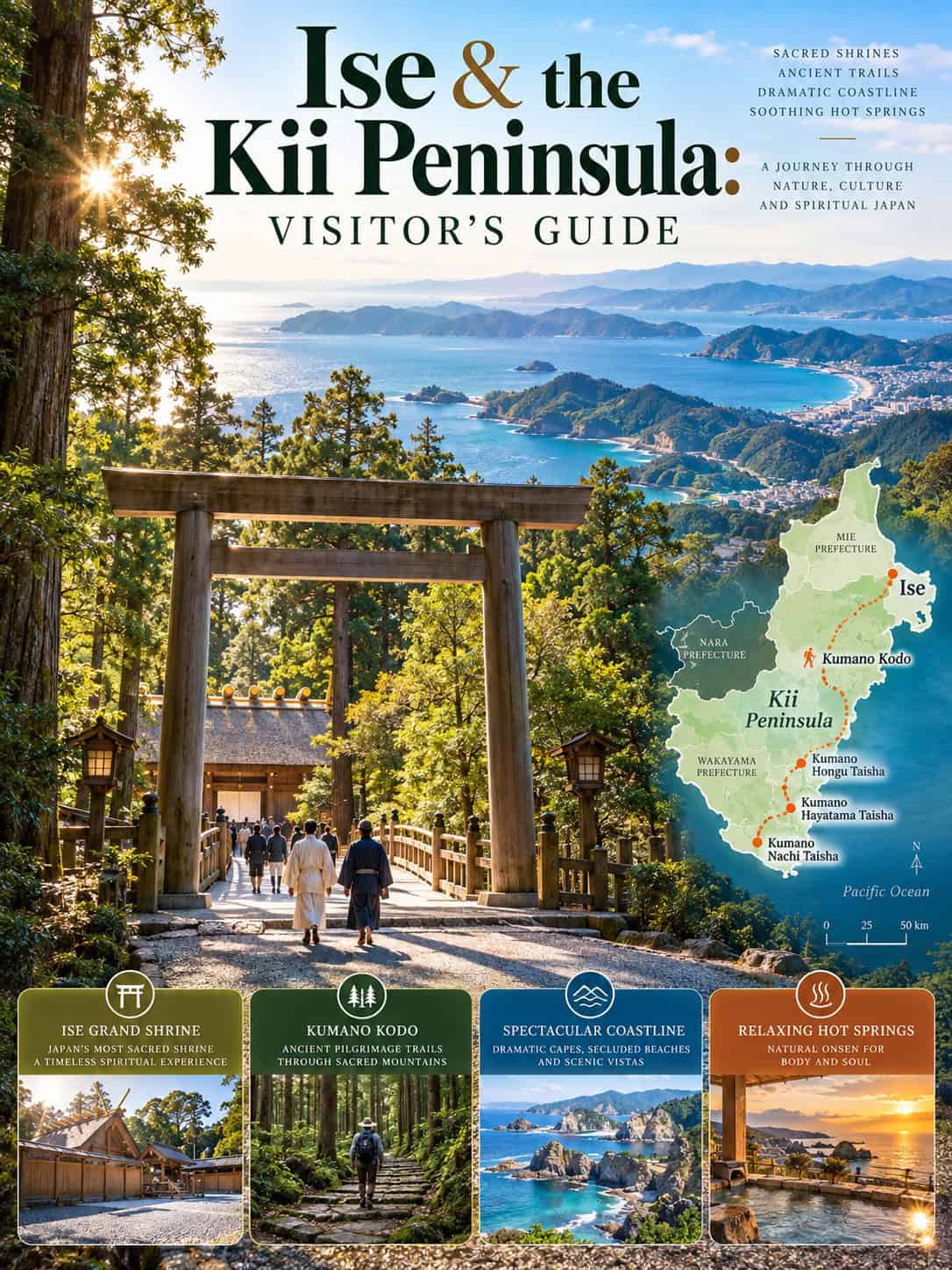
Most first-time visitors to Japan never make it past Tokyo, Kyoto and Osaka, which means they miss Japan’s holiest Shinto shrine and one of its last great pilgrimage landscapes, both on the Kii Peninsula. This guide covers two different destinations: Ise Grand Shrine (Ise Jingu) with Toba, and the Kumano Kodo pilgrimage trails further south. They sit far apart and use different transport hubs, so plan them as separate legs rather than a single easy loop.
Ise Grand Shrine and the Kii Peninsula at a Glance
| Destination | Best for | Time to allow | Main hub |
|---|---|---|---|
| Ise Grand Shrine (Geku and Naiku) | Japan’s most sacred Shinto shrine, Oharaimachi street, Toba | 1 to 2 days | Iseshi and Ujiyamada, via Kintetsu from Nagoya or Osaka |
| Kumano Kodo pilgrimage (Nakahechi) | Mountain pilgrimage trails, Hongu Taisha, Nachi Falls, onsen | 2 to 4 days | Kii-Tanabe or Kii-Katsuura, via JR from Osaka |
Ise Grand Shrine: Japan’s Holiest Shrine
Ise Jingu is a network of roughly 125 shrines anchored by two main precincts about five to six kilometers apart. The Outer Shrine (Geku) enshrines Toyouke-Omikami, the deity of food, clothing and housing, and the Inner Shrine (Naiku) enshrines Amaterasu-Omikami, the sun goddess and, in Shinto belief, the ancestor of Japan’s Imperial family. Tradition holds that Geku should be visited before Naiku. Every 20 years in a ritual called Shikinen Sengu, the main buildings are dismantled and rebuilt on an adjacent plot using fresh timber, a cycle repeated 62 times since 690 CE, most recently in 2013, with the next in 2033. Both precincts are free to enter, and they are open from early morning, with closing times changing by season: roughly 5:00am to 6:00pm from January to April and in September, to 7:00pm from May to August, and to 5:00pm from October to December. The innermost sanctuaries are closed to the public and visible only beyond a final gate, and photography is not allowed there.
Ise Grand Shrine Itinerary: Geku, Naiku and Oharaimachi
- Geku first: start at the Outer Shrine, a quieter precinct, and take your time walking the approach.
- Transfer to Naiku: the Geku-Naiku Loop Line bus (routes 51 and 55) runs between the two precincts and takes 15 to 20 minutes for ¥520 one way to the Naiku-mae stop, or you can take a taxi for about ¥2,500 per car. Naiku is larger and busier, with the wooden Uji Bridge at its entrance and a riverside path.
- Oharaimachi and Okage Yokocho: finish with the historic stone-paved street leading to Naiku, lined with shops and restaurants. Try Ise udon and the local rice cakes. Weekends and holidays are crowded, so a weekday is calmer. Okage Yokocho opens at 9:30am and closes at 5:30pm from March to July and in October (6:00pm on weekends and holidays from April to July), at 6:00pm in August and September, and at 5:00pm from November to February. The closest bus stop is Jingu Kaikan-mae, ¥450 from Geku.
- Toba (optional): a half day at Mikimoto Pearl Island, a museum about the first cultured pearls with ama diver demonstrations. Admission is ¥1,650 for adults and ¥820 for ages 6 to 15, and the ticket includes the Pearl Museum, the ama demonstration and the Memorial Hall. In late autumn and winter the island closes at 5:00pm or slightly earlier, and ticket sales stop 60 minutes before closing, so arrive by mid-afternoon.
Getting to Ise Grand Shrine
The Kintetsu Limited Express is the standard way in: from Nagoya it takes about 80 minutes, arriving at Iseshi or Ujiyamada Station, and from Osaka it takes roughly one hour 40 minutes to two hours depending on the train. JR trains also reach Iseshi from Nagoya in about 90 minutes, and Japan Rail Pass holders can use that route but may pay a small supplement because part of the line is non-JR. From Kyoto, a transfer may be needed. See our Osaka guide and Nagoya guide for the starting points.
Every Kintetsu Limited Express seat is reserved, so you pay a limited express supplement on top of the base fare, and it is best bought in advance. From Osaka Uehommachi, Tsuruhashi or Osaka Namba the trip takes 1 hour 40 minutes to 2 hours without a change. From Tokyo, take the Shinkansen to Nagoya (about 3 hours) and change to the Kintetsu. The Ise-Shima Liner has box seats for four with a table and luggage space, which suits families.
Getting Around Ise and Toba: Fares and Times
| Leg | Fare (one way) | Time and notes |
|---|---|---|
| Geku to Naiku-mae by Loop Line bus | ¥520 | 15 to 20 minutes; pay by cash, IC card or a bus ticket from the station counter |
| Geku to Jingu Kaikan-mae (Okage Yokocho) | ¥450 | See the bus timetable |
| Geku to Naiku by taxi | About ¥2,500 per car | See the taxi stand |
| Naiku to Toba by CAN bus | ¥1,050 | About 41 minutes |
| Iseshi to Futaminoura by JR | ¥210 | 7 to 10 minutes, about two trains an hour; the stations are unstaffed and IC cards do not work, so bring cash |
Where to Stay Near Ise Grand Shrine
Ise, around Iseshi or Ujiyamada Station, is the most practical base for the shrines and Oharaimachi. Toba puts you closer to Mikimoto Pearl Island and the coast, with traditional ryokan and seafood-focused dinners.
Kumano Kodo Pilgrimage: Trails and the Kumano Sanzan
South of Ise, the Kii Peninsula’s mountainous interior holds the Kumano Kodo, a network of pilgrimage trails registered by UNESCO in 2004 as part of “Sacred Sites and Pilgrimage Routes in the Kii Mountain Range.” The trails converge on the Kumano Sanzan, three grand shrines linked through shared deities: Kumano Hongu Taisha, Kumano Hayatama Taisha and Kumano Nachi Taisha. The most walked route, the Nakahechi, starts from Tanabe on the western coast and is dotted with traditional lodgings, making it the most practical for a multi-day walk. The Kohechi cuts across the center and is far more demanding, the Ohechi follows the Pacific coast, and the Iseji connects Ise to the Kumano Sanzan along the eastern side.
Kumano Kodo Itinerary: 2 to 4 Days from Tanabe to Nachi
The Nakahechi connects Tanabe, Hongu, Nachi and Kii-Katsuura, but you cannot see all of it in a single day. These plans are starting points, so adjust them to your fitness, the weather and the transport timetable.
| Length | Plan | Notes |
|---|---|---|
| 2 days | Sleep the first night in Tanabe (even the earliest train and bus from Osaka or Kyoto leave too little time for the first stage), take the bus to the Takijiri-oji trailhead and walk about 16 km (around 6 hours) to Chikatsuyu, overnight there, then walk about 24.5 km (around 9 hours) to Kumano Hongu Taisha and Oyunohara and return by bus to Tanabe | Two long walking days; buses stop at Chikatsuyu-oji, so you can ride part of either stage |
| 3 days | Add a rest day in the Hongu area with a night at Yunomine Onsen, and soak in its historic hot spring bath before visiting Hongu Taisha | A more relaxed pace and a pilgrim’s purification stop |
| 4 days | From the Hongu area walk about 13 km (around 5 hours 30 minutes) to Koguchi and overnight, then about 14.5 km (7 to 8 hours) on to Nachi Taisha and Nachi Falls, then exit through Kii-Katsuura by JR limited express | The whole line on foot is four walking days after the Tanabe night; buses to and from Koguchi let you split or skip a stage |
Kumano Hongu Taisha and Oyunohara
The head shrine of more than 3,000 Kumano shrines across Japan. Floods in 1889 forced the shrine to move about a kilometer from its original site, Oyunohara, which today holds a very large torii gate marking the original ground.
Kumano Nachi Taisha and Nachi Falls
A shrine complex beside Nachi Falls, Japan’s tallest single-drop waterfall at 133 meters. Reaching the area from the coast typically means a JR limited express to Kii-Katsuura and a local bus to the falls, which takes about 25 minutes from Kii-Katsuura Station to Nachisan. The shrine grounds are free to enter, while the falls viewpoint costs ¥300 for adults and ¥200 for children and is open from 7:00am to 5:00pm.
Yunomine Onsen
A hot spring village long used by Kumano Kodo pilgrims for ritual purification before Hongu Taisha. Its Tsuboyu bath, a tiny wooden hut over a stone-lined spring, is the only hot spring included in the Kumano Kodo’s UNESCO listing.
Tsuboyu costs ¥800 for adults and ¥400 for children under 12, and the ticket also covers the medicine bath and the public bath. The soak is private for one or two people for 30 minutes, and there are no reservations: buy a ticket from the vending machine, swap it for a numbered card at the counter and wait to be called. The baths are open from 6:00am to 9:00pm, with the last ticket sold at 8:30pm.
Dual Pilgrim Stamps and Certificate
Stamps sit in wooden stands at most shrines and trail sites, and the completion stamp comes from Kumano Hongu Taisha. Walkers who have also done the last 100 km of the Camino de Santiago on foot can become Dual Pilgrims: collect the stamps in the free Dual Pilgrim Credential (available at the tourist centers in Tanabe, Hongu, Shingu and Nachi-Katsuura), walk Takijiri-oji to Hongu Taisha or Hongu to Nachi Taisha, and register in person at the Kumano Hongu Heritage Center or the Tanabe Tourist Information Center next to JR Kii-Tanabe Station. A bus for part of the way is acceptable, and the pin badge and washi certificate are free.
Getting to the Kumano Kodo: Train, Bus and Car
From Osaka, the JR Kuroshio Limited Express reaches Kii-Tanabe in roughly two to three hours depending on the departure station. From there a local bus runs to Takijiri-oji, the start of the Nakahechi, and long-distance buses such as the Ryujin and Meiko services connect Tanabe with Hongu Taisha in around two hours, but frequency is limited. On the coast, Kii-Katsuura is the rail hub for Nachi. Public transport works well for a plan built around Tanabe, Hongu and Kii-Katsuura, while a car gives more flexibility for remote sights but mountain roads can be narrow and close in bad weather. Most travelers reach the Kumano region via Osaka or Kyoto rather than from Ise.
Bus payment differs by company. Meiko Bus, which runs from Kii-Tanabe to Takijiri-oji, accepts IC cards. Ryujin Bus, which runs from Kii-Tanabe to Hongu, does not take IC cards, but its Kumano Hongu Line accepts contactless credit cards. Kumano Gobo Nankai Bus, which serves Hongu, Shingu, Koguchi, Nachi and Katsuura, also accepts contactless credit cards but not IC cards. Cash with the exact fare works on all four companies, so keep coins on hand.
Where to Sleep on the Kumano Kodo
Lodging along the trail is booked through KUMANO TRAVEL, the region’s community reservation system. Ryokan often serve a kaiseki set dinner, minshuku serve home-style meals from local produce and often have shared baths, and pensions serve Western meals. Temple lodgings (shukubo) usually serve Buddhist vegetarian shojin ryori, while guesthouses and B&Bs usually include no meals, so plan on village shops and vending machines for those nights.
Luggage on the Kumano Kodo
The daily luggage shuttle between lodgings is added when you book through KUMANO TRAVEL, at least 20 days in advance, and it cannot be arranged after you arrive in Tanabe. Pickup times are set by each provider and cannot be changed at the last minute, and everything must be packed inside the bag with nothing attached outside. Without a booking, store a bag or send it ahead:
| Option | Where and hours | Price | Notes |
|---|---|---|---|
| Daily luggage shuttle | Lodging to lodging, booked through KUMANO TRAVEL | See the booking page | Book at least 20 days ahead |
| Bag storage | Tanabe Tourist Information Center next to JR Kii-Tanabe Station, 9:00am to 6:00pm daily | ¥500 per bag per day | No reservation; holds bags up to one month |
| Coin lockers | Kii-Tanabe Station, 5:00am to midnight | ¥400, ¥500 or ¥700 per day (small, medium, large) | Up to 3 days; 100-yen coins |
| Coin lockers | Yunomine Onsen public bath, 6:00am to 9:00pm | ¥200, ¥300 or ¥500 per day | 1 day only; 500-yen coins for the large size |
| Coin lockers | Kii-Katsuura Station, 8:00am to 6:00pm | ¥400, ¥500 or ¥700 per day | Up to 3 days |
| Yamato or Yu-Pack parcel | Send anywhere in Japan, delivered the next day or later | From ¥940 (size 60, 2 kg) to ¥2,510 (size 160, 25 kg) in the Kansai area | No advance booking; cash at most counters |
Etiquette at Ise Grand Shrine and on the Trails
- Shrines and temples are active places of worship. Bow at gates, keep voices low, and follow photo rules, especially beyond the inner gates.
- On the trails, stay on marked paths, carry water and a rain layer, and start early so you arrive before dark.
- Carry some cash for small lodgings and shops, and book lodgings and luggage forwarding ahead on multi-day routes.
- Check the weather and the status of trails and buses before each leg. Typhoon season can disrupt mountain roads and trails.
If the Weather Turns
Most injuries on the Kumano Kodo come from slips on wet stone and root-laced sections, and heavy rain or typhoon winds can cause flash floods, landslides and flying debris. Skip a stage rather than push through: buses stop at Chikatsuyu-oji and run to and from Koguchi, so a long day can be cut short. Typhoons can also disrupt JR trains. In winter, days are shortest, so leave early and plan to reach your lodging between 3:00pm and 5:00pm, because the villages sit in valleys that go dark earlier than the ridges. At Ise, both precincts close at 5:00pm from October to December, so start at Geku in the morning.
Natural water along the trail has not been tested, so fill your bottles at your lodging. There are almost no public bins, so carry out all garbage. Long sleeves and trousers help against land leeches, ticks and hornets, and it is worth shaking out your shoes in case a mukade has crept in. For emergencies call 119 (fire and medical) or 110 (police), and the Japan Visitor Hotline at 050-3816-2787 answers around the clock in English, Chinese and Korean. One route is closed regardless of weather: the Ohechi between Wabuka and Tako stations, with reopening estimated for the end of April 2027; trains and buses bypass it.
Best Time to Visit Ise Grand Shrine and the Kumano Kodo
Spring and autumn bring the most comfortable walking weather for both Ise’s shrine grounds and the Kumano Kodo’s mountain trails. Typhoon season, from August into September, can disrupt roads and trails in the Kumano region, so many travelers avoid that window for the pilgrimage. Ise itself stays accessible year-round. See our guide to cherry blossoms, autumn leaves and seasons for the wider picture.
Food Near Ise Grand Shrine and on the Kii Peninsula
Ise udon pairs soft, thick noodles with a concentrated tamari-soy broth. Tekone-zushi mixes vinegared rice with marinated fish such as bonito or tuna, and Matsusaka beef, one of Japan’s celebrated wagyu brands, is raised in this region and is a splurge for travelers passing through.
Frequently Asked Questions
How do I get from Nagoya to Ise Grand Shrine?
The Kintetsu Limited Express runs from Nagoya to Ise-shi or Ujiyamada in roughly 80 minutes. JR trains also reach Iseshi in about 90 minutes. Check current fares and reservations with the operators.
Should I visit Geku before Naiku at Ise Grand Shrine?
Tradition holds that the Outer Shrine (Geku) is visited first and the Inner Shrine (Naiku) second, since Geku’s deity prepares the sacred food offerings for Amaterasu at Naiku.
How long should I spend at Ise Grand Shrine?
Plan a half day for both Geku and Naiku, plus time at Oharaimachi, and a full day if you add Toba. Naiku is the larger and busier precinct, so allow more time there.
What is the Shikinen Sengu?
A ritual rebuilding of Ise Jingu’s main shrine buildings every 20 years on an adjacent plot with fresh timber. It has been repeated 62 times since 690 CE, most recently in 2013, with the next in 2033.
Can I visit Ise and the Kumano Kodo pilgrimage on the same short trip?
Not easily. The two areas are far apart and not well connected directly, so most travelers treat them as separate legs of a longer Kansai trip, reaching the Kumano area via Osaka or Kyoto.
How many days do I need for the Kumano Kodo pilgrimage?
You can sample the Nakahechi route in two days, but three to four days gives a more relaxed walk with time at Hongu Taisha, Yunomine Onsen and Nachi Falls. You cannot walk the trails and visit all the sights in one day.
How do I get to the Kumano Kodo from Osaka?
Take the JR Kuroshio Limited Express to Kii-Tanabe, which takes roughly two to three hours depending on your departure station, then a local bus to the trailhead at Takijiri-oji. Bus schedules are limited, so check times in advance.
Is it better to use public transport or a car for the Kumano Kodo?
Trains and buses work for a route built around Tanabe, Hongu and Kii-Katsuura, but schedules are sparse in the mountains. A car gives flexibility for remote sights, but mountain roads can be narrow and affected by weather.
Bottom Line
Ise Grand Shrine and the Kumano Kodo reward travelers willing to go beyond Japan’s usual circuit: a shrine most Japanese visit once in their lives, a pearl-diving coastline and mountain trails that have drawn pilgrims for over a thousand years. Treat them as two legs of a longer trip, and read our Japan visa guide before you book.