By Nippon With Me EditorialPublished Updated
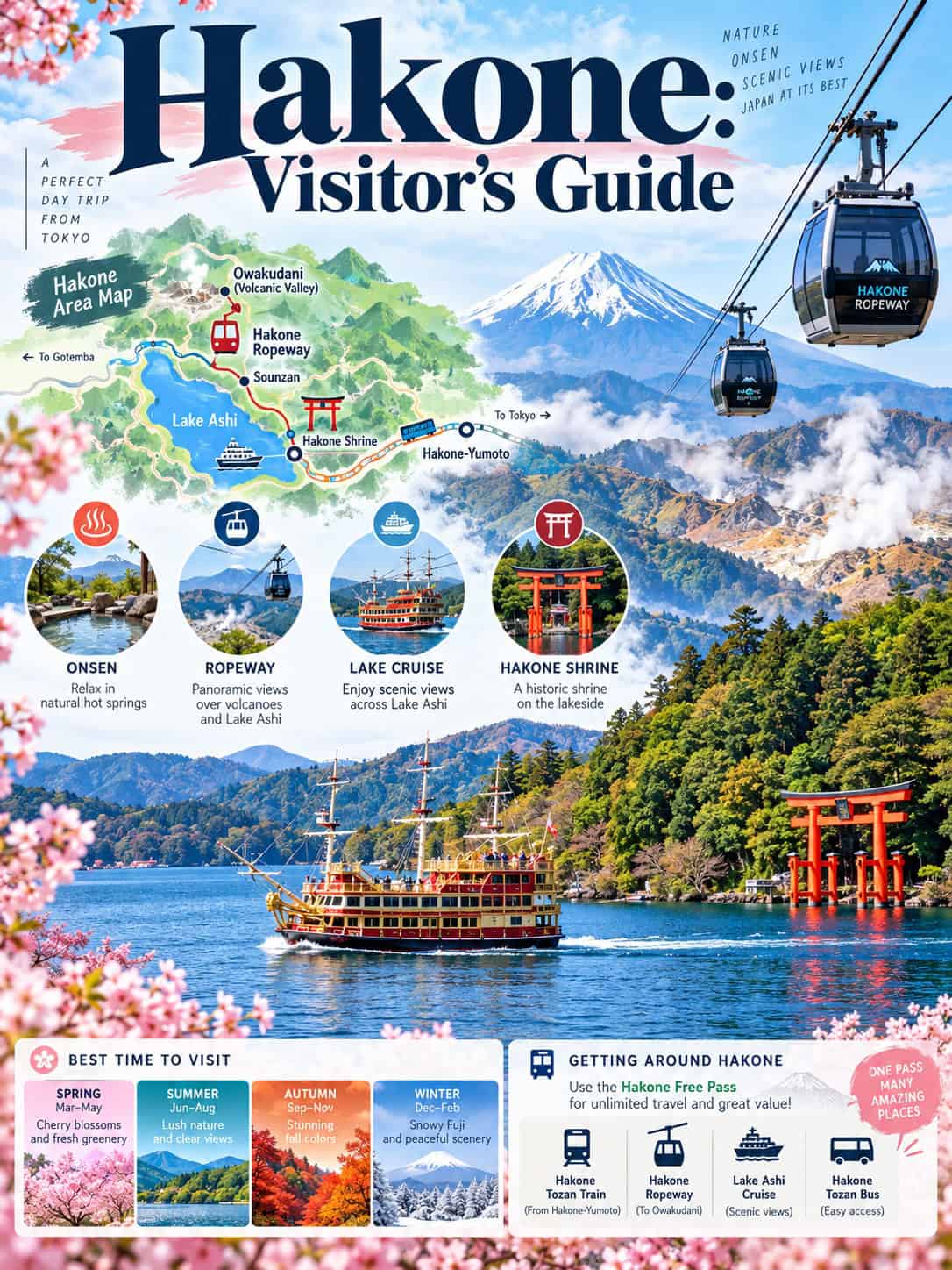
Hakone packs a volcanic valley, a lake with a floating shrine gate and one of Japan’s most famous mountain railways into a loop that most visitors complete entirely by train, cable car, ropeway and boat, with no car required. This Hakone travel guide covers the best things to do in Hakone, how the classic loop fits together, how the Hakone Free Pass works, and how to plan a one-day trip or a night in an onsen ryokan.
Hakone at a Glance
| Category | Details |
|---|---|
| Best for | A volcanic valley, a mountain lake, hot springs, Mt. Fuji views on clear days |
| Ideal trip length | 1 full day as a loop from Tokyo, or 2 days with an overnight at an onsen ryokan |
| Getting there | From Shinjuku, the Odakyu Romancecar takes roughly 85 minutes to Hakone-Yumoto |
| Getting around | Hakone Tozan Railway, cable car, ropeway, Lake Ashi cruise and local buses, covered by the Hakone Free Pass |
| Best time to visit | Winter for the clearest Mt. Fuji views, mid-June for hydrangeas, November for autumn color |
| Currency | Japanese yen (¥) |
The Classic Hakone Loop, Step by Step
The standard Hakone itinerary runs in one direction, but the order depends on the weather and on which legs are operating. Check the status of the ropeway and cruise on the morning you travel, and be ready to reverse the loop or skip a leg.
| Step | Route | Transport | What to expect |
|---|---|---|---|
| 1 | Hakone-Yumoto (or Odawara) to Gora | Hakone Tozan Railway | A switchback mountain train, the hydrangea railway in mid-June |
| 2 | Gora to Sounzan | Cable car | Short climb; Hakone Open-Air Museum is near Gora |
| 3 | Sounzan to Owakudani to Togendai | Hakone Ropeway | Views over the volcanic valley, sulfur smell, black eggs sold at the station |
| 4 | Togendai to Moto-Hakone or Hakone-machi | Lake Ashi sightseeing cruise | Hakone Shrine and its torii gate at Moto-Hakone, Fuji views on clear days |
| 5 | Moto-Hakone back to Hakone-Yumoto or Odawara | Bus | Return to the train for Tokyo |
Weather, Ropeway Closures and Fuji Views
The legs of the loop can close independently. The ropeway may be suspended without notice for strong wind or other bad weather, and service can be halted when volcanic gas levels rise near Owakudani, so access to the valley and the egg-boiling area can be restricted. The ropeway also has scheduled maintenance closures: Odakyu Hakone’s notice lists the Owakudani to Sounzan section as closed from 7 to 24 December 2026 and the Togendai to Owakudani section from 12 January to 26 February 2027, with replacement buses running. Mt. Fuji views are never guaranteed, since haze and cloud hide the mountain more often than not outside winter.
If the Weather Turns
Rain and low cloud do not stop the loop, but they hide the Fuji views that make the lake crossing and the ropeway worth the fare. On such a day, give the long middle of the trip to indoor stops: the Hakone Open-Air Museum has indoor galleries, including the Picasso Pavilion, and the Pola Museum of Art in the Sengokuhara area is open 9 AM to 5 PM with the last entry at 4:30 PM. If your plan has a second day, keep the ropeway and the cruise for a clearer morning.
The valley around Owakudani releases hydrogen sulfide and sulfur dioxide whose strength changes through the day. People with asthma or other breathing problems, heart conditions, pregnant women, small children and older travelers should be particularly cautious there, and anyone who feels unwell should stay in an observation area or head back down the mountain. The hiking trails around the valley are frequently closed for safety.
Things to Do in Hakone
Hakone Open-Air Museum
An outdoor sculpture museum in Gora combining large-scale works across hillside grounds with a Picasso-focused indoor pavilion. The museum is open every day from 9 AM to 5 PM, with the last entry at 4:30 PM. Adult admission is ¥2,000 at the gate and ¥1,800 when bought online; university and high school students pay ¥1,600 (¥1,400 online), middle and elementary school students ¥800 (¥600 online), and preschool children get in free. Plan it between the Tozan Railway and the cable car, so it costs little extra time.
Owakudani and the Hakone Ropeway
The ropeway climbs from Sounzan over Owakudani’s volcanic valley on its way to Togendai, with steaming vents and a strong sulfur smell. Owakudani’s famous black eggs, boiled in the valley’s hot springs until their shells turn black, are sold near the ropeway station as a snack. Check current access to the valley and the egg-boiling site, since it depends on volcanic gas levels. Ropeway boarding runs from 9 AM to 5 PM from February through November and from 9 AM to 4:15 PM in December and January, so winter loops need an early start. Each of the three sections (Sounzan to Owakudani, Owakudani to Ubako, Ubako to Togendai) takes about 15 minutes, and passengers riding the whole line change at Owakudani.
Lake Ashi Sightseeing Cruise
A pirate-ship-styled sightseeing boat connects Togendai, Moto-Hakone and Hakone-machi across the lake, with Mt. Fuji visible across the water on clear days. The crossing takes about 30 minutes one way. In winter, from December to mid-March, the timetable is reduced and some sailings take longer. The Hakone Free Pass covers the standard cabin; the special room costs extra on every ride.
Hakone Shrine
A shrine on Lake Ashi’s shore best known for the red torii gate standing partly in the water, one of the most photographed spots in the area. Within the same grounds, Kuzuryu Shrine draws visitors seeking luck in relationships and business.
Hakone Tozan Railway
A mountain railway from Odawara to Gora that switches back on itself to climb the steep terrain, with the driver and conductor swapping ends of the train each time. It is nicknamed the “Hydrangea Railway” for the flowers that bloom along the tracks around mid-June. IC cards work on the train but not on the cable car, and wheelchairs can be rented at Hakone-Yumoto, Gora and Sounzan stations.
Hakone Yunessun
A hot spring theme park in Kowakien with a swimsuit area of novelty baths and a separate traditional nude onsen section. Check hours and prices on the official site, since they vary by date.
Hakone Free Pass vs Single Tickets
The Hakone Free Pass covers eight modes of transport in the Hakone area, so it suits a two- or three-day visit that rides most legs of the loop. From Shinjuku, Odakyu revised the adult price on 1 October 2025 to ¥7,100 for two days and ¥7,500 for three days. From Odawara it costs ¥6,000 for two days and ¥6,400 for three days. Children pay ¥1,600 and ¥1,850 on the Shinjuku pass (¥1,500 and ¥1,750 from Odawara). There is no one-day version, and the pass includes one return trip on the Odakyu line between the departure station and Odawara, with unlimited stops on the way. It is not valid on Izu-Hakone buses, and it brings discounts on entrance fees at around 70 attractions. The pass does not include the Romancecar reserved-seat charge. Whether it saves money depends on your route. Adult single fares since 1 October 2025: the ropeway costs a flat ¥2,000 one way whether you ride to Owakudani or all the way to Togendai (¥3,000 round trip, valid for two days), and the Lake Ashi cruise from Togendai to Moto-Hakone or Hakone-machi costs ¥1,700 one way (¥3,000 round trip). Add the Tozan Railway, cable car and bus legs you actually plan to ride, plus the round-trip Odakyu fare, and compare the total with the pass price. If you are only visiting for a day and want a few rides, single tickets can make more sense. The pass is sold in the EMot smartphone ticket app, at Odakyu stations (from one month before departure; on the day only from vending machines), at 7-Eleven stores and at the information centers in Odawara and Hakone-Yumoto.
Hakone Ticket Prices at a Glance
| Ticket | Adult | Child | Notes |
|---|---|---|---|
| Hakone Free Pass, 2 days from Shinjuku | ¥7,100 | ¥1,600 | Includes one Odakyu return trip to Odawara; Romancecar surcharge not included |
| Hakone Free Pass, 3 days from Shinjuku | ¥7,500 | ¥1,850 | Same coverage |
| Hakone Free Pass, 2 days from Odawara | ¥6,000 | ¥1,500 | No Odakyu trip to Odawara needed |
| Hakone Free Pass, 3 days from Odawara | ¥6,400 | ¥1,750 | Same coverage |
| Romancecar surcharge, Shinjuku to Hakone-Yumoto | ¥1,200 | ¥600 | Paid on top of the base fare; ¥50 less as an e-ticket; every seat reserved |
| Hakone Ropeway, any section, one way | ¥2,000 | ¥700 | Round trip ¥3,000 adult, ¥1,000 child |
| Lake Ashi cruise, Togendai to Moto-Hakone or Hakone-machi, one way | ¥1,700 | ¥850 | Round trip ¥3,000 adult, ¥1,300 child; special room costs extra |
| Hakone Open-Air Museum | ¥2,000 | ¥800 | Online ¥1,800 adult, ¥600 child; free for preschool children |
| Tozan Railway and cable car | see operator | see operator | Included in the Free Pass; IC cards work on the train but not on the cable car |
Where to Stay in Hakone: One Night in a Ryokan
Hakone-Yumoto is the most convenient base, right where trains from Tokyo arrive, with the widest range of ryokan and hotels. Gora or the Lake Ashi area suit travelers who want an early start at Owakudani or the lake. An overnight in an onsen ryokan, with a hot spring bath and a multi-course kaiseki dinner, is a large part of Hakone’s appeal, and it takes pressure off the loop. See our guide to onsen hotels near Hakone and Mount Fuji.
Getting to Hakone from Tokyo
From Shinjuku, the Odakyu Romancecar is the fastest and most comfortable option, a limited express covering the trip to Hakone-Yumoto in roughly 85 minutes, with a reserved-seat charge on top of the base fare. The surcharge from Shinjuku is ¥1,200 for adults and ¥600 for children aged 6 to 11 to Hakone-Yumoto (¥1,000 to Odawara), and ¥50 less as an e-ticket. Every seat is reserved, and sales open at 10 AM one month before the departure date. Regular Odakyu trains cover the same route for less, taking longer with a transfer. Our Tokyo to Hakone transfer guide covers the options, and our Tokyo guide helps you plan the rest of your trip.
Best Time to Visit Hakone
Winter brings the driest air and the best odds of seeing Mt. Fuji from Lake Ashi or the ropeway, though it is cold at higher elevations. Mid-June brings hydrangeas into bloom along the Tozan Railway, and November brings strong autumn color around the lake. Summer is more humid and more likely to hide Fuji behind haze, though the altitude keeps Hakone somewhat cooler than Tokyo. For the mountain itself, see our Mount Fuji climbing and viewing guide.
A Simple Hakone Itinerary: 1 Day or 2 Days
One day
- Morning: Romancecar from Shinjuku to Hakone-Yumoto, then the Tozan Railway up to Gora.
- Midday: the Open-Air Museum, then the cable car to Sounzan and the ropeway over Owakudani.
- Afternoon: the ropeway on to Togendai, the cruise across Lake Ashi to Moto-Hakone for Hakone Shrine, then a bus back to Hakone-Yumoto for the train to Tokyo.
Two days with one night in a ryokan
- Day 1: the loop at a relaxed pace, finishing at your ryokan for an onsen bath and dinner.
- Day 2: a slow morning, the legs you skipped or any Fuji viewpoint you missed, then head back to Tokyo.
This covers the full loop in a long single day, and splitting it across two days makes for a less rushed visit. If a leg is closed, the loop has enough separate pieces that a single closure rarely ruins the trip.
Food in Hakone
Owakudani’s black eggs are a snack rather than a meal, with local legend saying each one adds years to your life. Soba noodles are widely available, often served alongside the regional yuba, and many onsen ryokan serve elaborate kaiseki dinners built around seasonal ingredients, a highlight for overnight guests.
Practical Tips for First-Time Visitors
Check the operating status of the ropeway and other legs the morning of your visit rather than assuming the full loop will run. Weekends and holidays bring heavier crowds, especially to the ropeway and cruise, so a weekday or early start makes a real difference. Carry some yen for smaller shops and cafes, and a layer for the cooler altitude.
For a single guided day from Tokyo, the Mount Fuji & Hakone Day Tour from Tokyo is available to book online.
Frequently Asked Questions
Can Hakone be visited as a day trip from Tokyo?
Yes. The full Hakone loop is doable in one long day from Shinjuku, but an overnight stay at an onsen ryokan makes for a more relaxed visit if time allows.
Is the Hakone Free Pass worth buying?
It depends on your route. The pass covers eight modes of transport in the Hakone area, so it suits visitors who ride most legs of the loop over two or three days. If you plan only one or two rides, compare the pass price with the single fares for your route before you buy. The Romancecar reserved-seat charge is not included.
What does the Hakone Free Pass cover?
The Hakone Free Pass covers unlimited rides in the Hakone area on the Hakone Tozan Railway and cable car, the ropeway, the sightseeing cruise on Lake Ashi and designated buses, plus a round trip on the Odakyu line from the departure station, depending on the version you buy. Check the current coverage map before you buy.
Can I see Mt. Fuji from Hakone?
Sometimes. Lake Ashi and the ropeway offer views toward Mt. Fuji on clear days, most reliably in winter, but haze and cloud often hide the mountain, even when Tokyo looks clear.
What happens if the Hakone Ropeway is closed?
The ropeway can be suspended for strong wind, bad weather or volcanic gas, and sections close for scheduled maintenance, usually with replacement buses. Check the operating status on the morning you travel and be ready to reorder or skip the ropeway leg.
Do I need the Romancecar, or can I take a regular train to Hakone?
The Romancecar is faster and more comfortable but needs a separate reserved-seat ticket on top of the base fare. Regular Odakyu trains reach Hakone-Yumoto for less, with a longer trip and a transfer.
Is Hakone crowded?
Weekends and national holidays bring the heaviest crowds to the ropeway and the sightseeing cruise. A weekday visit or an early start cuts waiting at each transfer.
Bottom Line
Hakone rewards a full day spent riding its loop of trains, cable cars, ropeways and boats, and rewards an overnight stay at an onsen ryokan even more, for travelers who can spare the extra day.