By Nippon With Me EditorialPublished Updated
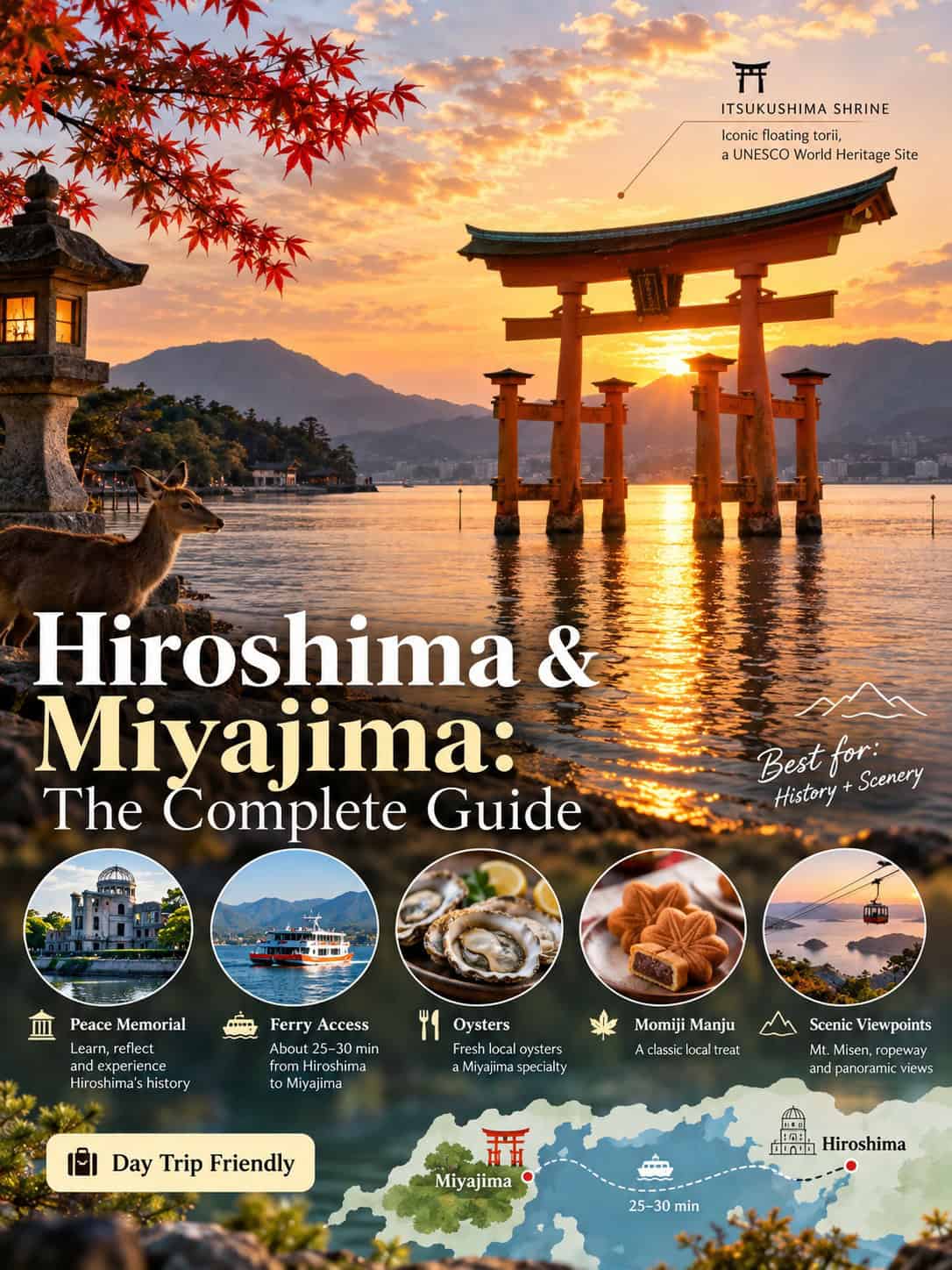
The best things to do in Hiroshima combine the Peace Memorial Park, local food and a day trip to Miyajima. From Hiroshima Station, take a train to Miyajimaguchi and then a ferry of about 10 minutes to the island. This Hiroshima travel guide covers the city’s historic sights, Itsukushima Shrine and the current closure of Hiroshima Castle’s main keep.
Things to Do in Hiroshima at a Glance
| Category | Details |
|---|---|
| Best for | Peace Memorial history, Itsukushima Shrine, Hiroshima-style okonomiyaki, a manageable day-trip pairing |
| Ideal trip length | 1 full day for Hiroshima’s main sights, 1 full day for Miyajima — 2 days total covers both comfortably |
| Getting there | Shinkansen: ~1.5 hours from Osaka, ~4 hours from Tokyo; Hiroshima Airport also has domestic and limited international flights |
| Getting to Miyajima | Train to Miyajimaguchi, then ~10-minute ferry; JR Pass covers the JR ferry fare, not the ¥100 visitor tax |
| Best time to visit | Late March-May and October-November for comfortable weather and good foliage/blossoms; August 6 draws heavy crowds for the Peace Memorial Ceremony |
| Currency | Japanese yen (¥) |
Things to Do in Hiroshima by Neighborhood
Peace Memorial Park Area
The city’s most-visited district, centered on Peace Memorial Park and the Atomic Bomb Dome along the Motoyasu River. It’s a quiet, deliberately contemplative area rather than a commercial one.
Hiroshima Castle Area
A short walk or streetcar ride north of downtown, built around the castle’s moated grounds and Shukkeien Garden nearby. It’s one of the city’s greener, more spread-out districts.
Hondori & Downtown
Hiroshima’s main covered shopping arcade and surrounding streets, the best area for okonomiyaki restaurants, shopping, and evening dining. It sits only a short walk from Peace Memorial Park, so the two areas are easy to combine in a single afternoon and evening.
Hiroshima Station Area
The city’s transit hub, where the Shinkansen, JR lines, and Hiroden streetcar network all converge. It’s less of a destination in itself but a practical base for travelers prioritizing easy train access.
Top Things to Do in Hiroshima and on Miyajima
Hiroshima Peace Memorial Museum
The city’s central historical institution, documenting the 1945 atomic bombing through artifacts, photographs, and survivor testimony. Admission is ¥200 for adults (¥100 for high school students, free for younger children), with hours running 7:30am to 7:00pm from March through July and September through November, 7:30am to 8:00pm in August (9:00pm on August 5 and 6), and 7:30am to 6:00pm from December through February; last entry is 30 minutes before closing. The first hour, 7:30am to 8:30am, is open only to visitors holding an online ticket. In the same park, the Hiroshima National Peace Memorial Hall for the Atomic Bomb Victims is free to enter and open 8:30am to 6:00pm (7:00pm in August, 5:00pm from December through February), closed December 30-31.
Atomic Bomb Dome (Genbaku Dome)
The skeletal remains of the former Hiroshima Prefectural Industrial Promotion Hall, left standing as it was found after the bombing and now a UNESCO World Heritage site. It’s viewed from the outside only, free, and accessible at any time, directly across the river from Peace Memorial Park.
Hiroshima Castle
Originally built in the 1590s and reconstructed after being destroyed in the bombing. The castle park is free and open at all times, and the Ninomaru gate building is also free to enter (hours 9:00am to 5:30pm, 4:30pm from October through March). The main keep’s interior, however, has been closed to the public since March 2026 due to earthquake-resistance concerns — city officials and an expert panel are weighing a full rebuild, with no reopening expected for years. The exterior remains viewable from the castle grounds.
Shukkeien Garden
A traditional Japanese landscape garden dating to the early 1600s, built around a central pond with islands and bridges. Admission is ¥350, with hours running 9:00am to 6:00pm (5:00pm from mid-September through mid-March); closed December 29-31.
Itsukushima Shrine
Miyajima’s famous shrine, built on stilts over the water with its iconic torii gate appearing to float at high tide. Admission is ¥300 (¥500 combined with the treasure hall), with hours varying seasonally from roughly 6:30am to between 5:00pm and 6:00pm; no closed days.
Shrine hours run 6:30am to 6:00pm from March 1 through October 14, 6:30am to 5:30pm from October 15 through November 30 and from January 4 through the end of February, and 6:30am to 5:00pm in December. The Treasure Hall is open 8:00am to 5:00pm all year. Children pay less: elementary and junior high students are ¥100 for the shrine and ¥150 for the combined ticket, and high school students ¥200 and ¥300. Combined tickets are sold only at the shrine entrance. The covered corridors have small gaps between the floorboards, so wear flat, comfortable shoes rather than heels.
Mt. Misen Ropeway
A two-stage ropeway climbing partway up Miyajima’s highest peak, from Momijidani Station, with a hiking trail covering the final stretch to the summit observation point. Round-trip fare is ¥2,000 for adults, running 9:00am to 4:00pm (last return departure 4:30pm).
One way costs ¥1,100 for adults, which suits a ride up and a walk down. Children aged 6 to 12 pay ¥550 one way or ¥1,000 round trip, and younger children ride free with an adult (one per adult). The first stage from Momijidani to Kayatani takes about 10 minutes with departures roughly every minute, and the second stage from Kayatani to Shishiiwa takes about 4 minutes with departures about every 15 minutes. The ropeway stops in strong wind and thunderstorms, and for maintenance twice a year, usually around February and July.
Miyajima Public Aquarium
A good indoor stop on the island on a wet day. It is open 9:00am to 5:00pm, with reception closing at 4:00pm. Adults pay ¥1,420, elementary and junior high students ¥710 and children aged 4 and older ¥400; under 4 is free. The aquarium is closed for facility repairs from December 1, 2026 to March 31, 2027.
Orizuru Tower
An observation tower directly across the street from Peace Memorial Park, offering an open-air rooftop viewpoint over the park, the Atomic Bomb Dome, and the surrounding city. Admission is ¥2,200 for adults, with the tower open daily from 10:00am to 6:00pm (last entry 5:00pm); hibakusha (atomic-bomb survivors) enter free, and a modest discount is sometimes available with a same-day receipt from another nearby attraction.
Mazda Museum
A free factory tour at Mazda’s headquarters on the city’s eastern edge, covering the company’s history, a showroom of current and historic models, and a short look at part of the actual assembly line. Guided tours run on weekdays only, last roughly 90 to 120 minutes, and must be reserved online in advance — up to three months ahead — since walk-ins aren’t accepted. The English-language tour leaves the Head Office lobby at 2:15pm and the Japanese-language tour at 9:15am. On a few Saturdays a year, such as December 5, the museum holds an Open Day with free entry and no guided tour; those visits are also booked online, with bookings opening on the first day of the previous month.
Where to Stay
Hiroshima Station Area is the most practical base, with direct access to the Shinkansen, JR lines to Miyajimaguchi, and the Hiroden streetcar network.
Peace Memorial Park Area suits travelers who want to be within walking distance of the main historical sites and downtown Hondori.
On Miyajima itself, a handful of ryokan let visitors experience the island after the day-trip crowds leave — worth considering for travelers who want to see Itsukushima Shrine at dawn or dusk.
Getting to Hiroshima
The Shinkansen is a convenient way to reach Hiroshima from Osaka and Tokyo. Journey times and fares vary by train, departure point, seat type and travel date, so compare current services before booking. Hiroshima Airport also has domestic and selected international flights, with onward bus connections to the city. Travelers from overseas should also check our Japan visa guide before booking.
Hiroshima Miyajima Day Trip: Getting to the Island
From Hiroshima Station, take the JR Sanyo Line to Miyajimaguchi, then walk to the ferry terminal. The crossing to Miyajima takes about 10 minutes. The regular adult fare is around ¥200 one way, plus a separate ¥100 visitor tax when entering the island (children under 6 are exempt, and a child’s one-way ferry fare is ¥100). The JR ferry fare is covered by a valid Japan Rail Pass, but pass holders must still pay the visitor tax. A direct sightseeing boat also operates from near Peace Memorial Park; check its current fare and timetable separately.
Getting Around: Things to Do in Hiroshima Without a Car
The Hiroden streetcar network covers most of the city’s main sights, including direct lines between Hiroshima Station, Peace Memorial Park, and Hiroshima Castle’s area. It’s slower than a subway but easy to use, and most routes are flat-fare; an IC card (ICOCA, Suica, or any of Japan’s other regional transit cards) works on every line and saves the hassle of counting out exact change. The Mazda Museum, being well outside the central streetcar network, is more easily reached by a short taxi ride to Mazda’s Head Office, where booked visitors meet their guide in the lobby and ride a shuttle bus to the museum (arrive 15 minutes before departure).
The flat fare is ¥240 for adults and ¥120 for children on every Hiroden line, including the Miyajima line. Tap an IC card when you board and again when you get off. A solo adult can leave by any door, but children and anyone on a discounted fare must leave through the driver’s door, because IC cards do not apply the half-price child fare automatically.
Best Time for Things to Do in Hiroshima and Miyajima
Late March through May and October through November generally offer the most comfortable weather, with cherry blossoms around Hiroshima Castle in early April and good autumn color on Miyajima in November. Summer is hot and humid, and August 6 — the anniversary of the atomic bombing, marked each year by the Peace Memorial Ceremony — draws significant crowds to Peace Memorial Park specifically; it’s a meaningful day to witness but a more subdued one for casual sightseeing. Winter is mild by Japanese standards but can be damp, with fewer crowds at both Hiroshima’s sights and on Miyajima. For seasons across the whole country, see our guide to the best time to visit Japan.
Things to Do in Hiroshima: An Easy Two-Day Itinerary
Day 1 — Hiroshima: Peace Memorial Park and Museum in the morning, the Orizuru Tower’s rooftop viewpoint right afterward for a wider perspective on the same area, then Hiroshima Castle and Shukkeien Garden in the afternoon, finishing with Hondori for dinner.
Day 2 — Miyajima: an early ferry over, Itsukushima Shrine around low tide for the torii gate’s sand-level view (or high tide for the floating effect — both are worth seeing, just different), then the Mt. Misen Ropeway if time and weather allow. If Hiroshima is one stop on a longer trip, our Japan 2-week itinerary shows how it fits the wider route.
This is a deliberately compact starting template — many travelers do both in a single very full day as a side trip from Osaka or Kyoto, though splitting it across two days removes the rush. Travelers with an extra morning and an interest in cars can swap in the Mazda Museum’s free factory tour, provided a reservation is booked well ahead of the trip — the guided tour is weekday-only, so it needs to be planned around rather than slotted in on the fly.
What the Two-Day Itinerary Costs per Person
Admissions and the ferry for both days come to ¥5,550 per adult, before streetcar rides at ¥240 each, the train to Miyajimaguchi and meals. The Mazda Museum tour is free.
| Item | Adult | Child |
|---|---|---|
| Day 1 | ||
| Peace Memorial Museum | ¥200 | Free (¥100 for high school students) |
| National Peace Memorial Hall | Free | Free |
| Hiroshima Castle grounds and Ninomaru | Free | Free |
| Shukkeien Garden | ¥350 | See venue |
| Orizuru Tower | ¥2,200 | See venue |
| Day 1 admissions | ¥2,750 | See venue |
| Day 2 | ||
| JR ferry, round trip | ¥400 | ¥200 |
| Miyajima visitor tax | ¥100 | ¥100 (free under age 6) |
| Itsukushima Shrine | ¥300 | ¥100 (elementary and junior high) |
| Mt. Misen Ropeway, round trip | ¥2,000 | ¥1,000 (ages 6 to 12) |
| Day 2 total, excluding the train to Miyajimaguchi | ¥2,800 | ¥1,400 |
If It Rains
On a wet Day 1, spend the extra time at the Peace Memorial Museum and the free National Peace Memorial Hall, and move the open-air Orizuru Tower rooftop and Shukkeien Garden to whenever the rain eases. On a wet Day 2, the ropeway stops in thunderstorms and strong wind, so plan an indoor alternative on the island: the Itsukushima Shrine Treasure Hall (¥300, 8:00am to 5:00pm) or the Miyajima Public Aquarium (¥1,420, 9:00am to 5:00pm, closed for repairs from December 1, 2026 to March 31, 2027). On a weekday, the free Mazda Museum tour back in the city also works as an indoor option if it is booked ahead.
Food and Things to Do in Hiroshima After Sightseeing
Hiroshima-style okonomiyaki is the city’s signature dish and distinct from the more famous Osaka version — built in layers (batter, cabbage, noodles, and toppings grilled separately and stacked) rather than mixed together before cooking. Hiroshima is also one of Japan’s largest oyster-producing regions, and fresh or grilled oysters show up on menus throughout the city, especially in winter. On Miyajima, momiji manju (small maple-leaf-shaped cakes, typically filled with sweet red bean paste or custard) are the island’s signature souvenir and snack.
Practical Tips for First-Time Visitors
Peace Memorial Park is a solemn site rather than a typical tourist attraction, and visitors generally keep a quiet, respectful tone throughout, especially inside the museum. Miyajima’s wild deer roam freely around Itsukushima Shrine and the surrounding streets — they’re used to people but shouldn’t be fed, since human food can make them sick and encourage more aggressive begging behavior. Because Hiroshima Castle’s main keep is closed to the public, travelers specifically hoping to go inside it should adjust expectations and treat the visit as a park and exterior-viewing stop rather than a museum visit. Anyone hoping to join the Mazda Museum’s factory tour should book online well before arriving in Japan, since reservations open up to three months out and weekday slots — the only guided ones — can fill up, especially the English-language tour. Heading on to Kansai afterwards? Our Nara visitor’s guide covers a good next stop.
Bottom Line
Hiroshima and Miyajima offer contrasting experiences: Peace Memorial history in the city and a scenic island shrine visit. A two-day stay gives each destination time without rushing.
Frequently Asked Questions
Can I visit Hiroshima and Miyajima in one day?
Yes, though it makes for a full day — many travelers do both as a single day trip from Osaka or Kyoto. Splitting it across two days, as in the itinerary above, allows a more relaxed pace at each site.
Can I still go inside Hiroshima Castle’s main keep?
No — the main keep’s interior has been closed to the public since March 2026 over earthquake-resistance concerns, with no reopening expected for years. The castle park and the Ninomaru gate building remain open and free.
Is the Itsukushima Shrine torii gate better at high tide or low tide?
Both have their appeal — high tide gives the famous “floating” effect, while low tide lets visitors walk out across the sand right up to the gate’s base. Checking a tide table before the trip and timing a visit (or staying long enough to see both) is worth the extra planning.
Is Hiroshima safe to visit, and is it an appropriate destination for families?
Yes to both — Hiroshima today is an ordinary, safe Japanese city, and the Peace Memorial Park and Museum are widely considered an important, age-appropriate (with some discretion for very young children) experience for visitors of most ages.
Do I need to book the Mazda Museum tour in advance?
Yes — it’s reservation-only, with no walk-in option, and slots can be booked up to three months ahead. Guided tours run on weekdays only, so it needs to be planned into the itinerary rather than added spontaneously.
What are the best things to do in Hiroshima on a first visit?
Start with Peace Memorial Park and Museum, see the Atomic Bomb Dome, then explore Hiroshima Castle’s grounds, Shukkeien Garden and Hondori.
Is a Hiroshima Miyajima day trip possible without a car?
Yes. Take the train to Miyajimaguchi and the ferry to Miyajima, then explore the shrine and waterfront on foot.
What should a Miyajima island guide include?
Plan time for Itsukushima Shrine, the waterfront torii gate, local snacks and, if the weather allows, the Mt. Misen Ropeway. Check the tides if you want to see the torii gate at both high and low water.