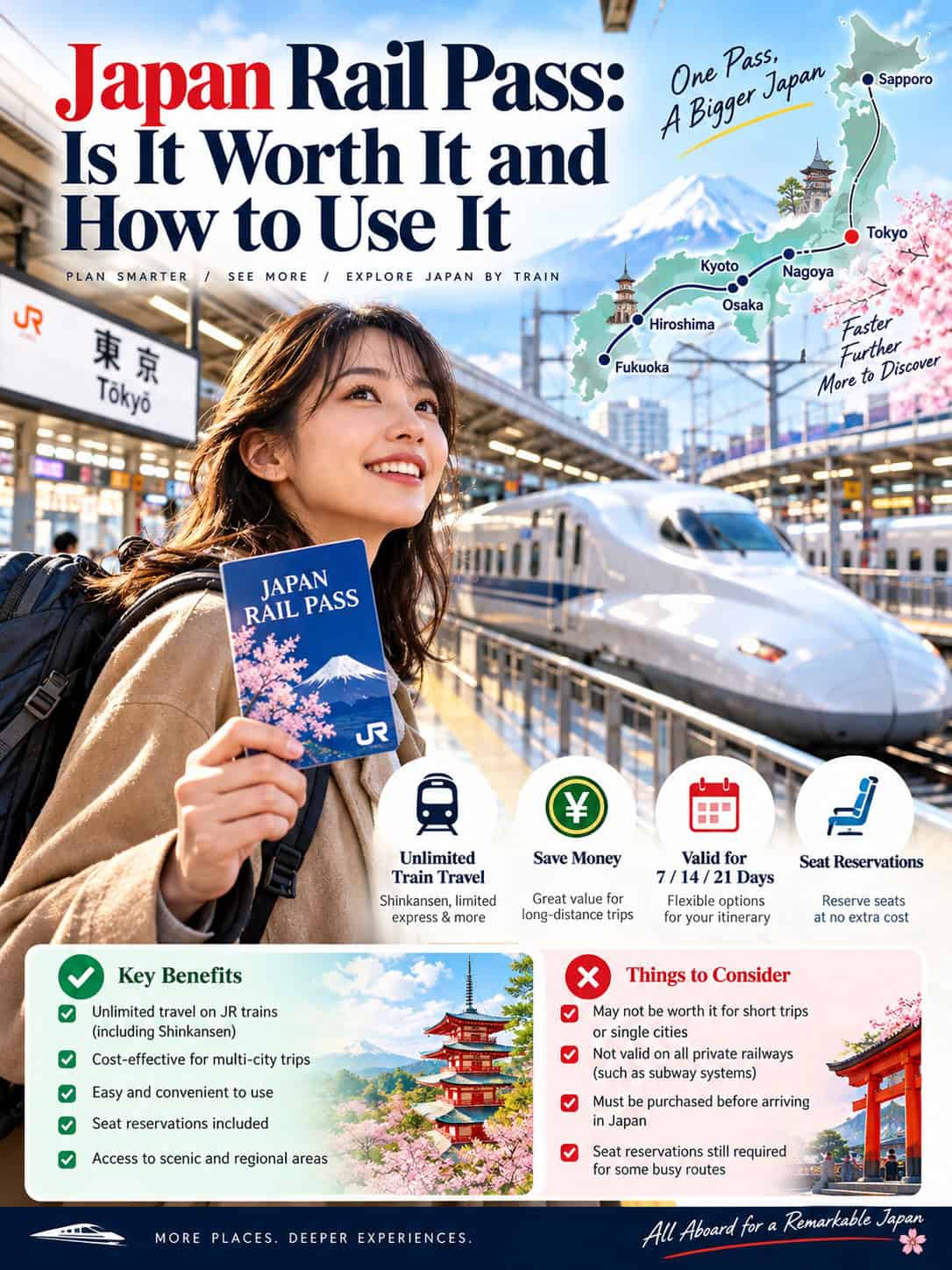
By Nippon With Me EditorialPublished Updated
The Japan Rail Pass used to be an easy recommendation for almost any first-time visitor planning more than a couple of cities. That changed with the big price increase of October 2023, and on October 1, 2026, JR Group raised prices again for passes bought through overseas agencies, while the official website kept its earlier prices. The pass is still a good deal for the right itinerary, but it is no longer worth it automatically. The math needs checking before you buy.
Quick Answer
| Question | Answer |
|---|---|
| Japan Rail Pass price, 7 days (Ordinary, adult) | 7-day Ordinary Japan Rail Pass (adult): ¥50,000 when purchased through the official online service, or ¥53,000 via an overseas agency (from 1 October 2026). |
| Is it worth it for one round trip? | Usually no. A single Tokyo-Kyoto round trip costs far less than the pass |
| Is it worth it for a multi-city loop? | Often yes, especially when you add side trips and local JR rides |
| Can I ride the Nozomi? | Only with a separate NOZOMI MIZUHO Ticket each time; Hikari, Sakura and Kodama need nothing extra |
| Who can buy it? | Foreign tourists with a Temporary Visitor stamp; Japanese nationals living abroad only under official conditions |
What the JR Pass Covers
The pass covers travel on the JR Group network nationwide, including most Shinkansen (bullet train) services, JR limited express trains and ordinary JR local and rapid trains. The Narita Express and the JR lines around Tokyo count too. It does not cover private railways such as the Nankai or Keisei lines, which come up in our Kansai Airport guide and Narita and Haneda guide.
The Nozomi and Mizuho, the fastest trains on the Tokaido, Sanyo and Kyushu lines, are not covered. Pass holders can still ride them by buying a separate NOZOMI MIZUHO Ticket each time. Tokyo to Shin-Osaka or Tokyo to Kyoto costs ¥4,960, Tokyo to Nagoya ¥4,180 and Tokyo to Hiroshima ¥6,500. Seats are limited and the ticket is valid only for the section and day printed on it. Most pass holders simply take the Hikari or Sakura on the same routes. The slower Kodama, which stops at nearly every station, is covered too and is useful mainly for short hops.
The NOZOMI MIZUHO Ticket goes on sale one month before the day of travel at reserved seat ticket machines, JR ticket offices and Travel Service Centers. Further west, Shin-Osaka to Hakata costs ¥4,960 and Hakata to Kagoshima-Chuo ¥5,150. The price is the same for reserved, non-reserved and Green Car seats, and a non-reserved version is sold except in peak periods, when every Nozomi seat is reserved. An unused ticket can be refunded where you bought it, minus a ¥340 fee for reserved and Green Car seats.
Japan Rail Pass Price: 7, 14 and 21 Days
The latest price increase took effect on October 1, 2026, and applies only to passes bought through overseas agencies. If you see much lower numbers in older blog posts or forum threads, they date from before the October 2023 increase. Children aged 6 to 11 pay the child fare.
| Pass length | Ordinary adult | Ordinary child | Green Car adult | Green Car child |
|---|---|---|---|---|
| 7 days | ¥50,000 online, ¥53,000 via overseas agency | ¥27,000 | ¥74,000 | ¥37,000 |
| 14 days | ¥84,000 | ¥42,000 | ¥116,000 | ¥58,000 |
| 21 days | ¥105,000 | ¥53,000 | ¥147,000 | ¥74,000 |
Apart from the 7-day Ordinary adult price, the figures above are what overseas agencies charge. Buying on the official website costs less for every pass type:
| Bought on the official website | Ordinary adult | Ordinary child | Green Car adult | Green Car child |
|---|---|---|---|---|
| 7 days | ¥50,000 | ¥25,000 | ¥70,000 | ¥35,000 |
| 14 days | ¥80,000 | ¥40,000 | ¥110,000 | ¥55,000 |
| 21 days | ¥100,000 | ¥50,000 | ¥140,000 | ¥70,000 |
The price that applies is the one in effect on the day you pay online or the day the agency issues your Exchange Order. The same date sets the child fare: a child who is 11 on that day keeps the child price even after turning 12 before the trip.
Green Car is the Japanese equivalent of first class, with wider seats, more legroom and a quieter carriage. It costs noticeably more and most travelers do not need it. Unless comfort on long hauls matters more to you than price, the Ordinary pass covers everything you need.
JR Pass Eligibility: Who Can Buy It
The pass is for visitors, not residents. You need to enter Japan with a “Temporary Visitor” stamp or sticker in your passport, which is standard for most tourists. If you use the automated gates at the airport you will not get a stamp, so use a manned gate or ask a clerk to add one. Other entry statuses, such as trainee or entertainer, do not qualify.
Japanese nationals living overseas are not shut out entirely. They can use the pass if they meet the official conditions, which include overseas residence documents, and they must buy it through an overseas agency. They cannot buy it on the official website. Eligibility is checked when you collect the pass, so confirm it before you leave home.
How to Buy the Japan Rail Pass
The easiest route is the official Japan Rail Pass Reservation website, open from 4:00am to 11:30pm Japan time. You need your passport and a credit card in the purchaser’s name. One purchaser can buy for up to six eligible travelers, and children on the same itinerary can be included without their own card. After you pay, the same site lets you reserve Shinkansen and limited express seats in advance. Booking seats online before you arrive is only possible when the pass is bought on the official site; agency buyers reserve at JR ticket offices and machines once they have the pass.
The other route is an overseas travel agency, which sells an Exchange Order that you swap for the pass in Japan. This is also the only route for Japanese nationals living abroad. Either way, the pass is not a ticket you load onto your phone. You collect it in Japan, as described below.
How to Use the Japan Rail Pass
Collect the pass before its start date, or at any point during its validity period if you start it partway through your trip. Go to a JR-designated ticket office or to a reserved seat ticket machine in the JR East or JR West area. Bring the number issued at purchase and your passport with the Temporary Visitor stamp. Staff may also ask for the passports of everyone traveling with you.
If you booked seats online, collect those tickets from a reserved seat ticket machine. For where the pass fits into a longer trip, see our 2-week itinerary and our Tokyo to Kyoto Shinkansen guide.
Reserved vs. Unreserved Seats
The pass does not require seat reservations. You can walk onto most trains and sit in an unreserved car. During busy periods such as Golden Week, Obon and New Year, unreserved cars fill up fast and you may end up standing on a long ride. Reserving costs nothing extra with the pass. You can do it online when you buy, or afterward at a JR ticket office or reservation machine once you have your pass.
Some trains have no unreserved cars at all, and on those a reservation is the only way to ride with the pass. If you travel with a large suitcase on the Tokaido, Sanyo or Kyushu Shinkansen, also reserve a seat with an oversized baggage area for any bag whose length, width and height add up to more than 160 cm (250 cm is the limit). The seat costs nothing extra, but boarding with such a bag and no reservation costs ¥1,000.
Is the JR Pass Worth It? A Simple Japan Rail Pass Calculator
You do not need a special tool for a Japan rail pass calculator. List every long-distance leg you plan, look up each one-way fare on a fare site or in Google Maps, add them up and compare the total with the pass price for your trip length. Add any local JR rides you would otherwise pay for, and the cost of a NOZOMI MIZUHO Ticket if you plan to use it.
A short loop such as Tokyo to Kyoto, a side trip to Hiroshima and back to Tokyo usually comes out cheaper paid leg by leg than a 7-day pass. The pass earns its price when you add more movement, such as day trips around Kansai, an extra city like Nagoya or Okayama, or local JR trains. Travelers doing four or more long-distance legs inside the pass window are still likely to come out ahead. If the totals are close, the convenience of not queueing at ticket machines counts for something, but it is not free.
Japan Rail Pass 7 Days, 14 Days or 21 Days
The 7-day pass suits a focused trip with several long legs packed into one week, for example Tokyo, Kyoto, Hiroshima and back. The 14-day pass makes sense for a two-week loop across several regions, like the route in our Japan itinerary. The 21-day pass only pays off if you keep moving across the country for three weeks. Remember that the days run consecutively from the start date you choose, so rest days inside the window still use up pass days.
One Pass or a Regional Pass?
The nationwide pass is not the only option. JR East, JR West and other JR companies sell their own passes for smaller areas. A pass covering just Kansai, for instance, costs considerably less and can be the better deal if your whole trip stays around Osaka, Kyoto, Kobe and Nara, as in our Kyoto to Osaka guide. If your itinerary runs from Tokyo through Kansai to Hiroshima or beyond, the nationwide pass is usually simpler to manage.
Before You Fly
Plan your payments before you land. Our guide to cash, cards and ATMs explains how to get yen, and the Japan visa guide covers the entry stamp the pass depends on.
Frequently Asked Questions
Is the Japan Rail Pass worth it after the price increase?
It depends on your itinerary. For a single round trip or a simple loop, paying leg by leg is often cheaper. For a packed multi-city itinerary with several long-distance legs inside your pass window, it can still pay off.
How much is the Japan Rail Pass?
An adult Ordinary pass costs ¥50,000 for 7 days when purchased through the official online service (¥53,000 via an overseas agency, from 1 October 2026), ¥80,000 for 14 days (¥84,000 via an agency) and ¥100,000 for 21 days (¥105,000 via an agency). Green Car passes cost ¥70,000, ¥110,000 and ¥140,000 online, or ¥74,000, ¥116,000 and ¥147,000 through an agency. Child prices are about half.
Can I ride the Nozomi with a Japan Rail Pass?
Yes, but not for free. Pass holders buy a separate NOZOMI MIZUHO Ticket each time they ride, for example ¥4,960 for Tokyo to Shin-Osaka or Tokyo to Kyoto. Seats are limited, so it can sell out, and all Nozomi seats are reserved in peak periods. The Hikari, Sakura and Kodama need no extra ticket.
Do I need to reserve seats with the Japan Rail Pass?
No, unreserved cars are included. Reserving ahead is free with the pass and worth doing on busy travel dates, because unreserved cars can fill up on popular long-distance routes.
How do I collect the Japan Rail Pass after buying it?
Pick it up in Japan, before the start date or during the validity period, at a JR-designated ticket office or at a reserved seat ticket machine in the JR East and JR West areas. Bring the number issued at purchase and your passport with the Temporary Visitor stamp.
Who can buy the Japan Rail Pass?
Foreign tourists entering Japan with a Temporary Visitor stamp or sticker. Japanese nationals living overseas can use a pass only if they meet the official conditions, and they must buy it through an overseas agency rather than the official website.
Is the Green Car pass worth the extra cost?
For most travelers, no. Green Car means wider seats and a quieter carriage, but it costs noticeably more. It makes sense only if comfort on long rides matters more to you than the price.
Should I buy a regional JR pass instead of the nationwide one?
If your whole trip stays in one region, such as Kansai, a regional pass is usually cheaper. If you are crossing the country, the nationwide pass is usually simpler.
Bottom Line
The Japan Rail Pass is no longer a default “just buy it” recommendation. It remains a strong deal for travelers covering real distance across several regions in a short window. For a single round trip or a modest loop, do the fare math first, because individual tickets may genuinely cost less.