By Nippon With Me EditorialPublished Updated
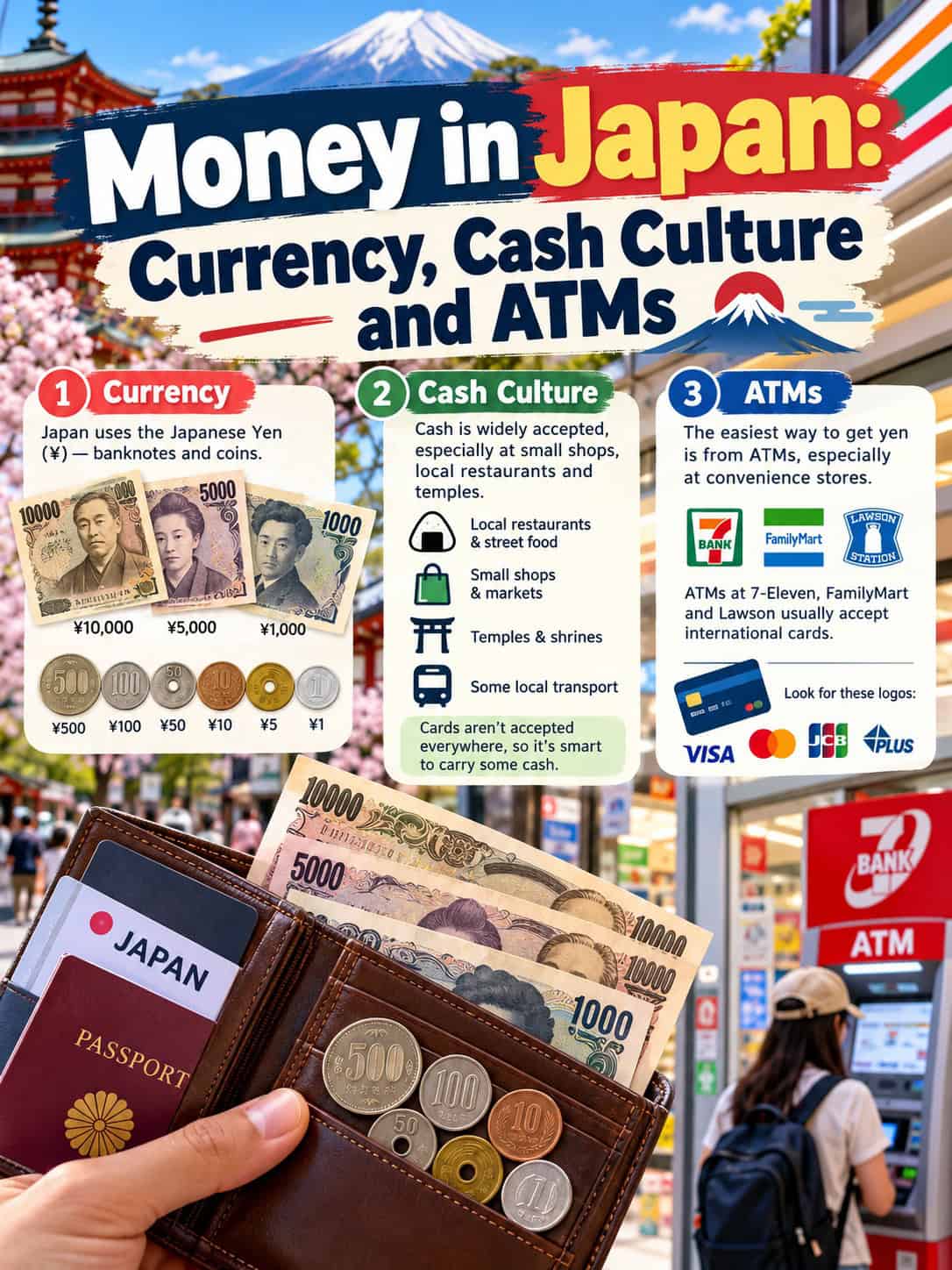
Japan currency is the Japanese yen (JPY, ¥), and money in Japan still runs on cash more than most visitors expect, even as contactless payment spreads through the cities. This guide covers cash, cards and ATMs: which coins and notes you will see, when you can pay by card, how to get yen from an ATM, and how to handle tax-free shopping.
Japan Currency Quick Answer
| Question | Answer |
|---|---|
| What is the currency of Japan? | The Japanese yen (¥, JPY) |
| Best way to get yen | Withdraw from a 7-Eleven (Seven Bank) or Japan Post Bank ATM with your home debit card |
| Exchange cash before arrival? | Only a small amount for the first few hours, then use ATMs |
| Need cash day-to-day? | Yes, for small restaurants, shrines, markets and some taxis |
| Tipping? | No, tipping is not practiced in Japan |
| Consumption tax | 10% standard, 8% on takeaway food and drinks, usually included in displayed prices |
Japanese Yen Currency: Coins and Notes
| Type | Denominations | Good to know |
|---|---|---|
| Coins | 1, 5, 10, 50, 100 and 500 yen | The 500-yen coin is worth holding onto, because most vending machines and coin lockers take it |
| Notes | 1,000, 5,000 and 10,000 yen | New designs of all three notes began circulating on 3 July 2024, and the older notes remain valid. A 2,000-yen note exists but is rarely seen |
Small shops and food stalls often struggle to break a 10,000-yen note, especially early in the day, so keep a mix of smaller notes and coins rather than carrying everything in large bills.
Japan Currency in Practice: Do You Need Cash in Japan?
Cash or card in Japan is a real question, because Japan is more cash-dependent than the US, Canada, Australia or much of Europe, although this is changing steadily. Visa and Mastercard are widely accepted at department stores, chain restaurants, convenience stores and most tourist-oriented businesses, and American Express works at more upscale venues. So, can you use credit cards in Japan? In many places yes, but you will still want cash at small neighborhood restaurants and izakayas, temples and shrines (entry fees, omikuji fortune slips, goshuin stamps), local markets and food stalls, and some taxis. Card terminals are increasingly common in big-city taxis, but not universal yet.
| Situation | What to carry |
|---|---|
| City days with department stores, chains and convenience stores | A card works for most spending, with some yen as a backup |
| Small restaurants, izakayas, markets and shrines | Cash, in small notes and coins |
| Day trips, rural areas and traditional ryokan inns | More cash than usual, withdrawn in advance |
| Trains, buses and vending machines | An IC card or coins |
Japan Money Exchange vs ATMs: Getting Japan Currency
Getting Japan currency is easy once you know the options. For most travelers, withdrawing from an ATM with a home debit card is simpler than exchanging cash at a counter, and it often gives a better rate, but compare your own bank’s rate and fees before you decide. Airport counters at Narita, Haneda and Kansai are the most convenient option, though convenience usually costs more. Exchange only a small amount before you fly, enough for the airport transfer and your first few hours, and get the rest from ATMs after you arrive.
Best ATM in Japan for Foreign Cards
7-Eleven (Seven Bank) ATMs
7-Eleven (Seven Bank) ATMs are the most convenient option for most tourists: nationwide, open around the clock and with an English menu. They accept major international cards, but fees and limits vary by card and bank, so check the fee shown on the screen before you confirm the withdrawal. Visa and Mastercard cards work 24 hours a day, 365 days a year, while American Express, JCB, UnionPay and Discover cards pause for a few minutes around midnight. Each withdrawal with an overseas card is capped at ¥100,000, or ¥30,000 when the machine reads the magnetic stripe instead of the chip, and your own bank’s daily limit may be lower.
Japan Post Bank ATMs
Japan Post Bank ATMs, found at post offices and some other locations, are a solid backup. Its international ATM service covers cash withdrawals on cards issued overseas, with brands including Visa, Mastercard, Maestro, Cirrus, Plus, JCB, UnionPay and Discover. American Express is not on its list, so Amex holders should head to a 7-Eleven instead. Cash withdrawal hours are 7:00am to 11:00pm Monday to Saturday and 7:00am to 9:00pm on Sundays and holidays, although hours vary by machine and a given card may not be accepted even within those hours. The compact Japan Post Bank ATMs inside some FamilyMart stores run much longer, from 12:05 a.m. to 11:55 p.m. on most days. At any Japan Post Bank ATM, a single withdrawal with an overseas card is capped at ¥50,000.
Japan ATM Fees and Other ATMs
Japan ATM fees depend on the machine and your card. Japan Post Bank says a usage fee of ¥220 per use may apply to certain cards issued abroad, and your own bank may add foreign transaction charges on top, so ask your card issuer before you travel. AEON Bank ATMs at AEON malls also take foreign cards, while coverage at other ATMs, including Lawson and regular bank branches, is inconsistent, so do not rely on them as your main source of cash.
A few practical details help. Always choose to be charged in yen rather than your home currency, because the conversion offered by the machine or terminal (dynamic currency conversion, or DCC) is usually less favorable than your bank’s. Make sure your card’s PIN is 4 digits, since longer PINs can fail at Japanese ATMs. Apple Pay and Google Pay will not work at an ATM, so you need a physical card.
IC Cards: Suica and Pasmo for Everyday Payments
Beyond trains and buses, a Suica or Pasmo IC card doubles as a tap-to-pay method at convenience stores, most vending machines, station lockers and many cafes and restaurants. It is genuinely useful for small purchases where you do not want to deal with coins. Suica and Pasmo can also be added to Apple Wallet on iPhone, and availability of physical cards and tourist versions changes, so check the options at the airport or with the operator before you travel. IC cards do not cover Shinkansen or limited express trains, which need a separate ticket, a rail pass or a reservation app. For using the card on the Tokyo network, see our guide to Tokyo subways, JR lines and IC cards.
Tipping and Money in Japan: Do Not
Tipping is not practiced in Japan, whether at restaurants, for taxi drivers or for tour guides. Pay the exact amount on the bill or receipt. The one exception is a private guide or interpreter who regularly works with overseas visitors: they may accept a tip as thanks, but it is never expected and should be handed over discreetly in an envelope. Leaving extra cash on the table is more likely to cause confusion than appreciation, and in some cases a server may chase you down to return money they assume you left behind by mistake.
Money in Japan: Consumption Tax and Tax-Free Shopping
Japan’s consumption tax is 10% on most goods and services, with a reduced 8% rate for food and drinks bought to take away rather than eaten on-site. Alcohol is the exception: beer, sake or wine is taxed at 10% even when you buy it to take away from a convenience store. Displayed prices at most shops already include tax, so the number on the shelf is generally what you’ll pay at the register.
Visitors can shop tax-free at registered shops when they spend at least ¥5,000 before tax per shop per day. Until October 31, the shop takes the tax off at the register when you show your passport. For purchases made on or after November 1, the system switches to a refund. You pay the full tax-inclusive price, and the consumption tax is returned after customs confirms at your departure airport or port that the goods are leaving Japan.
Complete the customs check within 90 days of buying. Do it at a tax-free procedure terminal in the international departure lobby, before you check your bags, so keep the goods with you until then. At Narita, Haneda, Kansai, Chubu, Fukuoka, New Chitose and Naha, the first step can also be done online through Visit Japan Web. Food, drinks and cosmetics no longer need special sealed packaging, but they are not refundable if you use them up in Japan. The refund is paid by the shop or its authorized refund provider, so ask at the register how it will reach you.
How Much Cash to Bring to Japan: Planning Your Japan Currency
There is no single right amount of Japan currency to carry, so treat any figure as an example rather than a fixed budget. A comfortable approach is to carry enough yen for a day of small purchases and top up as needed rather than carrying a large sum all at once. Before a travel-heavy day, such as a Shinkansen trip or a day trip to a smaller town, top up the night before at a convenience store ATM. On arrival, withdraw some yen at a 7-Eleven ATM inside the airport so you start your trip with working cash rather than hunting for an ATM while jet-lagged.
Japan Travel Budget: Where Cash Goes
When planning a Japan travel budget, remember that Japan currency in cash is mostly for small, everyday spending: street food, shrine entry fees, small restaurants, coin lockers and vending machines, while hotels, department stores and larger purchases are often paid by card. For ideas on what to spend on, see our Tokyo food guide and our 10-day route through Tokyo, Kyoto and Osaka, and explore our guides to Tokyo and Osaka before you go.
Practical Tips for Handling Money in Japan
Withdraw larger amounts less frequently rather than making several small withdrawals, since a flat per-transaction fee applies regardless of the amount. Let your bank know you are traveling to Japan to avoid a declined card from an automatic fraud flag, and carry a backup card in case one does not work at a particular machine. Keep a small stash of coins for coin lockers at train stations, which typically do not take notes. If you also need a visa or mobile data, see our Japan visa guide and our guide to SIM cards and eSIMs for tourists.
Frequently Asked Questions
Can you use credit cards in Japan?
Yes in many places. Visa and Mastercard are widely accepted at department stores, chain restaurants, convenience stores and most tourist-oriented businesses, but many small restaurants, shrines, markets and some taxis are still cash-only or cash-preferred, so carrying yen is still necessary.
Do you need cash in Japan?
Yes. Carry some yen for small restaurants and izakayas, temples and shrines, markets, food stalls, coin lockers and some taxis, and top up as you go rather than carrying large sums.
How much cash to bring to Japan?
There is no fixed figure. Bring a small amount of yen for the first few hours, then withdraw more as needed. Plan for more cash if you will visit rural areas, small restaurants or traditional ryokan inns, which tend to be more cash-dependent than Tokyo or Osaka.
What is the best ATM in Japan for foreign cards?
7-Eleven (Seven Bank) ATMs are generally the most convenient: nationwide, open around the clock and with an English menu. Japan Post Bank ATMs are a solid backup, and its official site lists the card brands accepted and its ATM hours.
Are there Japan ATM fees for foreign cards?
Possibly, and your own bank may add its own charges. Japan Post Bank says a usage fee of ¥220 per use may apply to certain cards issued abroad. Check the fee shown on the ATM screen and ask your card issuer about its charges before you travel.
Is it better to exchange money before I leave or withdraw in Japan?
Exchange only a small amount before you fly to cover your first few hours, then withdraw the rest from ATMs in Japan. Compare your bank’s rate and fees with a currency exchange counter, since airport counters are convenient but often offer poor rates.
Should I pay in yen or my home currency?
Pay in yen. If a terminal or ATM offers to charge you in your home currency (dynamic currency conversion), the rate it uses is usually less favorable than letting your own bank convert.
Do I need a Suica or Pasmo card if I have a credit card?
It is still worth getting one. IC cards work for small purchases at convenience stores and vending machines where card payment is not always available, and they are the simplest way to pay for local trains and buses.
Is tipping expected anywhere in Japan?
No. Tipping is not customary in restaurants, taxis or for tour guides anywhere in Japan. Pay the exact listed price.
Is the consumption tax already included in the price I see?
Usually yes. Most displayed prices include the 10% (or 8% for takeaway food) consumption tax. Some duty-free shops show pre-tax prices to foreign passport holders, so it’s worth checking which pricing you’re looking at.
How do I get a tax refund as a tourist?
At registered tax-free shops, purchases of at least ¥5,000 before tax per shop per day qualify. From November 1 you pay the tax-inclusive price, then complete a customs check at the tax-free procedure terminal in the departure lobby. Do it within 90 days of purchase and before you check your bags. Keep your receipts and the goods with you until then.
Will my PIN work at a Japanese ATM?
Generally only if it’s 4 digits. Longer PINs can fail at Japanese ATMs, so check with your bank in advance if your usual PIN is longer.
Bottom Line
Handling Japan currency, whether cash or card, comes down to a few habits. Carry some cash for day-to-day spending, even as you lean on cards where they are accepted. A 7-Eleven or Japan Post ATM withdrawal, done in yen rather than your home currency, is usually the simplest way to get cash. Add a Suica or Pasmo IC card for small purchases and transit, skip the tip, and you will rarely be caught without a way to pay.