By Nippon With Me EditorialPublished Updated
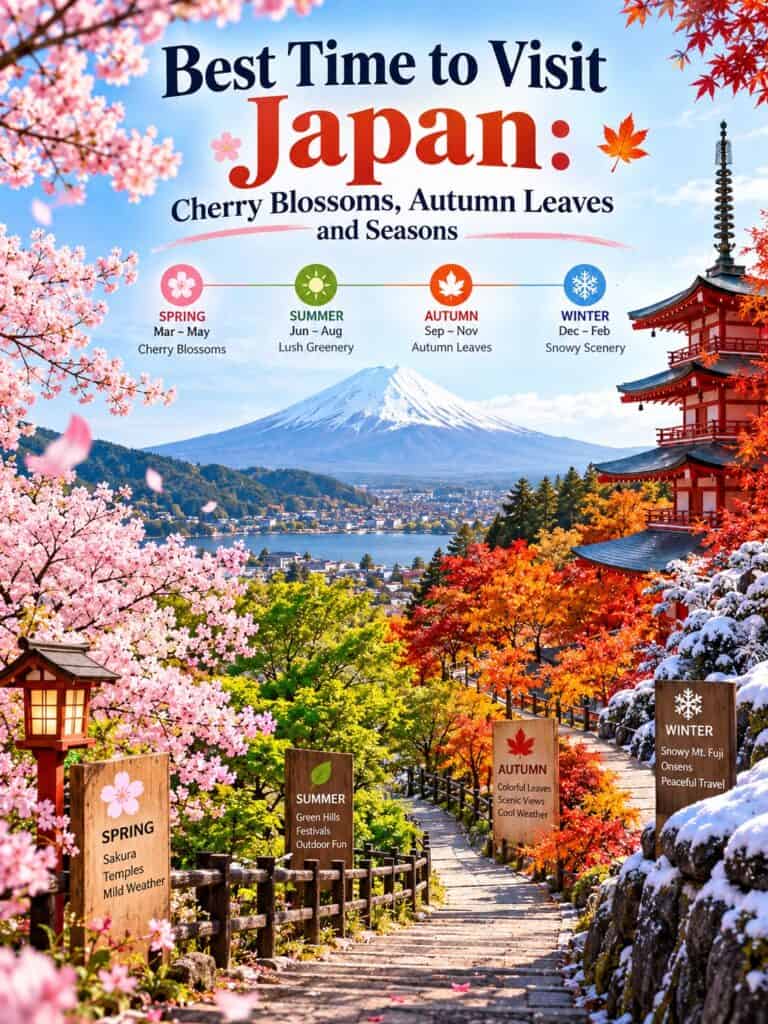
The best time to visit Japan depends on what you want to see. For cherry blossoms, go from late March to early April in Tokyo, Kyoto and Osaka. For autumn leaves, go from late October to early December, with the north and mountains first and Kyoto and the south last. For comfortable weather, April to early May and late September to November are the most reliable stretches, and for snow and skiing, go from December to February. Each window comes with trade-offs in crowds, prices and weather, so this guide helps you plan around them.
Best Time to Visit Japan by Goal
| Your goal | Best months | Notes by region |
|---|---|---|
| Cherry blossoms | Late March to early April for Tokyo, Kyoto and Osaka | Kyushu blooms earlier, Hokkaido around late April to May, and Okinawa has an early flowering season in January and February |
| Autumn leaves | Late October to early December | North and mountains first, Kyoto and southern cities last, often into December |
| Comfortable weather | April to early May and late September to November | Spring and autumn are mild, but Golden Week in late April and early May is very busy |
| Skiing and snow | December to February | Hokkaido and the Japan Alps are the snowiest. Tokyo is cold but mostly dry |
| Fewer crowds and lower prices | Parts of winter and the rainy season (June to mid-July) | Prices depend on festivals and holidays, so do not assume winter is always cheap |
The best time to visit Japan is a typical-year question: climate averages describe a typical year. They are not a forecast for your trip, and bloom and leaf dates can shift by a week or two.
Japan’s Seasons at a Glance
| Season | Months | Highlight | Trade-off |
|---|---|---|---|
| Spring | Late March to May | Cherry blossoms, mild weather | Peak crowds and prices during bloom and Golden Week |
| Early summer | June to mid-July | Hydrangeas, quieter sightseeing | Rainy season (tsuyu) in most regions |
| Summer | Mid-July to August | Fireworks, summer festivals | Heat, humidity, typhoon season, Obon crowds |
| Autumn | October to early December | Autumn leaves, comfortable temperatures | Peak-color weekends get crowded in Kyoto |
| Winter | December to February | Snow festivals, skiing, illuminations | Cold, especially in Hokkaido and the Japan Alps |
Best Time to Visit Japan for Cherry Blossoms: Spring and Japan in April
Cherry blossom season, or sakura, is Japan’s most famous and most crowded travel window. Forecasts are only published a few months ahead, so the windows below are typical, based on historical averages rather than any single year:
- Okinawa: late January to February, on a different variety from the mainland, so it is not really part of the mainland sakura season.
- Kyushu (Fukuoka): mid to late March.
- Tokyo: late March to early April, with full bloom around the start of April in an average year.
- Kyoto and Osaka: late March to early April.
- Hokkaido (Sapporo): late April into May, several weeks after Tokyo.
Spring temperatures are the biggest factor, so bloom dates can shift by one to two weeks from year to year. Elevation and latitude matter too: mountain areas such as the Fuji Five Lakes region typically peak later than nearby lowlands, and early-blooming varieties such as Kawazu-zakura on the Izu Peninsula flower about a month before the common Somei Yoshino variety. Once a tree reaches full bloom it usually holds for about a week before petals fall, and wind or rain can shorten that.
Japan in April
April is mild, with daytime highs in Tokyo typically around 19°C (66°F), cooler mornings and evenings, and occasional rain. Early April is peak blossom time in the Tokyo, Kyoto and Osaka area, while late April brings Golden Week, one of Japan’s busiest holiday periods. Book accommodation and trains well ahead for both. See our Japan events in April roundup.
For viewing spots, Tokyo’s Ueno Park is lively and crowded, Shinjuku Gyoen charges admission but is calmer, and the Sumida and Meguro rivers are popular for walks under the trees. In Kyoto, the Philosopher’s Path, Maruyama Park and Arashiyama draw the crowds. Mount Yoshino near Nara, with thousands of cherry trees across the mountainside, usually peaks in early to mid April, and Hirosaki Castle in Aomori holds a cherry blossom festival in late April and early May. Dates for specific festivals change each year, so check them closer to your trip.
Best Time to Visit Japan and the Rainy Season (Tsuyu) by Region
Most of Japan enters its rainy season, tsuyu (or baiu), in June, named for the plums that ripen around the same time. It brings a stretch of unsettled, humid weather rather than nonstop downpours. Approximate average start and end dates, based on JMA averages, vary by region:
- Okinawa: roughly the second week of May to late June, about a month earlier than the mainland.
- Kanto, including Tokyo: roughly early June to the third week of July.
- Northern Tohoku: roughly mid-June to late July, among the latest on the mainland.
- Hokkaido: largely spared, though it can still be cloudy and cool in June.
On average, the rains run from about 7 June to 19 July in Kanto, 6 June to 19 July in the Kinki region around Kyoto and Osaka, 4 June to 19 July in northern Kyushu and 15 June to 28 July in northern Tohoku. For a Tokyo, Kyoto and Osaka trip, that makes the third week of July the usual switch from rainy-season weather to hot, settled summer.
It does not rain every day during tsuyu. It is a decent time to visit if you do not mind packing for sun and rain: crowds thin out, and hydrangeas bloom well in the damp weather. Do not trust a forecast more than a day or two ahead. Exact dates differ each year, so look at the current season’s announcements from the Japan Meteorological Agency.
Best Time to Visit Japan in Summer: Heat and Typhoon Season
Once tsuyu clears in most of the country by mid to late July, summer turns hot and humid. Tokyo, Osaka and Kyoto regularly climb past 30°C (86°F) with humidity that feels hotter still, and Kyoto, being inland, can feel especially intense. Hokkaido is generally cooler and less humid than the main island, but it can still have warm spells, with Sapporo summers commonly reaching the mid-20s °C and occasionally hotter.
Typhoon season broadly runs from May to October, with activity typically increasing from August and peaking around late summer and early autumn. Exposure varies by region: the south (Okinawa and Kyushu) and the Pacific coast tend to see typhoons more often, while Hokkaido sees fewer. Typhoons are usually tracked well in advance, but they can disrupt flights and trains for a day or two. Obon in mid-August is a major holiday when many families travel, so expect packed trains and higher prices that week.
Best Time to Visit Japan for Autumn Leaves: October and November
Autumn foliage, koyo, moves through Japan in the opposite direction from cherry blossoms: it starts in the north and at higher elevations in October and works south and down into the lowlands through November and into early December. Hokkaido leads the country into autumn color, and Kyoto and the south come last.
Japan in October
October is comfortable, with typical highs in Tokyo around 22°C (72°F), down from about 28°C (82°F) in September, lower humidity and fewer typhoons than late summer, although storms are still possible early in the month. Color begins in northern regions and the mountains, and it is a good month for Hokkaido and the Japan Alps; see our Takayama and Japanese Alps guide. See our Japan events in October roundup.
Japan in November
November is often cited as an all-around strong month: typical Tokyo highs of around 17°C (62°F), clear skies, and peak color across much of the country, without the extreme crowding of cherry blossom season. Kyoto and the southern cities are at their best in the second half of the month and into early December, though weekends at famous temples are busy. See our Japan events in November roundup and the Kyoto guide.
Japan Fall Foliage Forecast
The 2026 forecast published by the Japan Meteorological Corporation, in its update of 1 October 2026, projected these peak dates for each city’s signature trees, yellow ginkgo and red maple. These are dates for the 2026 season only and should not be treated as a forecast for future years. A further update is expected in early November, and forecasters measure peak slightly differently, so check live reports for specific gardens.
| City | Ginkgo turns yellow | Maple turns red |
|---|---|---|
| Tokyo | About 26 November | About 28 November |
| Kyoto | About 27 November | About 11 December |
| Osaka | About 24 November | About 4 December |
| Nagoya | About 17 November | About 2 December |
| Fukuoka | About 28 November | About 7 December |
Ginkgo trees are more temperature-sensitive and usually turn before the maples in the same city. In an average year, maples peak around 28 November in Tokyo and Nagoya, 1 December in Osaka and Fukuoka, and 5 December in Kyoto, so the 2026 season runs close to normal in Tokyo but about six days late in Kyoto and Fukuoka. For other cities, check the current forecast, since the dates move with the season’s temperatures. If your trip is more than a few months away, plan around the typical windows above and check an updated forecast closer to travel.
Best Time to Visit Japan in Winter: Snow, Illuminations and Skiing
Winter temperatures vary sharply by region. Tokyo stays relatively mild for a winter capital, typically with highs of around 10°C (50°F) and only occasional light snow. Kyoto is a little cooler and damper, and Osaka and Hiroshima stay similarly mild. Hokkaido is the clear exception: Sapporo’s average daily high is about 2°C (36°F) in December and just below freezing in January, with heavy snowfall through January and February that makes it one of Japan’s best regions for skiing and snowboarding. See our Hokkaido winter itinerary and Niseko ski hotels guide.
Winter is also generally a quieter tourist season outside festival dates and holidays such as New Year, which can mean thinner crowds at major sights, but hotel prices do not always fall, so check rates for your dates.
Festivals Worth Planning Around
- Sapporo Snow Festival (Hokkaido): the 2027 festival is planned for 4 to 11 February at Odori Park, Tsudome and Susukino. Confirm details with the organizers closer to the date.
- Takayama Spring Festival (Gifu): held in mid April in the preserved old town, with ornately carved floats.
- Gion Matsuri (Kyoto): runs through July, with the main float processions in mid and late July.
- Nebuta Matsuri (Aomori): held in early August, with giant illuminated floats paraded at night.
Festival dates move from year to year, so check our Japan public holidays and festival calendar for the current dates.
So, When Should You Actually Go?
If cherry blossoms or autumn leaves are the whole point of your trip, build the itinerary around the regional windows above and stay flexible on exact dates until closer to departure. If you want comfortable weather and do not care about blossoms specifically, late September through November and April through early May are the most reliable stretches, with correspondingly higher prices and crowds. If budget and quiet matter more than ideal weather, the rainy season and parts of winter can be good value, but you trade some sunshine or warmth for it. For a first route, see our 10-day itinerary for Tokyo, Kyoto and Osaka, and for the south see Okinawa.
Frequently Asked Questions About the Best Time to Visit Japan
What is the best month to visit Japan?
There is no single best month. November is often cited as a strong all-around choice because it combines comfortable temperatures with peak autumn color, without the extreme crowding of cherry blossom season. April is best for blossoms, and winter for skiing.
When is cherry blossom season in Japan?
Typically late March to early April in Tokyo, Kyoto and Osaka, mid to late March in Fukuoka, and late April into May in Sapporo. Dates shift by a week or two each year.
Is it better to see cherry blossoms or autumn leaves?
Both are spectacular. Cherry blossom season is more compressed and more heavily visited, while autumn color develops more gradually over several weeks.
Should I avoid Japan during the rainy season?
Not necessarily. It does not rain constantly, crowds are thinner, and hydrangeas bloom well. Pack for sun and rain and keep plans flexible. Hokkaido is largely spared.
When is typhoon season in Japan?
Broadly May to October, with activity increasing from August. Exposure varies by region, with the south and the Pacific coast more exposed than Hokkaido.
What is Japan like in October?
Comfortable, with lower humidity and fewer typhoons than late summer. Autumn color begins in the north and the mountains.
What is Japan like in November?
Often the best month for autumn leaves across much of the country, with mild days and cooler evenings. Kyoto and the south peak late in the month and into December.
When does autumn foliage peak in Kyoto?
In the 2026 forecast, the ginkgo was expected to turn around 27 November and the maples around 11 December. Dates change each year with temperature.
Is winter a good time to visit Japan if I do not ski?
It can be, especially for illuminations and quieter sights, but it is cold outside the milder cities, and hotel prices do not always fall, so check rates for your dates.
Seasonal windows are typical, and 2026 forecast dates apply to that season only.
Bottom Line
Japan has no wrong time to visit, only different trade-offs. Cherry blossoms and comfortable weather come with the highest prices and crowds, while the rainy season and parts of winter offer quieter travel in exchange for less ideal weather. Decide what you want to see, match the best time to visit Japan to the regional windows above, and build in flexibility, since both the blossom and foliage seasons can shift by a week or more from year to year. Before booking, check the Japan visa guide for entry rules.