By Nippon With Me EditorialPublished Updated
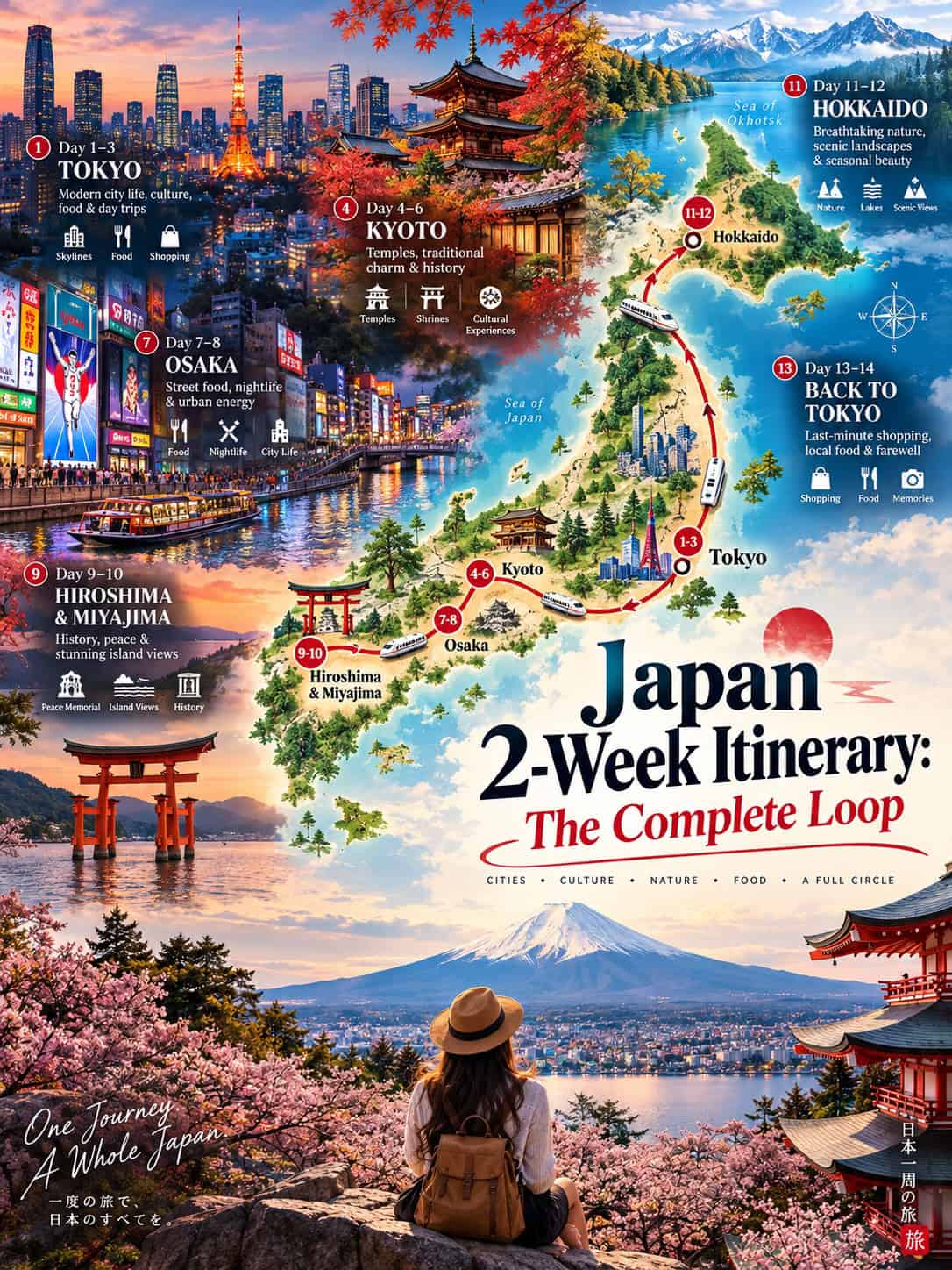
Planning 2 weeks in Japan? This Tokyo-to-Tokyo route includes Hakone, Kyoto, a Nara day trip, Osaka, Himeji, Hiroshima and Miyajima without forcing a new overnight stay at every stop. This is the itinerary to use if you’ve already decided ten days isn’t quite enough, or if you want to see the Golden Route’s full span rather than just its core three cities.
2 Weeks in Japan: Quick Route Overview
| Question | Answer |
|---|---|
| What’s the basic structure? | Tokyo → Hakone → Kyoto (with a Nara day trip) → Osaka → Himeji → Hiroshima and Miyajima → back to Tokyo |
| How do the 14 days split? | Roughly 3 Tokyo, 2 Hakone, 4 Kyoto/Nara, 2 Osaka, 2 Hiroshima/Miyajima, 1 return buffer |
| Round-trip or open-jaw? | This version is a true loop — fly into and out of Tokyo |
| Is a 14-day JR Pass worth it? | Not necessarily. Compare the total cost of eligible train and ferry journeys with the pass price; the route alone does not guarantee a saving. |
| Biggest mistake on a trip this long? | Adding a fourth or fifth base instead of using day trips — more than two overnight changes starts to eat your trip in packing and transit |
2 Weeks in Japan: The Route at a Glance
The version of this trip that actually closes the loop — flying into Tokyo and out of Tokyo again — runs Tokyo → Hakone → Kyoto (with Nara as a day trip) → Osaka → Himeji → Hiroshima and Miyajima → back to Tokyo by Shinkansen for a final night before departure. This covers most of the destinations in the national tourism board’s two-week Golden Route, in a slightly different order, with the main difference being that a true loop returns to Tokyo at the end rather than flying out of Osaka. An open-jaw alternative starts in Tokyo and ends in Osaka, or starts in Osaka and ends in Tokyo. In either case, you can avoid retracing the route simply to reach the same departure airport; compare flight prices and decide which order best fits your plans. This japan 2 week itinerary is a clockwise loop, but the same stops can be visited in reverse if that better matches your flights.
2 Weeks in Japan: Days 1-3 in Tokyo
Keep the first day light to absorb jet lag, then split the next two between old Tokyo (Asakusa and Ueno) and modern Tokyo (Harajuku and Shibuya). For neighbourhood details, see our Tokyo travel guide. Since this itinerary ends back in Tokyo, you don’t need to force everything into these first three days — save anything you’re not fussed about seeing early for your last night. For travelers planning 10 days in japan versus two full weeks, these first Tokyo days can stay almost the same; the extra time goes toward Hakone and western Japan.
2 Weeks in Japan: Days 4-5 in Hakone
Hakone is the add-on that makes this itinerary meaningfully different from the shorter Tokyo-Kyoto-Osaka trip. Spend a night here for lake views, an onsen soak, and a shot at seeing Mt. Fuji from Lake Ashi or the Hakone Ropeway — weather permitting, since the mountain is notoriously shy about showing itself. One night is enough if you’re efficient about it; two gives you breathing room if the weather doesn’t cooperate on your first attempt.
The Hakone Ropeway boards from 9 a.m. to 5 p.m. between February and November and until 4:15 p.m. in December and January, and it can stop in strong wind or for maintenance. The best Fuji views are usually in the morning in summer, while winter has more clear days. The Odakyu two-day Hakone Freepass from Shinjuku costs ¥7,100 for adults and covers the round trip to Odawara plus the mountain train, ropeway, Lake Ashi cruise and buses in the area. The Romancecar express is an extra ticket.
2 Weeks in Japan: Days 6-9 in Kyoto and Nara
Four days in Kyoto provide time for its main sights and a Nara day trip; our Kyoto travel guide covers neighbourhoods and attractions in more detail. Split the city days the same way a shorter trip would: Higashiyama/Gion/Kiyomizu-dera as one walkable cluster, Fushimi Inari as its own early morning (the shrine is open 24 hours but gets genuinely crowded from mid-morning on), and Arashiyama’s bamboo grove and riverside temples as a separate day. Fold Nara in as a single day trip from Kyoto rather than an overnight stop — Todai-ji’s Great Buddha and the free-roaming deer in Nara Park are easily covered in 6-8 hours door to door. A tokyo kyoto osaka itinerary is a classic foundation for first-timers, but this longer route also leaves room for Hiroshima and Miyajima.
2 Weeks in Japan: Days 10-11 in Osaka
Two days in Osaka can cover Dotonbori and Namba, Osaka Castle and Shinsekai, or a full day at Universal Studios Japan; use our Osaka travel guide to choose between them. Because this itinerary continues on to Hiroshima afterward, Osaka works better here as a shorter, food-and-highlights stop than the fuller 3-day treatment it gets in a Tokyo-Kyoto-Osaka-only trip.
Day 11 or 12: A Himeji Detour
Himeji Castle is a practical stop on the Shinkansen line between Osaka and Hiroshima, which makes it an easy half-day or full-day stop to fold into the journey west rather than a dedicated overnight. It’s one of the few original Japanese castles that survived both WWII bombing and the Meiji-era demolitions, and its white facade is worth the detour if your timing allows — treat it as a stopover on travel day rather than adding it as its own base.
Castle admission is ¥2,500 for adults 18 and older and free for younger visitors. The grounds are open from 9 a.m. to 5 p.m., with the last entry at 4 p.m., so arrive by mid-afternoon at the latest if you are splitting the day between the castle and a train.
2 Weeks in Japan: Days 12-13 in Hiroshima and Miyajima
Hiroshima Peace Memorial Park and Museum deserve a full, unhurried day. Miyajima is reached by ferry from Miyajimaguchi, and the JR ferry accepts the Japan Rail Pass. Set aside a separate day for Itsukushima Shrine and its floating torii gate, checking the tide times if you want to see the gate at different water levels. Note that Miyajima, which belongs administratively to Hatsukaichi City, charges a separate ¥100 visitor tax on arrival, introduced in October 2023 to help fund the island’s strained infrastructure — it’s collected on top of the ferry fare, not a replacement for it. Our Hiroshima and Miyajima guide covers the Peace Memorial area, ferry access and island sights in greater detail.
Itsukushima Shrine charges ¥300 for adults, or ¥500 for a combined ticket with the Treasure Hall. The shrine closes at 6 p.m. from March to mid-October, 5:30 p.m. until the end of November and 5 p.m. in December, so plan the torii gate at dusk around those times.
2 Weeks in Japan: Day 14 Return to Tokyo
The Shinkansen ride from Hiroshima back to Tokyo takes roughly four hours — long enough that most travelers treat this as a travel day with a final evening in Tokyo rather than squeezing in more sightseeing. Use this last stretch for anything you skipped in your first three Tokyo days, a last-minute souvenir run, or simply a calmer final night before departure. When planning 14 days in Japan, arrange your flight for after this return journey or keep a comfortable transfer buffer if departing the same day.
Is a 14-Day JR Pass Worth It for This Trip?
For a 14 day japan itinerary with several Shinkansen legs, compare point-to-point fares with the 14-day Japan Rail Pass before buying. The Ordinary pass costs ¥80,000 through the official online service or ¥84,000 through designated overseas agents; a Nozomi or Mizuho ride requires a separate special ticket for pass holders. For this japan two week itinerary, make sure your calculation includes the actual route, train category and any extra charges. The higher overseas-agency price introduced in October 2026 did not apply to the official online purchase price. For pass coverage and the latest purchasing rules, see our Japan Rail Pass guide.
Common Mistakes on a 14-Day Trip
A common planning mistake is adding more overnight stops than the route needs. Consider day trips from Tokyo, Kyoto or Osaka where connections are straightforward; a hotel change does not always cost half a day. The second common mistake is carrying heavy luggage between every city. A takkyubin courier service can forward bags between many hotels; the price depends on size and destination, and delivery times should be confirmed before sending.
Frequently Asked Questions
Does this itinerary return to Tokyo, or end somewhere else?
This version is a true loop — you fly into Tokyo and out of Tokyo again at the end, after looping through Hakone, Kyoto, Nara, Osaka, Himeji, Hiroshima, and Miyajima.
Can I do this itinerary in reverse, flying into Osaka instead?
Yes. You can start in Osaka and finish in Tokyo, or travel from Tokyo to Osaka and fly out there. Both avoid an extra return journey undertaken only to reach your original arrival airport.
How many days should I spend in each place?
Roughly 3 in Tokyo, 2 in Hakone, 4 in Kyoto (including a Nara day trip), 2 in Osaka, and 2 in Hiroshima and Miyajima combined, with a final day as a return-travel buffer.
Is a 14-day Japan Rail Pass worth it for this trip?
Not always. Compare your eligible train and ferry fares with the current pass price. The official online price for an Ordinary 14-day pass is ¥80,000, while designated overseas agents charge ¥84,000.
Should I visit Himeji Castle as its own overnight stop?
No, it works best as a half or full-day detour on the way between Osaka and Hiroshima, not a separate overnight base.
Is there a fee to visit Miyajima?
Yes. Visitors generally pay a ¥100 Miyajima visitor tax in addition to the ferry fare, including when travelling with a Japan Rail Pass. Check the ferry operator’s current fares before travelling.
What’s the biggest mistake to avoid on a two-week Japan trip?
Adding too many overnight bases can make travel days harder to manage. Use day trips when the connections work, but stay overnight when that reduces backtracking.
Should I carry my luggage between every city on this loop?
You can forward luggage between many hotels with a takkyubin courier service. Prices depend on parcel size and route, and delivery is not guaranteed for the next day on every route.
Bottom Line
A 14-day loop through Tokyo, Hakone, Kyoto, Nara, Osaka, Himeji, Hiroshima, and Miyajima covers Japan’s signature stops without the rushed pacing of the shorter Tokyo-Kyoto-Osaka trip. Keep it to these bases with day trips layered in rather than adding extra overnight stops, forward your luggage ahead when you can, and treat the long travel days — especially the final Shinkansen back to Tokyo — as part of the trip rather than dead time to rush through.