By Nippon With Me EditorialPublished Updated
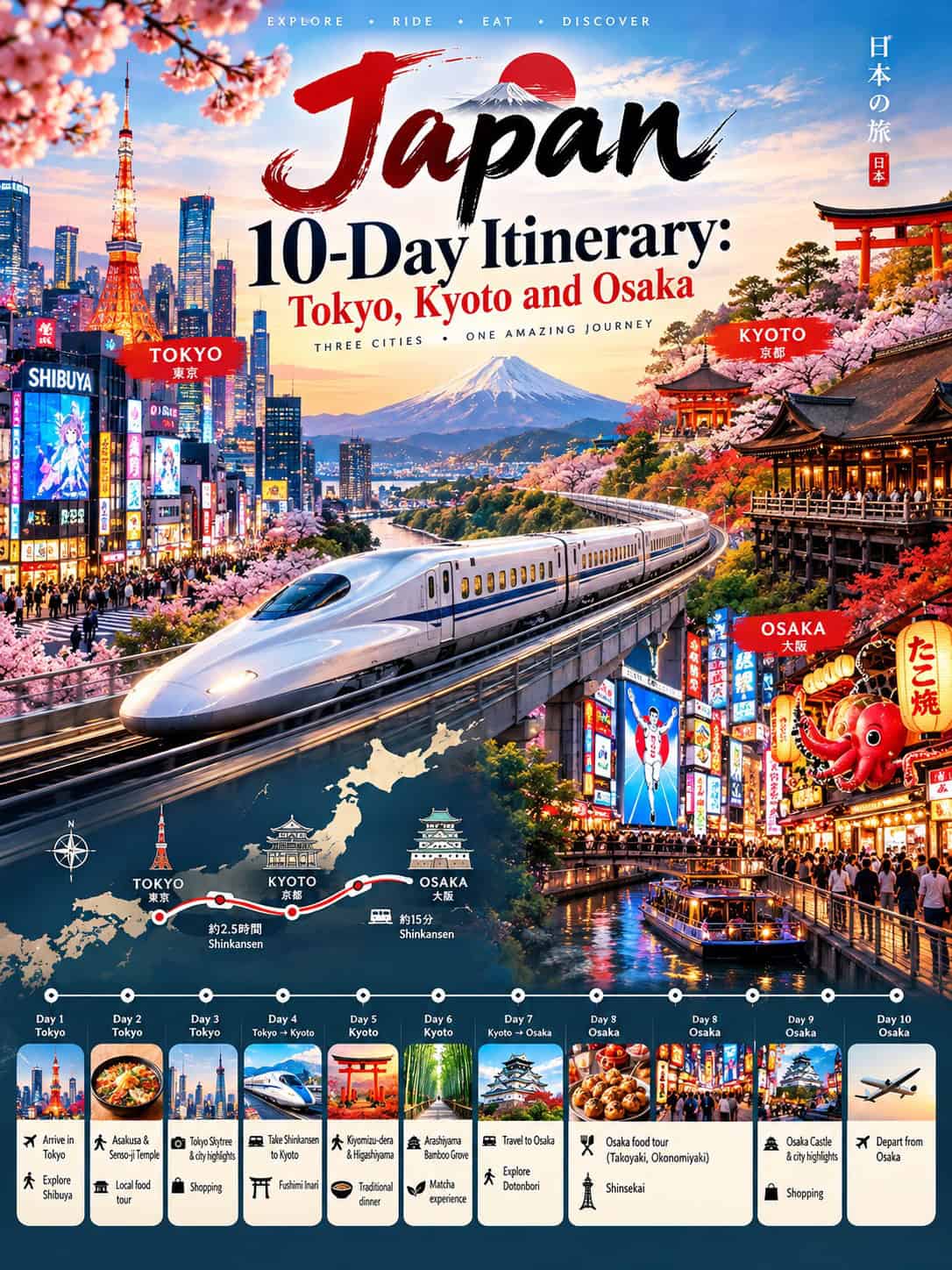
This Japan itinerary 10 days guide follows Tokyo, Kyoto and Osaka, with an optional day trip to Nara. It balances city sightseeing, temples, food and travel time without adding too many overnight stops.
Quick Answer
| Question | Answer |
|---|---|
| How should the 10 days split? | About 4 days Tokyo, 3 days Kyoto, 3 days Osaka (one Kyoto or Osaka day becomes a Nara day trip) |
| Fly in and out of the same city? | Most first-timers fly into Tokyo and out of Osaka (open-jaw) to avoid backtracking |
| Is Nara worth a full extra day? | No — fold it into a Kyoto or Osaka day as a 6-8 hour side trip |
| Is Hakone part of a standard 10-day plan? | Not usually — treat it as an optional swap for a Tokyo flex day, not a default stop |
| What should you book weeks in advance? | teamLab, the Nintendo Museum lottery, USJ Express Pass, scenic train seats, and popular themed cafes |
Japan Itinerary 10 Days: How to Split Your Time
For a first Japan itinerary 10 days trip, a practical split is roughly four days in Tokyo, three in Kyoto and three in Osaka. Tokyo gets the most time because it’s the biggest and most spread-out of the three, and because most itineraries build in a day-one buffer for jet lag and a slow arrival. Kyoto needs enough days that you’re not sprinting between temples, and Osaka’s allotment typically includes one or two day trips rather than three full days inside the city itself — Nara is the most common of these, usually folded into a Kyoto or Osaka day rather than given its own dedicated day on the calendar.
A smaller number of itineraries flip this and give Kyoto the most time (for example, 2 Tokyo / 4 Kyoto / 2 Osaka) if temples and gardens are the main draw and Tokyo is treated more as an arrival/departure point. That’s a reasonable variant if your priorities lean that way, but it’s the less common pattern — most first-time visitors get more out of the standard 4-3-3 split.
Japan Itinerary 10 Days: Tokyo (Days 1-4)
In this Japan itinerary 10 days route, group Tokyo attractions by neighborhood instead of crossing the city repeatedly. For more neighborhood details, see our Tokyo travel guide. For accommodation options, compare our hotels in Shinjuku, Shibuya and Ginza.
Day 1 — Arrival and an easy orientation. However you get in from the airport, keep this day light. A short walk near your hotel, an early dinner, and an early night beat trying to pack in sightseeing on top of jet lag.
Day 2 — Old Tokyo: Asakusa and Ueno. Senso-ji and the Nakamise shopping street in Asakusa pair naturally with Ueno’s parks and museums, and both are easy to combine with a stop in Akihabara if electronics or anime culture interest you.
Day 3 — Modern Tokyo: Harajuku and Shibuya. Meiji Jingu, Harajuku’s Takeshita Street, Omotesando, and the Shibuya Crossing scramble form a natural west-side loop, finishing with dinner in Shibuya or Shinjuku.
Day 4 — Flex day. This is the day to slot in whatever draws you most: a teamLab museum, a Mt. Fuji viewing day trip, Tsukiji’s outer market, the Ghibli Museum, or a quieter neighborhood like Shimokitazawa or Yanaka if you want a break from crowds. If you’d rather spend this day in Hakone instead, see the note below.
If the Ghibli Museum is on your list, tickets are sold only in advance and not at the museum: they go on sale at 10 AM Japan time on the 10th of the month for the following month, at ¥1,000 for adults (19 and older). Pick your Ghibli date first and build Day 4 around it.
One thing worth getting right: teamLab Borderless relocated from Odaiba to Azabudai Hills in February 2024, and teamLab Planets is a separate site in Toyosu roughly 8 kilometers away. The two are easy to mix up when you’re booking tickets, so double-check which one you’re actually buying for.
Japan Itinerary 10 Days: Kyoto (Days 5-7)
For the Kyoto portion of this Japan itinerary 10 days plan, organize sightseeing into three nearby clusters rather than crossing the city repeatedly. See our Kyoto travel guide for a closer look at the city’s main districts.
Higashiyama, Gion, and Kiyomizu-dera work well as one walkable day: Kiyomizu-dera in the morning, then down through Maruyama Park to Yasaka Shrine, finishing in Gion or Pontocho for dinner. Note that since April 2024, tourists are banned from entering the private alleys of Southern Gionmachi (near Gion Takahashi), and touching, chasing or photographing geiko and maiko without permission is prohibited, with fines possible for violations — public streets such as Hanamikoji and grounds such as Yasaka Shrine remain open, so this mainly means staying out of private lanes and leaving geiko and maiko alone.
Fushimi Inari deserves its own early morning rather than being squeezed in after another temple. The shrine is open 24 hours and gets genuinely crowded from mid-morning through late afternoon; arriving by 7-8am (or, alternatively, after 7pm) gets you a much quieter climb through the torii gates.
Arashiyama — the bamboo grove, Tenryu-ji, and the Togetsukyo Bridge, with Kinkaku-ji reasonably nearby — makes sense as its own half or full day, especially if you add the Hozu River boat ride.
Fold a Nara day trip into one of your Kyoto or Osaka days rather than giving it a separate slot. Nara’s Kintetsu Station puts you a short walk from Isui-en Garden, Todai-ji and its Great Buddha, Nigatsu-do, and Kasuga-taisha; the Great Buddha Hall at Todai-ji charges ¥800 for adults (¥400 for ages 6–12) and closes at 5:00 PM from November through March (5:30 PM April through October); budget 6-8 hours for a relaxed visit, or closer to 4 if you’re tight on time.
Japan Itinerary 10 Days: Osaka (Days 8-10)
In this Japan itinerary 10 days route, Osaka gets time for food and nightlife, city sightseeing, and — if you want it — a full day at Universal Studios Japan. Our Osaka travel guide covers additional sights and neighborhoods.
Dotonbori and Namba are best treated as an evening-and-food day: this is where Osaka’s street food reputation comes from, and it’s worth wandering without a tight schedule.
Osaka Castle pairs naturally with Shinsekai, Tsutenkaku Tower, and Kuromon Market as a single day covering history and more street food.
Universal Studios Japan, if you’re going, deserves its own full day rather than a half-day squeeze — the Donkey Kong Country area (open since December 2024) added significantly to Super Nintendo World, and lines for the headline attractions move slowly.
Japan Itinerary 10 Days: Should You Add Hakone?
Hakone isn’t part of the standard 10-day Tokyo-Kyoto-Osaka plan in most itineraries — it tends to show up as an alternative suggestion rather than a core stop. If mountain views and an onsen town appeal to you more than another Tokyo neighborhood, it’s a reasonable swap for the Tokyo flex day (Day 4 above), but going in you should know it replaces something rather than adding a free extra day.
Japan Itinerary 10 Days: Which Airports Work Best?
Because the itinerary moves Tokyo → Kyoto → Osaka in a straight line, most first-timers book an open-jaw flight: into Tokyo (Narita or Haneda), out of Osaka (Kansai Airport). If you are considering a national rail pass instead of point-to-point tickets, see our Japan Rail Pass guide. A standard pass does not cover Nozomi trains unless you buy the separate Nozomi/Mizuho special ticket. This avoids backtracking to Tokyo at the end of the trip. Some travelers instead loop back to Tokyo for a round-trip ticket, which works fine logistically but adds a final Shinkansen leg you don’t strictly need — worth it only if open-jaw pricing works out worse for your specific flights.
Japan Itinerary 10 Days: What to Book Ahead
A handful of popular experiences sell out or require lottery entry well ahead of your trip, so it’s worth checking these before you finalize your day-by-day plan:
- teamLab (Borderless or Planets) — roughly 2 months ahead
- Nintendo Museum — lottery entry opens about 3 months ahead and needs a free Nintendo Account; tickets freed by cancellations are sometimes sold first-come, first-served afterward
- USJ Express Pass — roughly 2 months ahead, and it can sell out
- Scenic train seats (such as the Sagano Romantic Train) — about a month ahead, sometimes selling out within an hour in peak season
- Popular themed cafes (such as Pokemon Cafe Osaka) — check the current reservation-release window, which differs by venue
Common Mistakes to Avoid
The single biggest planning mistake is overpacking each day — trying to fit in one more temple or neighborhood than the day actually allows leads to a trip that feels stressful rather than enjoyable. Build in slack, especially on travel days between cities. The second most common mistake is underestimating Fushimi Inari’s crowds and showing up mid-morning instead of early or late. Third, skip outdated transit advice — Japan’s rail and bus networks change frequently enough that a five-year-old blog post can send you down the wrong platform.
Bottom Line
This Japan itinerary 10 days plan works well with about four days in Tokyo, three in Kyoto and three in Osaka, including an optional Nara day trip from Kyoto or Osaka. Group Tokyo and Kyoto sightseeing by neighborhood rather than chasing individual landmarks across town, book the handful of experiences that sell out early, and leave enough slack in each day that one long line or one extra stop doesn’t throw off the whole plan.
Frequently Asked Questions
Is 10 days enough for Tokyo, Kyoto, and Osaka?
Yes, as long as you stick to these three bases. Adding a fourth city usually means cutting into the time that makes each stop worthwhile.
How many days should I spend in each city?
Roughly 4 in Tokyo, 3 in Kyoto, and 3 in Osaka, with a Nara day trip folded into one of the Kyoto or Osaka days rather than given its own slot.
Should I fly into Tokyo and out of Osaka, or round-trip?
Open-jaw — into Tokyo, out of Osaka — matches the itinerary’s direction of travel and avoids backtracking. Round-trip to Tokyo works too, just with an extra travel leg.
Is a Nara day trip worth it?
Yes, most visitors find it worthwhile for Todai-ji’s Great Buddha and the free-roaming deer, and 6-8 hours covers it comfortably without needing a dedicated overnight.
Should Hakone be part of the itinerary?
Not by default. It’s a reasonable swap for a Tokyo flex day if mountain scenery and onsen appeal to you more, but it’s not part of the standard core plan.
What’s the biggest mistake first-timers make with this itinerary?
Overpacking each day with one activity too many. Build slack into the schedule, especially around travel days.
When should I visit Fushimi Inari Shrine?
Early morning, ideally by 7-8am, or after 7pm. It’s open 24 hours and gets genuinely crowded from mid-morning through late afternoon.
What should I book in advance for a Japan itinerary 10 days trip?
Check teamLab availability early, enter the Nintendo Museum lottery around three months before your visit, and look for USJ Express Passes around two months ahead. Scenic trains and themed cafes have their own booking windows; check each operator before planning around a particular departure or date.
Is a 10 day Japan itinerary enough for first-time visitors?
Yes. Ten days is enough for a focused Tokyo, Kyoto and Osaka route if you keep the number of hotel changes low and leave time for transfers.
How to spend 10 days in Japan without rushing?
Use Tokyo, Kyoto and Osaka as three bases, group nearby attractions together, and avoid squeezing extra overnight cities into the route.
Does a Tokyo Kyoto Osaka itinerary need a JR Pass?
Not necessarily. Compare individual train fares with the current pass price. Nozomi services require an additional special ticket when used with a national JR Pass.