By Nippon With Me EditorialPublished Updated
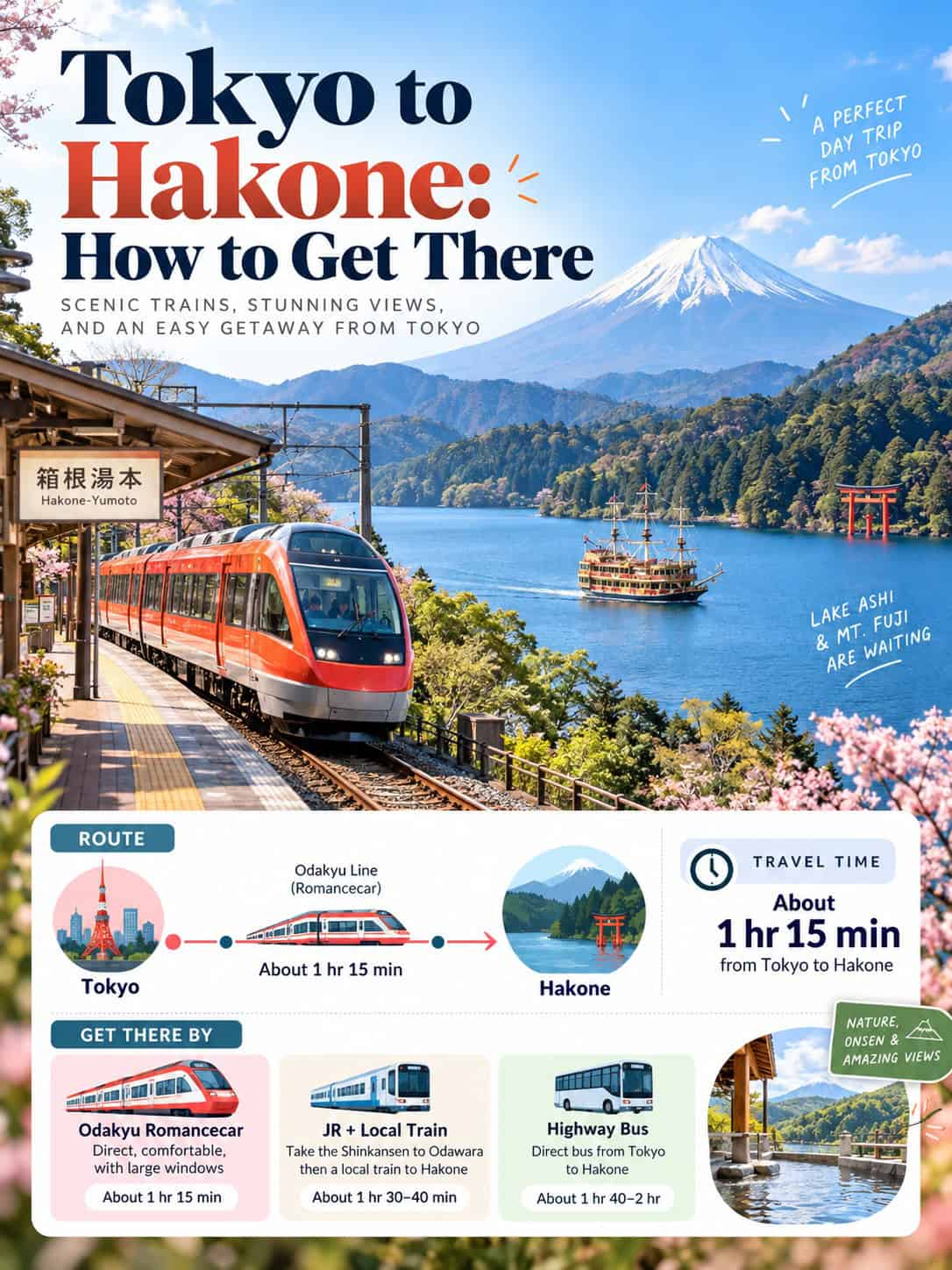
Tokyo to Hakone is an easy day trip by train, with several routes to choose from: the Odakyu Romancecar, regular Odakyu trains via Odawara, or the Tokaido Shinkansen. The best choice depends on your starting station, budget and Hakone sightseeing plans. This guide compares the Odakyu Romancecar, the Shinkansen-plus-Tozan-Railway route, the highway bus, and the Hakone Free Pass, so you can pick the right one before you reach the station.
Tokyo to Hakone: Quick Route Comparison
| Question | Answer |
|---|---|
| Fastest, most comfortable option | Odakyu Romancecar from Shinjuku — about 80 to 85 minutes, no transfers |
| Best for Japan Rail Pass holders | Shinkansen (Hikari or Kodama) from Tokyo Station to Odawara, then the Hakone Tozan Railway |
| Cheapest option | Regular Odakyu trains from Shinjuku to Hakone-Yumoto via Odawara, ¥1,270 one way; the Odakyu Highway Bus from Busta Shinjuku costs ¥2,560 to Togendai on Lake Ashi |
| Worth buying the Hakone Free Pass? | Usually yes if you’re riding the ropeway, the Lake Ashi cruise, and local buses — not if you’re only making one or two stops |
| Does the Romancecar need a reservation? | Yes, every seat on every Romancecar train is reserved |
Tokyo to Hakone Train: The Odakyu Romancecar
The Romancecar is Odakyu’s limited express train, and it’s the way most first-time visitors picture getting to Hakone. It departs from Odakyu Shinjuku Station, which sits next to — but is a separate building from — JR Shinjuku Station, so follow the Odakyu Line signs rather than assuming it’s the same ticket gate. The direct run to Hakone-Yumoto takes about 80 to 85 minutes with no transfers.
The Tokyo to Hakone train fare on the Romancecar includes the standard Odakyu ticket and a separate limited express surcharge. From Shinjuku to Hakone-Yumoto, the standard adult one-way total is ¥2,470, or ¥2,420 when the limited express ticket is purchased through EMot Online Tickets. That total is the ¥1,270 base fare (¥1,261 with an IC card) plus the ¥1,200 limited express ticket (¥1,150 online). Every seat on every Romancecar service is reserved, so you’ll need a limited express ticket with a seat assignment in addition to a regular ticket (an IC card like Suica or Pasmo, or a discount pass, can stand in for the regular ticket at the gate).
Odakyu runs several different Romancecar train models, and which one you get depends on the departure time rather than anything you choose yourself. The GSE (Series 70000) has panoramic front and rear observation seats — 16 at each end — which are the most requested seats on the whole line and worth booking as early as possible if you want them. They cost nothing extra beyond the normal limited express ticket. The EXE and EXEα have overhead racks and a dedicated luggage area suited to full-size suitcases, and the MSE adds a more upscale interior on some runs. None of the differences affect the fare; they just affect the ride.
Reservations open at 10am Japan time exactly one month before the day of travel, and you can book at station ticket windows, vending machines, or online through EMot. Digital tickets only work on smartphones, and changes or refunds before departure come with a ¥100 fee.
Tokyo to Hakone via Shinkansen and Odawara
If you’re departing from Tokyo Station rather than Shinjuku, or you already hold a Japan Rail Pass, this route can be convenient. For ideas before your trip, see our Tokyo travel guide. Kodama trains and selected Hikari services stop at Odawara; Nozomi services do not. Check your specific departure, as not every Hikari stops there. The Shinkansen ride from Tokyo to Odawara typically takes around half an hour. A separately purchased unreserved Shinkansen ticket from Tokyo to Odawara is currently listed from ¥3,280 one way. The Japan Rail Pass covers eligible Hikari and Kodama services to Odawara, but not the onward Hakone Tozan Railway.
From Odawara, take the Hakone Tozan Line to Hakone-Yumoto, a journey of about 15 minutes. The local fare is separate from the Japan Rail Pass. Allow extra time to change trains at Odawara and check the fare when planning your journey.
Tokyo to Hakone by Highway Bus
Highway buses from Shinjuku serve destinations in the Lake Ashi area, including Togendai, rather than functioning as a standard direct service to Hakone-Yumoto. Choose the bus if your destination is near its actual stop; for Hakone-Yumoto, the Odakyu train is generally more straightforward. The adult one-way fare from Busta Shinjuku is ¥2,560 to Hakone Togendai, ¥2,490 to Sengoku and ¥2,420 to the Hakone Glass no Mori Museum stop, and the timetable allows 2 hours 25 minutes to Togendai. The bus does not stop at Hakone-Yumoto. The trade-off is time and predictability: the ride takes a little over two hours under normal conditions on the Tomei Expressway, and that can stretch by another 30 to 60 minutes on weekends and holidays when traffic backs up near the mountains. It is not a budget option, since the fare to Togendai is higher than the Romancecar total to Hakone-Yumoto, but it drops you at Lake Ashi without the train, cable car and ropeway transfers. If you’re trying to make a same-day return or a tight onward connection, it isn’t the right choice.
Tokyo to Hakone With the Hakone Freepass
The Hakone Freepass combines designated local transport in Hakone with a round trip on the regular Odakyu Line if purchased from Shinjuku. The following adult and child fares apply:
| Pass | From Shinjuku | From Odawara |
|---|---|---|
| 2-day adult | ¥7,100 | ¥6,000 |
| 2-day child (6–11) | ¥1,600 | ¥1,500 |
| 3-day adult | ¥7,500 | ¥6,400 |
| 3-day child (6–11) | ¥1,850 | ¥1,750 |
The pass bought from Odawara is cheaper simply because it doesn’t need to cover the longer Shinjuku–Odawara leg — you’d be starting your free-area travel from Odawara either way. The Shinjuku version includes one round trip on the Odakyu Line between Shinjuku and Odawara, and you can get off at stations along the way as often as you like. Coverage includes the Hakone Tozan Railway, the Hakone Tozan Cable Car, the Hakone Ropeway, the Hakone Sightseeing Cruise on Lake Ashi, the Hakone Tozan Bus and Odakyu Highway Bus on designated routes within the Hakone area, the Tokai Bus on select routes, and the Kanko Shisetsu-Meguri sightseeing loop bus. Pass holders can receive discounts or other benefits at participating attractions; the amount depends on the venue.
What it doesn’t cover: the Romancecar’s limited express surcharge still costs extra on top of the pass, the separate Izu-Hakone Bus network isn’t included, and travel outside the designated Hakone area is charged normally. Run the math before buying — if your plan is the ropeway, the Lake Ashi cruise, and a couple of local bus rides across two days, the pass pays for itself easily against buying each ticket separately. If you’re only riding the train in and the train back out with one stop in between, individual tickets may be cheaper. Our Hakone visitor’s guide explains the sightseeing loop.
Tokyo to Hakone: Which Route Should You Choose?
If you already hold a Japan Rail Pass, the Shinkansen-to-Odawara route costs you almost nothing extra and is genuinely fast — there’s little reason to pay again for the Romancecar unless you specifically want the GSE’s panoramic seats. If you don’t have a rail pass and comfort matters more than saving a thousand yen, the Romancecar from Shinjuku is the simplest single-ticket option with no transfers. If you are travelling on a tight budget, compare regular Odakyu trains via Odawara with your other options. Highway buses can be useful for Lake Ashi destinations, but are not the default way to reach Hakone-Yumoto. For a sightseeing loop involving the ropeway, cruise and local buses, compare individual fares with the Hakone Freepass before buying.
Tokyo to Hakone Travel Tips
Book Romancecar seats early if you want the GSE’s observation seats, especially on weekends. If you are staying overnight, compare properties in our Hakone onsen hotels guide. If you’re traveling with a large suitcase, the EXE and EXEα trains have a dedicated luggage area, while the Shinkansen-to-Odawara route has more conventional overhead and between-seat storage; either way, consider forwarding bulky luggage ahead to your hotel through a Takkyubin counter rather than hauling it through transfers. The Hakone Freepass can be purchased at participating Odakyu ticket offices or digitally through EMot Online Tickets. Odakyu Line stations, 7-Eleven stores and EMot sell it from one month before the first day of use, while ticket machines sell only passes that start the same day. Check the departure point printed on your pass, because a pass starting at Odawara does not include the Shinjuku–Odawara journey.
If you would rather not manage the transfers yourself, the Mount Fuji & Hakone Day Tour from Tokyo covers the same area in one booked day.
Tokyo to Hakone: Final Route Recommendation
For most first-time visitors without a Japan Rail Pass, the Odakyu Romancecar from Shinjuku is the simplest direct option to Hakone-Yumoto. It requires both the base fare and a reserved-seat limited express ticket. If you’re already holding a Japan Rail Pass, take the Hikari or Kodama to Odawara and pay the small Hakone Tozan fare for the last stretch instead of paying again for the Romancecar. Decide on the Hakone Free Pass based on how much you’ll actually move around once you’re there, not just because it sounds convenient — it earns its price on a multi-stop sightseeing day, not on a quick there-and-back.
Frequently Asked Questions
Do I need a reservation for the Romancecar?
Yes — every seat on every Romancecar service is reserved, so you need a limited express ticket with a seat assignment in addition to a regular fare ticket.
Does the Japan Rail Pass cover any part of the trip to Hakone?
It covers the Shinkansen leg to Odawara as long as you take the Hikari or Kodama, since neither requires the Nozomi supplement. It does not cover the Odakyu Romancecar or the Hakone Tozan Railway from Odawara to Hakone-Yumoto.
Which Shinkansen trains stop at Odawara?
Hikari and Kodama both stop at Odawara. The Nozomi does not, so check the departure board rather than assuming any Tokaido Shinkansen will work.
Is the Hakone Free Pass worth it for a single day trip?
Only if you’re planning to use the ropeway, the Lake Ashi cruise, and local buses within that one day — for a quick in-and-out visit with one stop, individual tickets will usually cost less.
Can I use the Hakone Free Pass on the Romancecar?
The pass covers the regular Odakyu Line fare, but the Romancecar’s limited express surcharge is still an extra charge on top of the pass.
How much cheaper is the Free Pass bought at Odawara compared to Shinjuku?
The Odawara-departure pass is about ¥1,100 cheaper for the 2-day adult pass, because it doesn’t need to include the longer Shinjuku-to-Odawara leg.
What is the cheapest way to get from Tokyo to Hakone-Yumoto?
Regular Odakyu trains via Odawara are generally cheaper than the Romancecar because they do not require a limited express surcharge. The regular fare from Shinjuku to Hakone-Yumoto is ¥1,270 one way (¥1,261 with an IC card), against ¥2,470 with the Romancecar, so allow time to transfer at Odawara.
Can I buy Romancecar tickets on the day of travel?
Yes, subject to availability at station ticket machines or windows, but popular departures and the GSE’s observation seats can sell out, so booking ahead through EMot is safer if you have a fixed schedule.
How do I get from Odawara to Hakone-Yumoto?
Take the Hakone Tozan Line from Odawara Station to Hakone-Yumoto. The ride takes about 15 minutes and is not included in the Japan Rail Pass.